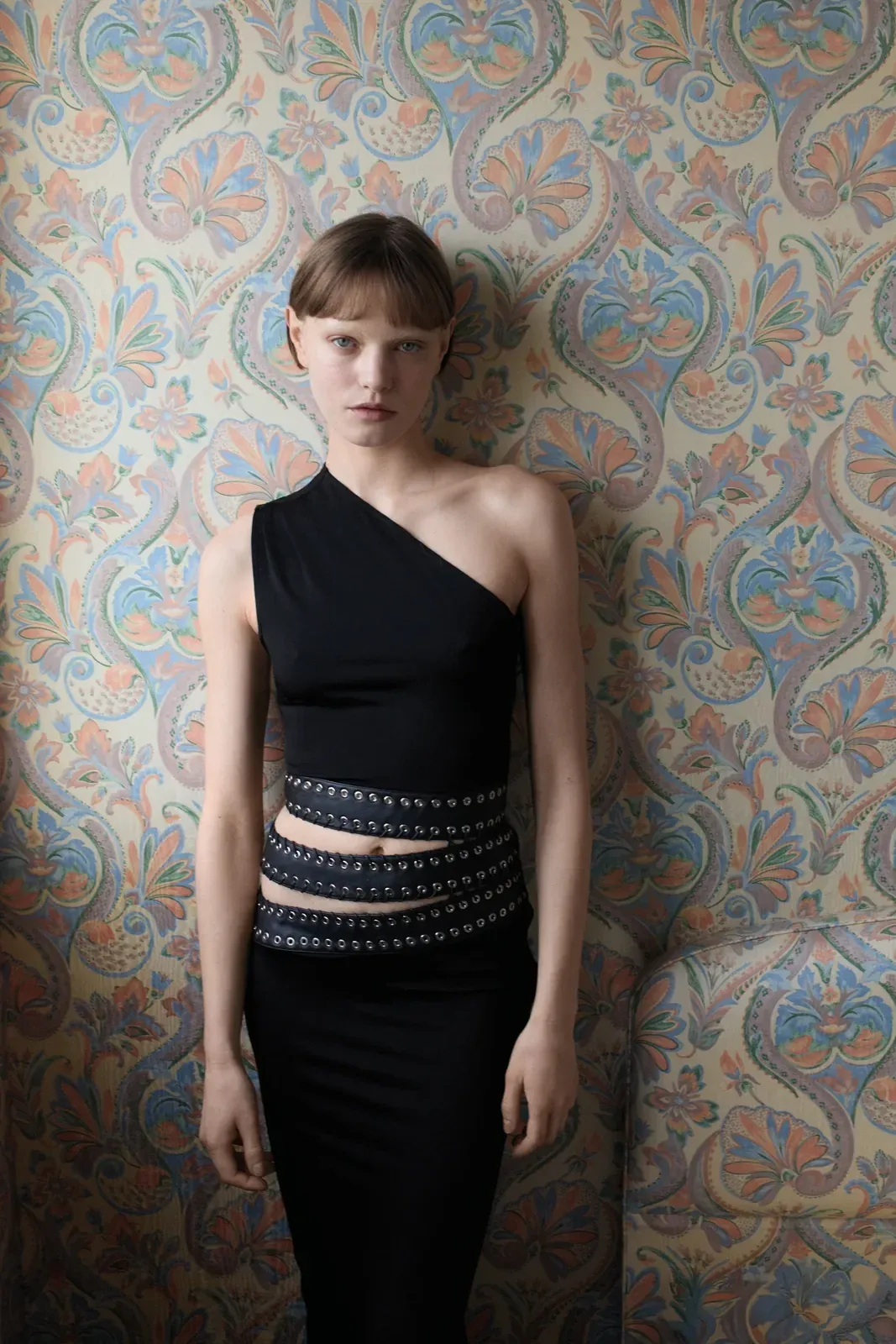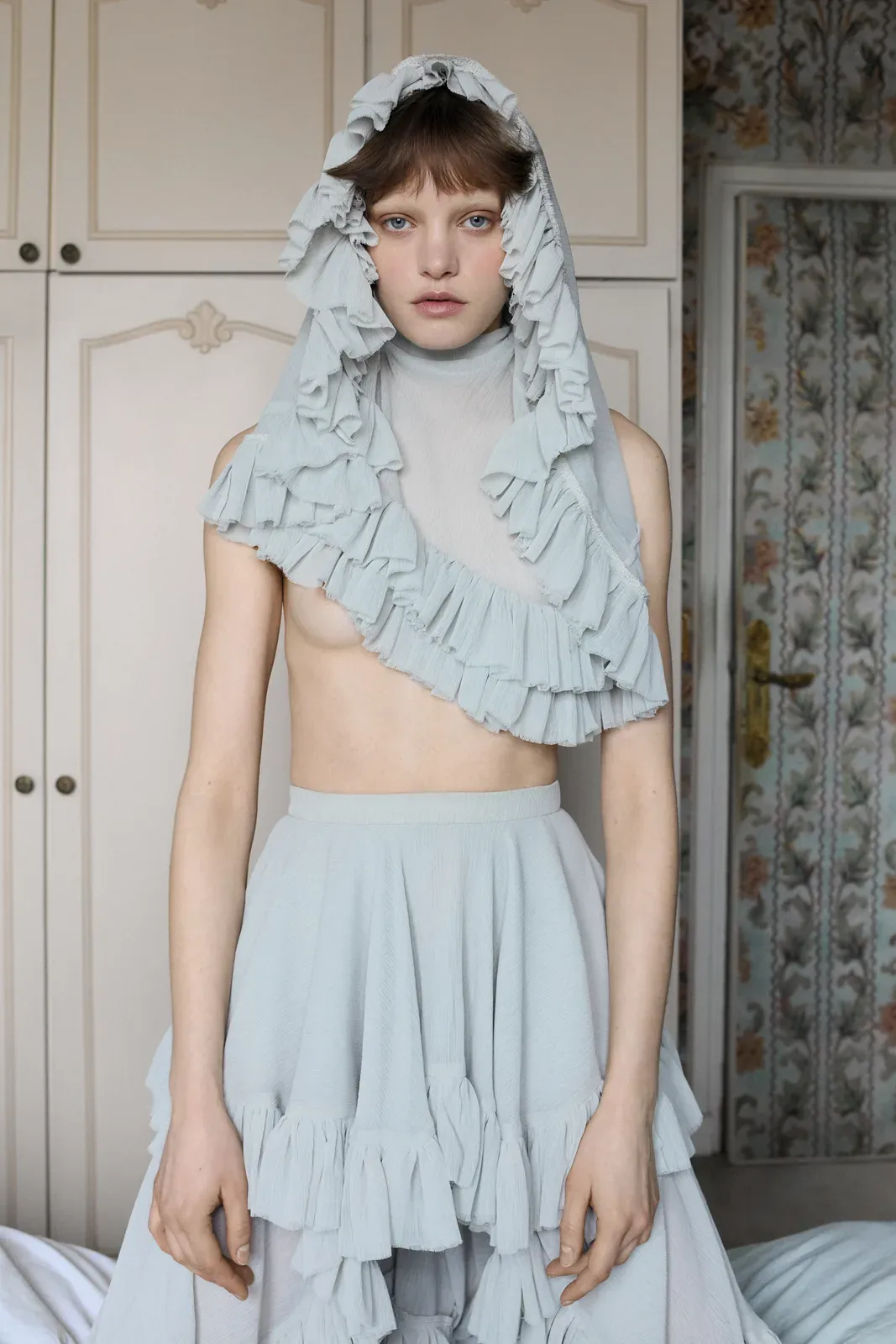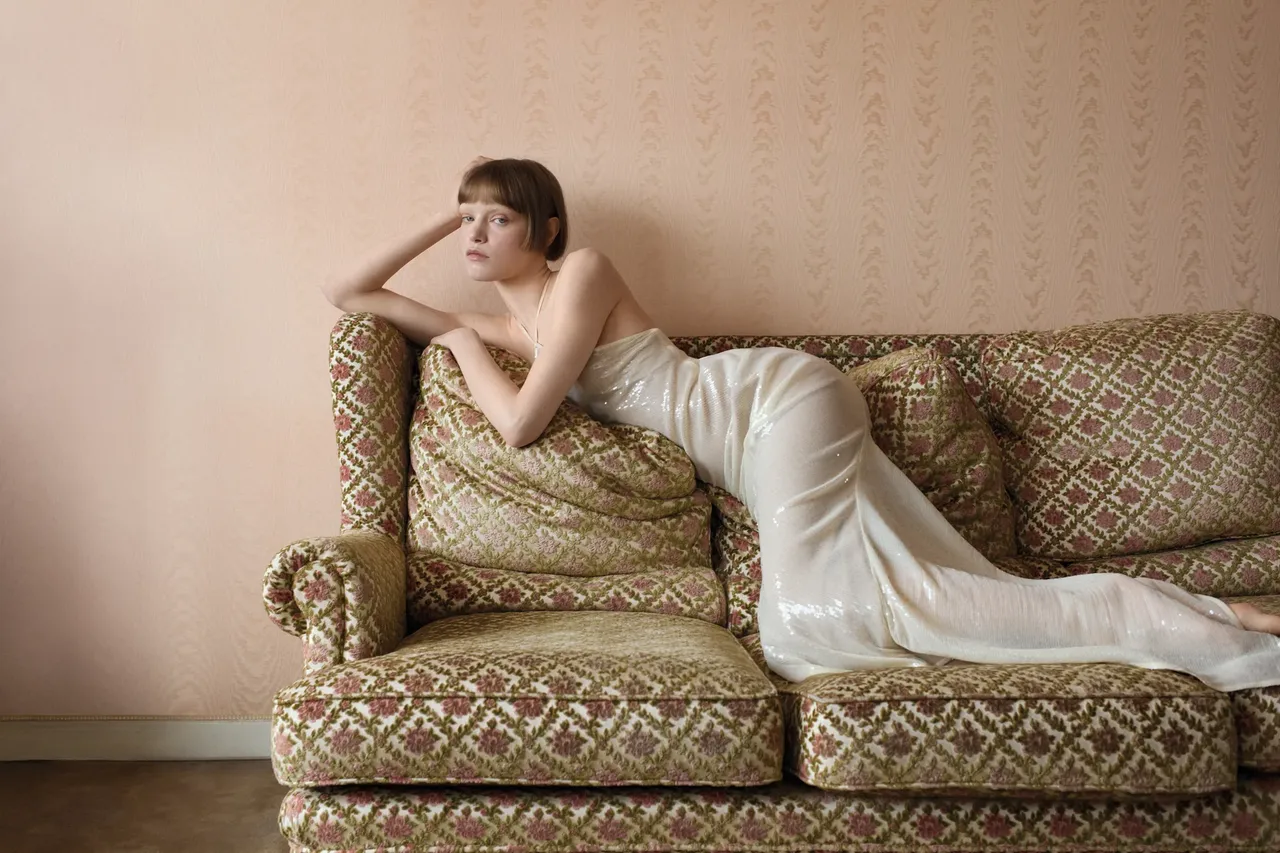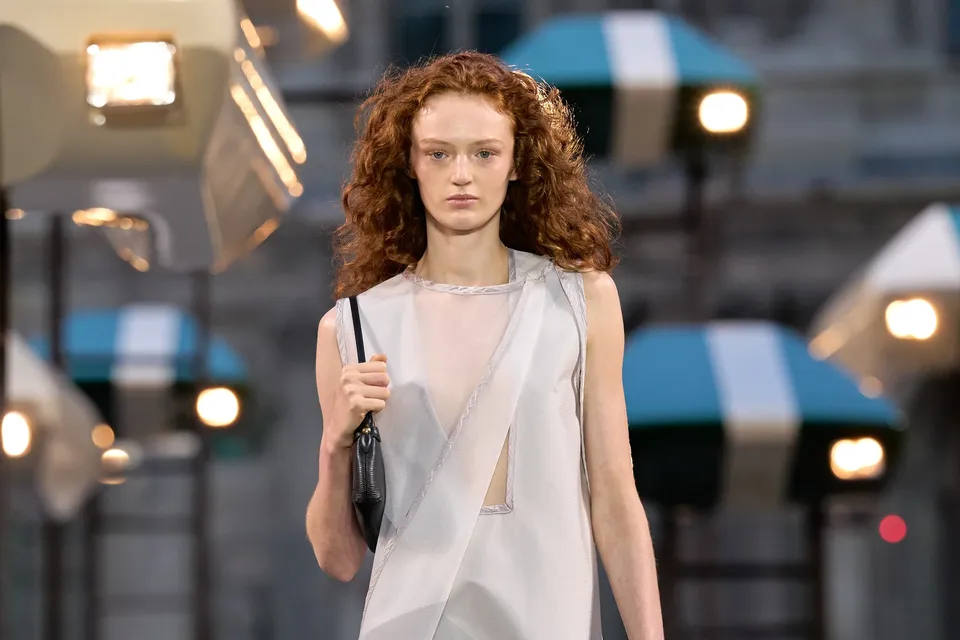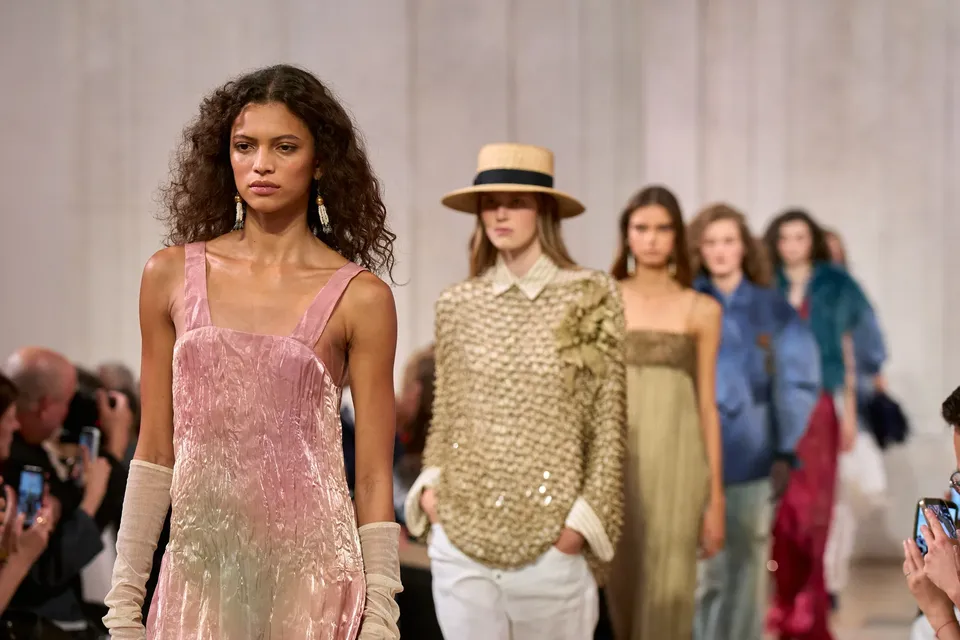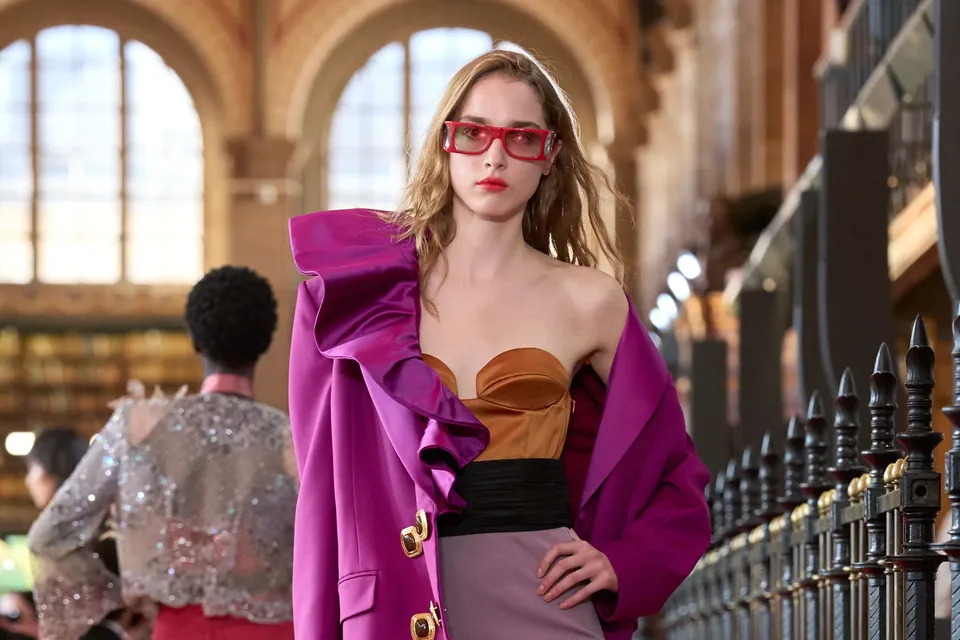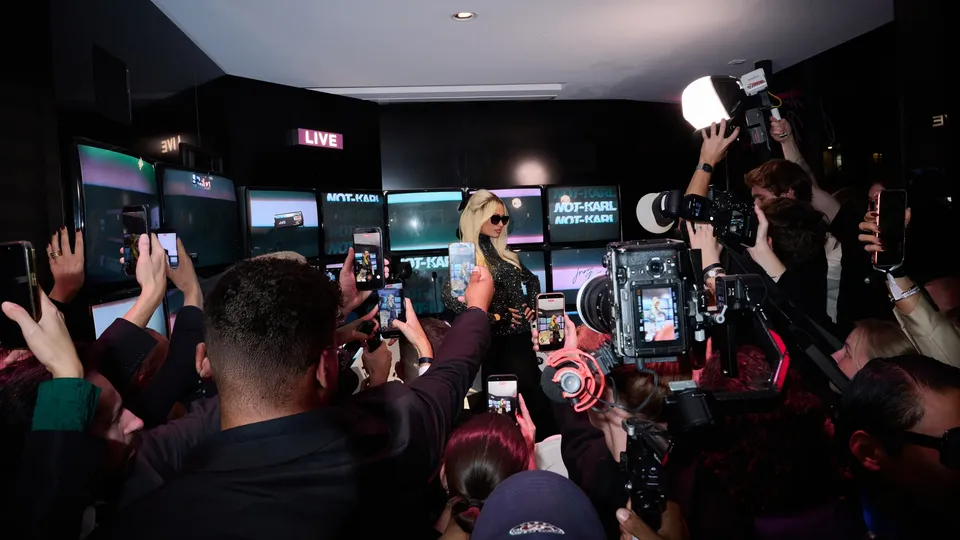
There’s the kind of fashion that makes you feel luxurious and erotic, glamorous in every way. The kind you see on red carpets and runways. Fashion that makes you feel loud and confident, even in everyday life. There’s fashion that lets you dream of more capricious, tender places and stories, and fashion that stands as a witness to incredible, delicate craftsmanship. And then there’s Ludovic de Saint Sernin’s fashion. Not because it isn’t all of these things, but because it is somehow more. Above all, his designs make you feel free, untouched by norms and expectations, embracing sexuality, queerness, and an honest, emancipated version of the self.
This interview is taken from Issue 54 and adapted for our digital platform. Order your print copy here.
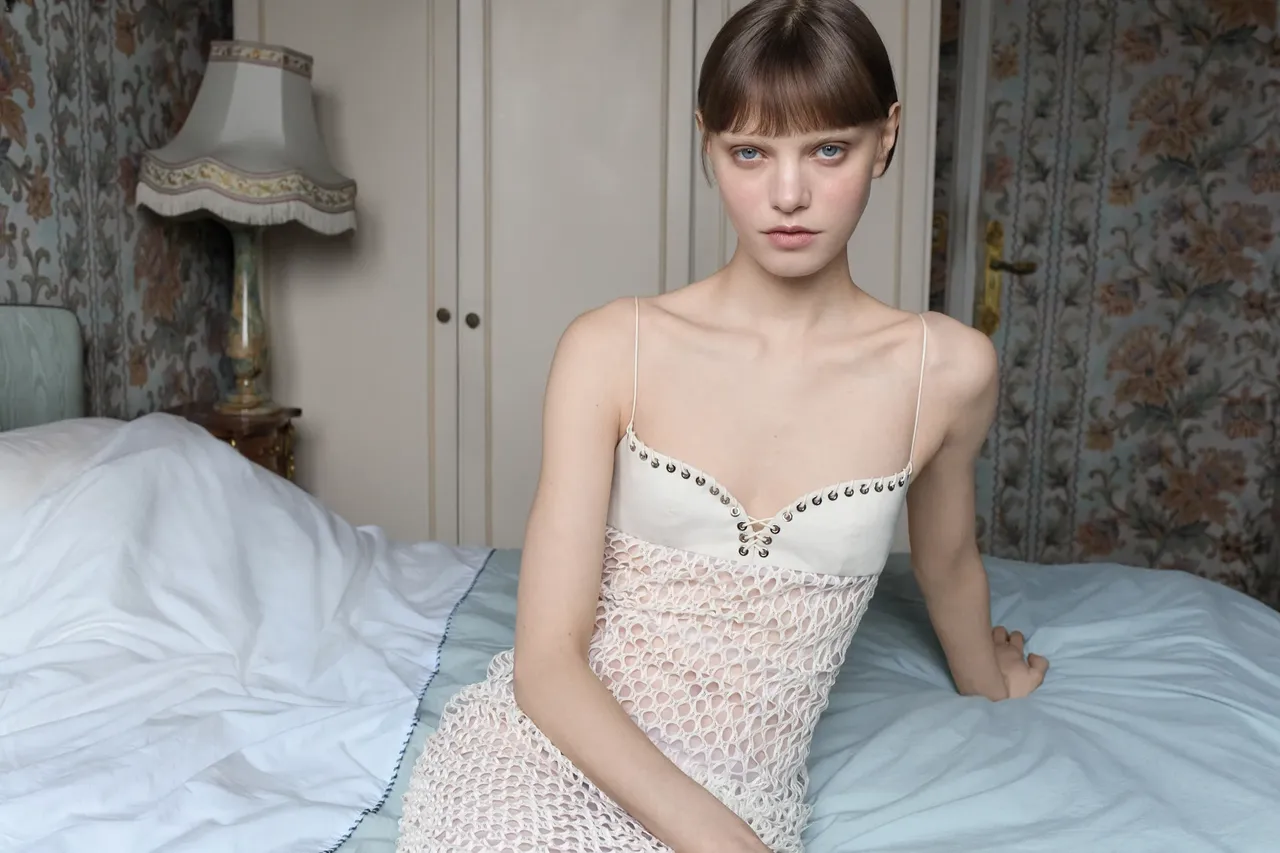
With form-fitting silhouettes, sheer fabrics, leather, metal rivets, and hedonistic pieces like the eyelet brief, the Brussels-born designer creates collections that are deeply personal. He weaves people he has met into the tulle of a gown, braiding memories and experiences into the silk of a corset. Always with the intention to reach and inspire those who share his desire for self-expression.
In many ways, he always knew. Whether growing up in Côte d’Ivoire or in the 16th arrondissement in Paris, drawing landscapes, sketching mermaids, or dreaming of dressing like the pop divas of the 2000s. He understood early on that clothing shapes identity. And that, ultimately, there shouldn’t be any rules. Today, he stands as one of fashion’s most luminous young talents. Calm and confident, he might seem intimidating at first, but in our conversation about weaknesses, shipwrecks, leadership, and Lindsay Lohan, it becomes clear that kindness and gratitude are what make him strong.
Hi, Ludovic! I read something that I really liked about you. I read that when you were younger, you used to draw mermaids a lot.
Yeah, I did.
I used to be obsessed with mermaids as well. What would your own mermaid tail look like?
Oh my god, that’s such a fun question. What I think would be major is if I was an albino mermaid and my tail was all white. You know, very pure, very minimal, long, a bit dishevelled. It’s almost like if it was a Rick Owens mermaid tail.
It sounds like a deep-sea creature you only see at night.
Angel of the night! Maybe it’s even phosphorescent, so in the night you can see me glow.
The Haute Couture collection you designed for Jean Paul Gaultier, “Le Naufrage”, the shipwreck, was also very mermaid coded. One of the highlights of your career so far! Each look had its own character. Do you remember which one resonated most with you?
Oh my God. You know what? I feel like I have multiple favourites, but that the finale dress was a really big moment, the bride. It was my first couture show, and it is a tradition to have a bride be the final look. I really wanted to respect that.
What was the story of the bride?
That look carried a very special meaning because it told the story of a bride lost at sea. She was crossing the ocean, perhaps from Paris to the US, in a kind of Titanic shipwreck situation. She never ends up meeting her husband. She is forever a bride. It took quite a lot of work to create that feather-bustier top. It was so delicate and fragile, with crisscrossing over the chest flowing into beautiful wings of thin tulle. It felt slightly dishevelled, shifting from natural white to off-white, almost a dirty white. It really showed what I could do in couture, and I think it made people see me differently as a designer.
When I saw the pictures of the collection for the first time, I felt like you had everyone in a chokehold. It was so beautiful.
Thank you!
I think my favourite actually is the one with the headpiece that looks like a black shipwreck. It’s so ghostly yet detailed.
Actually, this is where it all started. I was going through the archive, doing research, trying to understand the setting of my show, looking for a storyline and a narrative. Eventually I stumbled upon this picture of a girl wearing this red boat from one of Jean Paul’s first couture collections, and I loved it so much. At the same time, I was listening to Mylène Farmer. She’s the French Madonna, with red hair, stunning, and one of Jean Paul’s muses. I started looking into her videography and found this video of her with Seal. They’re on a boat, or really just a piece of wood, stranded at sea. I thought, oh my God, that’s it, it’s a shipwreck, that’s the story. That became the first look I sketched for the collection. The headpiece Jean Paul created was very red and flamboyant, almost like a full embroidery piece, but mine was more like a ghost version. I wanted it to be black, feathery, almost like a shadow or a memory of that boat.
It’s really, really cool. But I also love the metaphor of the shipwreck because it’s very ambivalent. It has this destroyed, dark vibe about it. It’s the memory, the witness of something that’s not there anymore. At the same time, something new can be born in destruction.
When I was talking to my friends and colleagues about wanting to do a shipwreck collection, they were like, oh my God, Ludovic, are you sure you’re willing to take that risk? Because if people don’t like it, they’ll say it was a shipwreck. In French, we say, Tu donnes le bâton pour te faire battre, meaning you’re giving people the baton to beat you with. And I was like, I understand that risk, but at the same time, that’s the story I want to tell. So, I took a big risk, making that my concept and setup. But I felt like narrative was such an important part of what Jean Paul did. Usually my collections are more autobiographical, more from personal experience and from my heart, so it’s rare for me to just invent a story. In that way, it was me trying to get closer to Jean Paul and his way of working. And yeah, it was definitely going to be a big milestone, especially because the people before me are so impressive. One of them was Olivier Rousteing, and being compared to someone you worked for before is super honourable. Haider [Ackermann] did it too, and I admire him as well. So, I had big shoes to fill, but it ended up being one of their most successful shows ever.
Staying with that maritime world for one more moment, what would your role be on a ship out at sea? Would you be the captain guiding us through the storm?
You know what, because I’m the captain in my own life, I would rather be the entertainment. I’d be the guest that’s here to entertain and to put on a show. Because that’s also what I know to do.
That’s fun. We need entertainment as well.
Exactly.
“I always stayed true to myself, and I think that has been my North Star. As long as you stay true to yourself, there’s no remorse.”
So, in real life, do you see yourself as a leader?
I think, having run my brand for the past nine years, you definitely need leadership skills. When you’re a young designer, you don’t always anticipate how much work that takes. At the beginning, with your first and second collections, it’s really about figuring out what matters to you, what you want to put out into the world, how you represent yourself, and what makes you unique. It’s about the art and the fashion, about proposing something new and exciting. Then as the brand grows, you have to step into this leadership role, and that either comes naturally or it doesn’t.
What does leadership mean to you in 2026?
When you’re starting your own eponymous label, it comes with the territory. And in 2026, what’s important is recognising that you can’t do everything on your own, but that others have talents that can really help you run things. So, it’s essential to surround yourself with amazing people you trust, who believe in your vision as much as you do, almost as if it were their own, and who will work for you and with you, no matter what. With the context we have now, it feels more important than ever to have that kind of support.
Leading your own brand can come with a lot of difficulties. That’s not all, there are a lot of issues in the fashion industry, and also in wider society, wars, addiction, horrible news we hear every day. What guides you through hard times?
A thought that guides me is waking up in the morning and exercising gratitude. You wake up, the sun is shining, you’re doing an interview with a magazine that supports and loves your work, and that feels rewarding. Then you go to the office and have a team dedicated to bringin your sketches and fantasies to life, and for that I’m always so grateful. Every day has its share of good and bad news, and as an entrepreneur it can be difficult to navigate. Sometimes, with everything going on in the world, you start to wonder if what you’re doing even matters. But it does matter to so many people. Fashion and creativity are there to inspire, to make days better, to offer a bit of escape. So, my job is to keep inspiring people, and that’s what carries me through both the good days and the bad. The rollercoaster can be exhausting, but it’s hard to complain when you’re in such a privileged position and so many people would kill to be where you are. I often think about my younger self and realise I’m living my dream, my fantasy.
I feel like a lot of people underestimate how fashion can help you deal with stuff.
Sometimes you put on a good look in the morning, and you have an amazing day no matter what, because you feel good.
Exactly! You just said it yourself, so many people would kill to be where you are right now. I think we can agree that you have become an icon for a new generation in the fashion industry. To flip it around, who inspired you to follow your own path?
Well, Jean Paul was definitely one of them, because I really admire his career. I think Marc Jacobs was one of them, Azzedine [Alaïa] as well, and Rick. What all of them have in common is a very unique sense of what their fashion is and what it represents. They have been shamelessly themselves and have dared to keep doing what they do over time, which I greatly admire. They never try to be someone else or to please others. They just continue to dream. When I met Marc or Rick, it felt like talking to one of my peers, even though they are obviously huge icons with far more experience. But when you talk to them, they still have that feeling of being a young designer with their own brand, navigating the industry. It feels very warm and familiar to talk to them, especially knowing how much they’ve lived, how big they are, and what they represent to people. Yet they are still so down to earth, sweet, and gentle. That is what I want to be like down the line.
That’s so cool. It’s not something you can take for granted in the fashion industry. So many people have worked incredibly hard to get where they are. I think that’s why some feel they’ve earned the right to gatekeep a bit. But honestly, staying kind in such a tough industry is even more powerful. To me, that is the strongest thing you can do. So, it’s really nice to hear that Marc and Rick are genuinely kind.
They’re amazing. They’re all amazing.
So, would you also say that this is one of your own personal biggest strengths? Being able to stay kind in a cruel industry?
Yes, I do. But you know what, it’s also my weakness. Still, I believe that people who are nice are always rewarded down the line. I can’t change who I am or the way I act. It’s funny, because sometimes people have this perception of me that is completely wrong. As soon as you talk to me and get to know me a little, you’re like, oh my God, he’s so sweet. And yes, sometimes that can be taken advantage of because I’m very trusting and open, but I wouldn’t change it. I have a big heart, and I think it’s important to be in touch with your emotions.
It’s so crazy to me that not everyone thinks that way.
In fact, when I was growing up and studying fashion, even that was so different. People were so bitchy at school and even at work. People weren’t nice. It was such a typical “The Devil Wears Prada” type of environment. I remember thinking, this is so unnecessary. It really says more about people’s own insecurities and past experiences than about me.
Yeah, that’s the thing. I’ve also noticed that, especially with social media and the way people present themselves. If you’re not harsh or overly confident, people in this industry tend to underestimate you. That really frustrates me, because why do we have to be mean, to be cool and interesting?
I also think that, you know, looking the way that I look and being a queer designer, I get underestimated a lot. Even though the fashion industry is full of queer people, people are still discriminatory down the line. So, it’s interesting.
Have you ever felt the need to hold back your kindness, to harden yourself and protect who you are, because of that?
No, not really. I was more guarded in fashion school because it was such a new, different world for me. I come from the 16th arrondissement in Paris, a very sheltered bubble, so I was cautious. But I always stayed true to myself, and I think that has been my North Star. As long as you stay true to yourself, there’s no remorse.
Your kindness certainly has brought you far! You’ve worked with so many iconic personalities, like Alex Consani, Amelia Gray, Charli xcx, Jennie… What is it like working with this generation of cultural figures?
It’s so cool because they have the same passion, drive, and love for fashion that I do. We grew up with the same references, so we share similar goals and visions. Girls like Amelia and Alex are exciting to work with because they become a new character each time, yet you always recognise them through their distinct look. They also have amazing fan bases and inspiring journeys, which makes working with them special. What really matters to me is being part of someone’s story at a key moment in their career, whether it’s a big red carpet, a major performance, or an important concert. At the same time, it can feel overwhelming. Between shows, collections, and custom projects, it becomes a constant machine with no breaks, and we’re always navigating the impossible. We don’t take on everything and often have to say no because we’re still a small team. But it’s good to be selective. If we did too much, we’d get sick of us.
Yeah. I just saw that you had a very good moment with Tate McRae on the red carpet of the Vanity Fair Oscar Party. I saw the dress she wore everywhere.
I’ve been taking over Tate’s creative direction with my partner, Ignacio [Muñoz], and we’ve been doing this since July of last year. It’s a very special and unique relationship because I get to be involved in every aspect of her career, whether it’s albums, music videos, red carpets, or performances. So, the red dress came to mind because last year we did a silver metal mesh look for Vanity Fair, a white chiffon naked dress for the MTV Awards, and a black latex dress for the Grammys afterparty. These are kind of all my colours. The last colour we hadn’t done together was red, so we wanted to go for it.
That’s so cool because it’s also very autobiographical again. There’s always a lot of yourself in your projects, I love that.
Yes, exactly. We wanted to go red and make it feel like a bombshell, because she’s such a beautiful young woman. We wanted her to feel amazing, snatched, young, fresh, comfortable, and just glow-y. The theme was kind of a pop star coming back from a vacation after world domination tours, because she did eighty-eight shows last year. She’s really on a roll!
You said that you’re very selective with your projects. So, what exactly makes the bond between you and Tate McRae so special?
I have always been so passionate about pop culture and grew up with incredible pop divas. As a gay man, you basically become an unpaid pop expert because you just know everything about it. Over the last few years, we have done many projects with stars like Sabrina [Carpenter] and Dua Lipa, which I love. But I always wanted to go deeper and learn more. I am always hungry for new experiences. I was friends with Tom [Skoglund], Tate’s manager, and he told me they were looking for a new creative director for her. I said, I would love to do it. He asked if I had time and if I had done it before, and I told him I would find the time and that I had so much passion for this. I really believe in her. She is an incredible artist. I probably watched her “Revolving Door” video a thousand times! Now we are preparing new projects later this year. She is headlining Lollapalooza, and we are already working on that performance. I did not realise events in August are planned as early as March. It is a long process, but it’s exciting to think about stage, choreography, set design, and lighting. It feels like an extension of what I do in a different industry, which is really inspiring.
Tate definitely became super popular in the past years. So, as an unpaid pop expert, why do you think icons in pop culture matter so much?
I think they matter because words and music can get you through so many moments in life. Whether it’s feeling good at the gym with a pop song or getting through a breakup with something more emotional, Tate covers that full range. She can be a mega pop star and at the same time super relatable. She almost feels like a friend to her fans because she is young and sweet but also strong and confident. She is an example. Visually, it is also a work of art. Dancing, performing, creating iconic imagery like we did for the VMAs becomes part of people’s lives. You see her on your phone, it feels familiar, and it becomes aspirational. Whether you are in the industry or not, you cannot help but become a fan.
So, Lindsay Lohan…
Yeah!
I know that she’s your personal style icon from the 2000s. What is it about Lindsay that makes her so iconic to you?
First of all, I thought she was the most beautiful woman on earth. She kind of looks like the Little Mermaid with her freckles and red hair, and she is absolutely perfect. I’ve always found her life fascinating because of how much it was documented by paparazzi and tabloids. She almost became more famous for her personal life than for her acting or singing, which is unfortunate because she is so incredibly talented. I’ve always rooted for her. Last year, I was able to do a custom dress for the premiere of “Freakier Friday”. We met and did the carpet together and that was one of my lifelong dreams to see her shine and have her moment. It was so special I almost forget it even happened.
Sounds like an out-of-body experience!
Yeah, totally. It was just perfect. I’ve been drawing her and obsessed with her for years. I have hundreds of sketches of her.
Have you told her that?
I don’t know if I did. I was maybe a little shy. In these moments, it’s not about me, it’s about her. In that moment, I’m polite and respectful and not imposing. I’m already dressing her, which is such an honour. I don’t need much more than that. But I feel like we need to talk about it at some point.
Ah, I hope one day you get the chance to do it.
Me too.
“Taking care of my happiness as a creative is important, because creativity can’t be forced, and if it is, the work suffers.”
To come back to the bigger picture of pop culture, earlier you mentioned that your vision for Tate McRae’s red-carpet look was a bombshell. In my opinion, pop culture often feels obsessed with nostalgia. Young artists are constantly compared to Britney Spears or Christina Aguilera, or they actively reference certain looks and performances. Why do older styles keep coming back again and again?
I don’t know. I think nostalgia and memories are a huge part of human nature. There is an imprint on our brain from those years as teenagers or young adults, being obsessed with your favourite idol, like Lady Gaga. That stays with you forever, and it happens to every generation. Marilyn Monroe is still a reference for many, but even more so for generations closer to her time. In our generation, idols from when we were young are Britney, Christina, Paris [Hilton], Lindsay, and the Olsen twins. They will stay a reference for a long time because it was before social media and before fashion and pop culture were so intertwined. These idols will always be an inspiration because it was great art.
Can you talk about a recent pop culture moment that truly had an impact on fashion?
That’s a hard question. I feel like I have so many different answers, but I can’t think of one right now. The other day, I was talking with my partner about how Hunter Schafer wearing my feather top from the Ann Demeulemeester Autumn/Winter 2023 collection felt culturally relevant.
I remember that one. She wore it at the Vanity Fair Oscar Party that year, right?
Yes, exactly.
I love how the feather top translates a different vibe every time someone wears it. With Hunter, it felt very witchy. But seeing it on Rosalía for the visuals of “LUX”, it felt more ethereal. How would you style the feather top for yourself?
I always fantasise about wearing the black version of that. I have the feather at home, which I need to frame because I want to be able to see it on a wall. It was a very special moment in my career and a very viral momen as well, almost as viral as the Gaultier thing! I will always be grateful that this happened.
That collection you did for Ann Demeulemeester was amazing! But looking back at your own brand’s history, I remember the first collection you presented in 2017, it was very autobiographical, very meaningful, very gender-fluid. What have you learned since then?
You know what? It’s so interesting you mention the first collection because I’ve been thinking about beginnings too. I feel like I’m at the end of a cycle. As you grow, you feel like you have to do more and more, especially with Instagram and social media, where every show has to be bigger, better, more impactful. Sometimes it’s almost addictive. Then I look back at the beginning and think, oh my God, it was so cute, humble, soulful, unique. I remember that time with so much love. Now I’m presenting my new Autumn/Winter 2026 collection, coming out this or next week, which is very exciting. For this one, I pared back completely and wanted something pure, simple, and all about the fashion, with no stunts, although we love a stunt.
Oh, we do love a stunt.
Yeah, I’m not criticising that at all. I love performance. And I’m not saying that I’m not going to do that again. But with the Autumn/Winter 2026 collection, I wanted to do something for myself that’s more focused on fashion, something very pure and closer to the beginning. I’m excited to release it and see how it comes together. We’re off calendar, showing later, not chasing clickbait, just offering something people can really appreciate.
I can imagine the fatigue can be intense sometimes, that constant pressure to produce and keep producing. So, stepping away from that must feel freeing. Did you notice a change in how you work once you removed yourself from the official calendar?
It’s about where I am in my career right now. I’ve done my own brand, worked with Gaultier, I’m working with Tate, and there are all these different projects happening. We’re even going to be featured in a movie. There’s a lot I want to explore. As long as I’m happy and not pushing myself or my team to constantly produce more, I’m a better person, and that’s what it comes down to. At the same time, I’m still hungry for more and excited by what I could do at a future house if the fit is right. There’s always that drive, but I’m also trying to be more selective, making sure I’m not overexposed, even though part of me still wants visibility. It’s a constant balance of knowing when to be present and when to step back, when to be at the centre and when to disappear and return. Taking care of my happiness as a creative is important, because creativity can’t be forced, and if it is, the work suffers.
So, if Ludovic de Saint Sernin was a ship, that’s the direction you’re steering to. Guided more by happiness and self-fulfilment than by obligation.
Exactly.
What would you name that ship?
Good question! I have to think about it.