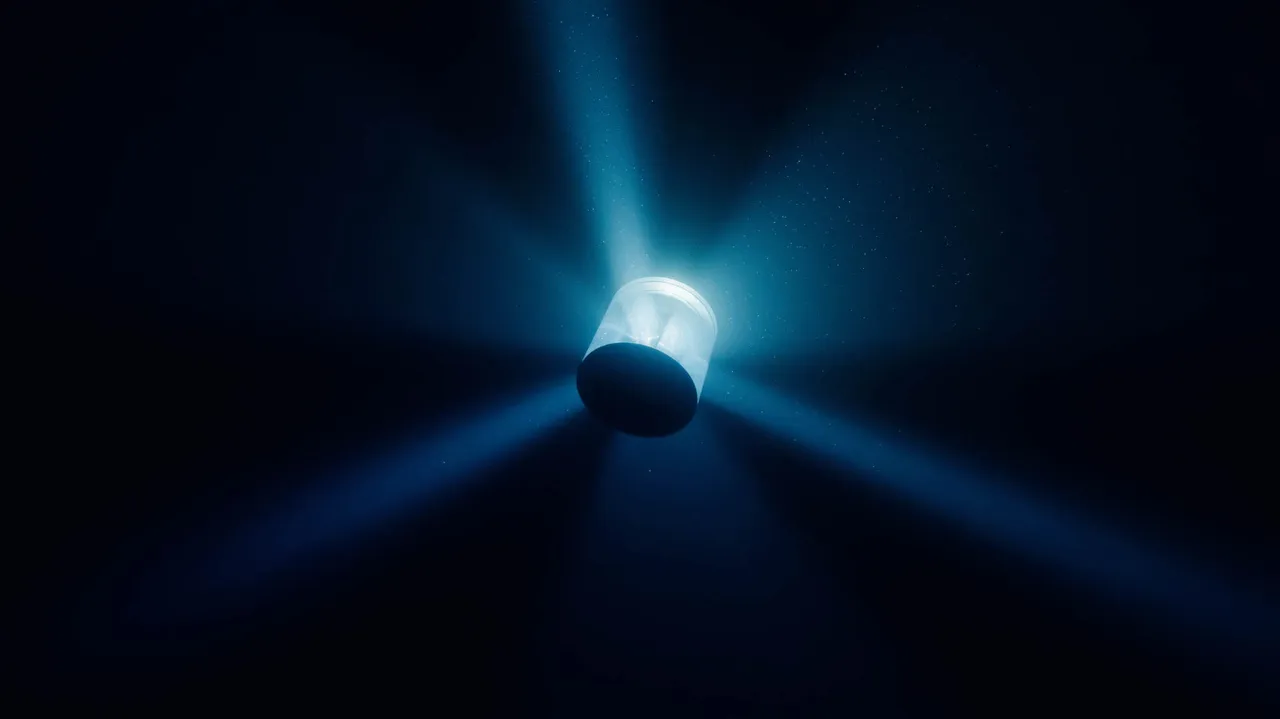
Schools of fish whip past the camera, the constant murmur of their tails flapping and barely audible sea creature conversations filling the expanse with almost imperceptible sounds. Light from a Fresnel lighthouse shines through the depth, attracting your glance, guiding your drift through the depths of the ocean. Humans are irrelevant to the fish, but we are omnipresent just by watching or hearing the drone of ships passing by overhead. Inspired by this static-like sound and free-flowing drift, musician Laurel Halo builds a soundtrack for the film Midnight Zone by artist Julian Charrière. Released on March 13th, the tracks are grounding, uncanny, and transcendent. They mimic the suffocating pressure of descending deeper into the ocean, while also offering a comfort in the constant hum of the background.
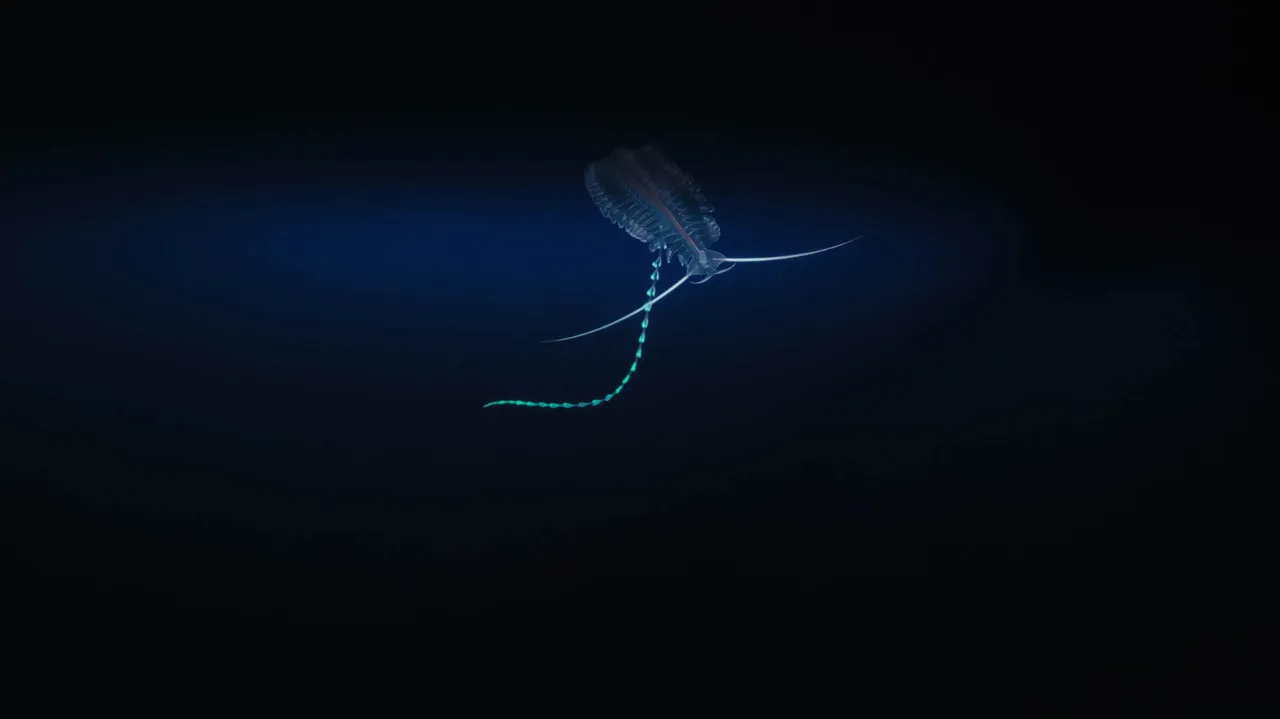
Charrière’s film follows the subaquatic life happening just below our flippers as we splash around the Clarion-Clipperton Fracture Zone of the Pacific Ocean. It “reveals the deep not as void, but as a luminous biome teeming with fragile life.” The scientific titles relate to the ocean but also offer a point of reflection for the mysterious elements of these very empirical terms. For example, while Abyss, Twilight Zone, and Fracture relate to oceanic stratification, they also evoke a sense of mystery. What happens if we travel through the abyssal fracture? Where the sun doesn’t shine any longer? What can we discover? It is as much an emotional whirlwind as it is a scientific experiment. We speak with Halo about her creative process using visuals to develop a soundtrack, the human experience underwater, and whether or not her music is meditative.
What similarities do you see between the ocean and music?
Interesting question! Not sure if I possess the philosophical depth to answer it well. I guess both the ocean and music can seem quite immortal but are actually dependent on air. The history of music and the vastness of the ocean are both humbling.
When developing the soundtrack, did you already have the visuals or did they come after, or was it a back-and-forth kind of process?
The film was in a near-final edit, so I was working to that cut after a spotting session with Julian to map out the sections.
What was the collaborative process like for a film that has no words and whose main characters are sea-life creatures? How did you build and interpret the story?
During the spotting session, Julian had specific beats that he wanted to hit in terms of rises or falls in energy, moments of silence, moments of density versus moments of emptiness in the music. He was encouraging me to not anthropomorphise the visual material.
“The history of music and the vastness of the ocean are both humbling.”
How did this album feel different to your previous, in relation to its ideation and execution?
It’s a different setup because it’s an original soundtrack as opposed to an artist album. So there was already the visual map to be working from, with its aesthetic and narrative constraints. With an artist album it’s more free. I think with both I was striking a balance between electronic and acoustic instrumentation and how to incorporate the two.
Who or what were your inspirations for this soundtrack?
Probably Eduard Artemyev, Koichi Shimizu’s music and sound design work for Apichatpong Weerasethakul, Biosphere, Éliane Radigue (RIP).
Tracks range from just a couple of minutes to over ten. What is the difference in the way you compose shorter versus longer tracks, if there is any?
I guess with shorter tracks there need to be more moments or development happening in a shorter amount of time in order to sustain interest. Longer tracks can take their time and change more gradually, but the shifts still have to be noticeable and compelling somehow.
While the ocean and non-human actors are the stars, I would say the human is still perceptible, wouldn’t you? It reminds me of the composition, straddling between electronic, constructed sounds, and more ambient, nature-inspired sounds. How did you balance them?
It’s interesting because our ears aren’t really designed to listen underwater. Our directional hearing is limited, and most hearing takes place through conduction of sound waves through skull bones. So the human isn’t necessarily allowed to listen that deep, at least not unaided. I think a soundtrack like this necessitated the use of both acoustic and electronic sounds, for this reason to start.
And then, at 600-1200 metres deep (about where the film was shot), there’s a mix of marine vocalisations, human sounds in the form of ships’ mechanical drones and synthetic sonar, booms and other noises from tectonic activity, and then also amazingly the sound of the sheer biomass of fish and plankton creating this widespread, high-frequency popping or fizzing sound. So I guess I needed to incorporate both electronic and acoustic texture in order to emulate a bit of all of these sounds.
And then, at 600-1200 metres deep (about where the film was shot), there’s a mix of marine vocalisations, human sounds in the form of ships’ mechanical drones and synthetic sonar, booms and other noises from tectonic activity, and then also amazingly the sound of the sheer biomass of fish and plankton creating this widespread, high-frequency popping or fizzing sound. So I guess I needed to incorporate both electronic and acoustic texture in order to emulate a bit of all of these sounds.
You once spoke about the difference between mood and emotion, can you tell me how each of those show up in the soundtrack?
Emotions are more short-lived and causal, moods are more diffuse and less clear in their origin. Probably this soundtrack is more mood-orientated as there aren’t a lot of overt emotions present, which may be more readily picked up on in the form of for example clear melodies, or varying smoothness versus agitation in the arrangement or rhythm of a piece of music. This soundtrack is more slowly shifting and evolving, which would point more towards the presence of a mood or a sustained, indirect feeling.
“Writing slow-changing music necessitates breathing as a form of pacesetting. I would say the music is pointing towards a meditative feeling, but wouldn’t go so far to say as it actually achieves or embodies that.”
The titles reflect aspects of the ocean — emptiness, mystery, and almost religious faith in nature. What went into choosing them?
That’s interesting because I thought the titles were more scientific and dry. Many are related to ocean stratification (Sunlight Zone, Twilight Zone, Midnight Zone, Hadal Zone, Abyssal Zone) or the specific oceanic region that stars in the film (the Clarion-Clipperton Fracture Zone).
You spoke about meditating and the concept of “where the room isn’t” and that it was something you brought into your music. Being that this soundtrack is for a film about the ocean, expansiveness, and humanity, where do you see this meditative concept in your composition?
There was a specific section of the film that felt like the apex, for which Julian had requested the music carry some kind of ‘om’ energy, or an energy of transcendence. I also feel like I was bringing some breathing aspect to the composition, following the descent of the lens and the movement of the water and sea life in the film. Writing slow-changing music necessitates breathing as a form of pacesetting, at least for me. I would say the music is pointing towards a meditative feeling, but wouldn’t go so far to say as it actually achieves or embodies that.