Can a wedding feast be transformed into a counter-cultural rally? And can a traditional dance become a missile launched at the heteropatriarchy? For over a decade, (LA)HORDE has been answering these questions through the medium of the dancing body. Their journey—leaping from total, unsubsidised self-management to directing the Ballet National de Marseille in 2019—is the evolution of a band of ‘elite squatters’ who have turned choreographic dissidence into a state-sanctioned art form. Now, they revive their 2019 work, Marry Me in Bassiani—as relevant today as ever—presenting it at La Villette from 16 to 25 April, where the revolution is once again dressed in bridal white.
At this stage, (LA)HORDE’s trajectory reads like a manifesto on the body’s resistance against the norm. One might imagine they were always an army of anonymous dancers, but this Parisian collective actually began in 2013 with just three members: Marine Brutti, Jonathan Debrouwer, and Arthur Harel, sporting a name that already hinted at a multitude. Their evolution, from the viral video To Da Bone to helming a company of twenty-seven mostly international dancers, began as a curiosity for the post-internet dances of bedroom culture and YouTube jumpstyle. Today, that interest has matured into a unique ability to pick at the seams of national identity. This process of growth—both technically and politically sophisticated—is palpable in Marry Me in Bassiani, a living organism that intertwines Georgian institutional violence with the precision of ancestral folklore.
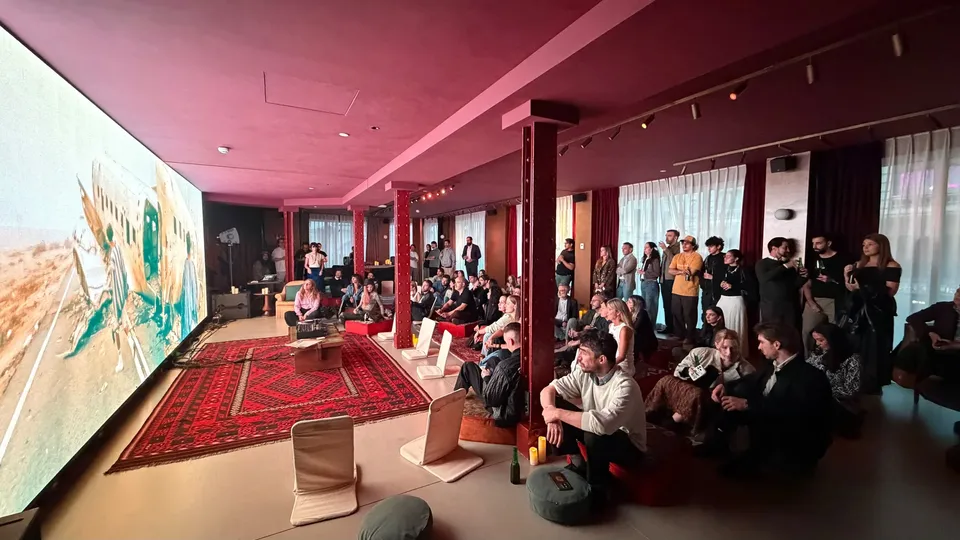
The production is built upon the electric memory of May 2018, when police stormed Bassiani, the techno club housed in the former Olympic swimming pool of Tbilisi’s national football stadium. It had served as a bunker for the LGBTQ+ community and progressive youth. Days later, the response to the raid was a peaceful rave of ten thousand people outside the Georgian Parliament under the slogan: ‘we dance together, we fight together’.
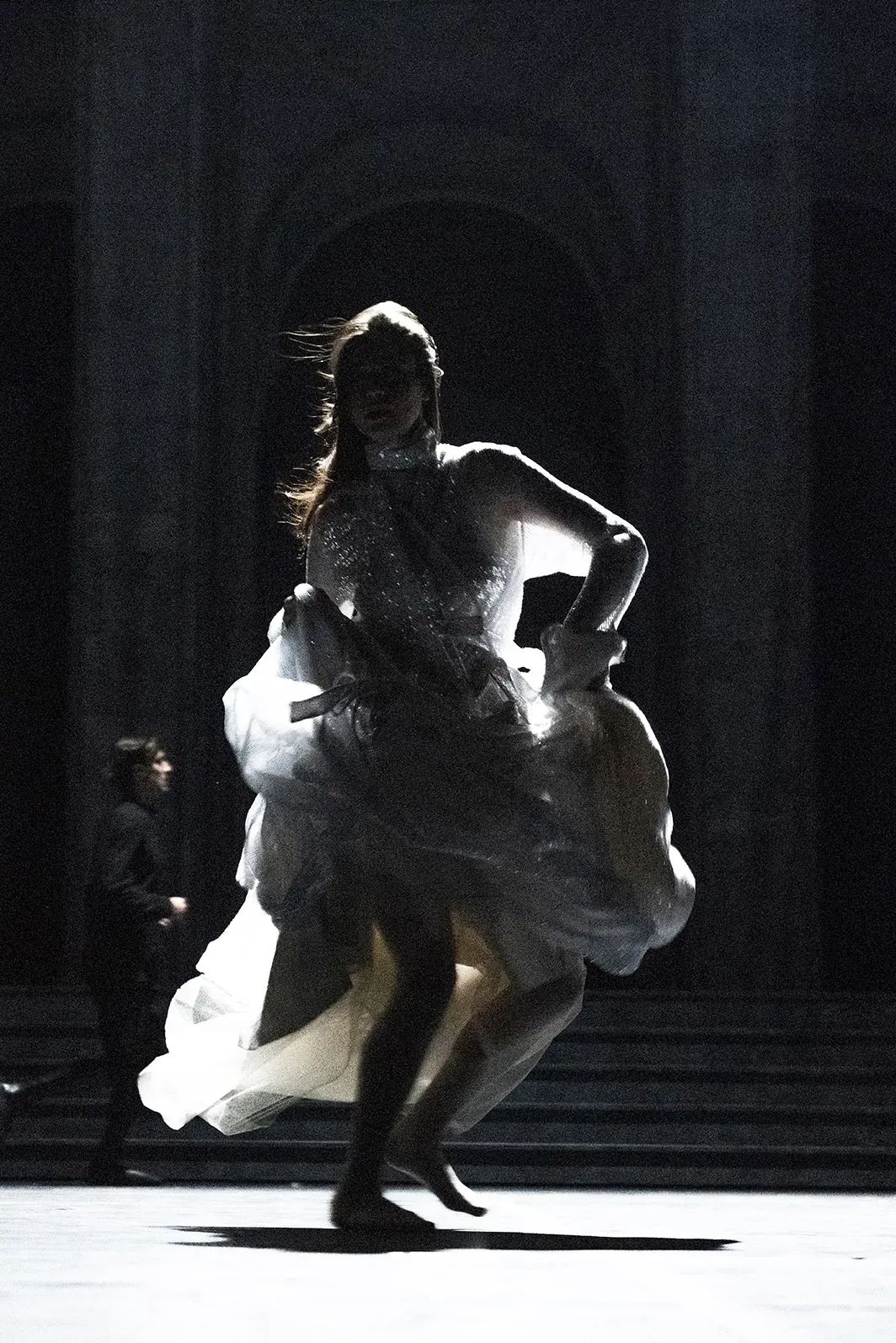
While that episode permeates the work, it does so more as an underground current. For (LA)HORDE, the event highlighted the social and symbolic dimension of dance in the Eurasian nation, which they have reimagined as a wedding banquet where marriage is, in truth, a battlefield. Rather than separating tradition from protest, the collective merges with Ballet Iveroni and the electronic beats of Sentimental Rave. The result is that the acrobatic leaps and martial swirls of Georgian folklore lose their institutional rigidity, transforming into cries for freedom.
Historically tied to the assertion of identity, this local dance reappears here knocked out of alignment by a contemporary pulse. This friction is the true engine of a creation that unfolds as a violent yet liberating rite of passage before the steps of a replica Georgian Parliament, presided over by the statue of a medieval knight.
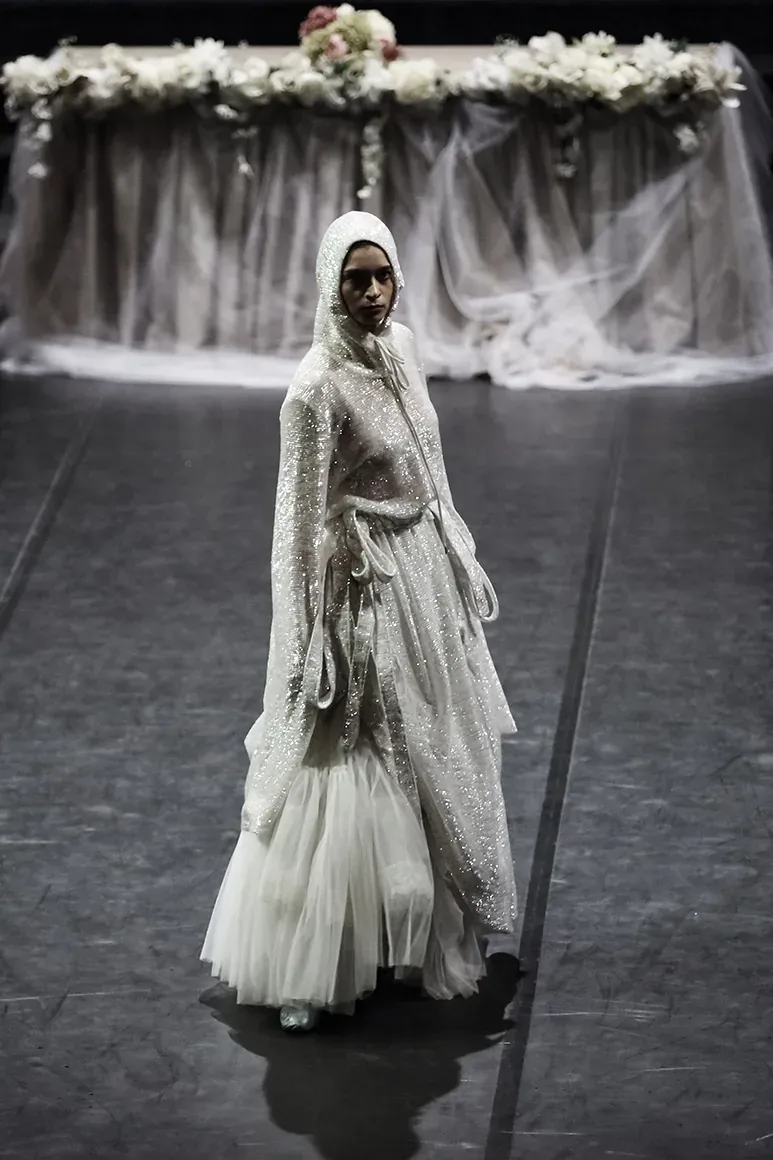
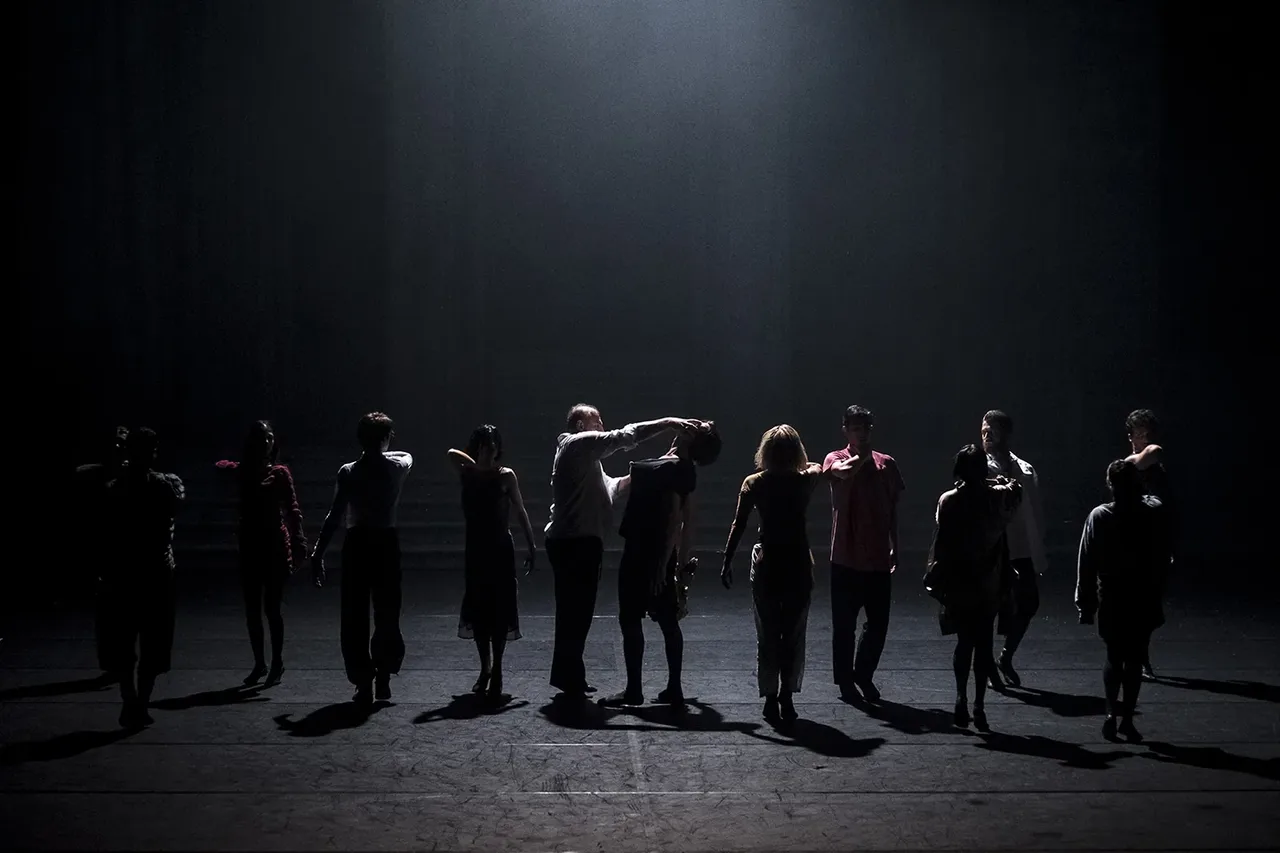
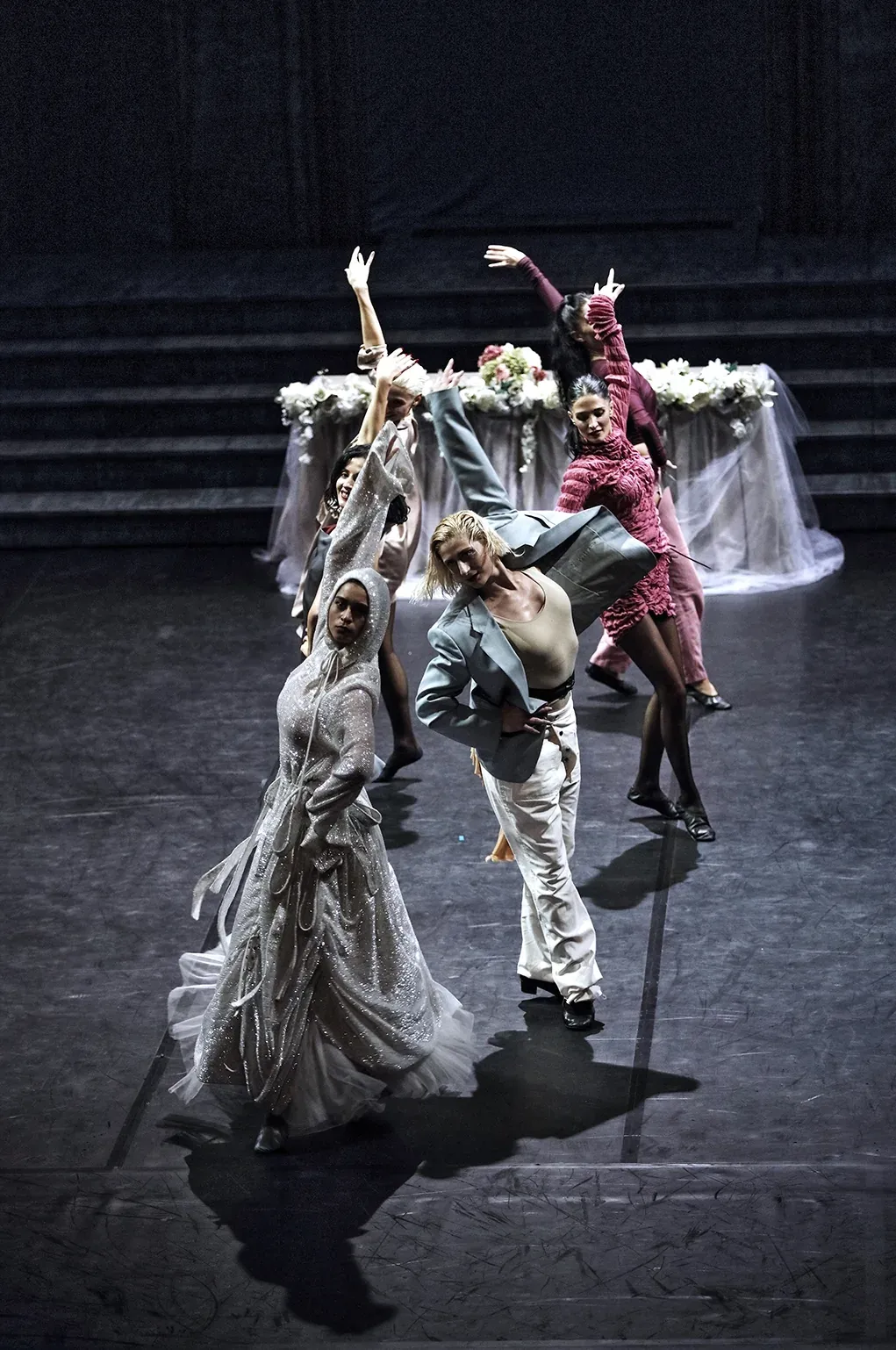
The cast is organised into six couples, the two newlyweds, and the father of the bride—who is no mere silent bystander: he dances as well as, if not better than, the rest of the ensemble. The performance begins without a curtain; the dancers are already on stage as the audience enters and takes their seats, creating a mirror effect where guests and spectators arrive simultaneously, greeting each other, exchanging pleasantries, and taking selfies. At the top of the stairs, the father of the bride grows impatient. She is late to appear, and when she finally does, we see her in a state of transport, gliding between the columns.
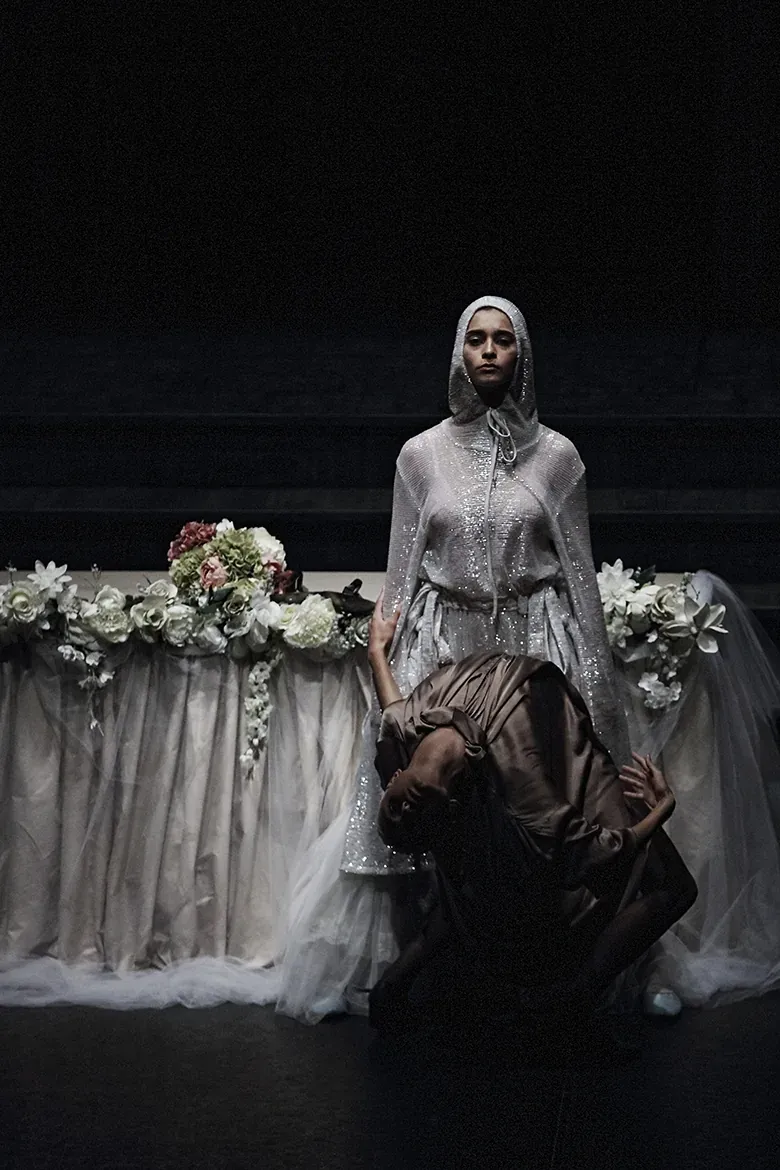
From this displaced beginning, the celebration reveals a peculiar imbalance: everyone seems to be enjoying themselves except the newlyweds. Regional dances explode in a euphoria of rapid footwork, abrasive glides, leaps, and the clashing of sparking swords — a display of markedly masculine virtuosity. Meanwhile, the women orbit timidly on demi-pointe, reduced to ornamental submission. In this metamorphosis through trauma and dance, the wedding ceremony acts as the corset of a stifling patriarchal system, where the bride embodies absolute disobedience: by decapitating the statue and defying paternal authority, she breaks the contract of an arranged marriage to flee imposition.
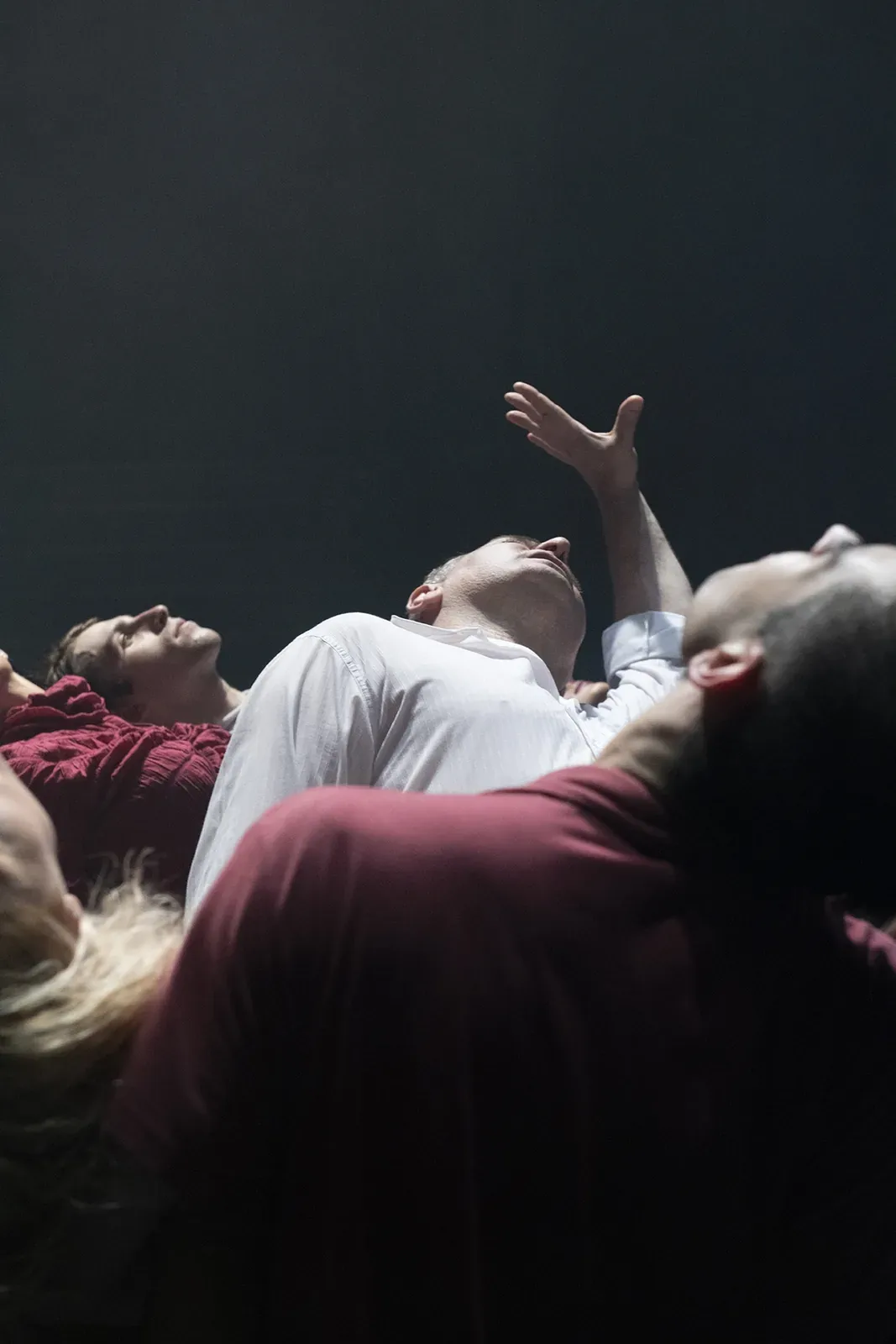
Abrupt, dry musical cuts shatter the regional folk music, introducing a deep bass that usually coincides with the bride taking centre stage, as if the scene were being filtered through her own consciousness. In this distortion of temporality, the group slows its movements, caught in an inertia that feels difficult to reverse. Far from triggering an immediate liberation, the bride’s flight instils a thick, soporific duration where progress stalls and the ensemble's rhythm freezes. The political weight of the narrative reconfigures in this interval: the women perform the masculine dances, perhaps hinting at a subtle feminist shift.
Beyond the narrative, Marry Me in Bassiani seals an alliance born from the choreographic contagion between the French and Georgian companies. Virtuosity and rage are assembled to prove that dance is not a tribute to yesterday, but a valid tool for resisting the present.
Towards the end, the production culminates in a tempered catharsis. From one side of the stage to the other, some advance slowly, others spin like tops, and others run, while the Parliament building slides towards the audience like a tangible threat. The bride reappears, transformed and autonomous, her hood removed, and the building—that heavy authority—is eventually physically displaced by the ensemble.
Liberation does not arrive as an explosion, but as a collective effort executed against the beat. Only in this closing stretch does the techno break through frontally, as if the revolt needed this long detour to finally make itself heard. At this intersection, the definitive collision occurs: tradition is blurred with protest until the boundary between the rigour of the stage and the wild pulse of the street vanishes.
More than half a decade after its premiere, Marry Me in Bassiani offers a renewed reading of resilience. The work has ceased to be a chronicle of a specific event in Georgia and has become a universal study of how rhythm can dismantle social control. At the Grande Halle de La Villette, the spectator witnesses a mutual transfer where tradition is no longer a fossil, but the fuel for a modern revolt. It is the confirmation that, when the air becomes stifling, movement is one of the few territories where the individual remains sovereign.