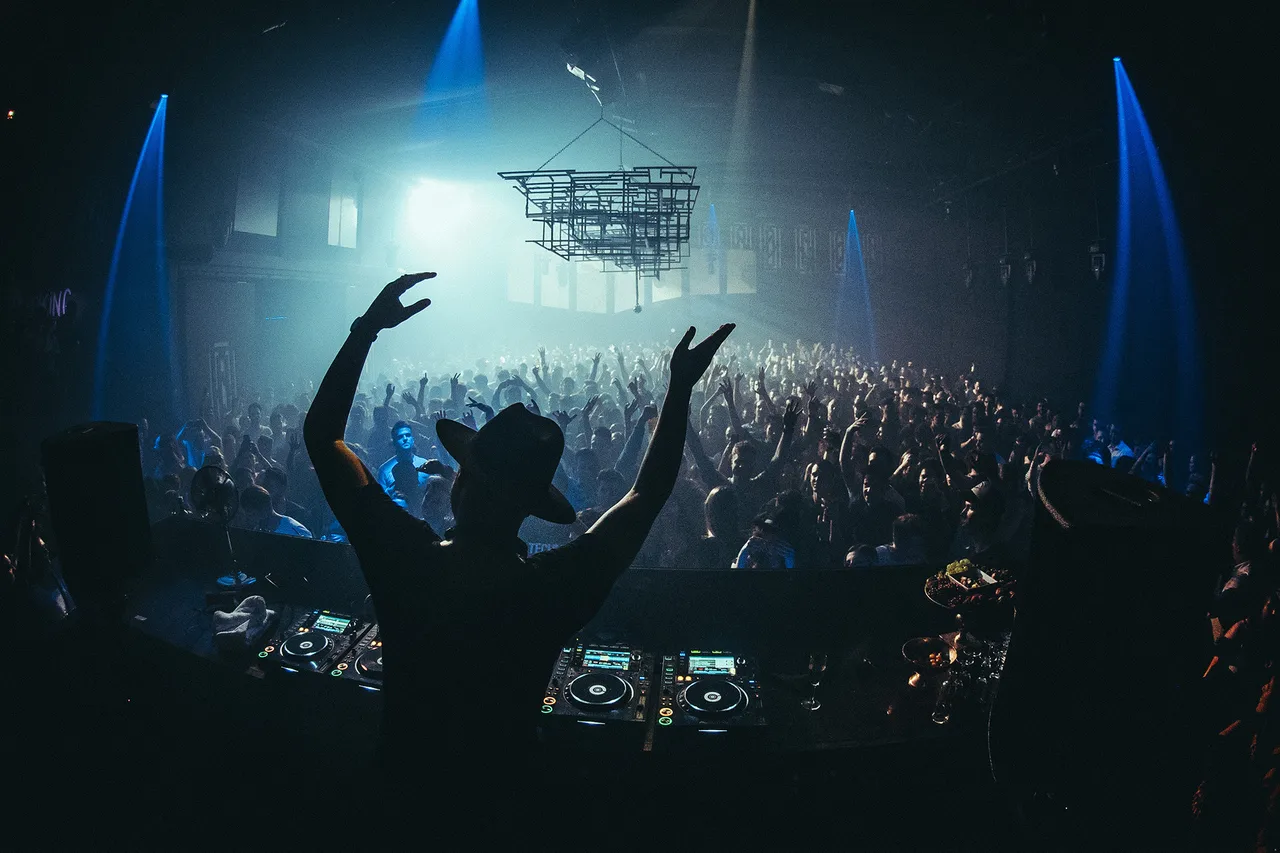
With Kölsch and the Machine, Kölsch steps out from behind the decks and into a living, breathing version of his studio. Premiering at Amsterdam Dance Event in October, the project will soon travel across Europe, arriving at Lab the Club in Madrid on 12 December. Check out all tour dates and get your tickets here.
For the Danish producer, this new project is less about replaying classics than about re-composing them on the spot, where pieces like Grey, Loreley or Goldfisch are reopened, rerouted and felt anew under the voltage of the moment. This new chapter coincides with KINEMA, the album set for release in October, whose title nods to movement and to an artist in forward motion.
Rather than leaning on concept for concept’s sake, Kölsch uses both record and show to reframe familiar emotions with fresh textures: opera and symphonic gestures meet shoegaze haze, indie inflections and the analogue grit of his machines. From Amsterdam to Berlin, London, Paris, Antwerp and Madrid, the tour traces a line between intimacy and scale, nostalgia and invention, studio solitude and the collective charge of the floor.
If his résumé reads monumental –Cercle atop the Eiffel Tower, long-running global tours, collaborations with Coldplay, Imogen Heap or Tiga– it’s the idiosyncrasies that make Kölsch feel present tense. Kölsch and the Machine compresses all of that precision and risk into a single proposition: invite the audience inside the circuitry and see what sparks.
Hello Kölsch, welcome to METAL! It’s a pleasure. How are you, and where are you answering us from today?
Hello there. I'm currently on a flight from Ibiza back to Copenhagen. A bit tired from touring, but all good.
A few weeks ago, you announced Kölsch and the Machine. What makes this project so personal right now?
It feels very personal, as my studio has always felt like a sacred place to me: a place where I could transform insecurities and emotions into sound. Bringing that on the stage feels very daunting.
On Instagram, you said every sound will come from your own catalogue, but nothing will ever play out the same way twice. Does that unpredictability feel thrilling or terrifying?
It is thrilling. I love the idea of improvisation. The biggest challenge in all this is to tame the chaos and structure a compelling experience out of all of it.
For the first time, you’ll be taking parts of your studio setup on stage. What does it mean to you to share that private space with the crowd?
As mentioned, it's a bit scary. My modular setup is pretty big, and a lot can go wrong there.
You also wrote: “Join me inside the machine.” What do you imagine that connection between artist and technology will feel like once you’re in front of an audience?
I hope it will be an immersive experience for both the audience and me. Creating something like that feels super exciting as an artist. I’m trying to project that energy to the crowd, so they can be part of something different from me.
“My studio has always felt like a sacred place to me: a place where I could transform insecurities and emotions into sound. Bringing that on the stage feels very daunting.”
When you think about reshaping tracks like Grey or Loreley with modular systems, what new sides of those songs do you expect to uncover?
It’s not so much reshaping, but about adding elements to it. I could never completely abandon my originals, as they mean way too much to me. It’s more about replacing elements of the original with modular leads, basslines, and such.
The tour will come to Madrid at Lab the Club on December 12. You’ve said in the past how much you love performing there, and that you expect people to be open-minded and ready for something different. What makes Madrid special for you?
Madrid is a very special place for me. I've been playing in the city since 2006, and every time it's a joy to return. I’m sure the audience is ready for this. Madrid crowds are always open-minded. It’s going to be fun.
Your new album, KINEMA, will be released alongside the show. How do the record and the live project speak to each other?
The album is a new chapter for me. Whereas the other albums were conceptual, this is very much about moving forward and embracing new ideas. The album includes opera and symphony, but I also work with shoegaze and indie as inspiration. I’ve written all the songs and lyrics, so it is a huge step for me. The live shows are centred around the album material, but I do bridge into all my earlier work as well.
Kinema means movement in Greek. Why did you choose that word to define this new chapter?
I want it to feel like a new beginning. I had a great conversation with a friend, and I realised I had been holding back, limiting what I felt I could release as an artist. He said: just stop holding back, if you made it, it’s you. That was so true, and I decided it was time.
How much of the performance will be mapped out in advance, and how much will rely on improvisation in the moment?
We have found a way of MIDI mapping the synths to the individual tracks, so I can keep the spontaneous feeling of a DJ set. In that way, I can use CDJs to mix the songs, yet the MIDI is synced with the music. It's the best mix of both worlds.
Do you think fans will instantly recognise the classics, or will they feel like entirely new tracks?
They will absolutely recognise them. There may be new elements, but the melodies are the same.
You’ll be stepping outside the decks. Do you enjoy the idea of stepping into that kind of danger?
From a technical standpoint, the CDJs are still there. The setup allows me to treat it similarly to a DJ setup, but the songs are all sending MIDI to the synth setup.
Your Cercle set at the Eiffel Tower became iconic. How does this make you feel?
It was so special. I will never forget that moment. Paris has such a special place in my heart, and playing an ode to that city from the Eiffel Tower was magic. I can’t believe that happened.
Do you see Kölsch and the Machine as an even bigger leap?
It is a big leap for sure. We are still working out all the details. I felt it was time to try something different for myself, a new challenge.
Was there a specific turning point in the studio when you thought, This really belongs on stage?
I always thought it did, but it seemed impossible to combine the freedom of performing with the complexity of the synth setup. It took years to figure out.
You’ve collaborated with Coldplay, Imogen Heap, Tiga, and many others. Could you imagine opening the Machine to other artists in the future?
I had the idea early on to add vocalists and musicians. Maybe a string quartet or a pianist. This is something I’d love to explore in the future.
Christiania, where you grew up, was all about creative freedom. How does that spirit still guide you today?
Absolutely. It’s a defining part of me as a person. Feeling free to explore creative visions is essential. Sometimes good, sometimes bad. The only way to find out is to test the ideas.
What do you most hope audiences will feel the first time they see Kölsch and the Machine live?
I hope they will experience a sense of joy and wonder, an interest in the Machine, but also an appreciation for the show. There is a lot of focus on the visual side as well, and we have worked very hard to make it pure, emotional, and beautiful.