Once upon a time, a girl by the name of Jeanine Brito was born to a German family where the fables of the Grimm brothers, among others, filled her dreams with a hungry wolf and cannibalistic witch in the woods. As the stories unfolded with their poisonous apples, murderous stepfamilies, and heroic princes, Brito wondered what it all meant. She asked the magic mirror on the wall, who are the villains in these tales? And the mirror chuckled back to her: discerning who is evil is not as easy as these stories will make you believe.
Brito flips the script on classic fairy tales in her new exhibition, All the Better to Eat You With, on display until 20 December at Los Angeles’ Nicodim Gallery. Anchoring her work in fairy tales, she offers a familiar narrative for the audience to connect to her work, and most importantly, to understand her commentary on how malleable these stories can be. They are a fragile practice passed down through word-of-mouth over hundreds of years, providing the authors with a skeleton to adorn with meat, muscle, and skin.
Her interpretation is a theatrical, tongue-in-cheek commentary on the folly of traditional gender roles, the performance of femininity, and, with this most recent exhibition, masculinity. And, believe me, it doesn’t disappoint. You may not get every single reference, but it’s exactly that which gives her art an air of mystery, of wanting to look behind the red curtains that drape the corners of the canvas. We speak with Brito about her creative process of dress-up, reimagining old fables from another untold perspective, and performing gender online and in daily life.
It’s no secret that your work revolves around fairy tales and folklore, particularly from the Grimm brothers and Hans Christian Andersen. Do you have a favourite from either of them that you haven’t incorporated in your art yet?
There are so many fairy tales that I haven’t touched yet, and where I have, I’ve really only skimmed the surface. I made a painting a few years ago called Everything I Did, I Did for Love, a portrait of one of the stepsisters from Cinderella at the end of the story with her toe cut off and her eyes pecked out. I think there’s more to explore with the stepsisters and with the villain characters generally across fairy tales.
Of the stories I haven’t worked with at all yet, I love the Twelve Dancing Princesses — the image of the worn-out shoes piling up night after night is so fun. Another favourite, though from Madame D’Aulnoy, is the tale of the white cat, in which a beautiful magical cat must be beheaded by her beloved in order for her to transform into her true form, a princess. It’s such a bizarre, violent story, and I love Kelly Link’s interpretation of it in her collection White Cat Black Dog.
Of the stories I haven’t worked with at all yet, I love the Twelve Dancing Princesses — the image of the worn-out shoes piling up night after night is so fun. Another favourite, though from Madame D’Aulnoy, is the tale of the white cat, in which a beautiful magical cat must be beheaded by her beloved in order for her to transform into her true form, a princess. It’s such a bizarre, violent story, and I love Kelly Link’s interpretation of it in her collection White Cat Black Dog.
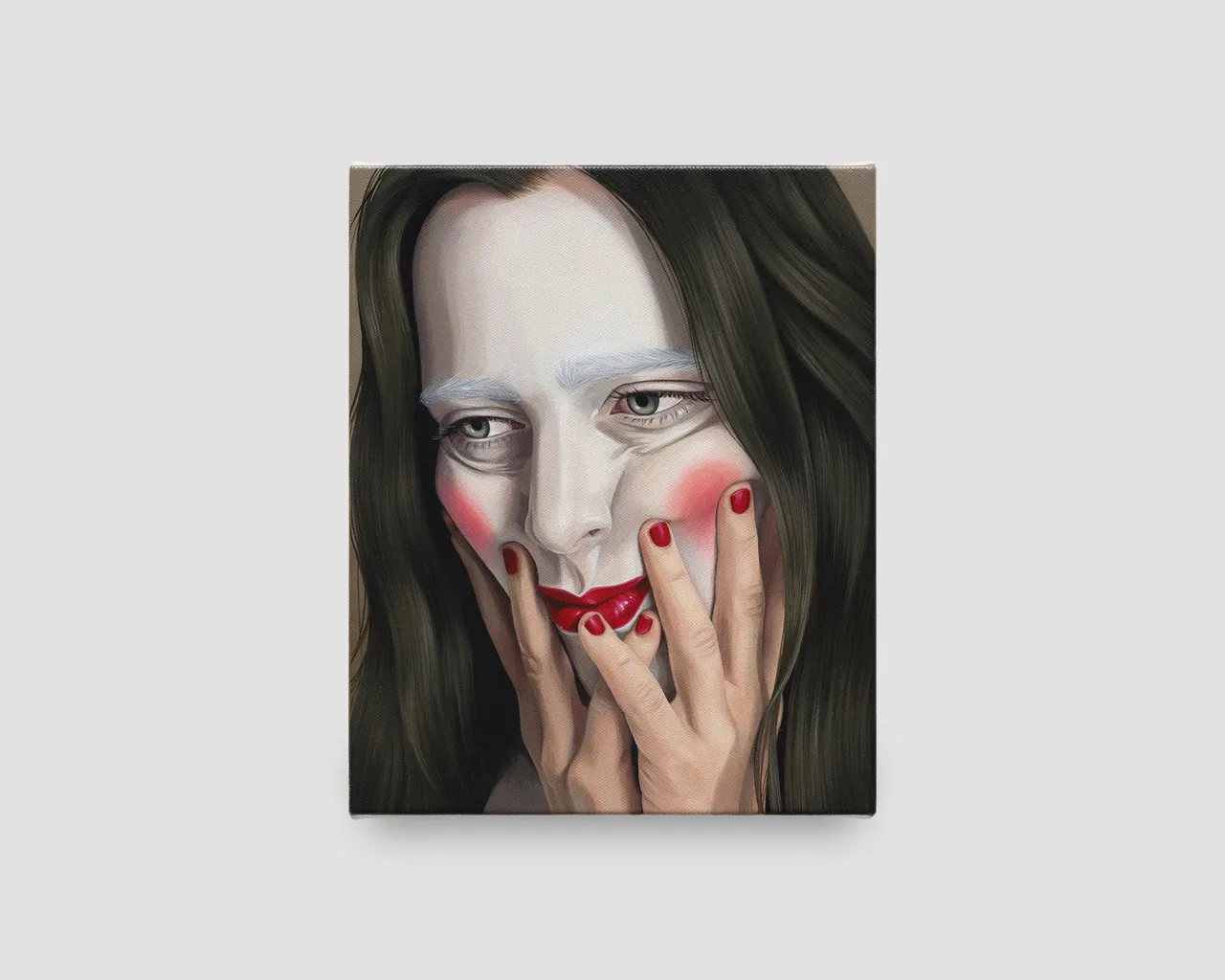
The make-up and costume design in the paintings are beautiful and so detailed. You have a background in fashion which really shows in the styling of your subjects — or yourself I guess. What is the creative process behind that? Are you dressing up yourself, trying out new make-up looks?
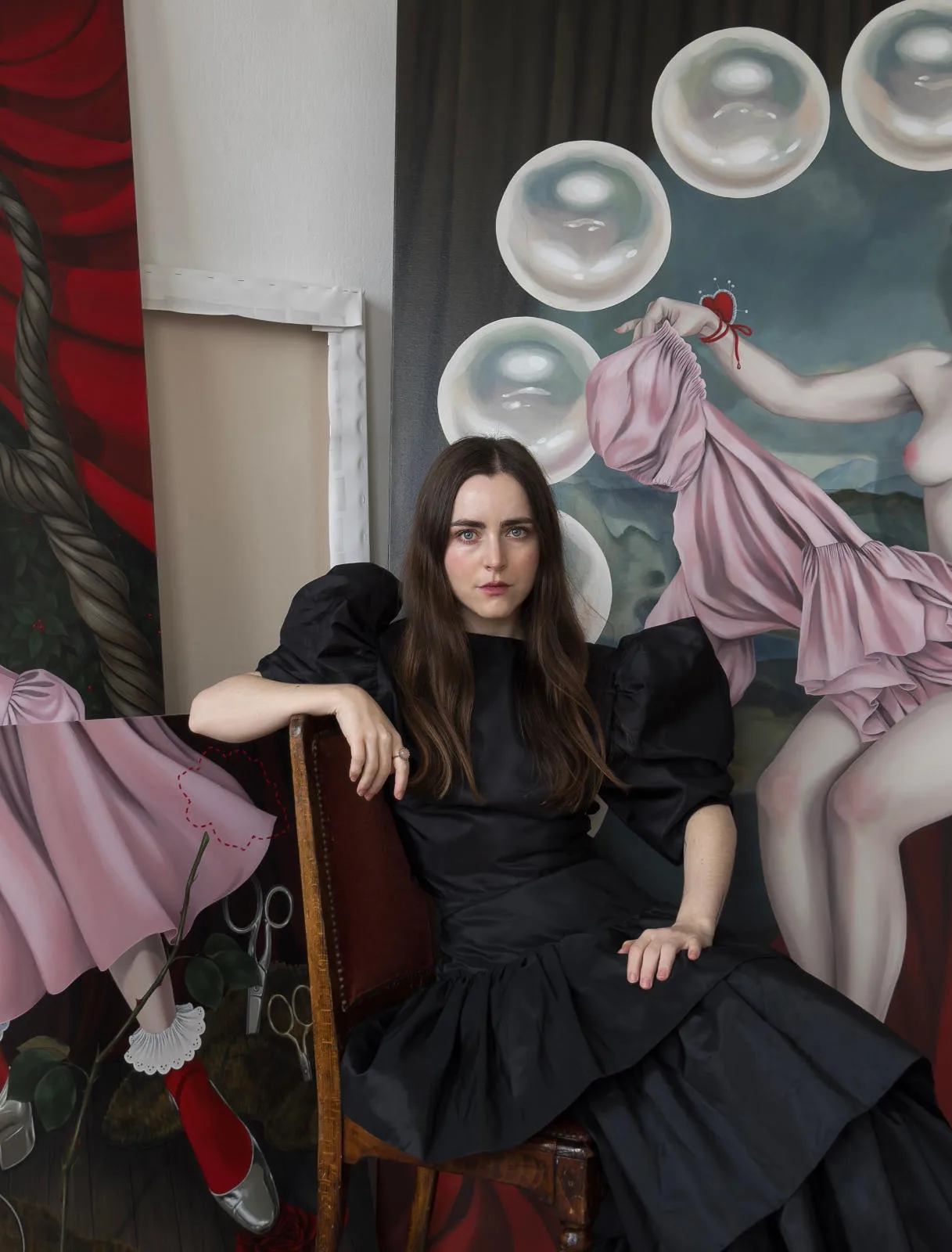
The costumes for the figures in my paintings are largely based on items in my own wardrobe, which I keep in my studio. Most of what I collect is vintage, so a lot of the dresses that appear in my work are handmade; former costumes or special occasion dresses that I imagine someone’s mother or grandmother lovingly made for them. My grandmother used to sew all of my mother’s clothes, so this idea of these carefully made pieces from across time landing in my hands makes me feel connected to a history of women who cherish beauty.
Each painting begins with a rough sketch, and then I think about who the characters are and what they might be wearing. Then I film myself dressed as each character and move through different poses, and make more refined sketches based on that. The dress-up component is very important to me. The way I paint is very controlled, but how I compose each painting always begins with imaginative play.
Each painting begins with a rough sketch, and then I think about who the characters are and what they might be wearing. Then I film myself dressed as each character and move through different poses, and make more refined sketches based on that. The dress-up component is very important to me. The way I paint is very controlled, but how I compose each painting always begins with imaginative play.
One of the oldest fairy tales making the woman out to be the damsel in distress and waif-like is Adam and Eve, wouldn’t you say? And the red apple she eats, like the apple given to Snow White, is present in a lot of your paintings. Can you tell me a bit about that decision?
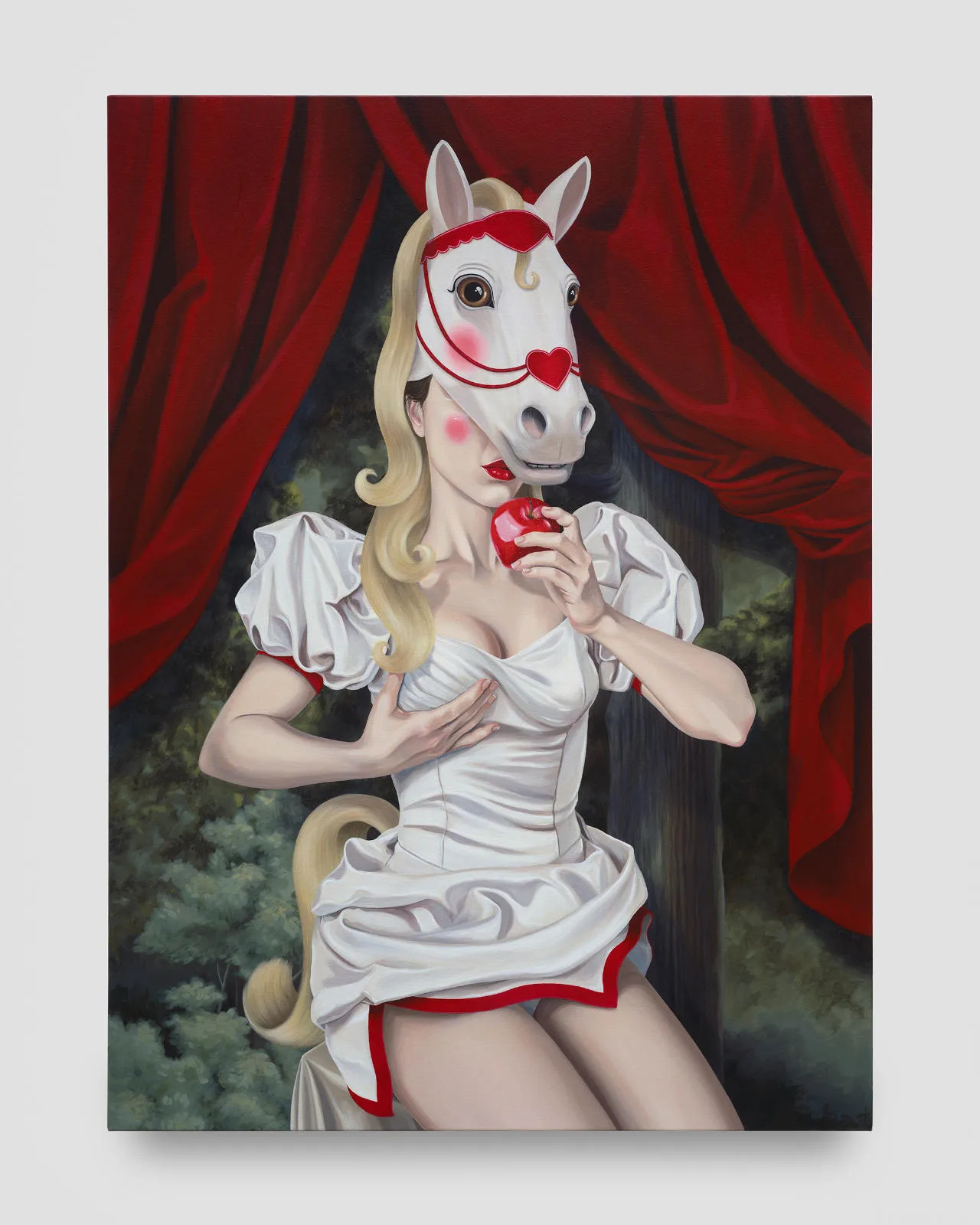
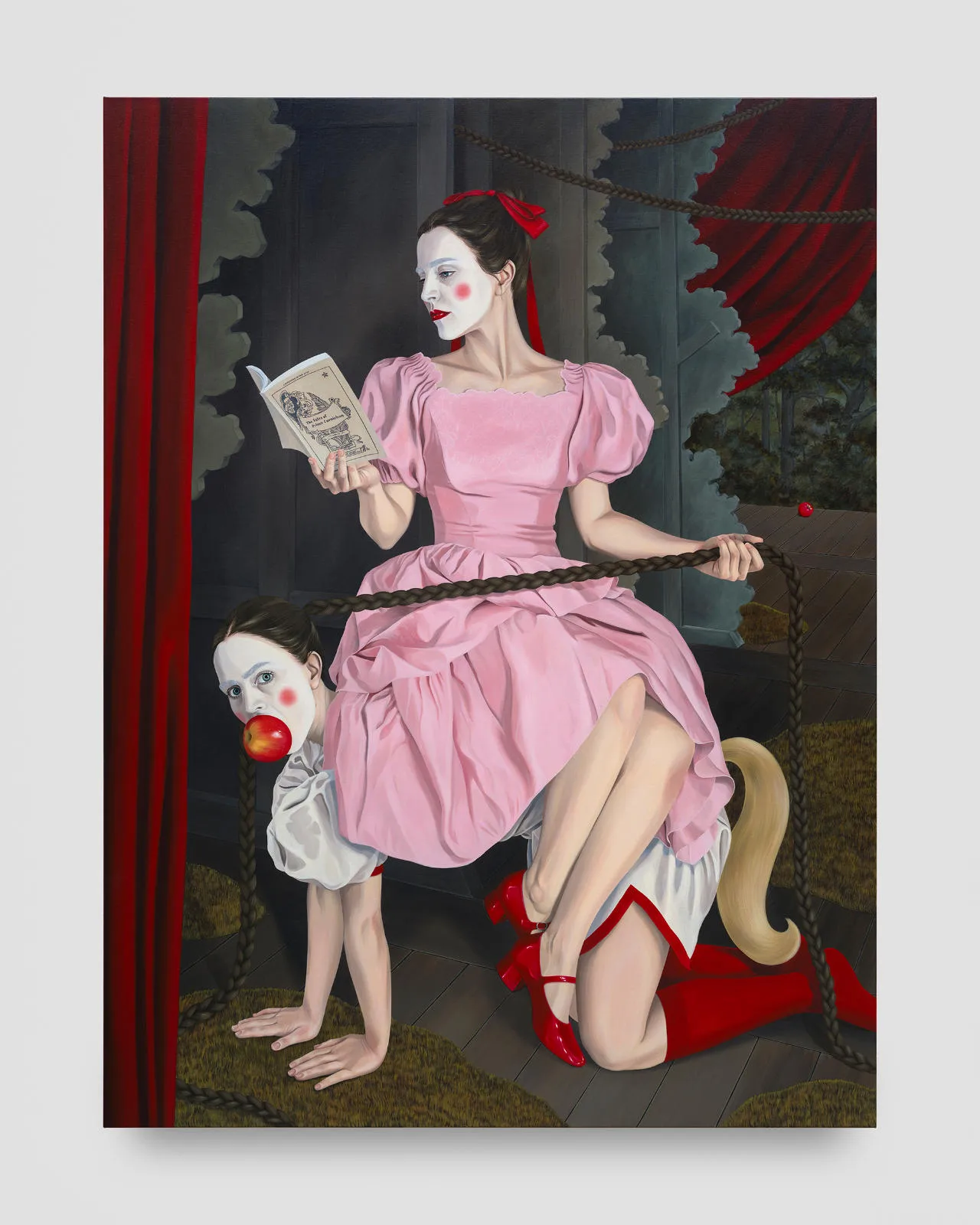
Eve was punished for her curiosity, for her desire for knowledge, and I’m fascinated by how the apple has remained a symbol for the dangers of women ever since. For me, the apple is about engagement with pleasure. I want the women in my paintings to indulge in their appetites and desires. They offer the apple and they eat from it themselves: they are both seducer and seduced.
In all of your work, you have yourself as the subject. You’ve said that this is to reflect on each part of yourself and how they interact with one another — their contrasts, conflicts, conversations. What did you learn about yourself in doing this?
The most surprising thing to emerge while making this show was the masculine wolf character, the Impresario. The way I present myself is usually quite feminine, but it was an interesting exercise to put on a large suit and embody this new figure, and notice the way my movement changed in response. It reinforced for me the power clothing can have.
“My grandmother used to sew all of my mother’s clothes, so this idea of these carefully made pieces from across time landing in my hands makes me feel connected to a history of women who cherish beauty.”
What pushed you to include a man, or even just someone who’s not you, for the first time All the Better to Eat You With?
The honest answer is that I have become a bit bored with myself. It’s been very practical to use myself as my model. I’m always available. If I decide to change the pose or costume in a painting, I can immediately shoot new reference material. But I’m reaching the end of what there is to explore with only my likeness, at least for now. Bringing my partner into the paintings felt like the natural next step, and working with him is nearly as seamless — he’s a very willing, generous model. The narrative began to take shape as I thought about how to introduce his character and what his role in my world would be.
I loved your ode to Angela Carter and her reimagining of fairy tales from a more feminist perspective, where the women have more agency and the blurred lines between what we think of good and bad. What purpose do you think the original fairy tales and folklore serve versus the amended versions?
I think in order to interpret fairy tales and write new ones, you have to begin with a deep love for the source material. Part of what makes them so attractive is their lack of specificity. Fairy tales come from the oral tradition, so the recorded versions we have are necessarily vague. Settings are mysterious, characters are often unnamed. In some ways they function more as framework than story, wherein the teller fills out the details with their own context and experience. Then there’s what Marina Warner calls the ‘dimension of wonder,’ the magical element where anything is possible, that reminds me of hearing these stories for the first time as a child. Fairy tales also have a familiarity that can be relied upon in the audience or reader. Even if they do not know the specific story, they likely know the component parts.
So if the original recorded tales function as the outline of an image, then their retellings provide the colour, the specificity, and imbue the story with fresh meaning. In Angela Carter’s retelling of the Bluebeard tale, The Bloody Chamber, the protagonist is rescued not by her brothers, but by her mother, whose eleventh-hour entrance on horseback is as magnificent as any princely rescue. In Ella Enchanted, Gail Carson Levine’s novel retelling of Cinderella, Ella’s unceasing obedience to her cruel family is reimagined as a curse she received as a baby and must learn to break. The stories gain texture in their retelling, whether told by a grandmother or a famous novelist.
So if the original recorded tales function as the outline of an image, then their retellings provide the colour, the specificity, and imbue the story with fresh meaning. In Angela Carter’s retelling of the Bluebeard tale, The Bloody Chamber, the protagonist is rescued not by her brothers, but by her mother, whose eleventh-hour entrance on horseback is as magnificent as any princely rescue. In Ella Enchanted, Gail Carson Levine’s novel retelling of Cinderella, Ella’s unceasing obedience to her cruel family is reimagined as a curse she received as a baby and must learn to break. The stories gain texture in their retelling, whether told by a grandmother or a famous novelist.
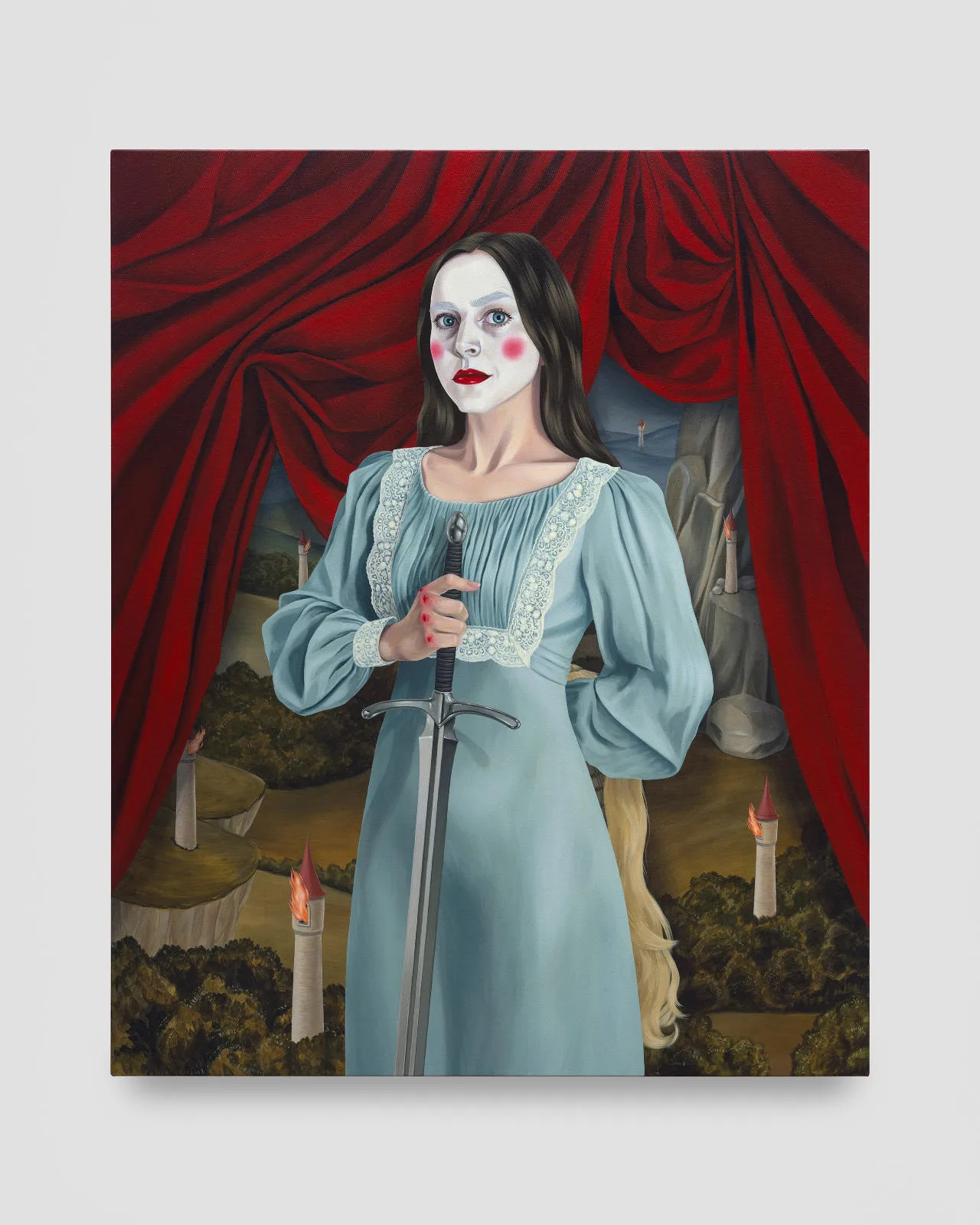
I especially loved Self-Portrait as a Damsel. The smirk, bloody knuckles, hidden hand, and fires burning in the background. She’s hiding something, something violent, and happy about it. What did you want to communicate with this piece?
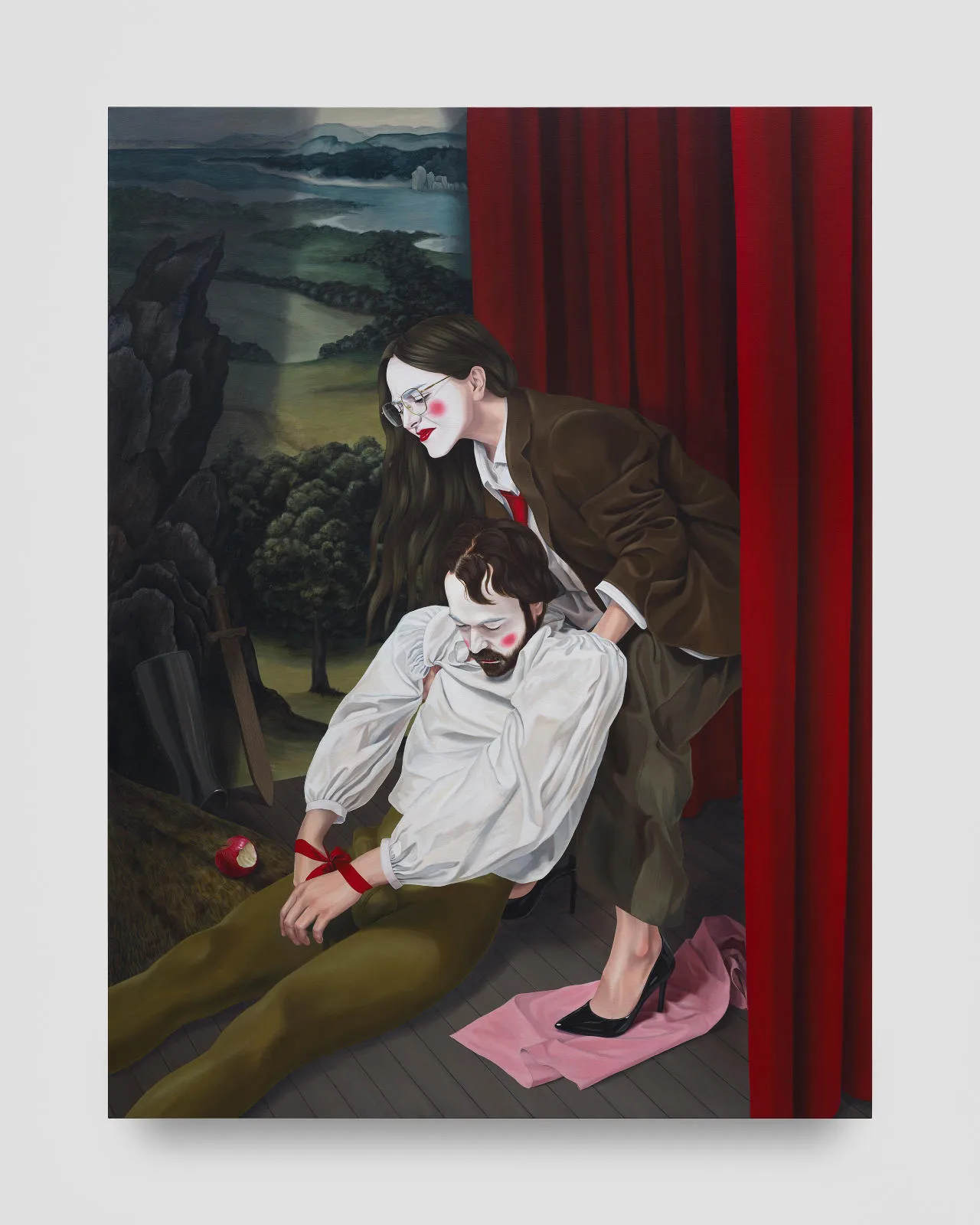
This is the first painting I made for the show and I think it set the tone. It reminds me of that meme of the little girl smirking in front of a burning house. She’s self-satisfied and defiant. Narratively, Damsel is the turning point, living between the introduction of the prince in Rugged Male Hero, and his abduction by the women into their fairy tale theatre troupe in The Lovers. In Rugged Male Hero, the figure in the tower lures the prince with her blonde braid, and then in Damsel we learn that it’s a wig, the towers across the landscape behind her are all on fire, and there’s been some kind of struggle. She’s kind of there to say, this is not that story.
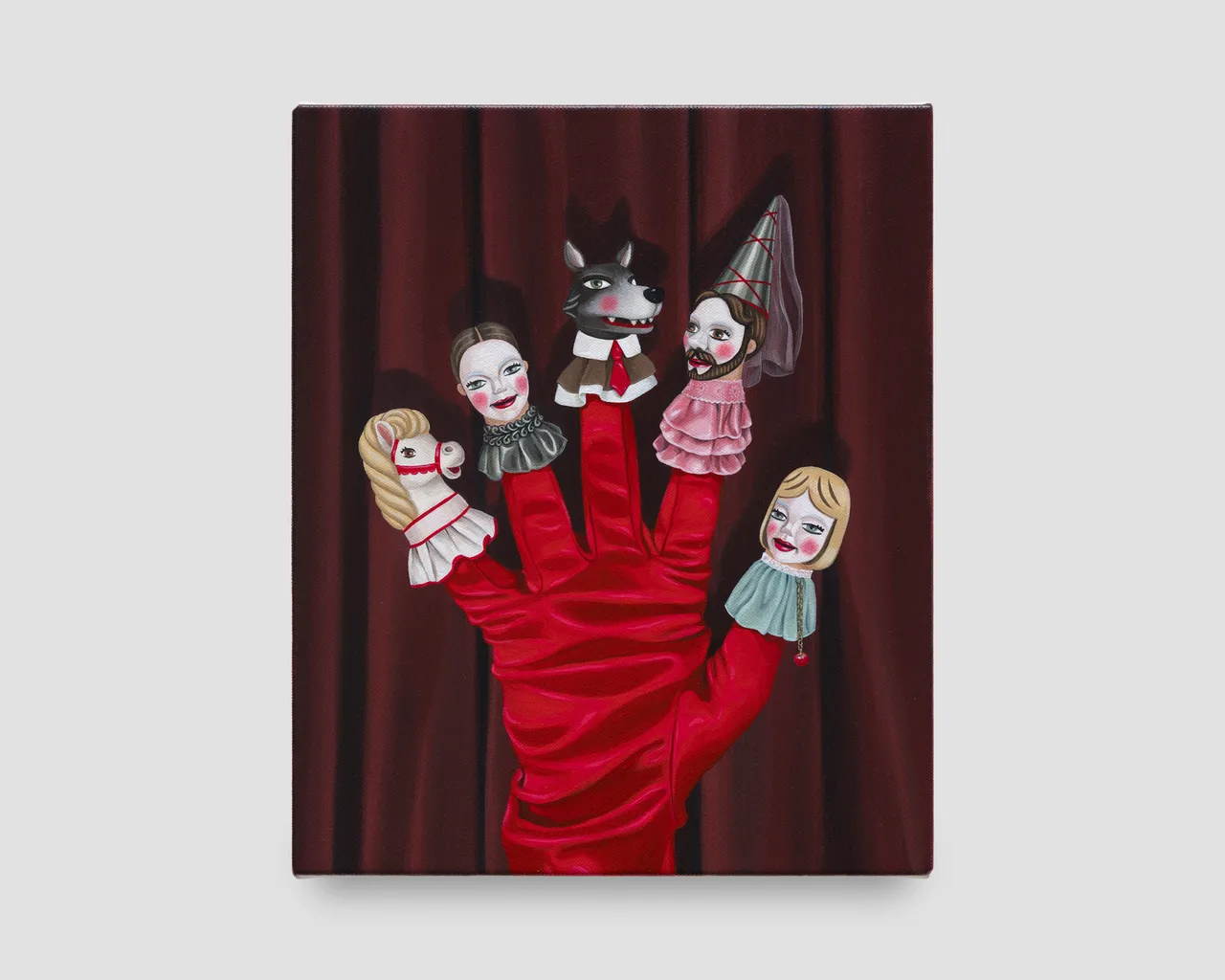
In Kasperle, the man is the princess finger puppet, whereas the women are the ones perpetrating the ‘harm.’ What made you choose to flip the traditionally feminine and masculine roles like this?
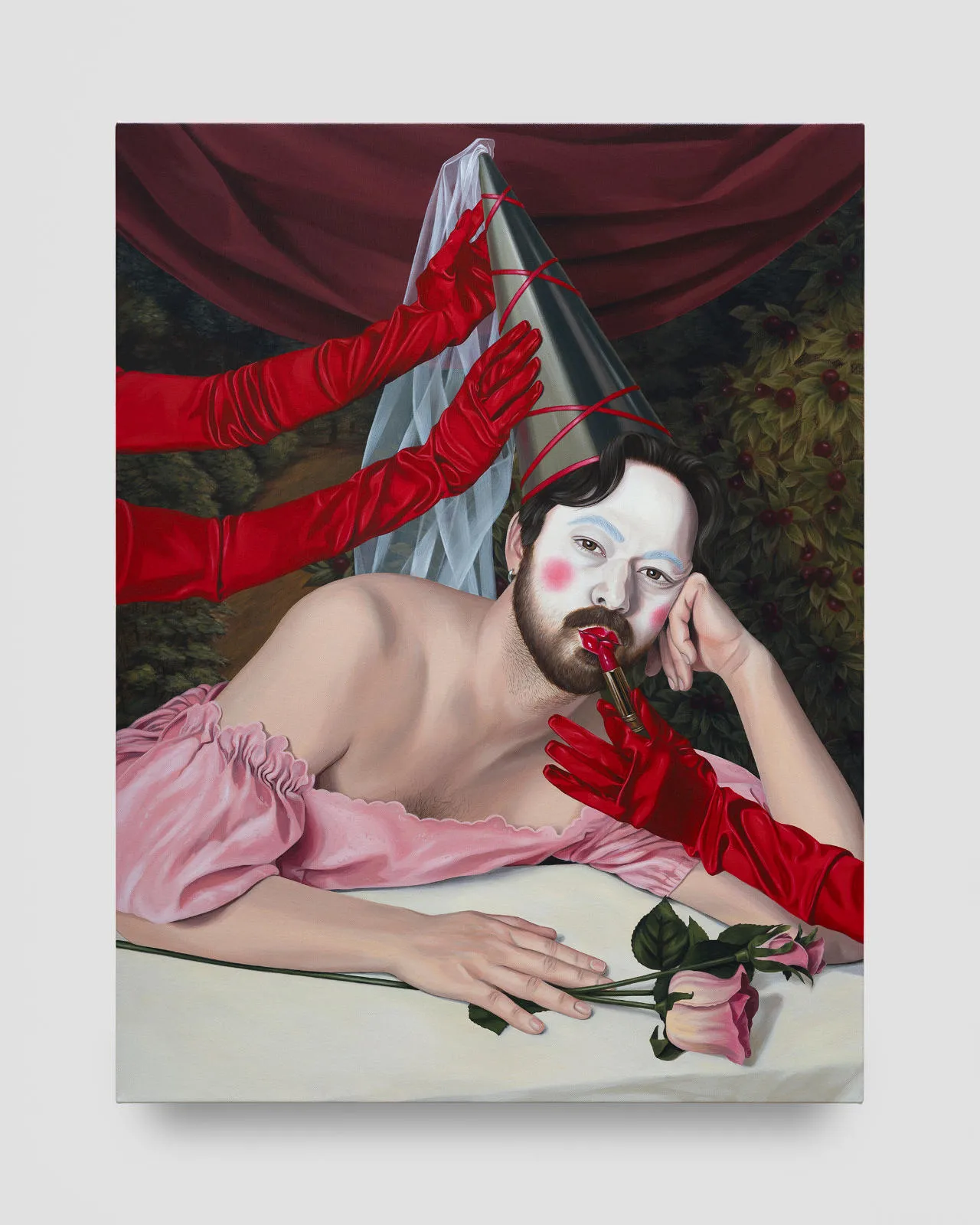
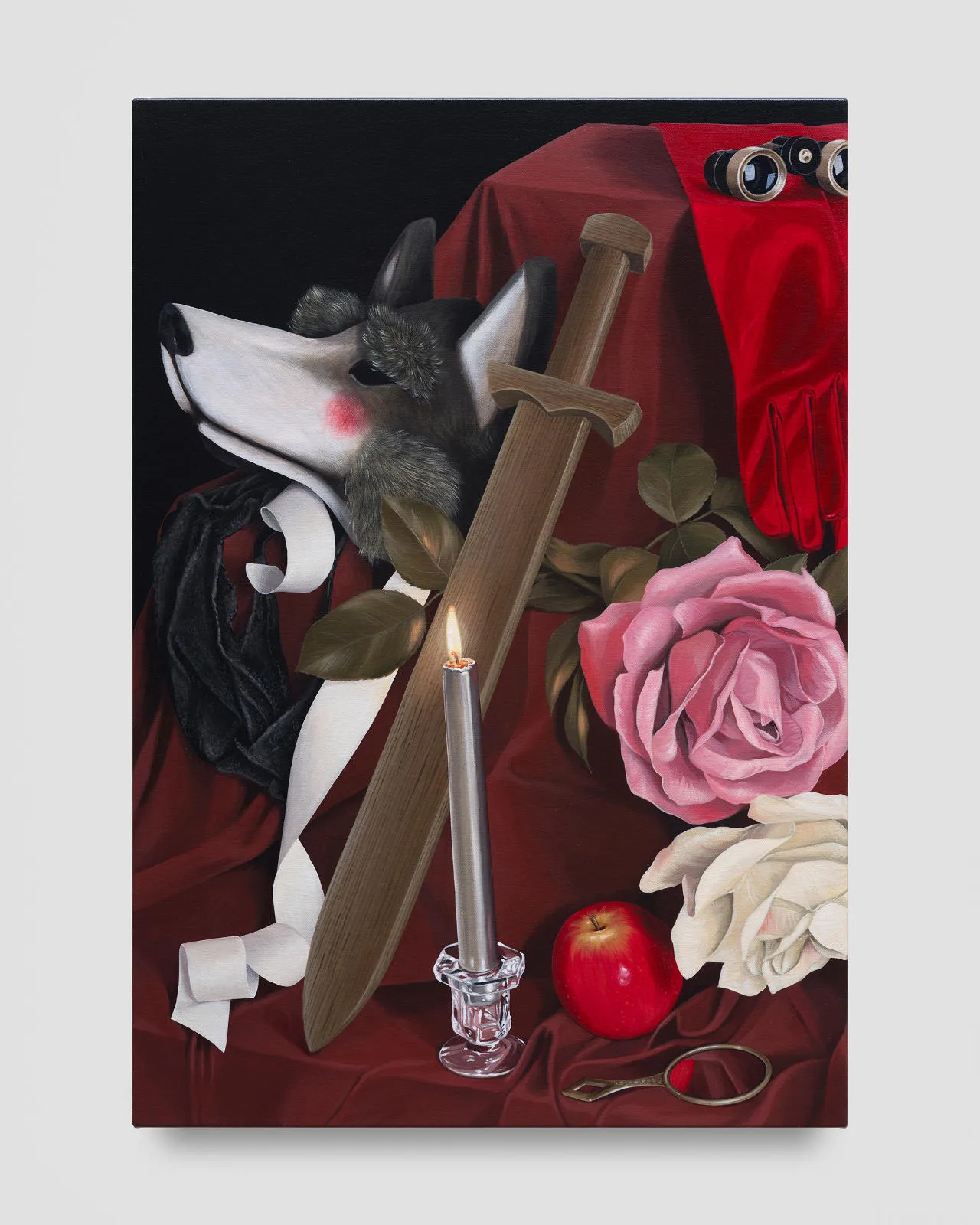
I wanted this little painting to function as a sort of dramatis personae of the show. I have the figure of the prince in drag in two of the four paintings he appears in, so if we imagine Kasperle as the final bow, it feels logical for his puppet form to also be in the pink dress. I loved playing with gender in these paintings. So much of my previous work has explored the performance of femininity, but this was the first time I was also looking at masculinity too.
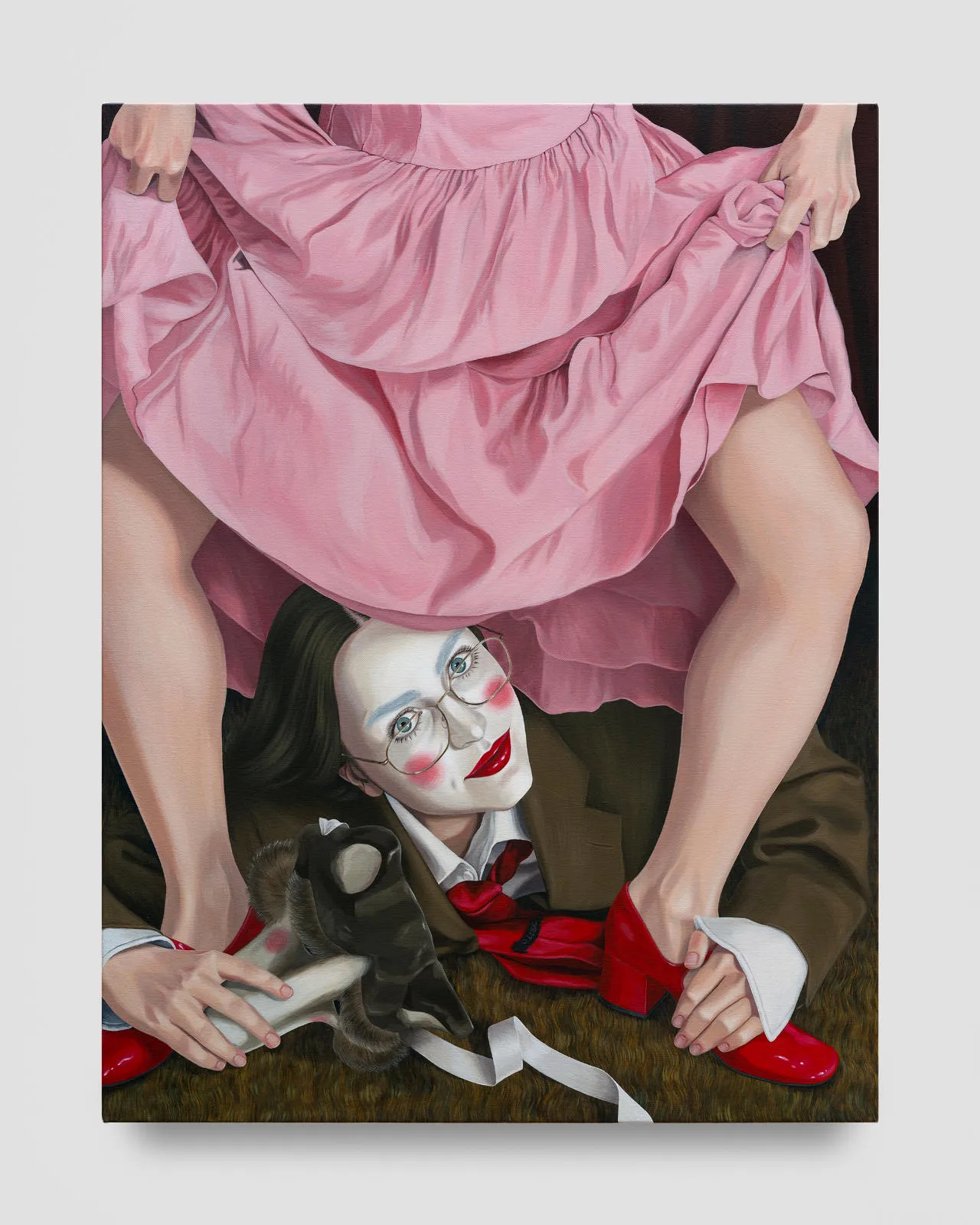
There’s another painting, Costume Department No. 2, where one of the women is putting on the prince’s armour, and in Good Girls the pink dress is worn by another of the women as well. So there’s this idea of gender as a costume, something that can be tried on and taken off again and passed around.
There’s another painting, Costume Department No. 2, where one of the women is putting on the prince’s armour, and in Good Girls the pink dress is worn by another of the women as well. So there’s this idea of gender as a costume, something that can be tried on and taken off again and passed around.
Nowadays, there is a big trend of hyper-femininity online, especially with trad wives. This trend is kind of taking over what it means to be a woman, reverting to more traditional roles. How do you balance this notion of loving to be a woman while not falling down the rabbit hole of losing independence?
I think this is an interesting discussion in relation to fairy tales, which, in their original forms, tend to favour obedient, pretty girls. The heroine — selfless, kind, chaste, hard-working, lacking any vanity but naturally beautiful — feels so in line with the modern idea of the trad wife, who sacrifices everything with a smile for her husband and children, all with a fresh blowout.
Related to the trad wife, and what I find personally much more seductive, is beauty culture. That’s where I feel friction between my values and my actions. I think about Marina Warner on Angela Carter, from her book From The Beast to the Blonde: On Fairy Tales and Their Tellers: “Her crucial insight is that women… produce themselves as ‘women’, and that this is often the result of force majeure, of using what you have to get by.” So much of my work is about that, the performance of femininity, of gender. What does it mean to produce oneself as a woman in this moment? According to my algorithm, it’s deep plane facelifts, but it can also be more ordinary: how much money have I spent on serums, how many diets have I been on?
The production of femininity is often violent and always resource intensive; not just money, but time and headspace. I think about The Substance (2024), in which Sue essentially buys time from her older self so she can stay in her youthful body as long as possible. There’s always a cost. So I feel this desire, or perhaps imperative is a better word, to maintain whatever youth I can, while logically knowing that my continued submission to these ideals is its own kind of prison. There is certainly a level of beauty labour that is about ‘using what you have to get by’, but I wonder how much we gild our own cages in the process.
Related to the trad wife, and what I find personally much more seductive, is beauty culture. That’s where I feel friction between my values and my actions. I think about Marina Warner on Angela Carter, from her book From The Beast to the Blonde: On Fairy Tales and Their Tellers: “Her crucial insight is that women… produce themselves as ‘women’, and that this is often the result of force majeure, of using what you have to get by.” So much of my work is about that, the performance of femininity, of gender. What does it mean to produce oneself as a woman in this moment? According to my algorithm, it’s deep plane facelifts, but it can also be more ordinary: how much money have I spent on serums, how many diets have I been on?
The production of femininity is often violent and always resource intensive; not just money, but time and headspace. I think about The Substance (2024), in which Sue essentially buys time from her older self so she can stay in her youthful body as long as possible. There’s always a cost. So I feel this desire, or perhaps imperative is a better word, to maintain whatever youth I can, while logically knowing that my continued submission to these ideals is its own kind of prison. There is certainly a level of beauty labour that is about ‘using what you have to get by’, but I wonder how much we gild our own cages in the process.
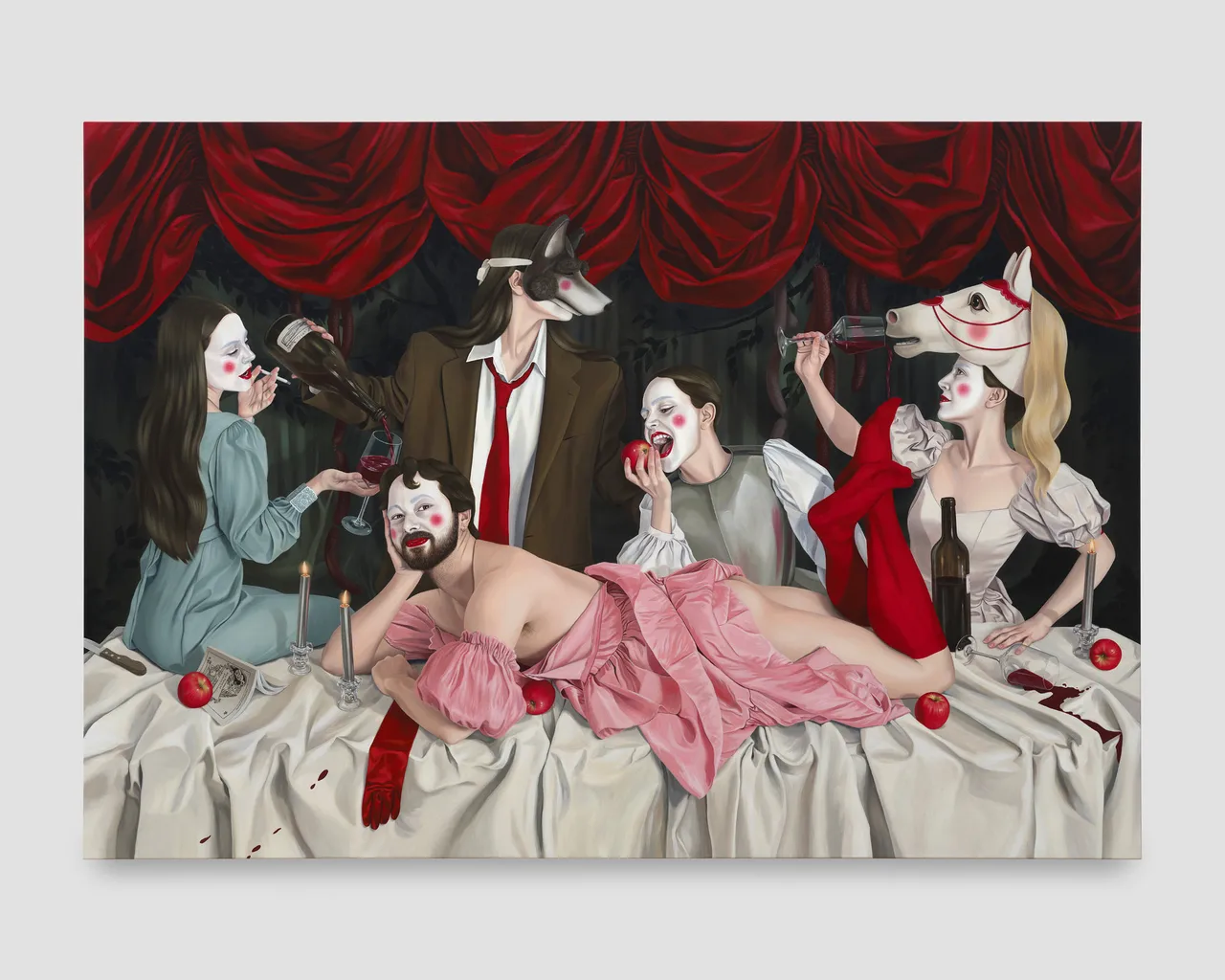
In the animated version of All the Better to Eat You With, the dinner party looks like those animatronic mannequins you see in storefront windows. What made you choose this style of animation — or any animation at all?
I love that comparison! I’ve been wanting to try animating one of my paintings for a long time. I used to work for a newspaper and one of my projects involved animating a series of illustrations to accompany a digital article. So I reached out to the same animator, Yan Aftimus Rosa of Prime Motion, with the idea of animating this specific work and was so thrilled when he said yes.
The way I constructed the painting — the layering of the backdrop, the figures, the curtains — I think of it a bit like a paper theatre. In the animation process we treated it similarly: separating out each character as their own layer, isolating the background, filling in the gaps, and then bringing everything to life with these subtle but very delightful movements. I like that it takes a moment to realise the painting is moving: it’s a little uncanny, it’s surprising.
The way I constructed the painting — the layering of the backdrop, the figures, the curtains — I think of it a bit like a paper theatre. In the animation process we treated it similarly: separating out each character as their own layer, isolating the background, filling in the gaps, and then bringing everything to life with these subtle but very delightful movements. I like that it takes a moment to realise the painting is moving: it’s a little uncanny, it’s surprising.