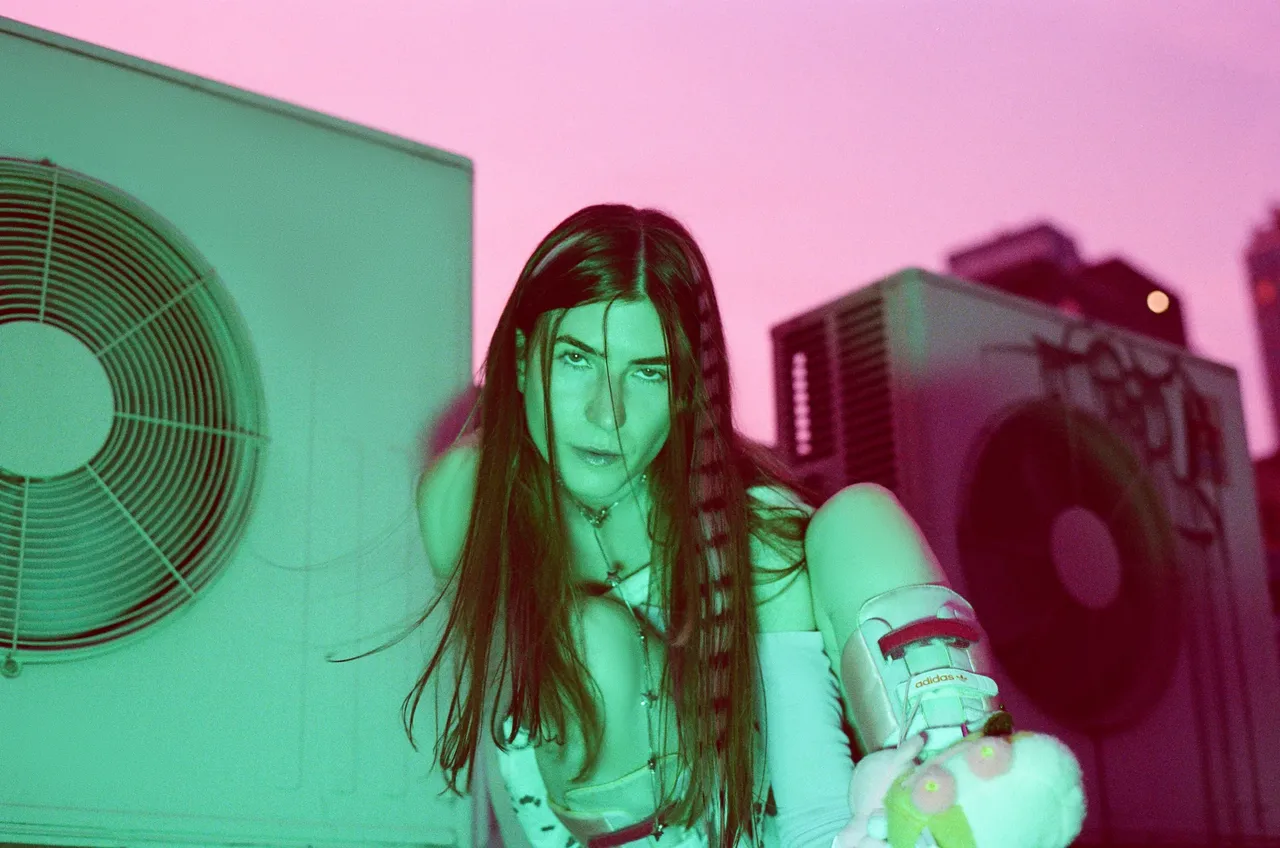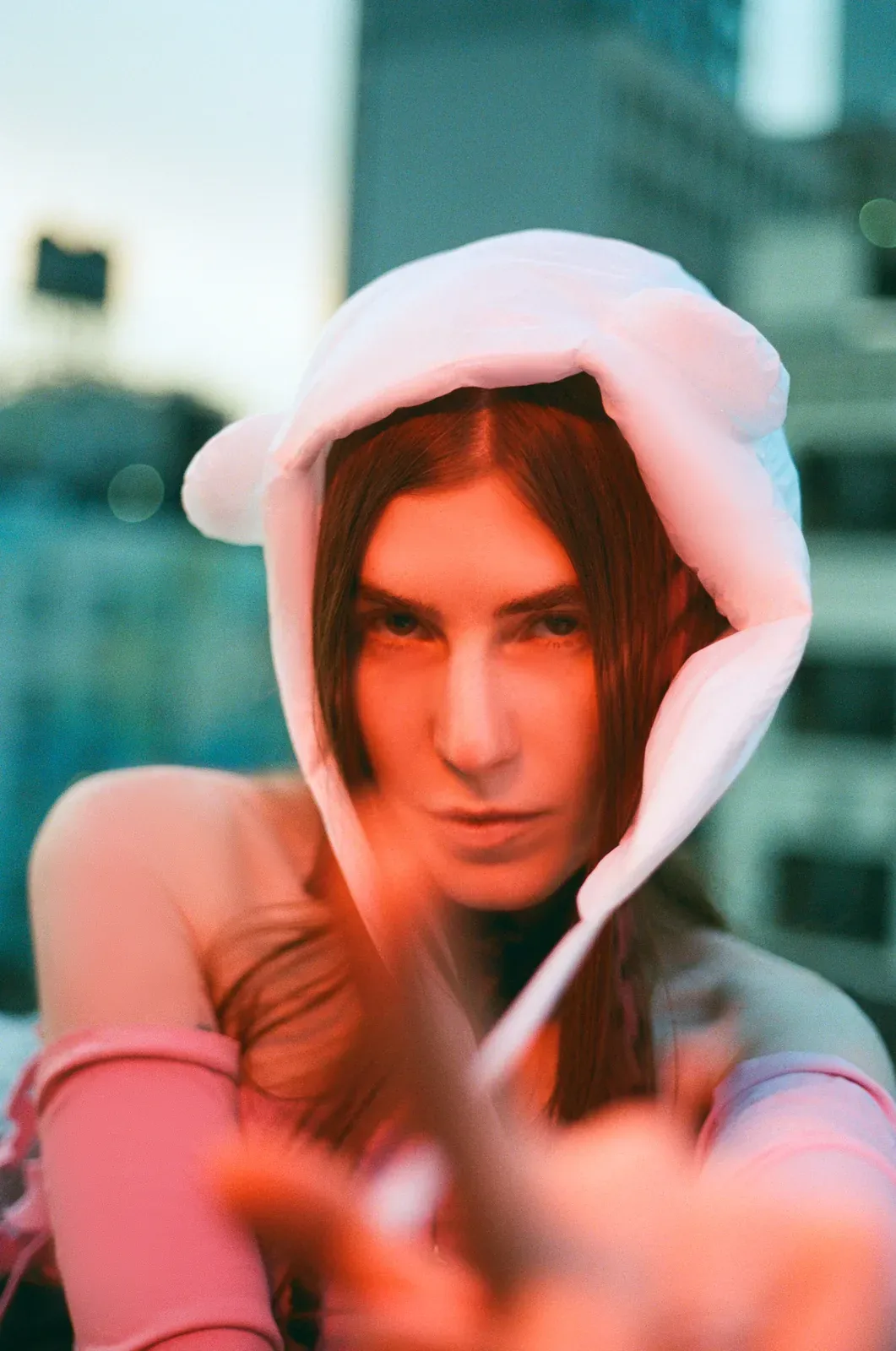
Each summer, james K and a collection of her friends head upstate, to the remote reaches of New York. The trip is partly, yes, the kind of thing any group of close friends might try to retreat from relentless calendars. As you’d expect from musicians and DJs packed into a cabin where no one is filing a noise complaint, there is partying aplenty, too. But the real purpose, Jamie Krasner explains, is simpler: they gather to share music communally, each bringing a piece of physical media to engage with the group.
That idea of music-centred togetherness may sound dangerously close to Hallmark movie territory for some, but in Krasner’s case, friendship is a clear part of the work’s territory. Her latest album Friend was made with collaborators whose skills, by her own account, took the music somewhere she could not have reached alone. Its recently released companion project, Friend Remixes, makes that premise even more explicit too, handing the record back to her real-life friends, collaborators and peers, including Objekt, JASSS, Loidis, Drew McDowall, Priori, and Arushi Jain, to interpret and translate her work anew.
Where PET and Random Girl, her previous two LPs, moved through conceptual persona and sonic fragmentation, with Krasner’s vocals often only half-discernible beneath synths and industrial squall, Friend comes from what she describes in our exchange as being able to “let go and trust myself.” The result is more open and direct, but not exactly clarified in the conventional sense. Her voice sits closer to the surface, with a cleaner presentation, while still behaving as texture through layering effects. Likewise, lyrics orbit attachment, isolation, grief and love without settling into linear confession, and beneath them, beats and loops shift underfoot rather than holding steady.
Our conversation that follows floats, a little like Krasner herself, along these hard-to-define lines, between her formative memories, the shapeshifting function of persona from PET to Random Girl to Friend, with mentions of the friends who helped along the way. If you’re eager to see her perform live, make sure to get to Los Angeles’ El Rey Theatre on May 6 or NYC’s Webster Hall on May 13.
I’d like to start by asking about your youth. What are your earliest memories of feeling really pulled towards making things?
I loved singing; I was always singing and making up songs to myself from as early as I can remember. I gravitated towards singing and turning these little bursts of feelings and ideas into songs, a bit like daydreaming, when I was about five or so. I also loved getting sick because I’d get to stay home and create these shadow-puppet plays. I’d write the stories, make paper puppets, and put on little productions under a table with a white sheet and a backlight.
Quite a theatrical approach to things, though I feel like a lot of kids often play make-believe — myself included. What do you think contributed to you being drawn into singing, stories, and puppets? Where do you think these desires stem from?
I know it was about creating stories and outlets for dream spaces; the sorts of worlds I felt, or thought up, and wanted to express. This has remained the core of my desire, even to this day: wanting to see an idea from my mind come to life as a channel to express feelings. What I can’t fully pinpoint is why that desire is so strong, but perhaps it’s something related to connecting the inside to the outside, to understand and be understood?
On a similar line, you’ve spoken about nature as a grounding force, and about going back to a childlike state when you make work. What do you remember most vividly about growing up in upstate New York? Are there specific memories you can pinpoint?
I was born in the city and grew up in the suburbs, right on the outskirts, but I would spend my summers in upstate New York from the age of six. I remember being in a wet field on a hot summer morning and suddenly noticing hundreds of tiny, neon-orange salamanders creeping out from the blades of grass. I remember an abandoned pool, black with thousands of tadpoles wiggling around. These experiences were like magic and are embedded deep in my memory; I almost look back and question if they were just dreams. I remember the smell of the forest and walking barefoot down a mossy path along the river.
Where was this? Your description makes it sound so inviting. Could you describe what the area was like, or rather, your experience of it at that time? I’m not that familiar with the US.
In the Adirondacks, High Peaks Wilderness. It’s bursting with life: lush, green, and natural. It’s truly off the grid: no cell service and barely any people. On a clear night, you can see every star. Once, I was lying in a river completely alone, face to the sky, and a beaver floated right by me.
You mentioned how trying to create stories and dream spaces is still part of your desire today. Do you think that environment gave you access to something specific you still look for now when you create? Not to say that floating beaver provided a transcendental experience, but do you feel there was something you were able to experience there that you can’t get anywhere else? As much as I am enamoured with harsh noise or full-throttle busyness, I often find myself drawn to the quiet when diving into something creative, wholeheartedly.
I still go often; being there is like breakthrough therapy for me, and I instantly feel like the truest form of myself, bursting with creativity from within. It’s essentially the only place I feel like a kid, away from expectations. A reason why I make art is to find that feeling and create within it, where you set your own expectations and shape your own world, just like I did as a child.
I grew up between the city, the suburbs, and these wonderful natural spaces. My family also holidayed in mountains and national parks all around the US. The frenetic energy and the calm vastness both play into a balance of what I need internally and express externally. When I’m making, I’m generally tapping into both and gliding along that balance line. If one becomes too heavy, I tend to feel uneasy.
I grew up between the city, the suburbs, and these wonderful natural spaces. My family also holidayed in mountains and national parks all around the US. The frenetic energy and the calm vastness both play into a balance of what I need internally and express externally. When I’m making, I’m generally tapping into both and gliding along that balance line. If one becomes too heavy, I tend to feel uneasy.
Today, then, are there specific methods you use to get into a creative, playful state? Certain routines or practices that have become habitual?
Lighting incense and putting on perfume. Scent is so strongly tied to memory and emotion, and for me, these play an important role in my process. The loosening of memories and emotions brings me closer to the dream-state I try to tap into while working on anything creative. As I said earlier, mimicking dreaming is how I would explain the flow state I try to enter while working. It’s a case of letting thoughts, memories, and ideas blend in uncanny ways, all guided by currents of emotion.
“Mimicking dreaming is how I would explain the flow state I try to enter while working. It’s a case of letting thoughts, memories, and ideas blend in uncanny ways.”
I ask this as personas appear to be a big through-line of your work. Around PET in 2016, you said personas helped you “access and examine” parts of yourself you might otherwise avoid, and gave you enough distance to critique those parts. By Random Girl, you were describing personas as “cultural jumping points,” and then during the Friend rollout you said those fragments feel “more in conversation and less separate.” What changed in the role persona was playing for you?
Personas are like wearing masks. It’s a great way to understand something and go deep into it while still feeling outside of it, allowing you to examine and critique it. On my last record, I felt they didn’t need to play as obvious a role as on my previous record, where it felt more conceptually tied to the album.
There are moments where personas are used. Play, for instance, is definitely leaning into the ‘pet’ persona I’ve come back to over the years. ‘Pet’ is defined as the ‘meta-fetishised pop’ persona, and you can hear this character in the vocals and lyrics. She’s more playful and punky; there are more walls to her, less access to the interior.
Sometimes I’ll lean into a persona in certain moments of a song. For instance, in Doom Bikini I’m really going in and out of various characters; that song is about moving between different mental states, highs and lows. I also think that synth line is a persona I’m trying on. I’m collaging sound references in the productions, so, thinking of persona as a cultural jumping point, there is always this piecing together of personas within the collective of the work I make.
There are moments where personas are used. Play, for instance, is definitely leaning into the ‘pet’ persona I’ve come back to over the years. ‘Pet’ is defined as the ‘meta-fetishised pop’ persona, and you can hear this character in the vocals and lyrics. She’s more playful and punky; there are more walls to her, less access to the interior.
Sometimes I’ll lean into a persona in certain moments of a song. For instance, in Doom Bikini I’m really going in and out of various characters; that song is about moving between different mental states, highs and lows. I also think that synth line is a persona I’m trying on. I’m collaging sound references in the productions, so, thinking of persona as a cultural jumping point, there is always this piecing together of personas within the collective of the work I make.
Would you say Friend came from needing less distance from personas, then? Or from understanding those different parts of yourself differently?
Friend came from being able to let go and trust myself. When I stopped examining the different pieces with such focus and criticality, everything sort of blended together and my core was much easier to reach; all the voices sang in unison (laughs).
Your voice is definitely presented more clearly on Friend, as Jazz Monroe pointed out during your Pitchfork London conversation a few months ago. Though I couldn’t help but think that your style of singing and its presence has stayed remarkably consistent from your debut RUM EP until today. Could you talk to me a little about when you first discovered your voice? It seems like you’ve had a clear conception for how you would present your vocals from the beginning — of your recorded music history, anyway?
It has always been pure intuition with my voice. Translating emotion. There was always an urgency to sing for as long as I can remember, and it was about expressing a well of feelings inside. Finding my voice came freely to me, though I do also love to sing other artists’ songs to try to emotionally inhabit them, and because, simply, I love singing; it’s just what I tend to do in my spare time. I suppose from doing this thousands of times over the years, I’ve taken bits and pieces from those singers and the songs, but the core is always translating the emotion I feel from within. Being a container for the emotion, that is what I would consider ‘the voice’.
How do you feel like you’ve grown, or changed, as a vocalist from your first album to this one? What sort of things have you tried to develop, or techniques that you’ve applied to your voice in production?
I don’t think much has changed in terms of my voice, but I have become much better at producing my vocals, and those techniques play a significant role in the music. I record and produce all of my vocals, and this is a very intimate process for me, which I find I must do alone. Over the years, I’ve mastered the process more and more, and I feel like I’ve finally got to a place where I can achieve what I want with them sonically, for the most part, but I’m also always pushing myself to explore more. Perhaps in another ten years from now, I’ll look back and say the same thing. That’s the beauty and pain of producing: you can always learn more and refine the craft.
On a related note, this blurring of voice made me think of your Truants (2025) interview, discussing how you sing “sounds which are halfway between a word and a feeling,” emerging meaning from sound, and how your shoegaze influences like Cocteau Twins, and others like Beck, gave you permission for words to be “open and misused or repurposed.” A lot of your music seems to live in that blurred space, where the voice becomes texture and the lyric is atmosphere-led as part of a broader, luscious soup — for lack of a better turn of phrase. I wondered, what draws you to blurring, the ambiguous? Does that blur let you express something that a cleaner, more clearly separated sound wouldn’t?
It’s about translating the feeling, always. I sing freely and translate the emotion from within, and then I take those pieces to construct a song. From there, it’s a puzzle of piecing together words to fit the emotion of the sounds. I find that words in poetic suspense tend to hold the emotional integrity of the song, rather than speaking didactically. I want it to feel like the feelings — a sort of dream-logic and unravelled. I hear textures swirling around in my head and it’s about making those sounds exist, not about writing a clear and direct pop song.
On this last record, the production and mixing were much cleaner than usual because it was important for me to try this out with my writing style, to hear the dynamics of all the textures and minute details, to hear the subtleties of the voice, and to have every sound have its place in the stereo field. It wasn’t to create ‘clarity’, but a sense of depth.
On this last record, the production and mixing were much cleaner than usual because it was important for me to try this out with my writing style, to hear the dynamics of all the textures and minute details, to hear the subtleties of the voice, and to have every sound have its place in the stereo field. It wasn’t to create ‘clarity’, but a sense of depth.
You’ve said that Peel was something you sang to one of the closest people in your life as she passed away, and that it changed your perspective on what life is forever. That’s an intimate origin for a song. What is it like to make, and then keep singing, something that sits so close to lived experience? Does music create any distance for you there, in the way personas once seemed to?
It’s beautiful. I think of her every time I sing it; it keeps her close to me. Honestly, I’ve cried more than a couple of times while singing it live. It still reaches in and chokes me up.
“There was always an urgency to sing for as long as I can remember, and it was about expressing a well of feelings inside.”
Did you ever feel protective over releasing Peel because of this? What has the experience been like, for it to be recontextualised in your work?
No, I don’t feel protective over my music; I generally want to share it, but it’s always about timing. I think more about when and in what context a song will be shared than ‘if’. I think, at their core, my songs are about the emotion, about baring myself and all the feeling, and this is what I find a lot of people resonate with. It can be extremely healing. It would be unfair not to share that.
So, you are releasing a remix album. There are some names on there which I believe you go a long way back with. I was wondering, in the spirit of Friend, if you could talk to me about some of these friends and collaborators and what they mean to you? Specifically, I wondered if your friendships and their shared (albeit distinct) musical practices helped clarify your own direction in music, or in life, in any ways you remember?
Yes, definitely. For instance, Drew McDowall has been a good friend of mine for a long while now. He reached out to me to buy my first album, which I was surprised and elated by, and he invited me over to drop it off. We became friends from then on and have collaborated and made music together. His approach to music-making and life has been such an inspiration to me. He is such an explorer in the deepest sense: creatively, intellectually, spiritually, and socially. He is also an incredibly supportive person. He has lifted me up and encouraged me many times when I needed it, and I know he has done the same for many other artists. He really has directly affected so much beautiful music and art that exists.
My friend Alex (DJ Richard), of about eighteen years now, is another one. We went to school together in Providence, then lived in Oakland, NYC, and Berlin together. He is definitely a foundational friend for me, and we’ve collaborated on various music projects over the years. I’ve always been inspired by his work and, of course, by him. I have a number of friends from throughout the years who continue to shape me in various ways! It’s all a chain reaction.
My friend Alex (DJ Richard), of about eighteen years now, is another one. We went to school together in Providence, then lived in Oakland, NYC, and Berlin together. He is definitely a foundational friend for me, and we’ve collaborated on various music projects over the years. I’ve always been inspired by his work and, of course, by him. I have a number of friends from throughout the years who continue to shape me in various ways! It’s all a chain reaction.
Lastly, I’d like to end on this. What’s something you’ve learned about yourself recently—as an artist or just as a person—that you don’t think you could have said five years ago?
Knowing and respecting my limits allows me to dream the most expansively.