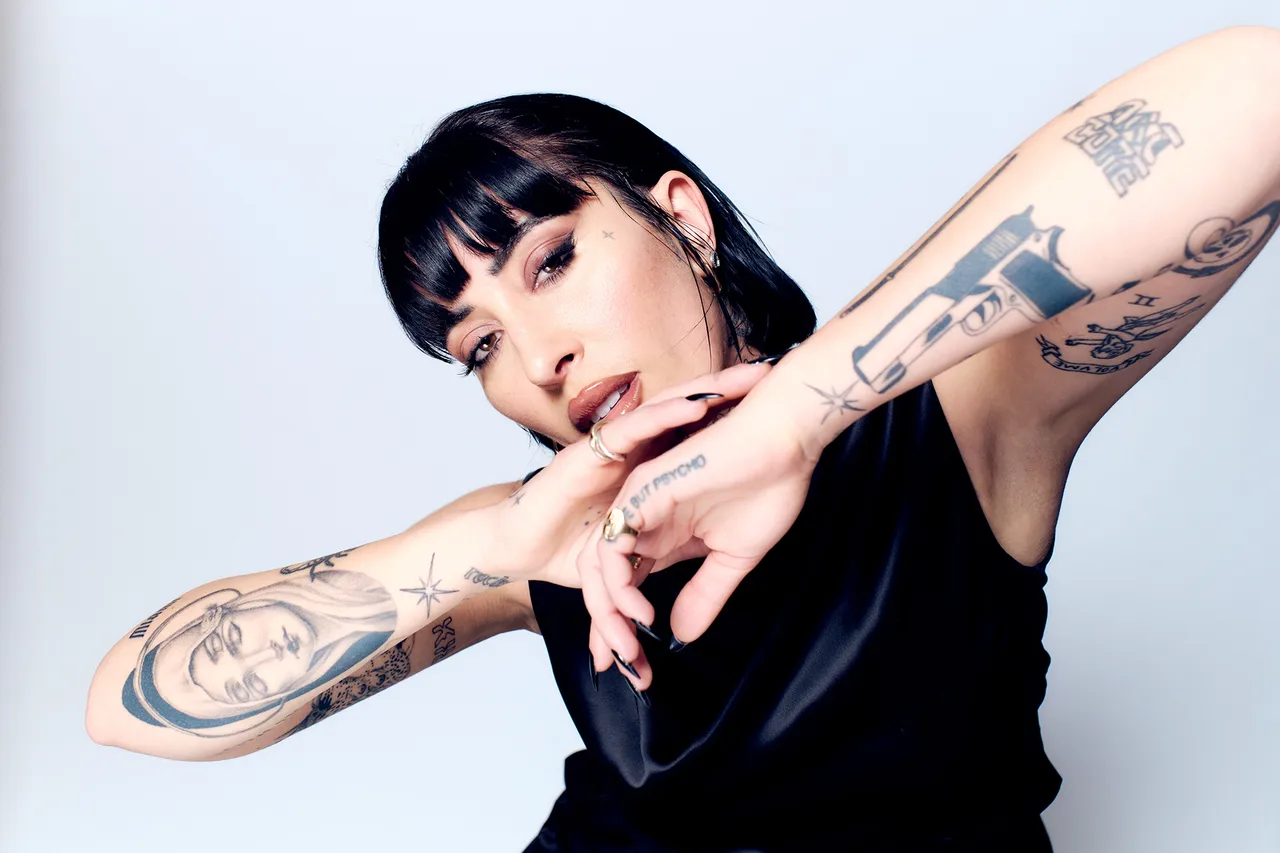
When we spoke with Indira Paganotto, she was back in the Canary Islands, at home, recovering from a broken leg and temporarily off the road. The timing mattered. With Arte Como Amante about to be released, the pause created space to talk about pressure, unfinished ideas, and the process of finally closing a chapter that had been quietly taking shape over the years.
That chapter becomes public today, following the release of La Patrona in early January as the final preview. “The whole album is a musical adaptation of my life,” she comments, reflecting on difficult decisions and the reality of choosing what stays and what gets left behind. With hundreds of tracks still unfinished, Arte Como Amante lands today, with a launch party taking place in London.
Indira, thank you for taking the time to speak with us. A few weeks ago, you broke your leg. How are you doing now, both physically and mentally?
Ohhhh, it was really hard! I’m still recovering, I can’t walk properly, so I know it’s going to be a long process with a lot of physical therapy too. I am always busy, hyperactive and on the go, so to not have the freedom to walk and be outside has been challenging, not to mention that I had to cancel a lot of shows, as it’s impossible to travel and DJ like this. But at the same time, maybe this was a sign to slow down. I think life works like that, in mysterious ways.
Arte Como Amante is a very personal title. Do you remember the moment when you stopped thinking about this as an album and started feeling it as your own story?
The record is a musical adaptation of my life and all of the experiences I’ve had since I started my journey into music. It was never an album for me, it’s always been a story. When you create something with that mindset, you make it with more passion and truer to who you are. The title translates as ‘art as a lover’ — Art is my all-time love, and it always will be.
You’ve been carrying these tracks with you for years. When it was finally time to put them together, how did you know which ones were ready to ‘leave’?
Even after this album, I still have about three hundred tracks left that aren’t finished or released, so you can imagine how hard this was. I think I changed my mind a hundred times, but in the end, I had to make decisions on which tracks truly showed each stage of my life better than others. That’s a choice only I can make — it’s a very personal release.
Is there one that took you the longest to finish, or one you almost gave up on at some point?
For sure, that's La Patrona. It is classed as the curveball of the album as it has a lot of drum and bass elements. I haven’t produced or worked a lot with that genre, but I am very happy with it. It’s different, and doing things outside of your comfort zone is important and helps you to grow as an artist.
Growing up in the Canary Islands, what’s something from that time that still sneaks into your music, even if you’re not aware of it?
The wilderness — it makes me feel free. That translates into my music and makes me aware that I can create whatever I want, be wild with my tracks and experiment.
Your father exposed you to many different sounds early on. Was there a moment when you realised you were listening to music differently from people around you?
Yes, most of the parties here are all reggaeton or salsa, and I was not into that as something I wanted to make. If it wasn't for my father, I wouldn't have heard or discovered most of the music out there, he educated me in every genre, which I wouldn't have been exposed to whilst living on the island. Both my father and mother taught me that music is rich in variety, a lesson I am always thankful for.
You started DJing very young. Do you remember the first night when everything clicked, and you thought, okay, this is my place?
I always loved music but was producing over DJing at first. I learned to love playing music slowly; it was a process, I had to figure out what I enjoyed playing the most. It was when I was about seventeen years old that I had a release on Ian Pooley’s label that everything clicked for me, and I knew that this was my path.
When you look at the Spanish electronic scene today, especially the more underground and psy-driven side, what excites you and what do you think still needs space to grow?
We all have a part to play in helping the music scene evolve and develop. Music is in constant progress, and I am so proud to be one of the only artists to drive a new sound, psy-techno — a blend between techno and psy-trance. It has now been recognised as its own genre, finally a home for the music I love. Each young artist who comes along in the future will have their own way of making new creations and variations of dance, and I think this is crucial to the development of music overall.
Even though you’re constantly touring, do you still feel emotionally connected to the scene you come from?
Always! It’s how I started out, and that’s something that can never leave you. Sometimes it’s easy to forget, but going back to your roots helps ground you and remind you of your journey, even if it was hard at times.
When you moved to Madrid, what was daily life like? Beyond the romantic version of starting from scratch, of course.
Daily life was very different back then. I was working hard on my own music and trying to connect with people, as well as to get shows. It wasn’t all that romantic! I knew I had something to give, and that it was different. Would people like it? Maybe not, but I always stuck to my path and vision, and it seems to have paid off.
The album flows almost like a film. Did that sense of journey come naturally, or did it take time to understand what the record wanted to be?
I always knew what the album would be: a sort of movie about my life. I tried to choose fourteen tracks that could best explain and show each part of my life to date. A lot of crying, happiness, learning and growing. There are a lot of feelings in this record, maybe that's why it feels like a movie.
You’ve spoken about opening the album with Sweet Tempest. Was that always clear to you?
I could have opened it with so many of the tracks, but for me, that was the most cinematic. I feel like it’s a Tarantino movie when I listen to it.
When you shared Black Magic, you talked about opening the door to your own mind. Was that an easy place to go creatively, or a challenging one?
It was both. Exploring your mind can create challenges — too much information, too many ideas — and you can get lost. Of course, it’s me, so I find it an easy place to go to when I need inspiration for music. But a creative challenge could best describe it, and I truly enjoy challenges.
The world around Crush feels very visual and emotional. Do images come to you while you’re making music, or afterwards?
Images come to me before. I have an image of how I want a track, usually this is visual. I will replay a moment in my head and create a sort of movie to that moment and then try to translate this into music. This song is all about a summer crush and the romance of it. All of that is taken from moments and memories.
With La Patrona, you went somewhere totally unexpected. Can you tell us a bit about how that track came to life?
I haven’t worked a lot with drum and bass but have always loved it. As I like a challenge, I wanted to explore this genre but also put that Indira-style trademark on it. I enjoyed making this bass-heavy and powerful track, which has some serious attitude!
Listening to the album from start to finish is a very different experience than the tracks separately. What kind of journey were you hoping people would go on?
A personal one — each track has moments of peaks and valleys throughout my life. Also, a feeling of flow, which makes the songs apt for different situations and moods. I guess a cinematic, sonar journey through my life, which I hope fans can relate to.
You get a lot of messages from people who feel deeply connected to your energy and your sets. How do you take that in without letting it overwhelm you?
It’s a weird thing at first as you don’t realise the impact you have on your fans and how invested they are in your life. I try to show as much of my personal side as I can, as I think it can relate to many people. But there is a fine line between how much you share on social media. The messages make me feel like home, like a family is there, and to be recognised for all the passion I have put into my career — that's always humbling.
Are there certain kinds of messages that stay with you longer than others?
Good or bad, they are always welcome. We are public profiles, so we need to listen to everyone. The good ones can make my day, and the bad mean that someone feels some kind of way, and that surely is something everyone has the right to express. However, I have learnt in the last few years that not everyone likes you, and I am fine with that.
ARTCORE has grown very fast and very naturally. Do you remember the moment when it stopped feeling like just your label and more like a movement?
I started ARTCORE alone years ago. It was a passion project for me that I poured all my love and energy into, and hoped it would grow into something special, but you never know when you start a label. The team I have behind has been so important — getting the right artists, releases, and eventually our shows too. It has become a movement. I think I realised that more than ever when we were acknowledged for creating a whole new sub-genre, psy-techno. No other label hosts or releases this sound, and that makes us stand out from the rest. The community that we have around ARTCORE is special. Our warriors are in every corner of the world, and I want them all to feel like they are part of a family.
What does ARTCORE give you that the wider industry never could?
A place to release music that never fit anywhere else. No one was interested at first, so why not create a home for it, nurture the label and hope that it grows into something bigger? It also provides the truth — the truth that any dreams can come true, and that we can all do things that seem impossible.
Touring, running a label and finishing an album at the same time is intense. What’s something small that helps you stay grounded when everything moves so fast?
I would like to stop sometimes and take a look back at what we have achieved over the years, all the highs and lows, so many lessons, special memories, etc. But being so busy, I find getting that time hard work. My fans and the love they bring to every show, even when you are tired, give you new energy. Also, being home with my family, back in the Canary Islands — that’s the most grounding place I know, and it’s important to always remember that.
Looking back to when you first started, how different is your idea of success today?
It hasn’t changed. A lot of people want money and fame, but the way I understand money is to be able to invest in myself, continue creating what I want, and a way to help my family. And also, give my pets the best life they can have! Being famous isn’t that relevant to me. We work in an industry that will remind you of what you’ve achieved. When you’re making something that’s truly your own, it reminds you that you are unique no matter what material success you may have achieved.