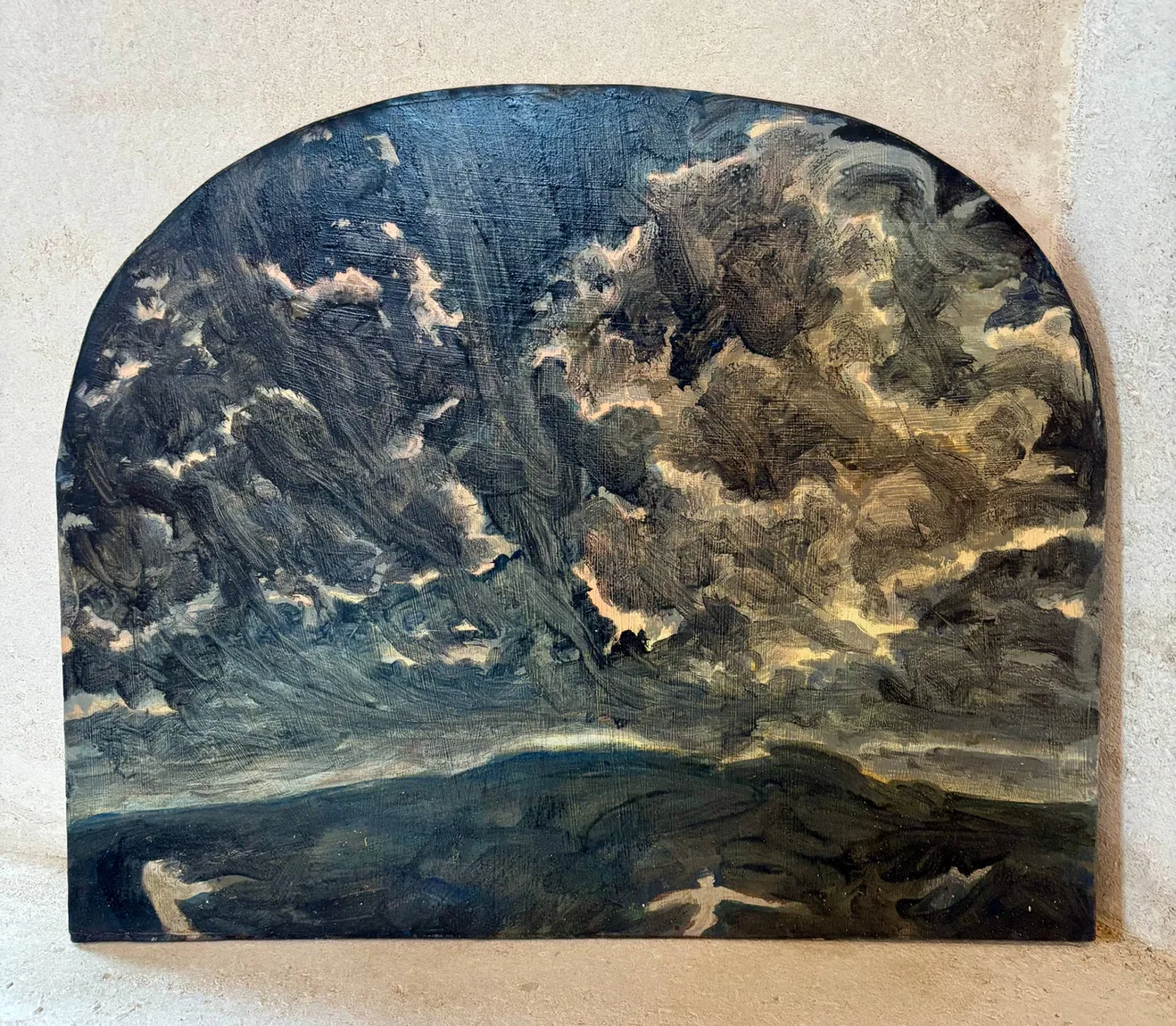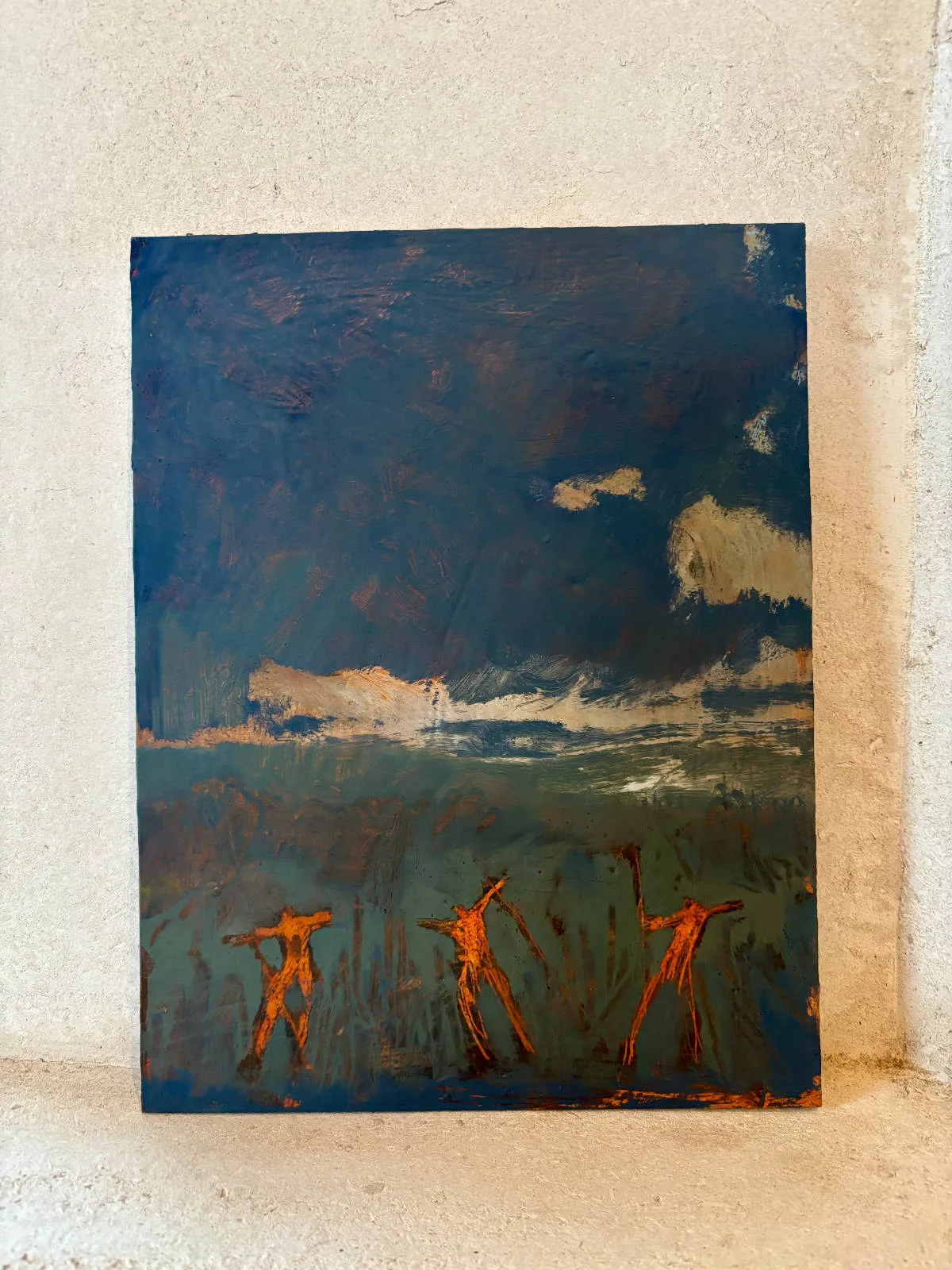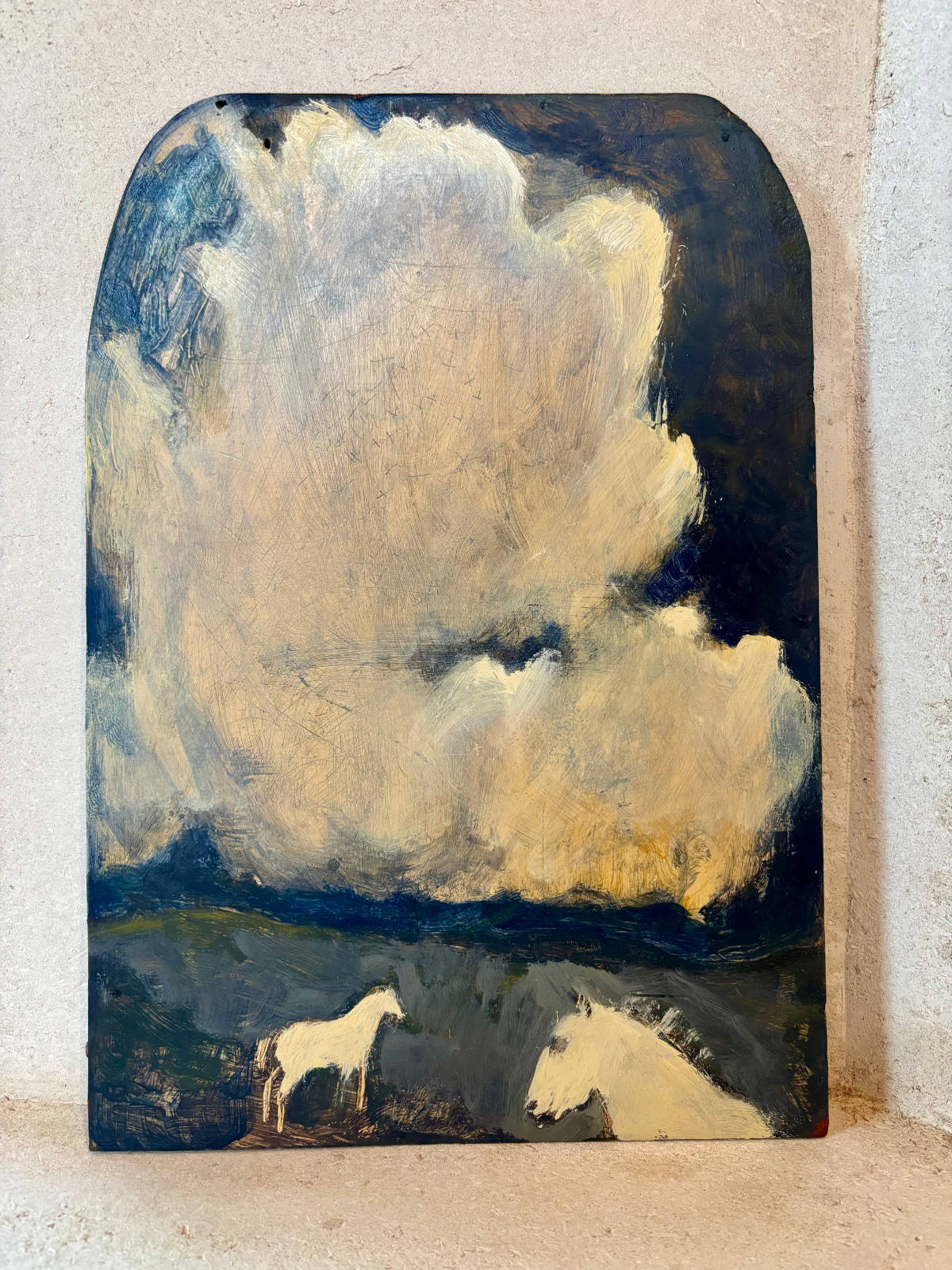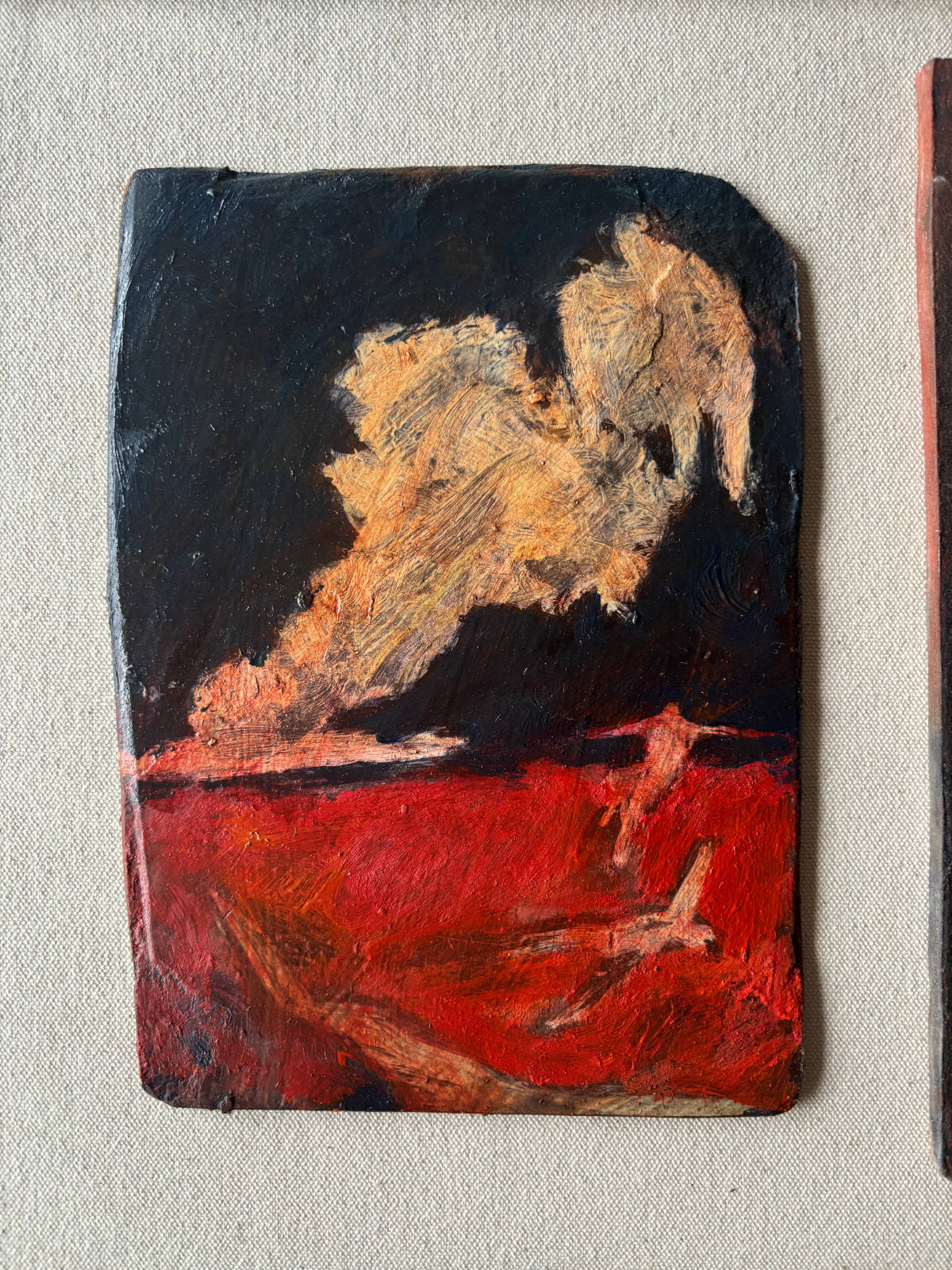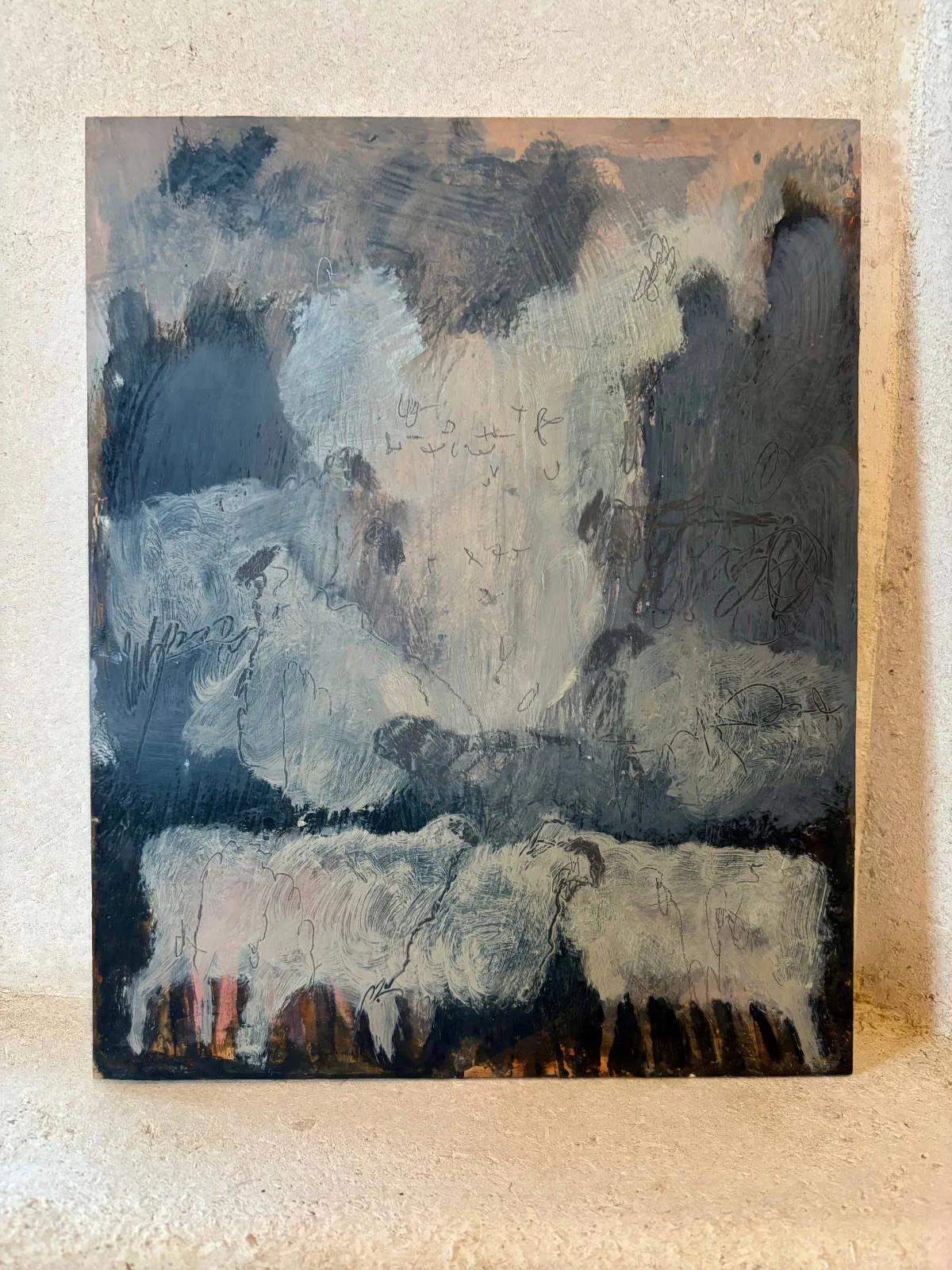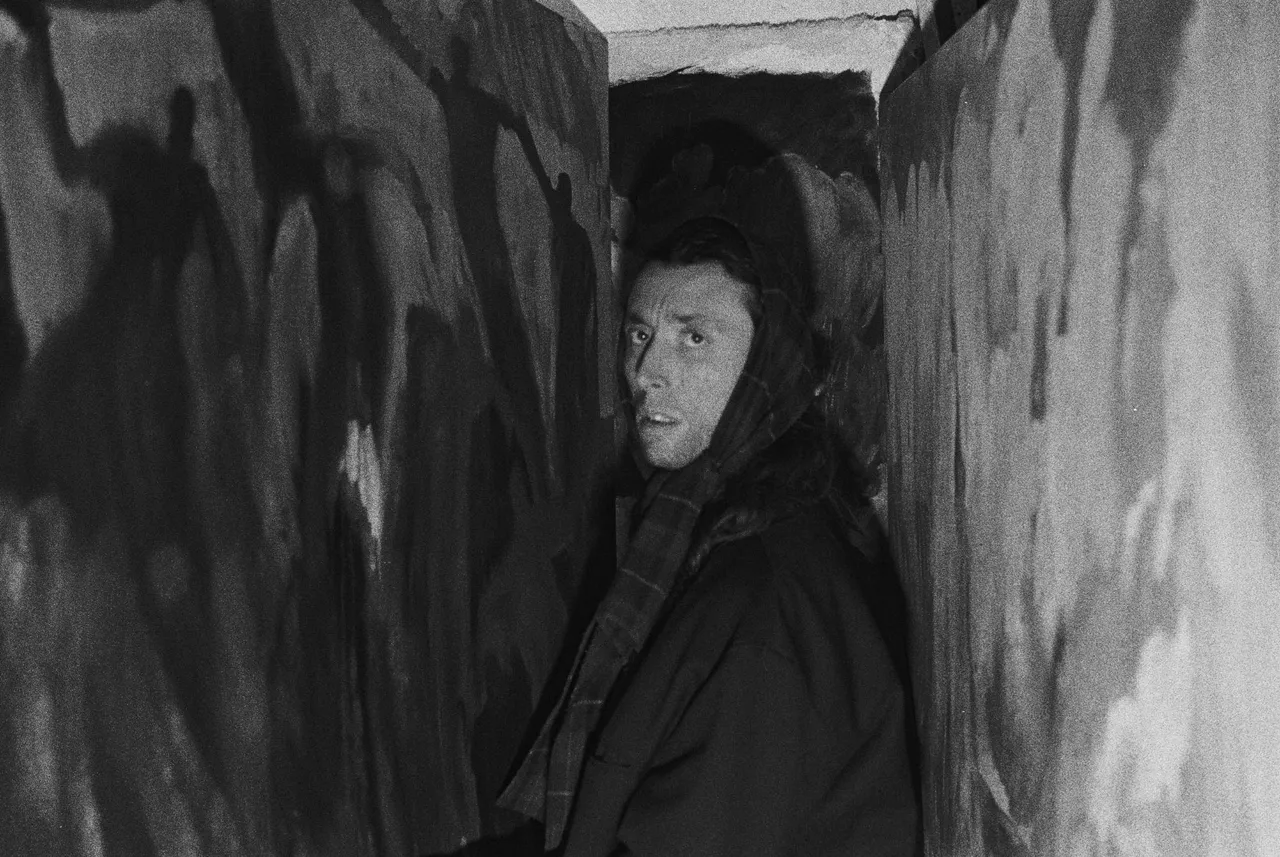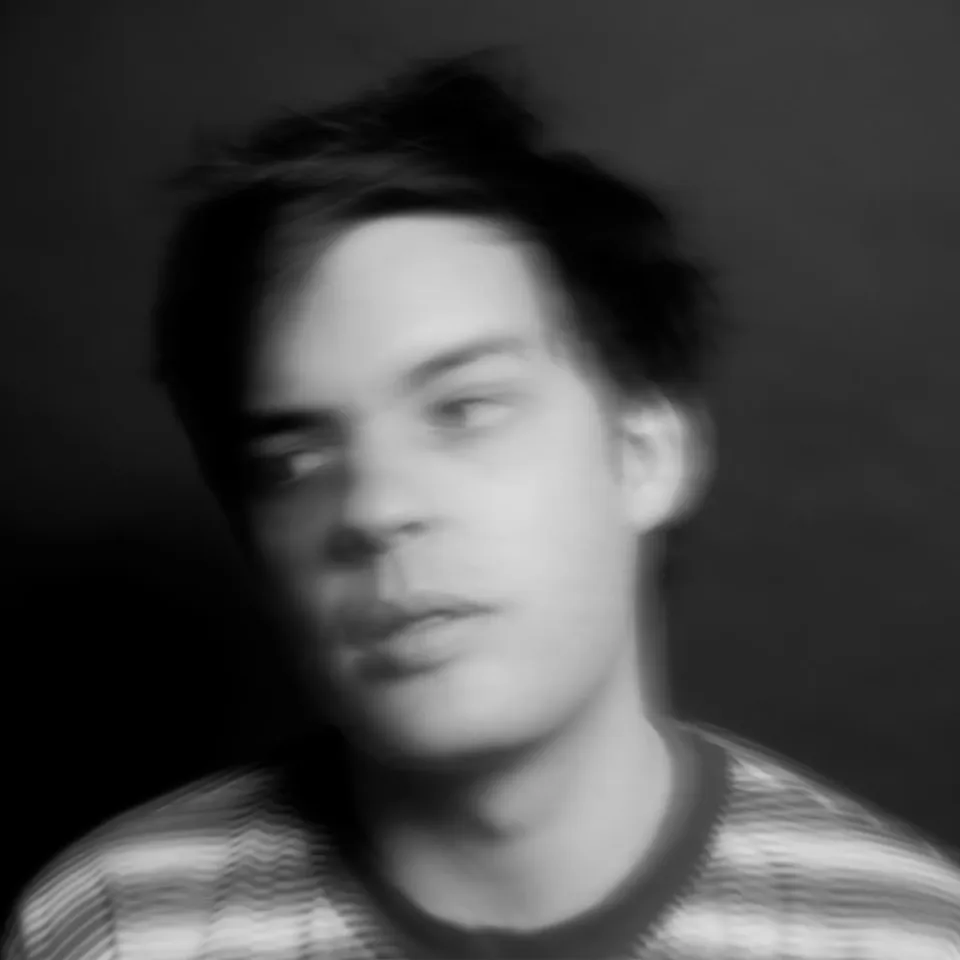
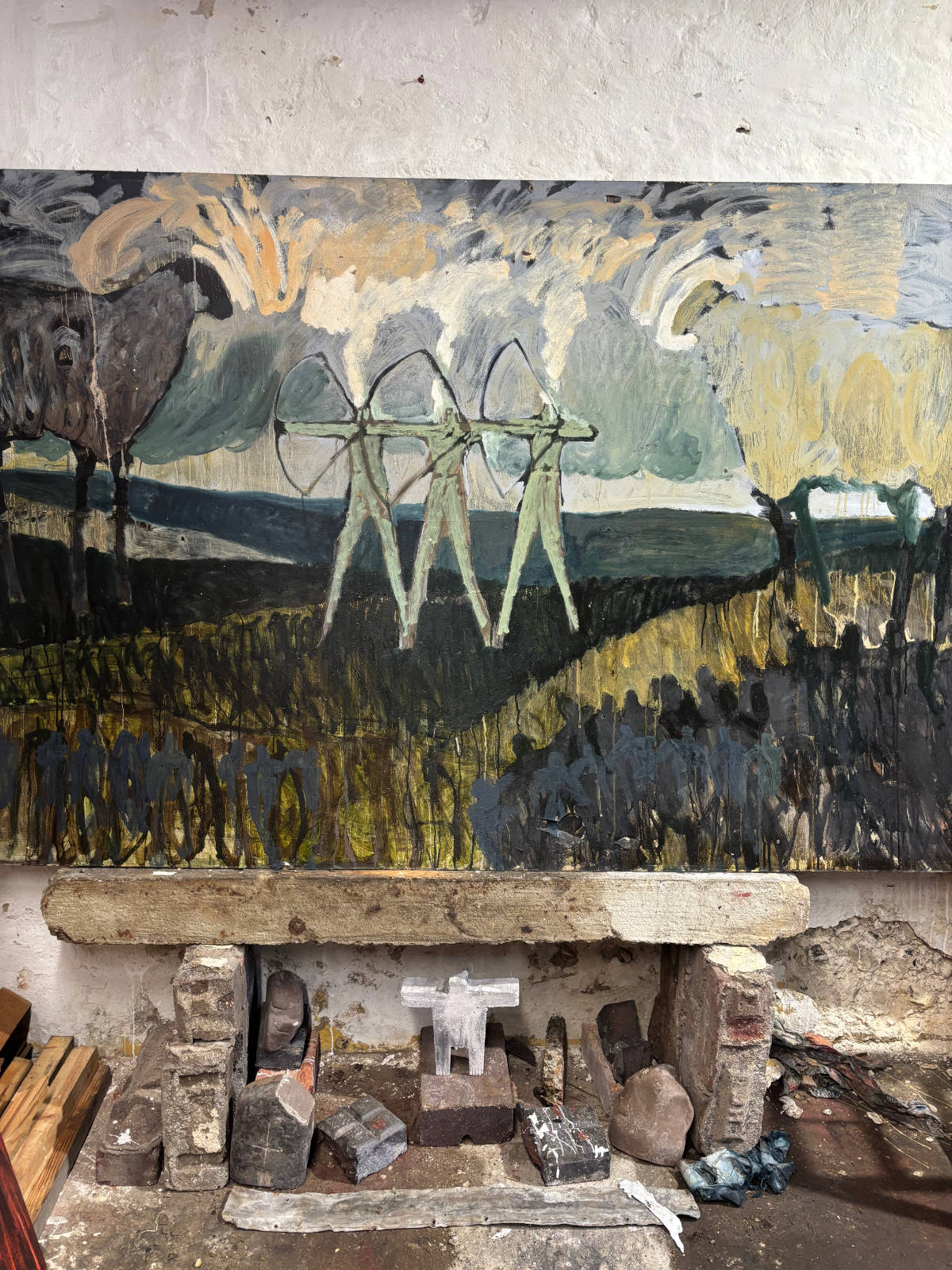
Between landscapes of supernatural and wonder, Hugo Winder-Lind’s paintings capture the space and magnitude of our connection to each other. Finding rhythm through green marsh fields, Winder-Lind navigates what keeps him inspired and what pushes him into transforming to “cloudy emotional action”. His paintings land between the concrete forms they take and the viewer’s sense of it, such that his work takes a fluid understanding that can never be fully answered. His works chart the magnificent. There is something silent about them, you can hear the wind calling through their vast imagination.
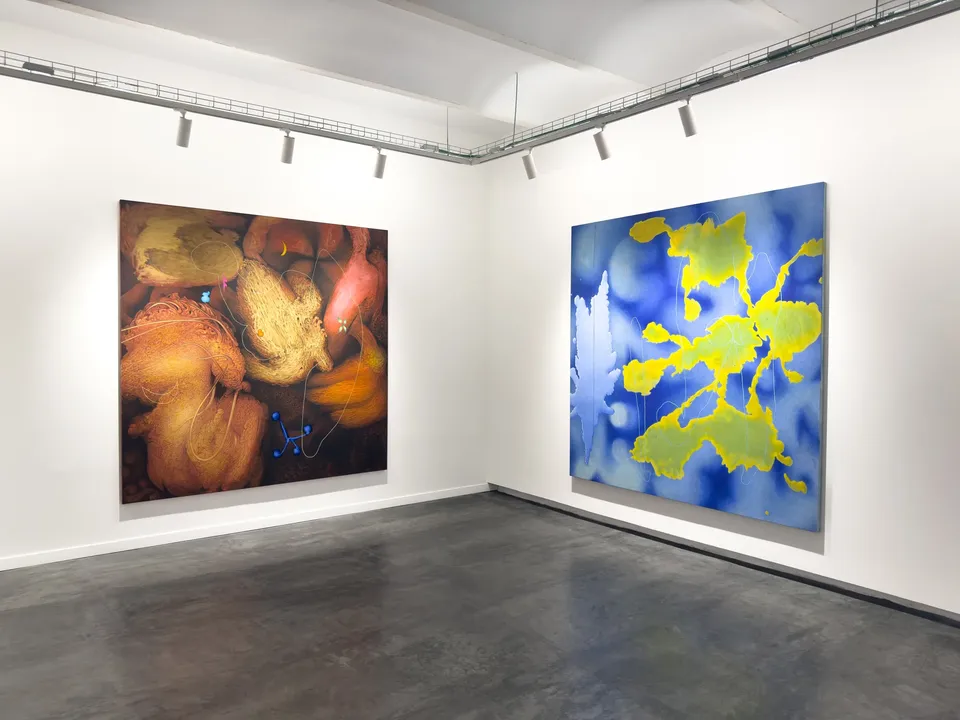
His works situate themselves perfectly within the exhibition, If it’s not magic, it’s not real, in which cool unearthly tones fittingly run through the dark weeks of 20th January to 27th February in Tin Man Art, Hampshire. Recalling science fiction author Arthur C. Clarke's 3rd Law: “Any sufficiently advanced technology is indistinguishable from magic”, the works connect through their shared language of nature, human life and mythology. If it’s not magic, it’s not real reveals a collection of artists marking worlds between fantasy and beyond. Winder-Lind takes his place to lead us between moors and mist, the outskirts of castle walls and the beyond blank fields where he found himself as a young child.
His work conceptualises towards figures of life and reality, reimagining the wild English countryside through his ideas of spirit and personhood. The paintings are ritualistic and calling, they hold the sway of bodies in movement. They capture something mid-air, weightless. Winder-Lind understands that the human forms on his canvas may be incarnations of himself, or the viewer, with the realisation that there is infinite possibility of what can be projected onto the scene in front of us.
Between a fog of a deep green in Circle Game, shapes blur as everything turns into movement. It reminds of Matisse’s Dance, which acted as a shift from realism to a focus on emotional expression. This feels aligned with Winder-Lind’s expression, that focuses on the exhilaration and freedom in relatedness. His coarse brush strokes are often textured, a drift, with washed colours and muted hues softening the circles of open, undefined spaces. His work is nostalgic, yet somehow futuristic, with a quiet solitude of the watchful eye. It holds a time between wilderness and domesticity — using life forms in repetition and shape, often exploring associations of key characters.
In accordance with the exhibition’s spiritual touch, Arthur C. Clarke's 1st law states that “older scientists are right about what's possible but wrong about what's impossible, and that the only way to find limits is to push past them.” Such is, Winder-Lind’s work unites the possibility of progress with something ancient. There is a primeval quality to them, deep into their worship of nature, allowing the reader to situate themselves in the scene they depict; finding a resting spot to contemplate the world behind, with and beyond us.
Hey Hugo! It’s good to have some time to chat. Starting off, Nature comes to the forefront in your paintings. Can you share a formative memory from being outdoors, one that still echoes in your work today?
I spent a lot of time outdoors as a kid so it’s hard to pick one moment specifically. I feel like I can express a lot through this kind of scrapbook of mountain ridges that are in my head. I’m not sure where they come from specifically. I feel a lot came from sitting in the back of my parents’ Volvo in the rain when I was younger. I have a really strong connection to moorland, vastness, I’m not sure where that comes from but it’s nostalgic.
How did you spend your childhood days? What obsessions, rituals, or imaginative worlds occupied you early on?
It’s hard to remember, I was quite secretive as a kid and in a way I don’t want to disrespect that younger self by spilling their secrets now. I think the kid I was when I was younger would disagree with anything I say now anyway. I daydreamed a lot and listened to audiobooks so I had a lot of places to escape to. I was lucky to have trips to the Lake District, Cornwall and Somerset and those British motorway landscapes when I was really young. I remember sitting at school and just thinking about summer holidays when I could go back out there and play outside. Maybe I was being a pirate or a knight or something like that.
Stalemate and Three Archers Weeping both feature archery. What drew you to this imagery, and what does it mean for you?
When I’m making paintings they depict vast abstract ideas in which I use human figures to invite people into a kind of fantasy space. These paintings that contain archers touch on so many parts of my thinking, I’ve got a really wide internal set of references for the people who want to jump into that conversation. But the viewer gets to score whether they see figures or shapes. I simplify an archer, a bow and arrow into these highly primed, tensioned shapes. The shape of archers are loaded for me, I feel the gesture in my body. They’re basically triangles, or a really grounded, base shape to build from. They kind of exist in this point before explosive destruction. Like they’re ready to burst. They’re also knights. Somehow knights seem to talk about justice and honour and righteousness but they’re obviously killers too. The viewer gets to place themselves in this narrative from a kind of fictional hero to an amorphous mass.
When you begin a painting, do you work from a clear intention or narrative, or do the figures and scenes reveal themselves through the process?
Intention. I’m aware of the limitations, so I will probably be thinking about that. It’s not so clear cut for me, I don’t really stick to my rules. Sometimes I feel like I can create images with pretty much anything and the resources produce their own boundaries. At the moment most of my restrictions come from outside of art making, like time, money, responsibilities and that impacts how I work, more than having really clear intentions for how the work should come about. That’s constantly changing as my access to resources changes. Sometimes I’m drifting off in my mind and then a really clear image just comes and I can make it without thinking, it’s not a clear 4K render as an image but as a kind of cloudy emotional action. When learning a new word or something, you suddenly learn about a new way to see the world and you can articulate that in any material, then it sort of gets its forms and figures itself out later.
Colour feels a big part of your practice. Is there a colour you’re particularly drawn to right now? How does it reflect where you find yourself personally or artistically?
I’ve been shopping at L. Cornelissen & Son on Great Russell street, getting raw pigment one pot at a time. I’ve been trying to find a safer alternative to cadmium red for ages, but as yet nothing is doing it. There’s an imitation Vermillion which I’ve got at the moment, but there’s a bit of self sacrifice tied up in using toxic materials which is so heavy. It’s kind of hard to feel colours are as powerful if they’re not actively trying to kill you… but I’m a sucker for black and white really. I’m very late to using colours. Titanium white and I make a dark out of Prussian blue, burnt umber and cadmium red. I use all those a lot. Prussian blue is crazy though. Like liquid midnight.
Your father worked as a stained-glass artist, often for churches. How did that early exposure to light, colour, and sacred spaces shape your understanding of art-making?
I remember visiting lots of churches, being shown stained glass and being intrigued by it, liquid, solid, translucent but also made by people, to tell stories. I was encouraged to keep making things when I was younger. To try stuff and make mistakes and learn lessons through doing. I still think about all those guidelines a lot. My dad worked all the time when I was younger, still does, he never really switches off. So I guess he was always paying attention to what inspired him, and he would talk about artistic and spiritual things in a connected way. We're similar in that, everything is connected and nothing is off limits for any discipline.
How do you see your work relating to the exhibition title If it’s not magic, it’s not real? Where does magic exist for you?
Magic can be real, life can be magical, or not. It’s up to the kid who is making the rules. I don’t need to say much about magic as everyone has their own limits for what is and isn’t magical. All things can be explained up to a point and beyond that, I suppose that is where art lives. I feel one of our last freedoms is to believe what we want to believe rather than what we know is true and there’s a certain liberty to that — in deciding to suspend disbelief in favour of things working outside of the rules. But there’s an argument in my work that art is what is real and grounding and concrete and divine. Or at least, when we strip away everything we’re left with a truth. In my work it’s my truth, but it can just as well be someone else’s truth, that they see, in my work. As I get older the more I begin to realise that bullshit walks. The reality is there even when the narrative goes away, and the narrative has to work really hard to convince you otherwise. Me, working in my studio tries to navigate that on some level. That’s not saying I don’t believe in magic, I do, but I think some people can spend a bunch of time on things which are just someone else’s vision and not their own and the liberty and revelation in making choices themselves is lost.
A central tension in your work lies between wilderness and domesticity. Can you walk us through how this manifests in your works?
When I’m making images, they mix up spit and blood and precious memories all together and that contains tension, but it also contains a release. The actual painting process contains these finite structures which are built and destroyed in the process of making. It’s important for me to leave some things unanswered in the final work but also to create a sense of balance for myself and for the painting. Maybe I’m just quite tense somewhere in my mind and painting is a way to acknowledge that without submitting to it.
What is a physical space you’ve visited recently that felt special to you?
I think of Britain and all the people that have been here, the sheer biomass of humans on the British isles, throughout millennia the ancient gods, Celts, Romans, Anglo Saxons, Buddhists, Muslims, Christians, Jedi. And the fact that we’re on an island with clear natural land-water borders means that any square metre has been special for at least one person. I think you would be hard pushed to find a place here that doesn’t mean something to someone. And some places with layers and layers of thought and belief and intention. My grandfather has lived in his house my whole life and that place is like a shrine to my family and their strange traditions. I’m sure all the ancestors have had places like this which feel eternal and are somehow right under our feet.
You live in Brighton, which is often associated with this idea of openness and creativity. How has living there shaped your ideas about character, your self within the community?
I can’t answer that one at the moment. It’s got to a point currently where I find it really hard to differentiate between myself and my environment. I think the work shows that, crowds and hills and sheep and horses. My symbolism kind of scoops everything up all at once. I know there’s huge amounts of creative people in Brighton but it’s always seemed like there’s less infrastructure than London for visual arts, we’re so close to London that if people want to go and see world class cultural happenings they can just go there, so it’s quite competitive but also really communal and everyone is working together. As I grow, I see more opportunities, community, connection coming up here, but again it’s kind of what I was saying earlier, it’s the kid who chooses what magic is or what culture they want or what opportunities look like. So I guess you get what you ask for. I really think Brighton can do that though, the land folds around the plough, the plough around the land.
As you noted, your work includes these human figures yet speak to something transcendent, other-worldly. These fluid moving, almost ghostly figures, connect beyond and through the backdrop of the scene. What first drew you towards these blurred, dreamlike lands?
My brain is pulled on a pendulum, I’m either craving people and crowded train stations and performances or I want escapism and stories and deep abstract ideas. Maybe everyone is like that. Painting is both at once. Big ideas and feelings and then physical material and finite still boundaries. The painting is always true to itself. It is what it is and there’s an amazing strength to that. Either you paint what you see and feel or you let the paint and the materials decide and tell you something new.
You’ve touched into practice with other mediums, like your book Ancestor Houses, which combines drawing and poetry. Moving forward, how do you hope to see your work evolving?
The work fills the space it’s conjured in and I struggle a lot with trying to control that. I think about the demiurge in Gnosticism and how sometimes things can look and feel and act like they are what you should be doing but actually they’re not and you will just find yourself at a dead end. For now I’m still having fun figuring this thing out.
Yes (laughs). Again, congratulations on the show! You’ve taken part in both solo and group exhibitions. Compared to solo work, what does a group exhibition allow for?
Usually a solo exhibition has one clear central point, all the work of an artist becomes self reflection and usually with a living artist it becomes a marker on a larger journey. With a group show you can talk about an idea in a more rounded way, spread ideas across people and artworks, creating something bigger than the sum of its parts. I like curating shows with different artists. I feel like the best works I made are from me but also a response to the world around me and the people I’m surrounded by.