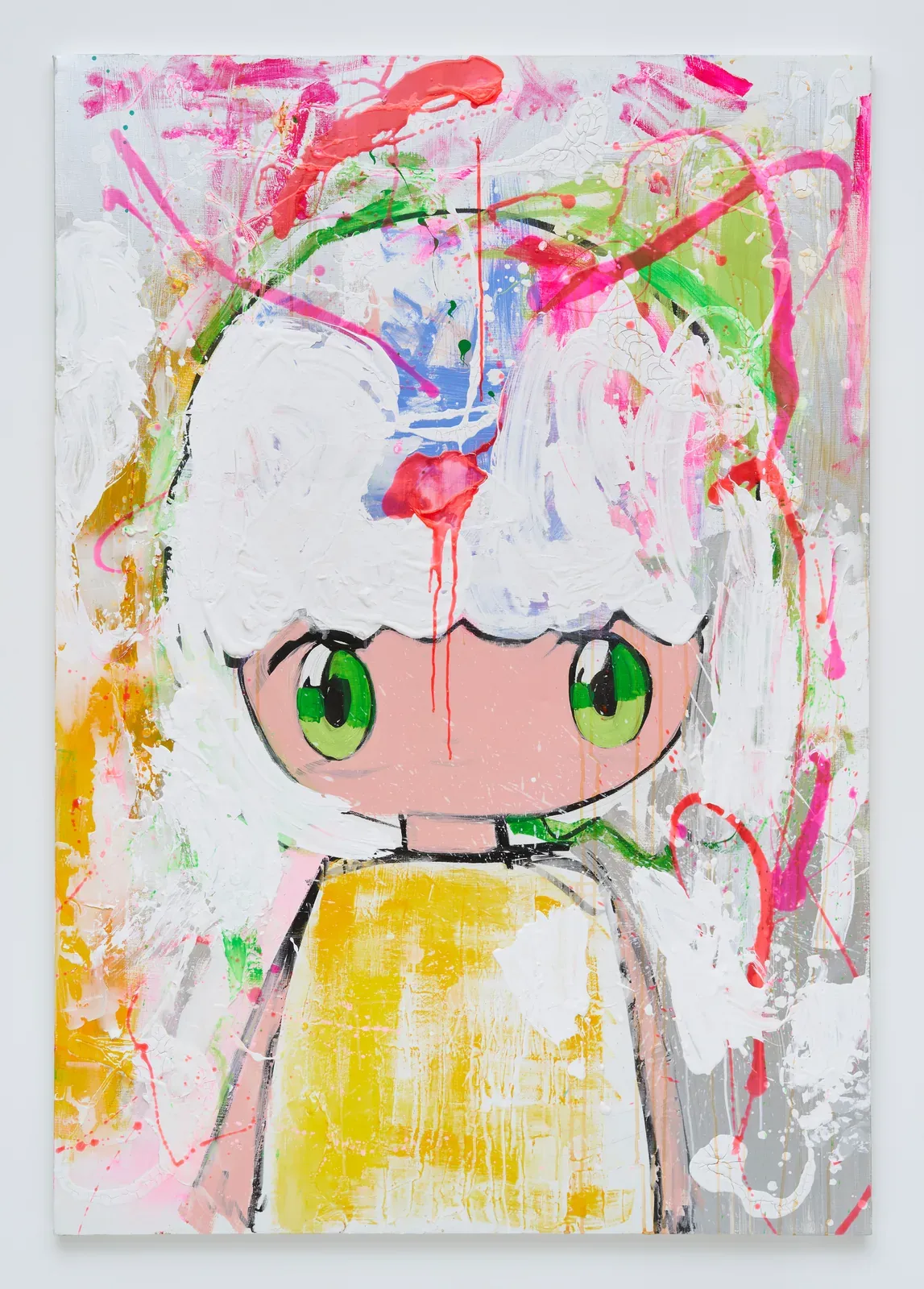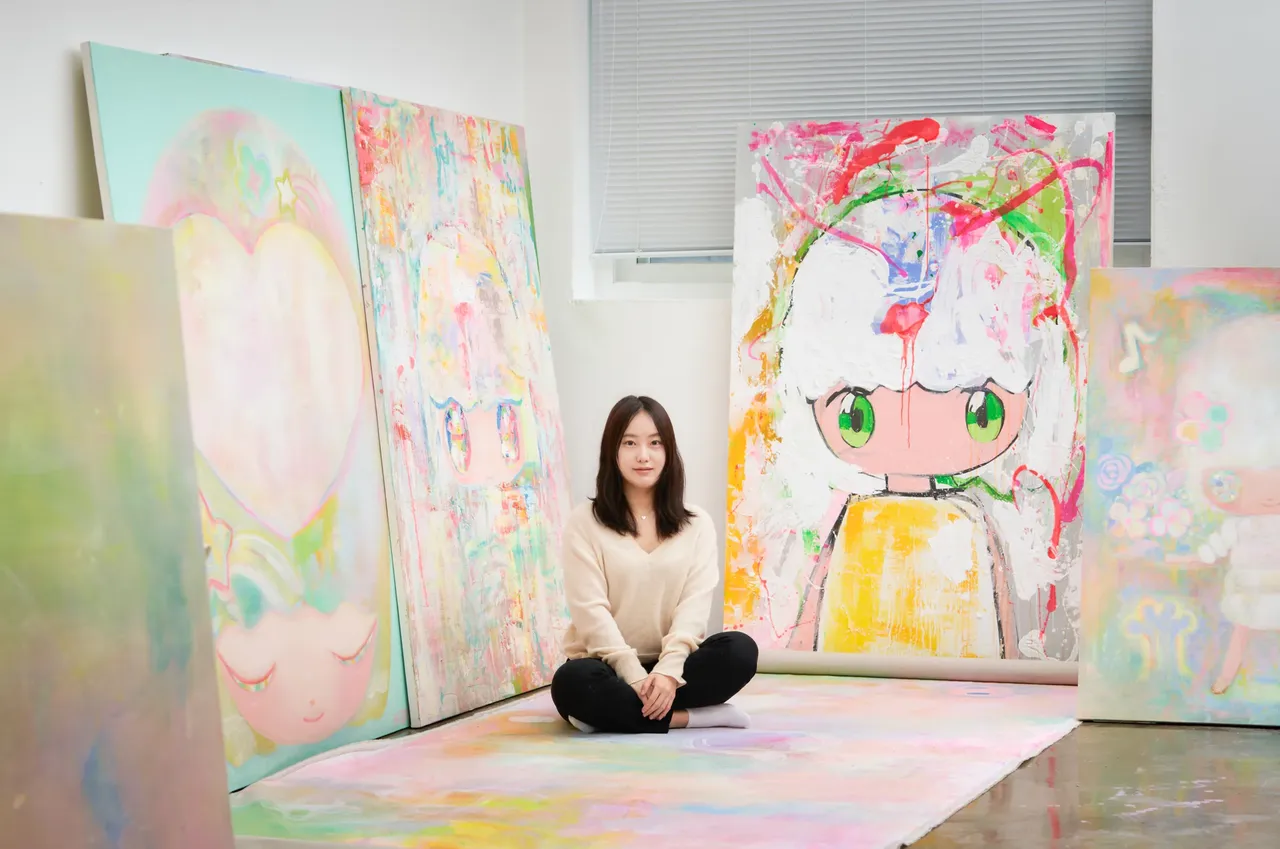
As humans, we have spent thousands of years trying to define what art truly is, yet it continues to resist any single, fixed meaning. Each artist, consciously or not, contributes their own interpretation. In South Korean artist Herry Kim’s case, her work seems to emerge as a quiet synthesis of these thoughts, as in her most recent work, with a colourful canvas that shares space with a cute strong being named Smile.
There is a certain humility in the way she speaks about her practice, one that recalls Socrates’ idea of “knowing that one knows nothing.” Despite her deep intellectual curiosity, there is no sense of pretension; only an openness to uncertainty. Her paintings reflect this balance: layered yet accessible, including gentle anchors in a broader, ever-expanding inquiry.
At the same time, Kim is clear about being in a constant state of becoming. Once a follower of the early 2000s emo culture who later realised its lack of hope and the need for it in our world, her work is not presented as a final statement but as part of an ongoing process of learning, experimenting, and evolving. What she creates today is only a fragment of a much longer journey — one that remains open, curious, and deeply human.
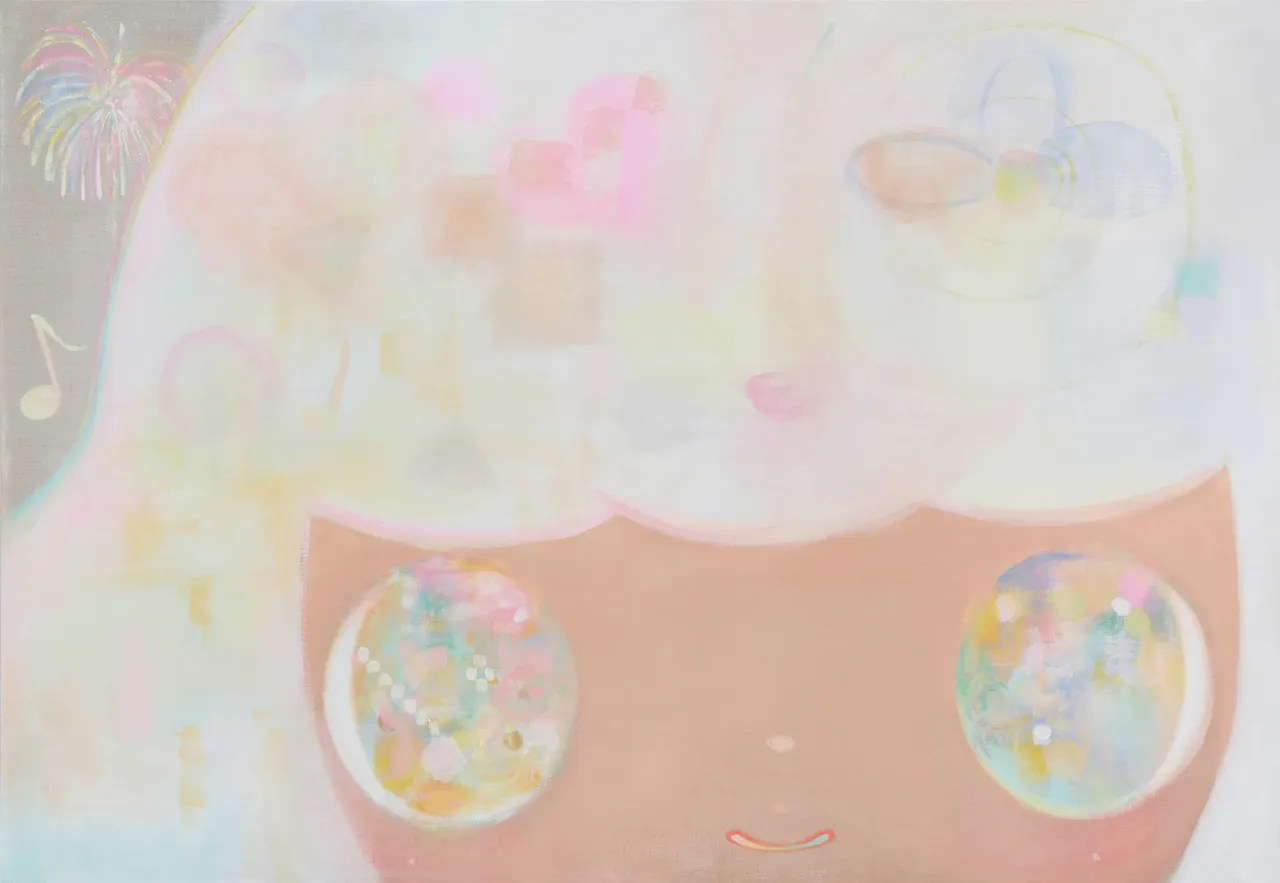
Picasso, like many other artists, was widely known for being massively talented from a young age, giving him enough time to explore multiple styles and techniques, even going through a plethora of emotions to navigate in his personal life. One could even say his art and personality shifted drastically every decade, like he became a different person each time. Being a young artist with a promising long career ahead of you, and for those who don’t know you yet, how would you describe yourself and your art as of now, 2026? Do you think that description and self-perception have changed or could change in a few decades?
I would describe myself as someone trying to study what I'm genuinely interested in and giving back to the world through art in return. That's what I can offer. I remember telling a gallery director in London that I'm just trying things out, and that's still true. There are endless possibilities, and I hope I manage to expand my visual grammar rather than confine myself to any one thing. When I started painting again, I made self-portraits in a flower-filled garden, as if I were living in a utopia. When I finished that painting, I knew. I wanted to keep doing exactly that: creating worlds directly, with nothing but a flat surface and paint. As for whether this will change, who knows? I can tell you I have a lot that I want to try.
One of the most heartwarming aspects of your paintings is the emotional pattern they carry, rather than a technical one. Most of your works evoke an optimistic, cosy, and calming feeling — almost like a warm hug. These paintings seem to remind viewers of their self-worth, that they are not alone, and that life can be good, with the hope of a new beginning always in sight. Have your creations always conveyed this vibe? Did it take a long time for you to find this particular aesthetic and emotional tone in your work?
I want my work to remind people that they aren't alone. Interestingly, to create that connection, I spend most of my time in solitude. But I think it's in that quiet space where I find the warmth I want to share with the world. I used to make very different work. In high school I was kind of emo, so I painted a lot of darker things, about competition, the cruelty of war. But at some point I realised that approach wasn't adding anything hopeful to the world or to me. So I quit painting for a while and tried other things, from video to installation to VR. Eventually I came back to painting. Something had shifted. I wanted to share a different kind of energy, and painting felt like the right way to do that.
A recurring figure in your art is a young girl who radiates grace and an ethereal aura, often referred to as Smile. Have you ever walked into your studio late and tired, only to see her leap out of a painting and ask you, “How was your day?” or perhaps offer you advice? Do you ever feel like she communicates with you in some way?
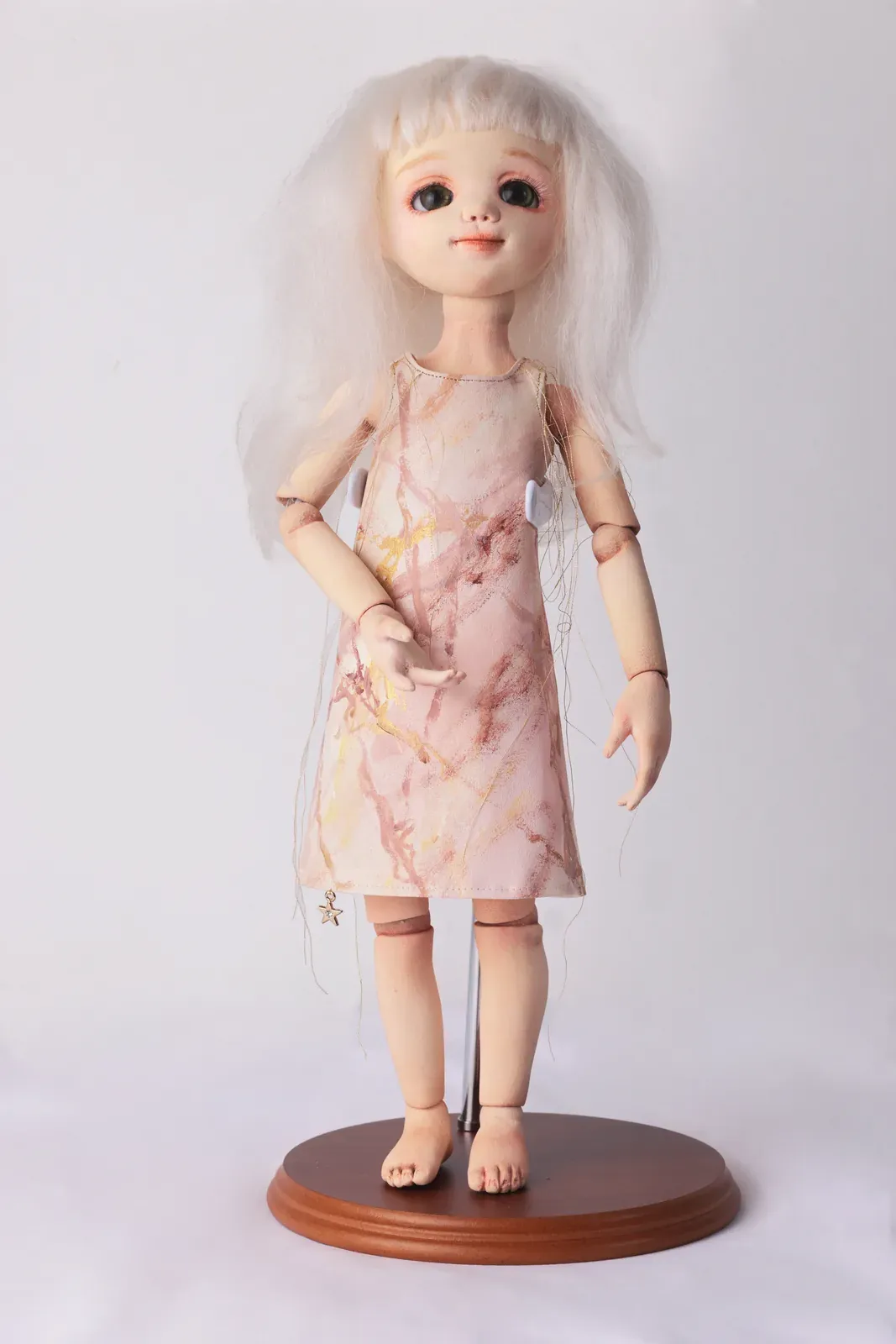
I initially created Smile because I feared getting lost in the vastness of abstraction; I needed a focal point, a soul to anchor the canvas. Dolls have always been my most faithful companions, and I’ve kept a large collection since childhood, and though some might find that obsession a bit uncanny, to me, they are a source of profound comfort. Inspired by the aesthetics of dolls and manga, I brought Smile to life. To be honest, I was a bit apprehensive at first, as I wasn't sure if she was a friendly presence or perhaps a “villain” lurking in the paint.
I’m naturally scared of many things; however, during those long, late nights in the studio when the silence felt heavy, she was always kind to me. She didn’t leap out to offer advice in words, but her presence offered a quiet, steady warmth that told me I wasn't alone. We’ve developed a good understanding now; she is the “friendly guide,” not just for the viewers, but for me as well.
Ceramics became another way to explore Smile's physical presence. Unlike stone powder clay, which cannot be fired, working with raw earth, glazing, and firing opened something new for me. It made me curious about earlier Korean clay works, and I discovered an interesting theory on the folk art of the Joseon dynasty by the Japanese scholar Yanagi Muneyoshi. There is something profound in ceramics: that the nature in humans remains in clay through honest interaction. My ceramics teacher taught me that there is light in the mind of clay. I found peace in that.
I’m naturally scared of many things; however, during those long, late nights in the studio when the silence felt heavy, she was always kind to me. She didn’t leap out to offer advice in words, but her presence offered a quiet, steady warmth that told me I wasn't alone. We’ve developed a good understanding now; she is the “friendly guide,” not just for the viewers, but for me as well.
Ceramics became another way to explore Smile's physical presence. Unlike stone powder clay, which cannot be fired, working with raw earth, glazing, and firing opened something new for me. It made me curious about earlier Korean clay works, and I discovered an interesting theory on the folk art of the Joseon dynasty by the Japanese scholar Yanagi Muneyoshi. There is something profound in ceramics: that the nature in humans remains in clay through honest interaction. My ceramics teacher taught me that there is light in the mind of clay. I found peace in that.
As an artist whose work is so heavily defined by colour, do you ever experiment with or enjoy the stillness of black, white, darkness, or the absence of colour in general?
I am constantly curious about new ways of creating, and lately, I’ve been deeply drawn to the stillness of traditional ink and the unique properties of Korean pigments. There is a distinct “engineering” to how these materials interact with the surface compared to Western mediums, a difference I find fascinating. Conceptually, Seon (Zen) Buddhism has been a profound influence. It encourages me to move beyond the “noise” of thinking and simply be. I’ve realised that overthinking often leads to dualism, the struggle between good and bad, light and dark. In the Korean artistic tradition, there is a beautiful focus on the synthesis of dualism, finding harmony rather than conflict between extremes. I want my work to reflect this balance.
When it comes to the absence of colour, I look toward Obangsaek, the traditional Korean spectrum based on the five elements. In this system, black and white are not just voids but essential components of a cosmic balance. I’m fascinated by the physics of colour, how there are infinite versions of black, from the deep, traditional ink to the modern void of Vantablack. One day, I hope to incorporate Vantablack into my practice to explore that ultimate “stillness” and see how it dialogues with the warmth of my Tender World.
When it comes to the absence of colour, I look toward Obangsaek, the traditional Korean spectrum based on the five elements. In this system, black and white are not just voids but essential components of a cosmic balance. I’m fascinated by the physics of colour, how there are infinite versions of black, from the deep, traditional ink to the modern void of Vantablack. One day, I hope to incorporate Vantablack into my practice to explore that ultimate “stillness” and see how it dialogues with the warmth of my Tender World.
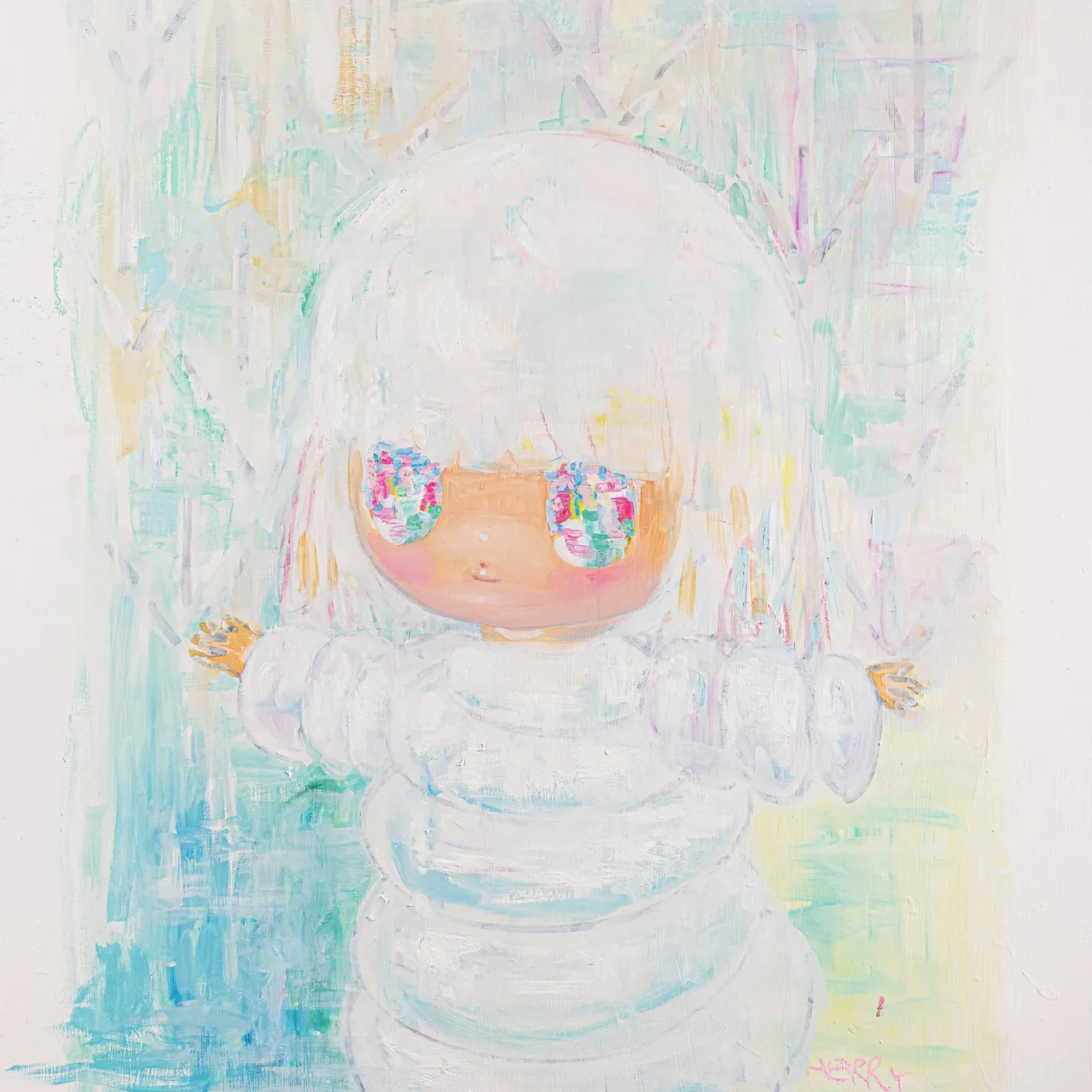
You've mentioned that concepts like anticipation of the future and clairvoyance play an important role in your art. Have you ever participated in a Tarot reading? Have you explored other forms of divination or fortune-telling, such as reading coffee grounds?
I’ve always found divination to be a fascinating lens through which we view the future. Like many Koreans, I enjoy Saju (fortune-telling based on birth alignment) and Tarot readings with friends, often finding their insights surprisingly accurate! During my time at CalArts, I began a study of the I-Ching (Book of Changes) and its profound correlation to binary systems, the very foundation of modern computing.
It is well known that Gottfried Wilhelm Leibniz was inspired by the I-Ching's hexagrams when he refined the modern binary system, and I find this historical bridge between ancient spiritual logic and digital technology deeply moving. This historical connection suggests a fascinating resonance between ancient spiritual logic and the birth of digital technology. It feels as though the binary foundations of our modern world were already whispered in the hexagrams of the past.
It is well known that Gottfried Wilhelm Leibniz was inspired by the I-Ching's hexagrams when he refined the modern binary system, and I find this historical bridge between ancient spiritual logic and digital technology deeply moving. This historical connection suggests a fascinating resonance between ancient spiritual logic and the birth of digital technology. It feels as though the binary foundations of our modern world were already whispered in the hexagrams of the past.
Ironically, as creators, our perspectives and thoughts are often confined to our own vision, whether it's deep or fleeting. We can only control what we wish to express at the moment of creation. Do you remember any particularly insightful or surprising comments someone has made about your paintings? Has any positive feedback about your art ever caught you off guard in a good way?
To be honest, I am rarely fully content with my work. I find myself in a constant state of experimentation, a restless evolution that I sometimes worry might challenge the expectations of traditional galleries. However, this perpetual searching is what keeps my practice alive. One of the greatest rewards of being a painter is the unexpected dialogue that occurs once a piece leaves the studio. I’m often caught off guard by how viewers find their own stories within my Tender World.
Because I weave personal nostalgia and spiritual themes into my art, people sometimes project their own deep, hidden memories onto my characters. While I can only control my vision during the moment of creation, seeing a stranger find inspiration to create their own art as well is incredibly moving. It reminds me that while the process of creating is often solitary, the life of the painting is a shared experience. These insights don't just surprise me; they often provide the very “grounding” I need to continue my next experiment.
Because I weave personal nostalgia and spiritual themes into my art, people sometimes project their own deep, hidden memories onto my characters. While I can only control my vision during the moment of creation, seeing a stranger find inspiration to create their own art as well is incredibly moving. It reminds me that while the process of creating is often solitary, the life of the painting is a shared experience. These insights don't just surprise me; they often provide the very “grounding” I need to continue my next experiment.
You’ve said that your art “pays tribute to dreamers and explorers, exploring the human experience from a deeply personal perspective.” Who are the dreamers and explorers who have influenced you the most?
Everyone is a dreamer and explorer, and that's genuinely what I meant. I want my work to speak to everybody, not a specific kind of person. There's something about visual art that I find remarkable: it's wordless, and yet it can carry something universal. Lately I’ve been deeply moved by my teachers. Calligraphy, ceramics, dolls, even dance. Each of them devoted themselves to something with real care and curiosity, and to me that is exactly what a dreamer and explorer looks like. I feel very grateful for them.
You once proposed that we should program AI to perceive humans as “cute” so they would either protect us or not feel threatened by us, which I personally think is a brilliant idea! This concept seems to connect deeply with your art, where you wonder about the nature of being human. Do you think that, like dogs or cats, the future of humanity may rely on us trying to be as “cute” as possible to survive?
This question makes me wonder if it would be a tragedy. But I want to start by saying: cute is strong. It's not weak or fragile. We may think cats and dogs have a lower IQ than humans, but they have their own way of existence, and that way has kept them close to us, cared for, and surviving. By that logic, compared to AI, I would have something like ant-level intelligence, and I think that's okay. Because I believe the bigger threat to human survival isn’t AI turning on us. It’s us turning on each other. The wars, the self-destruction. That saddens me deeply, and I think about it a lot.
I once worked on a collaborative installation with other artists and engineers, and the central idea was that whatever sin AI commits is only a reflection of our own because we trained it on human data. So the real question is what kind of humans we want to be. That's why I think what we need isn’t more intelligence but more wisdom. A spiritual clarity about our own existence and our relationship to others. If I imagine a very clever robot observing us, what would make humans seem cute and worth protecting isn't our intelligence. It’s our spirit. Our sense of time. The fact that we are alive in a way robots simply aren’t. We don’t have to be perfect. We just have to be genuinely, fully alive.
I once worked on a collaborative installation with other artists and engineers, and the central idea was that whatever sin AI commits is only a reflection of our own because we trained it on human data. So the real question is what kind of humans we want to be. That's why I think what we need isn’t more intelligence but more wisdom. A spiritual clarity about our own existence and our relationship to others. If I imagine a very clever robot observing us, what would make humans seem cute and worth protecting isn't our intelligence. It’s our spirit. Our sense of time. The fact that we are alive in a way robots simply aren’t. We don’t have to be perfect. We just have to be genuinely, fully alive.
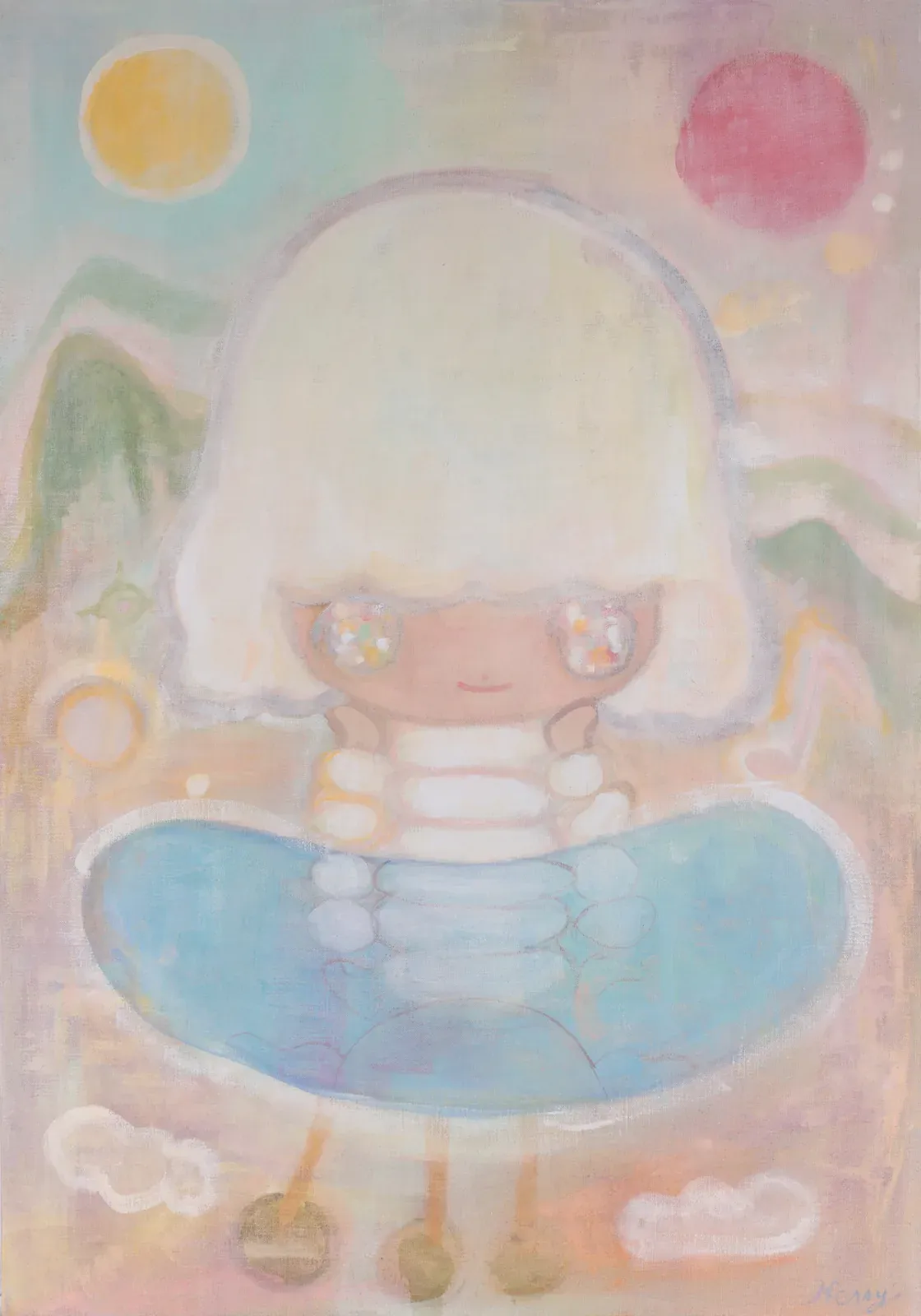
If Clovers (2024) and Dreaming Head (2025) were ever to have a conversation, what do you think they would talk about? Do you think they would get along well?
When I painted them, I wasn’t thinking about any of this, but since becoming more interested in Buddhism and the Avatamsaka Sutra, I’ve started to see them differently. Clovers feel like the flowers of Indra’s net, everything reflecting everything else. And Dreaming Head feels like the idea that life itself is a dream, a passing moment. Maybe I was painting these things before I had the words for them. So I think they would get along. I’m not sure if Dreaming Head needs to wake up to have a conversation.
You’ve mentioned being greatly influenced by Korean traditions. Some people believe that when they switch from their native language to English or other languages, their voice and even personality can change slightly. Do you feel this effect in your art? For example, when you see one of your pieces in your studio or at your home in Korea, do you perceive it differently when it's later displayed in a gallery in San Francisco? Does it feel like a stranger to you, someone you don’t quite know?
Yes, I do feel the switch from languages has different vibes because each language entails its own way of thinking and its history. On how the works feel in different environments, California and Korea have different sunlight and weather, so the same work is perceived differently. My colour palette has changed towards more pastel and liminal colours. I think as I gain more life experience, this will also change. However, regardless of where it’s shown, the works don’t feel foreign to me. What changes is the light, the atmosphere, the way viewers bring their own context to it. The work lives differently in each place, but its essence remains the same to me.
You’ve mentioned enjoying reading Albert Camus’ The Myth of Sisyphus, describing it as “quite dark.” It’s interesting to compare your art and process to this myth. While Camus’s story may seem like a struggle at first, it ultimately transforms into a message of hope and resilience. In a similar way, while your works may appear as colourful, friendly paintings at first glance, the meaning they convey often comes from a much deeper and more complex part of the human psyche. Both can show us how easily our lives can shift from simple joy to profound reflection. Do you find yourself often navigating this duality in your work?
I thought the situation of Sisyphus was quite dark because he was punished, condemned to boring and repetitive work, but the book had an incredible effect on me. I love the brilliance of Camus’ thought process, its logical yet profoundly patient beauty. I hope that my work gives something back, because I am dependent on others every single day. I don’t have a theory like Kandinsky, but I want to reach the musical state of his paintings — something about spirit and playfulness. I hope to do the mark-making of this era, the way ancient people made artefacts.
On duality, it brings me back to what I mentioned earlier about I-Ching and the digital. Buddhism teaches us to dissolve duality, and yet I find myself always thinking in terms of good and bad, black and white. Maybe that’s exactly the struggle worth painting through. While I often find myself thinking in dualities, I am deeply moved by how Seon (Zen) Buddhism seeks to dissolve these opposites, teaching us that our true form is “warm light.” I’ve noticed that when we try too hard to force a “good” outcome, it can ironically trigger “bad” decisions. Therefore, I believe the most sincere strategy is to dissolve the boundaries between the two.
On duality, it brings me back to what I mentioned earlier about I-Ching and the digital. Buddhism teaches us to dissolve duality, and yet I find myself always thinking in terms of good and bad, black and white. Maybe that’s exactly the struggle worth painting through. While I often find myself thinking in dualities, I am deeply moved by how Seon (Zen) Buddhism seeks to dissolve these opposites, teaching us that our true form is “warm light.” I’ve noticed that when we try too hard to force a “good” outcome, it can ironically trigger “bad” decisions. Therefore, I believe the most sincere strategy is to dissolve the boundaries between the two.
Could you recommend any Korean artists, either contemporary or classical, who have influenced you or who you simply enjoy?
I'm influenced by different ways of thinking and the visual syntax of many artists. These are some Korean artists I’d love to highlight. They’re well known in Korea, but I think they deserve wider attention with their artistic inquiry.
Kim Chonghui is a calligraphy practitioner of Joseon. He was exiled to Jeju Island, which can only be reached by ship, and it was dangerous. So he spent time isolated. During these difficult times he developed a very unique approach to calligraphy. His life story of creating something so mind-blowing during life challenges is so inspiring. Chun Kyung Ja is known for her paintings. I think there is a similarity in her approach and mine in painting, using stylised figures and flowers (decorative elements) for figurative composition. Her life story is also very inspiring; she kept nurturing her art despite difficult times.
Kim Soo-ja is a performance and installation artist using light and traditional craft, and her sense that we are all travellers of life resonates with me. I hope I gain strength and wisdom to navigate my own given path. Bang Hai-ja’s warm, distinct textures and colourways are strategies to express light, which is the essence of life. There is peace in her works that I want to reach. Oh Yoon made prints of realism that slip into something cartoonish and decentered, reminding me that art is tied to the era we live in and the importance of having an open eye.
Park Saeng-kwang learned art in Japan, and in his later years, he created powerful works of Korean spiritualism. As I am interested in shamanism, his creations and his attitude to painting inspire me very much. And lastly, Ham Sup, who worked with traditional paper to create wonderfully playful forms.
Kim Chonghui is a calligraphy practitioner of Joseon. He was exiled to Jeju Island, which can only be reached by ship, and it was dangerous. So he spent time isolated. During these difficult times he developed a very unique approach to calligraphy. His life story of creating something so mind-blowing during life challenges is so inspiring. Chun Kyung Ja is known for her paintings. I think there is a similarity in her approach and mine in painting, using stylised figures and flowers (decorative elements) for figurative composition. Her life story is also very inspiring; she kept nurturing her art despite difficult times.
Kim Soo-ja is a performance and installation artist using light and traditional craft, and her sense that we are all travellers of life resonates with me. I hope I gain strength and wisdom to navigate my own given path. Bang Hai-ja’s warm, distinct textures and colourways are strategies to express light, which is the essence of life. There is peace in her works that I want to reach. Oh Yoon made prints of realism that slip into something cartoonish and decentered, reminding me that art is tied to the era we live in and the importance of having an open eye.
Park Saeng-kwang learned art in Japan, and in his later years, he created powerful works of Korean spiritualism. As I am interested in shamanism, his creations and his attitude to painting inspire me very much. And lastly, Ham Sup, who worked with traditional paper to create wonderfully playful forms.