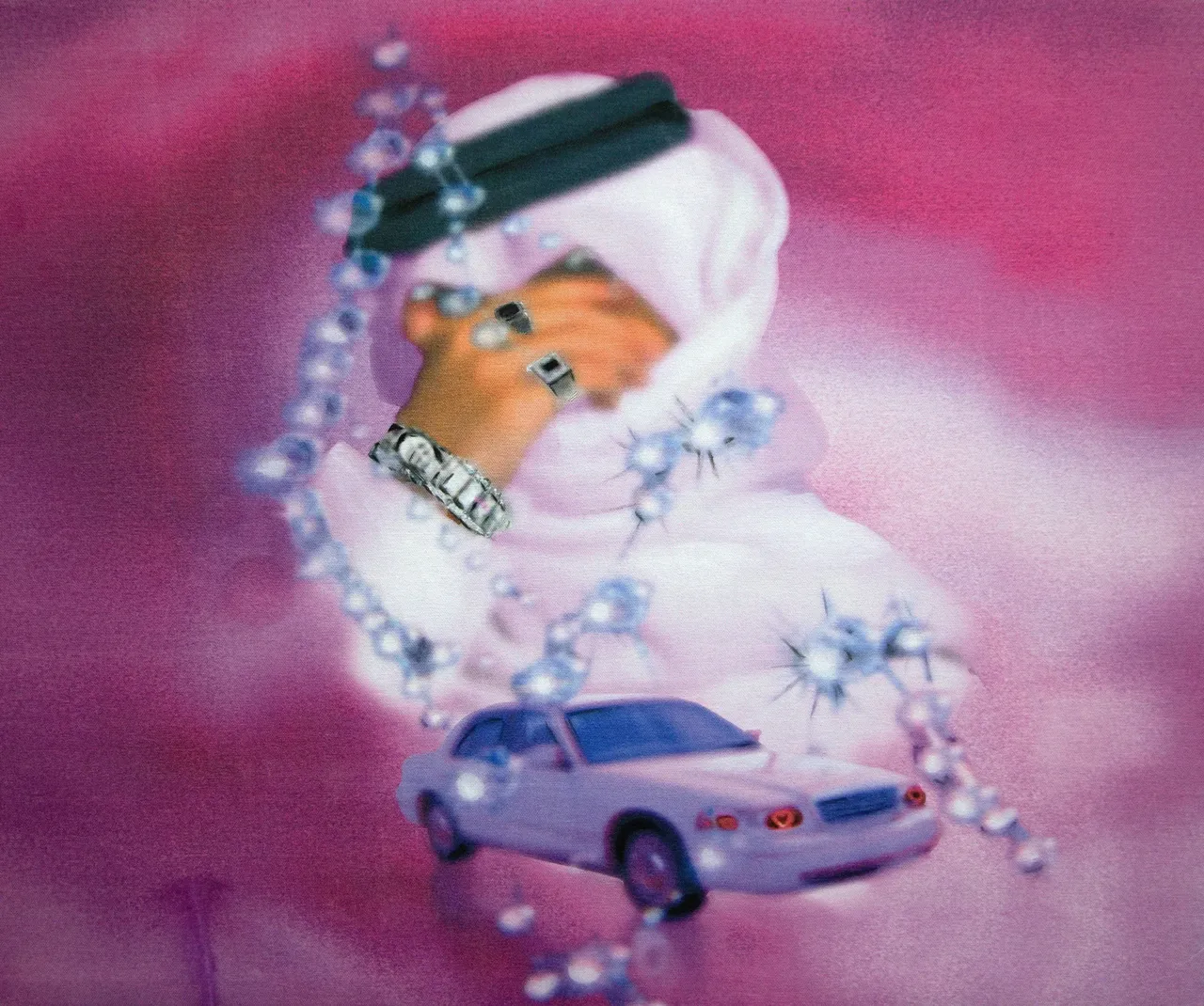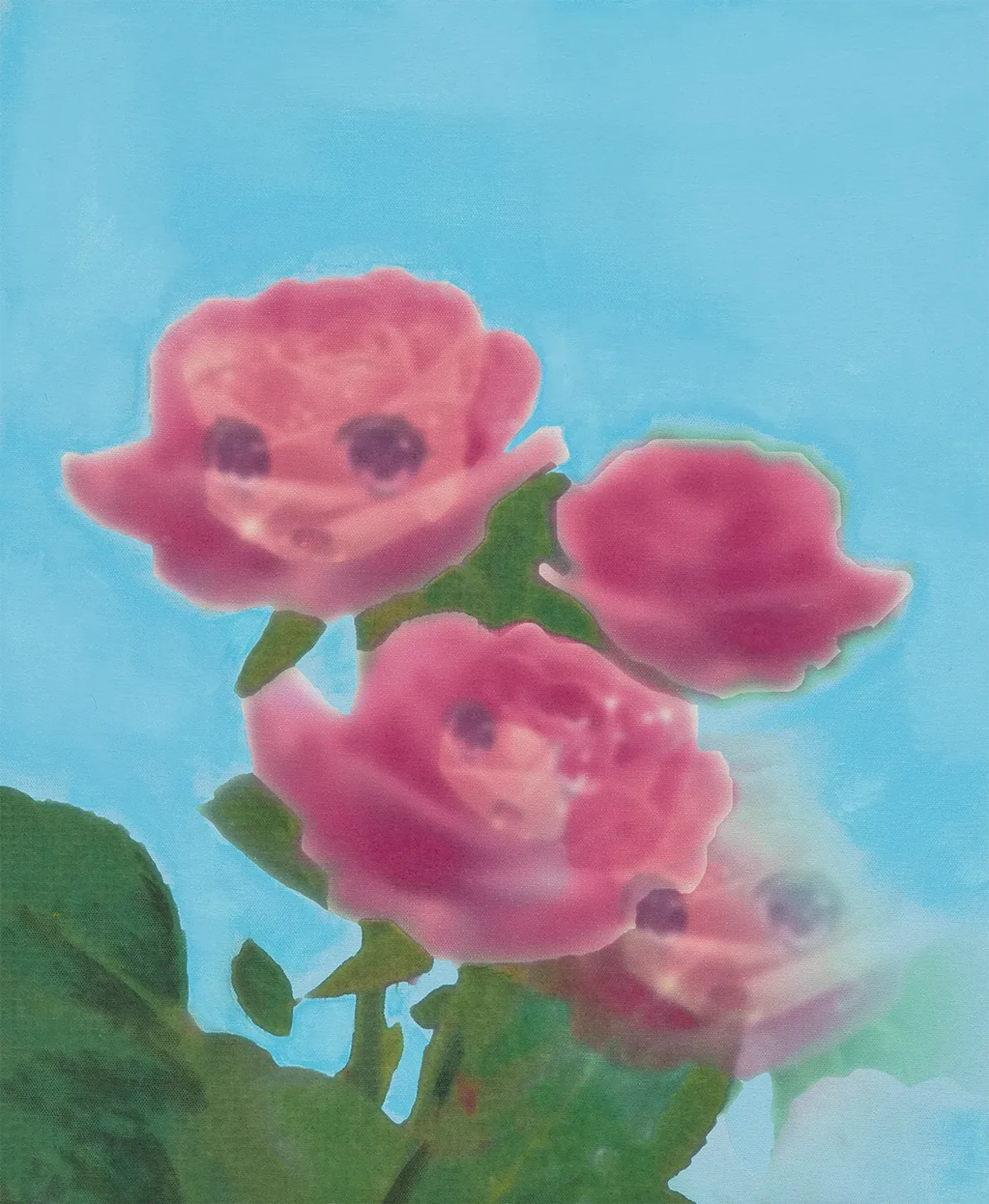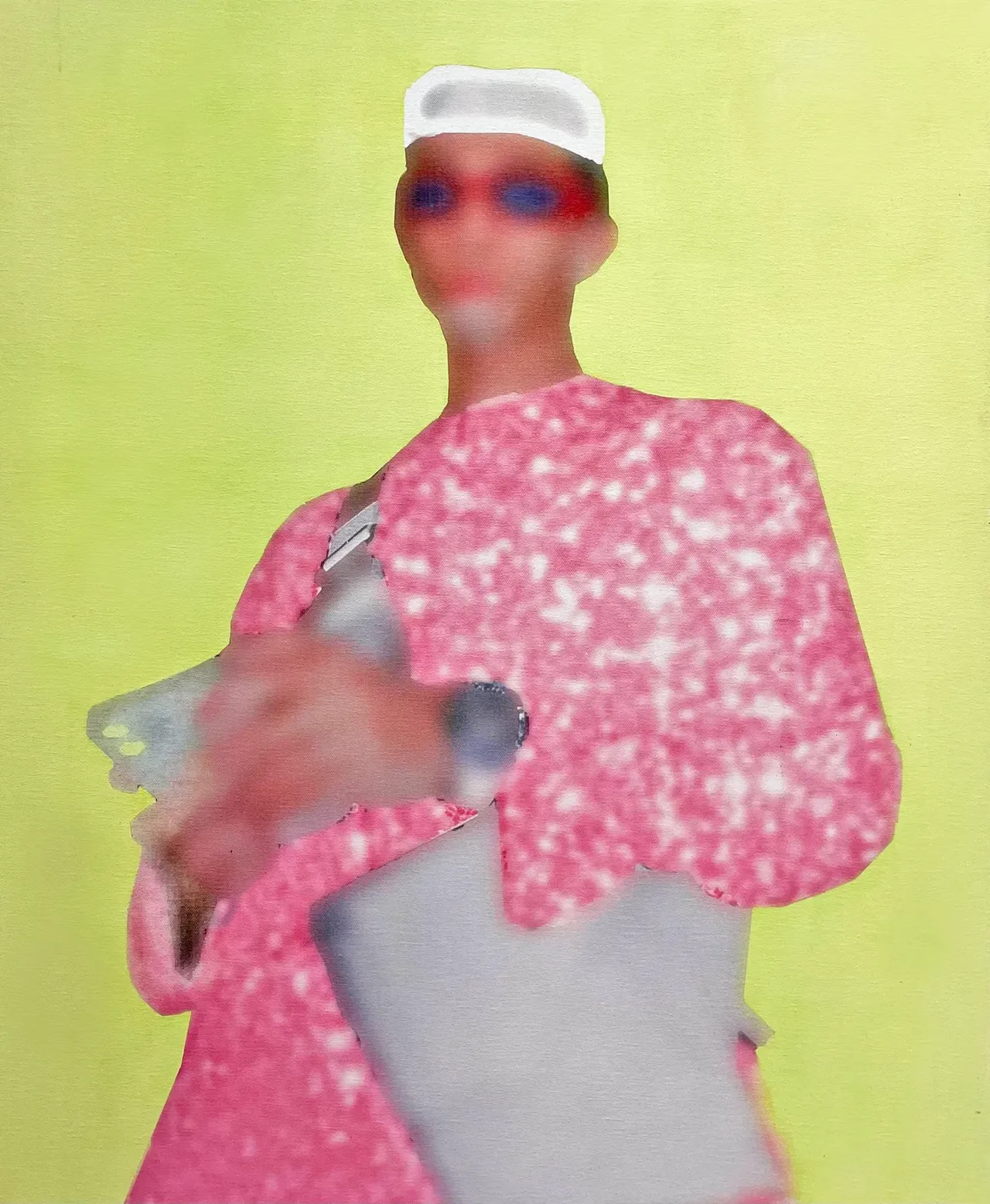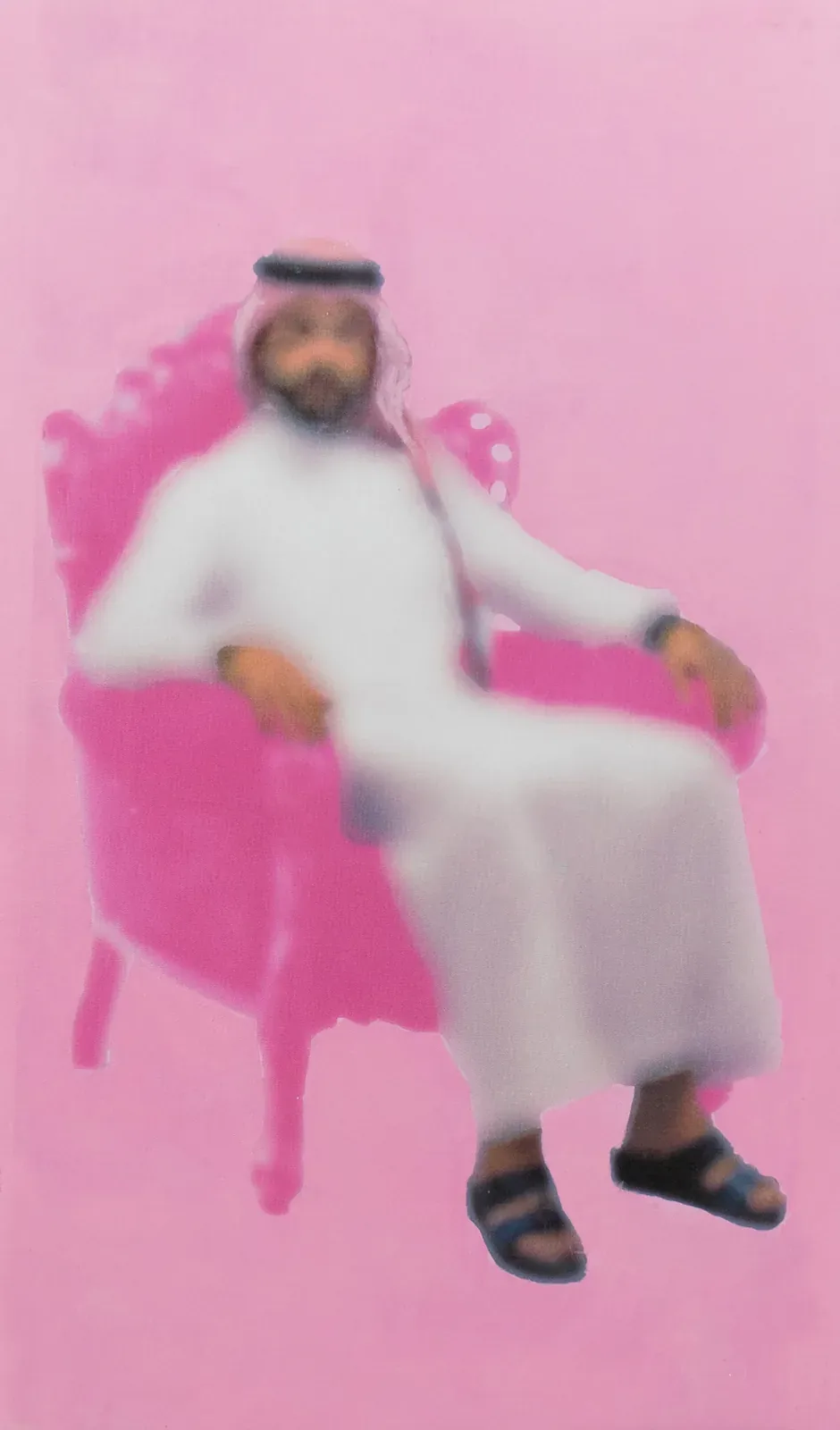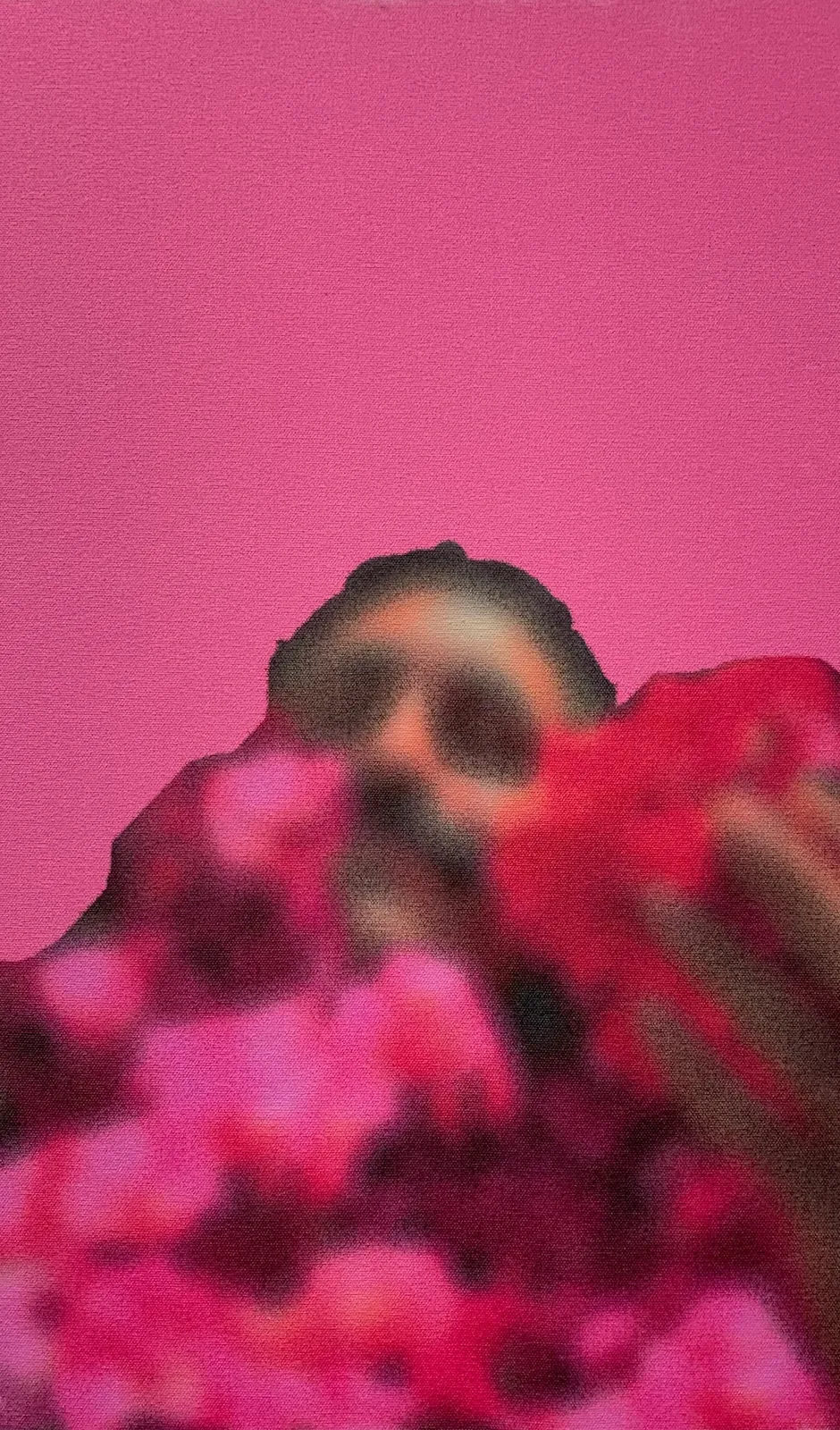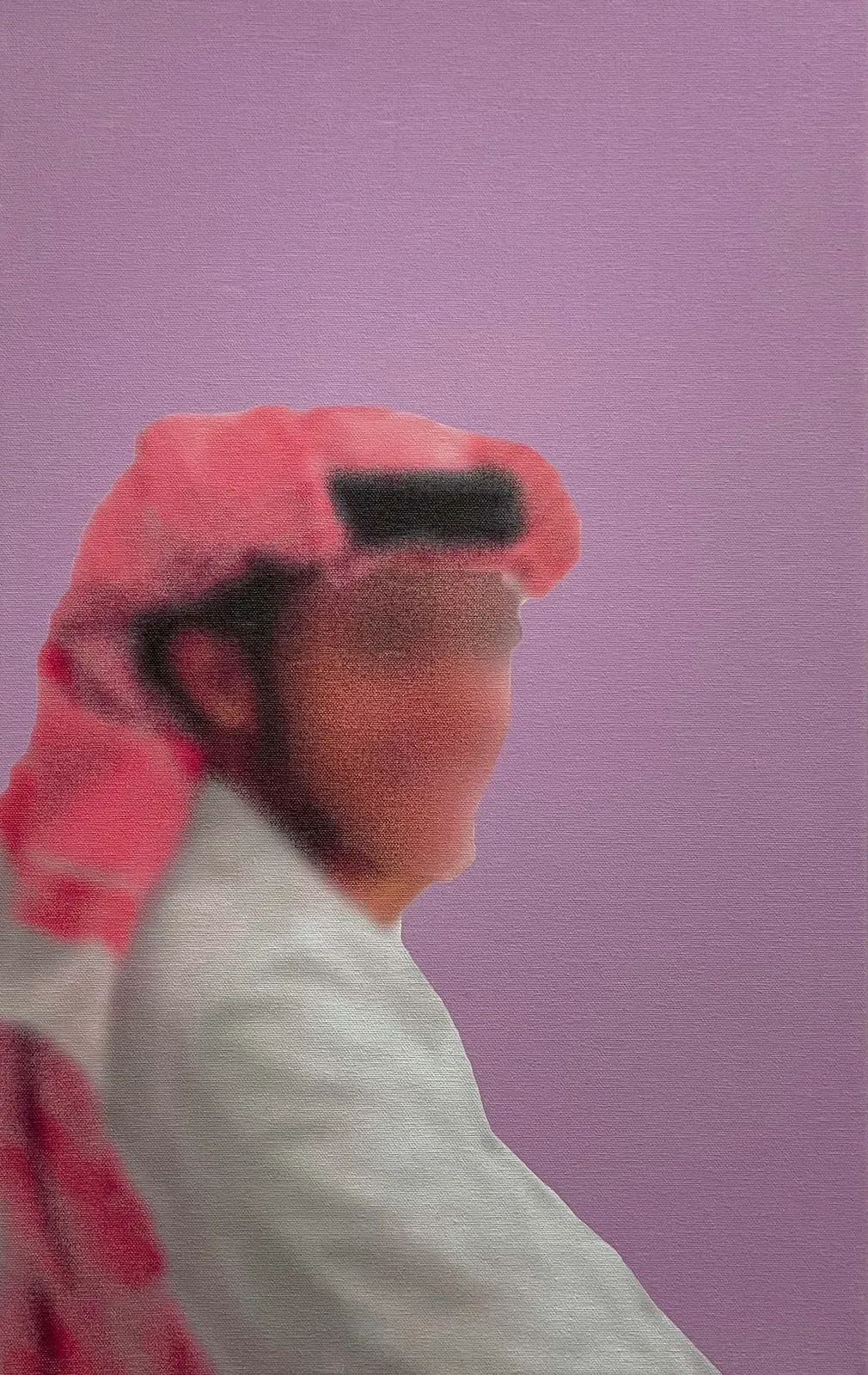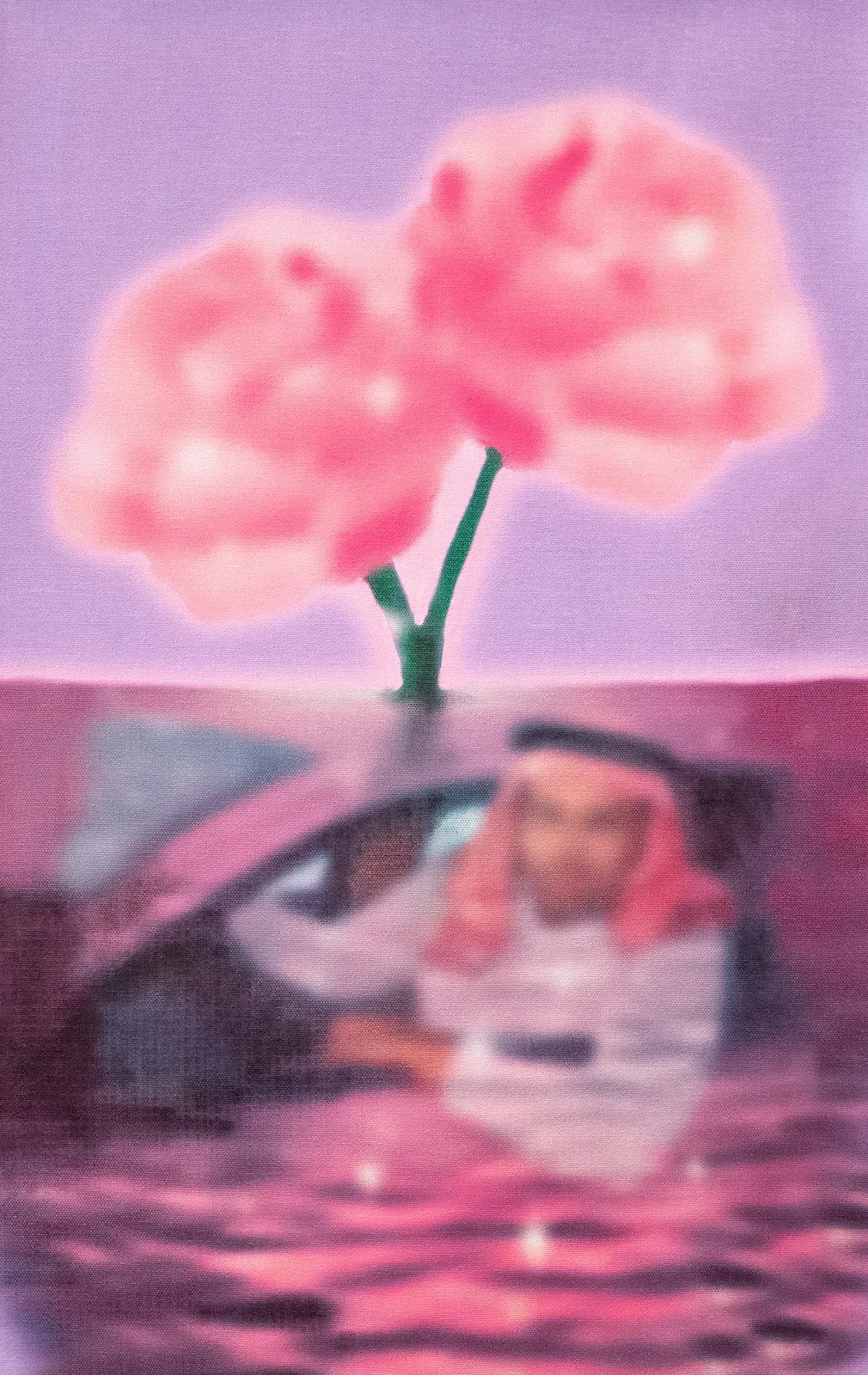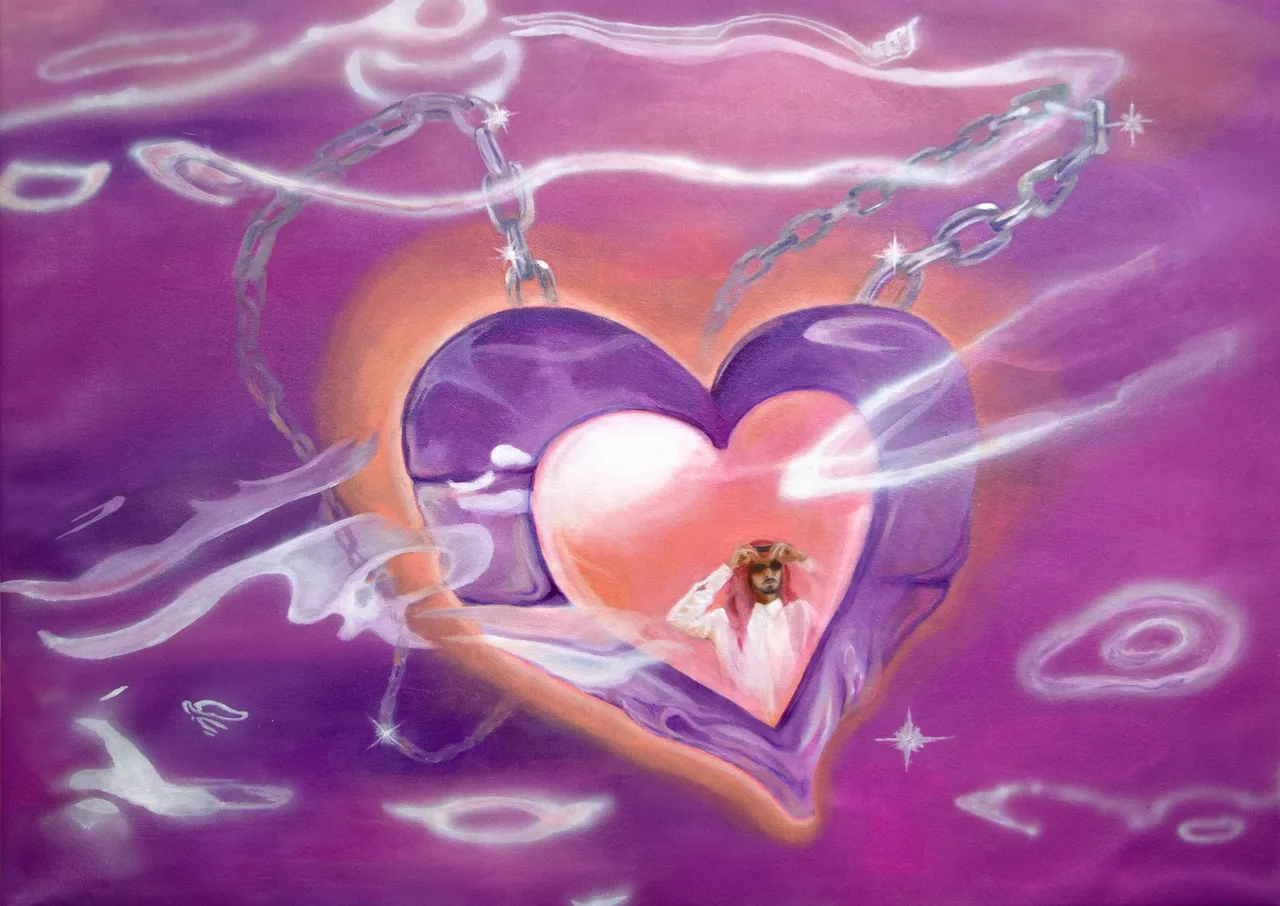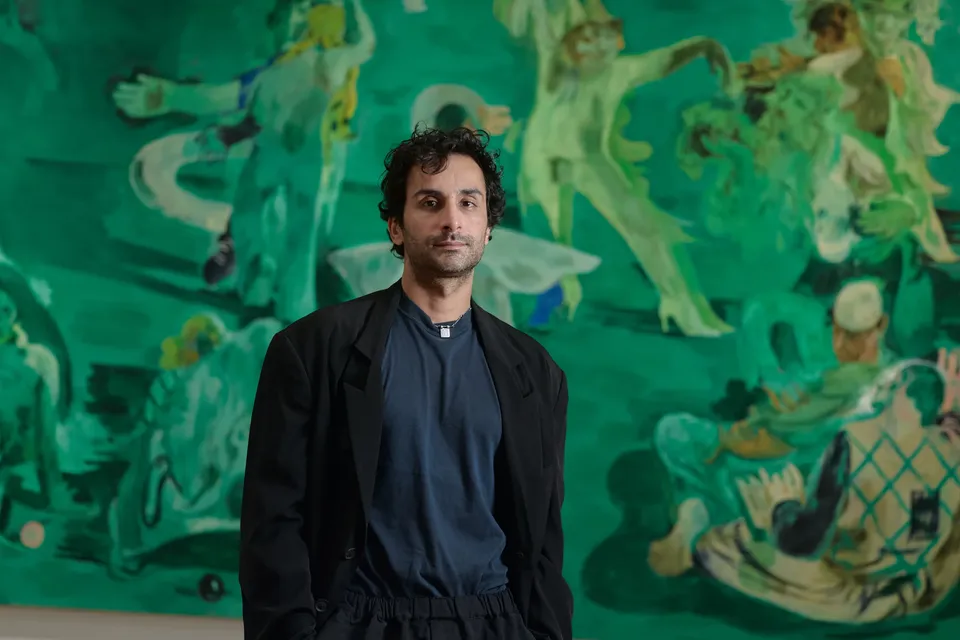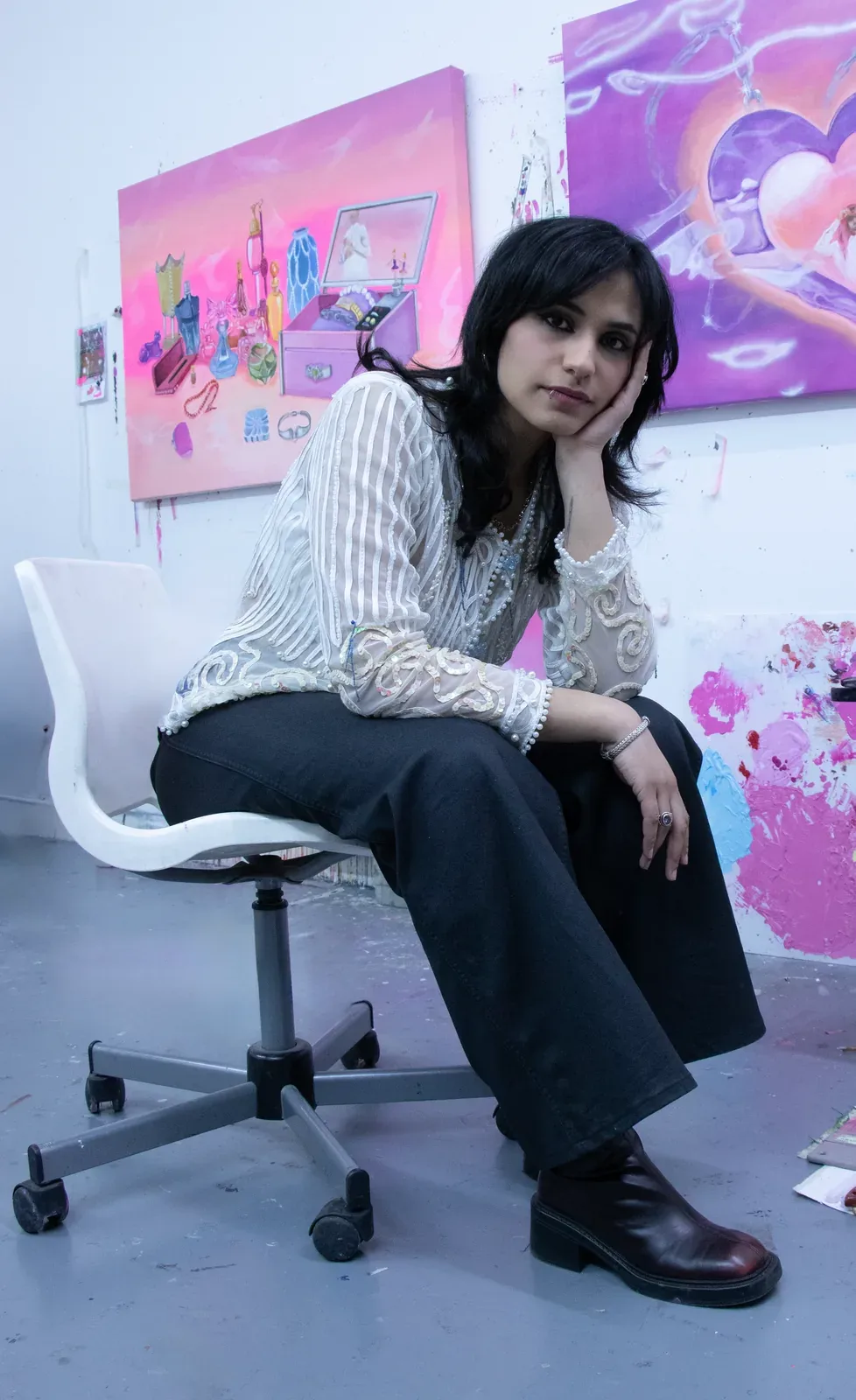
Hawazin Alotaibi is a restless Gemini who has lived many lives. Her work accordingly moves seamlessly through multiple disciplines. From her lush hyper-pop pink paintings that depict conceptions of masculinity in the Arab and SWANA world, to her DJ career, she’s an artist who pushes the boundaries on creation as well as interrogates censorship. For Alotaibi, “there’s just so much out there to explore, and I’m interested in staying open to wherever that curiosity leads me.”
Can you tell me about your childhood and how it shaped the artist you are today?
I spent my childhood in Saudi Arabia before moving to the US with my family in my mid-teens. Growing up there, I didn’t have access to music or art spaces like exhibitions and concerts, which we have now. So, most of the art and music I encountered came from within my home: watching TV, listening to music online, and immersing myself in anime, manga, and graphic novels. I didn’t really question it at the time; it was just normal, but it didn’t make it any less meaningful. I loved graphic novels and manga, and I would obsess over how the characters were drawn. Some of those scenes in the books are still vivid in my memory.
Eventually, I started making my own DIY graphic novels on A4 paper and sharing them with friends. I went to a public school in Saudi, which tended to be more religiously strict than private schools, so it was important to hide my drawings and the comics I brought with me, otherwise they would be confiscated. There were many layers of censorship around us, not just in that context.
Living within that meant constantly navigating different versions of yourself. It was common to live double or even multiple lives, especially as a girl, as many of these structures were shaped by gender roles that were heavier on girls. Those encounters stay with you. They’ve shaped who I am as an artist today. Stories and music became my tools of escapism, a way of building my own world, or extending reality into something with more possibilities. Those experiences continue to inform my work, which engages with themes of censorship, girlhood, and cultural representation, and reflects my ongoing focus on male figures, who were, and still are, dominant in society.
Eventually, I started making my own DIY graphic novels on A4 paper and sharing them with friends. I went to a public school in Saudi, which tended to be more religiously strict than private schools, so it was important to hide my drawings and the comics I brought with me, otherwise they would be confiscated. There were many layers of censorship around us, not just in that context.
Living within that meant constantly navigating different versions of yourself. It was common to live double or even multiple lives, especially as a girl, as many of these structures were shaped by gender roles that were heavier on girls. Those encounters stay with you. They’ve shaped who I am as an artist today. Stories and music became my tools of escapism, a way of building my own world, or extending reality into something with more possibilities. Those experiences continue to inform my work, which engages with themes of censorship, girlhood, and cultural representation, and reflects my ongoing focus on male figures, who were, and still are, dominant in society.
You trained as a painter but clearly refused to stay there. What sparked this change?
What motivates me to keep evolving and bringing new elements into my practice is a desire to experiment, to find new ways of expressing myself and to follow different creative paths. So many forms of art feel exciting and full of possibility, and when I encounter a performance or an artwork that inspires me, I become curious about the tools behind it and what I could create with them.
Becoming a painter was never something I originally wanted to be. Growing up, I wanted to make graphic novels and become an animator, and I still have the urge to do them. But there’s just so much out there to explore, and I’m interested in staying open to wherever that curiosity leads me!
Becoming a painter was never something I originally wanted to be. Growing up, I wanted to make graphic novels and become an animator, and I still have the urge to do them. But there’s just so much out there to explore, and I’m interested in staying open to wherever that curiosity leads me!
Your work keeps returning to masculinity, the gaze, vulnerability — and the push and pull between girlhood and masculinity. Where does that obsession come from?
A lot of this comes from my experience growing up as a girl in a male-dominated world, what masculinity and femininity meant in my culture, how those roles were structured, imposed, and expected to be followed. I feel like feminine roles were almost designed to reinforce masculinity’s dominance.
I also grew up with one sister and four brothers, one of them is my twin, so there was a lot of masculine energy around me. I was a ‘tomboy’, and looking back, it kind of feels like my own small form of protest.
Now I feel like I’m at a point where I’m really starting to unpack all of that, just trying to deconstruct it, understand it, and play with those thoughts and memories.
I also grew up with one sister and four brothers, one of them is my twin, so there was a lot of masculine energy around me. I was a ‘tomboy’, and looking back, it kind of feels like my own small form of protest.
Now I feel like I’m at a point where I’m really starting to unpack all of that, just trying to deconstruct it, understand it, and play with those thoughts and memories.
“A lot of this comes from my experience growing up as a girl in a male-dominated world, what masculinity and femininity meant in my culture, how those roles were structured, imposed, and expected to be followed.”
How do you find something new when it feels like everything has already been done?
As hard as it is, I try not to overthink it. There’s something really powerful about repetition, just trusting that each time will carry a different meaning. Sometimes, through doing the same thing again and again, something new surfaces, or an idea starts to form. I also try to just show up to the studio, even when I have no idea what I’m going to do. And to remind myself that hating what I make is part of it, it’s going to happen, and there’s no real way around it, and it can suck and frustrate you.
Your work holds a lot in tension. Do you see that tension reflected in your personal life? You pull images from social media, which is also where masculinity gets most aggressively performed. Does that context matter to you when you're looking?
Yes, it’s a crucial part of my process. Social media has influenced societies on a global level, and in the context of the Gulf, to put it simply, it’s blurred certain social boundaries and challenged ideas around what was once limited in terms of self-expression. Saudi was a very gender-segregated environment, but social media created new ways for people to connect and, in some ways, normalised those interactions. Suddenly, the ‘other’ gender, once distant or abstract, became part of my virtual space. That contrast feels huge, and honestly, really intriguing to me.
What does performance give you that a canvas can’t?
That’s a really interesting (and honestly difficult) question. I feel like it’s something I’ll keep thinking about, and my answer will probably keep changing. I’m not sure if I’d say performance gives me something a canvas can’t, maybe they offer similar things, just in really different ways. But on a personal level, performance feels more intimate and confrontational. That intimacy comes from it being a fleeting moment, something experienced differently by everyone in real time.
A canvas, on the other hand, holds a still moment. Even if we can talk about movement within painting, it’s still ultimately fixed. And I think that’s why I’m drawn to performance more; the kind of vulnerability it asks for is immediate. It’s about being present, and about how you’re connecting with others in that exact moment.
A canvas, on the other hand, holds a still moment. Even if we can talk about movement within painting, it’s still ultimately fixed. And I think that’s why I’m drawn to performance more; the kind of vulnerability it asks for is immediate. It’s about being present, and about how you’re connecting with others in that exact moment.
“Social media has influenced societies on a global level, and in the context of the Gulf, to put it simply, it’s blurred certain social boundaries and challenged ideas around what was once limited in terms of self-expression.”
Your practice spans painting, performance, print — and now music. Where do you see the overlap between all of these disciplines, and what does music give you that painting cannot?
I like to stay fluid in how I make my work, seeing these different disciplines as tools that can sometimes merge or stand on their own. Electronic music, in particular, can be very experimental; the tools, genres and possibilities are always evolving, and I try to bring that same energy of experimentation into my paintings. Painting can sometimes feel stuck in its traditional format, and that doesn’t always excite me. So, I try to push it, experiment with it, similar to how electronic music can be.
You're doing an MA in Curating at Goldsmiths. How has it changed the way you approach your work?
Having done my BA and first MA in Painting, it’s been really interesting to see art from a curatorial perspective. Many of the approaches actually overlap with making art, but this course has taught me a lot about writing and articulating ideas from a different lens and purpose. It’s also helped me look at other artists’ practices more deeply, not just to learn about them and be inspired, but also how to work with them as a curator.
What is one thing you are bored with right now?
I'm a Gemini, we get bored and unbored with things so quickly! Right now, I am probably bored with painting. I just finished new work for an exhibition, and I am so relieved, but just don’t wanna touch a paintbrush for one minute.