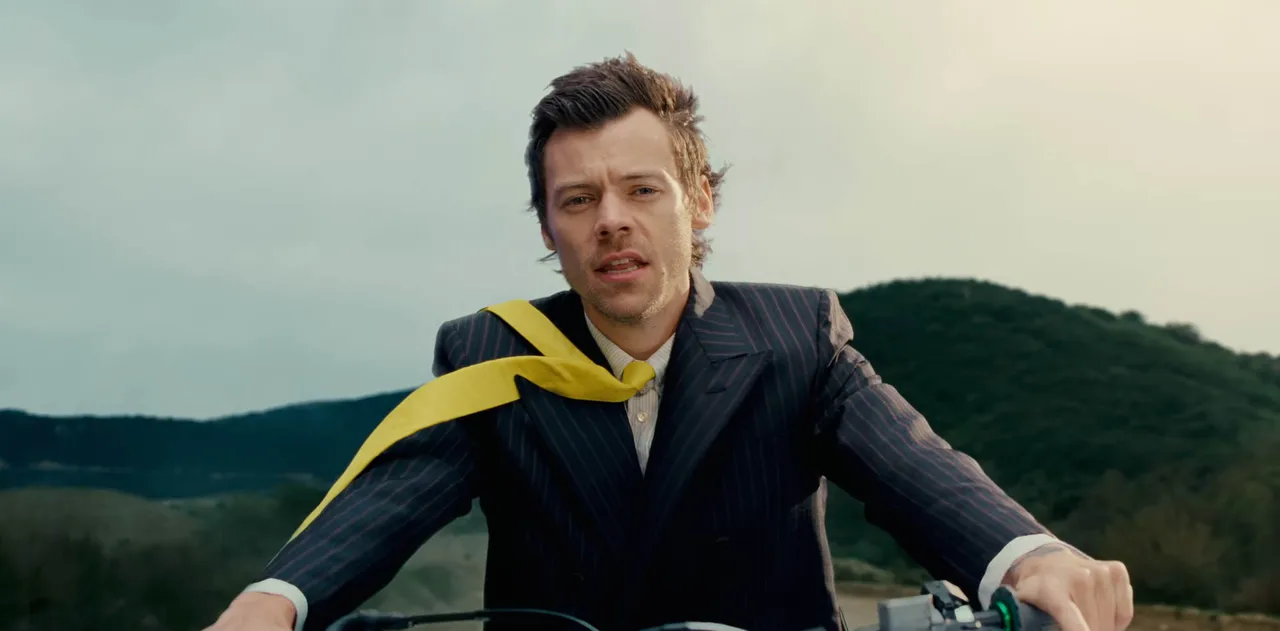
After almost four years out of the spotlight, Harry Styles returns with Kiss All the Time. Disco, Occasionally., an album that arrives wrapped in big expectations and even bigger promises. The title alone suggests glitter balls, sweaty dance floors, and a full commitment to disco revivalism. But the reality is a little more complicated. Despite the word “disco” sitting proudly on the cover, the album leans more toward synth-pop, soft house, and hints of new wave than it does toward anything that would actually light up a dance floor. Styles has mentioned influences ranging from LCD Soundsystem to the Berlin club scene, and you can definitely hear those electronic textures scattered throughout the record. The result is an album that feels atmospheric and polished, but also slightly unsure of what it wants to be.
Behind that polished sound is a production team that has been closely tied to Styles’ solo career from the start. Longtime collaborator Kid Harpoon, who co-wrote and produced large portions of Harry’s House and helped shape songs like As It Was, returns here as one of the album’s central architects. He’s joined again by Tyler Johnson, another frequent collaborator who worked on previous records including Fine Line and Harry’s House. Their presence gives the album a sense of continuity within Styles’ discography, even as it experiments with slightly more electronic textures. The duo’s track record with Styles has usually produced some of his most refined pop moments, which perhaps explains why the album sounds consistently smooth even when the songwriting feels less fully formed.
The opening stretch sets the tone for that ambiguity. Lead single Aperture is one of the record’s more interesting tracks: long, textured and sonically layered. It’s a strong opener, even if it doesn’t quite have the instant hit potential of As It Was from Harry’s House, whose massive success helped define the previous era. Here, the energy feels more restrained. The following tracks, American Girls and Ready, Steady, Go! lean heavily on catchy rhythms and repetition. American Girls has an undeniably sticky hook, but the production and lyrics feel strangely flat, as if the song never fully locks into place. Ready, Steady, Go! improves things with a punchier rhythm and a fun beat, even if it relies on the same formula of repeating a phrase until it becomes the entire chorus. It’s enjoyable on the surface, the kind of track that works well blasting through headphones, even if you don’t remember much about it five minutes later.
That pattern continues through songs like Are You Listening Yet? and Taste Back. Both start with promising ideas, interesting textures and a sense that the album might suddenly take a bold turn. Instead, they gradually settle into the same repetitive structures that run through much of the project. Taste Back at least delivers a chorus that sticks in your head, while Are You Listening Yet? ends up feeling slightly undercooked, like a demo that never quite evolved into its final form. Still, these songs highlight one of the album’s strongest traits: even when the songwriting is thin, the melodies are hard to shake. Styles knows how to craft a hook and here, he uses that skill generously.
When the focus shifts toward slower or more reflective moments, the comparisons to Styles’ earlier work become harder to ignore. The Waiting Game has a pretty instrumental base and some indie-electronic touches, but it lacks the emotional punch of the ballads that once defined him. Considering he’s the same artist who wrote songs like Sign of the Times, Falling or Matilda, the lyrics here feel a little underdeveloped. Something similar happens with Paint by Numbers, which arguably contains one of the album’s most interesting ideas. The song appears to reflect on the pressures of early fame —possibly even nodding to Styles’ beginnings in One Direction— and the strange experience of having an image built for you by the industry. The message is powerful, but at barely two minutes long, the song ends before the idea fully unfolds, leaving the listener wanting more.
Elsewhere, the album’s strongest moments tend to come from its production rather than its storytelling. Season 2 Weight Loss stands out as one of the sonic highlights, with a beat and atmosphere that finally hint at the club-inspired influences Styles referenced while making the album. Pop also leans into that glossy synth-pop aesthetic, pairing shimmering guitars with reverb-heavy drums and a slightly rock-leaning attitude that connects nicely with earlier songs like She or Only Angel. The lyrics are … straightforward, to say the least. The album title might promise disco, but the emotional theme sometimes feels closer to ‘horny all the time.’ Still, musically the track works.
The record finally approaches its supposed concept with Dance No More, one of the few songs that actually channels a disco-adjacent energy. Funky, glittery and slightly retro, the track carries the kind of mirrored dance floor atmosphere the album title suggests. There are even hints of influence from artists like Prince in its groove and playful funk undertones. In contrast, Coming Up Roses offers one of the album’s most satisfying musical moments thanks to its instrumental break, which shows how well Styles can work with more traditional instrumentation. Ironically, though, the song feels less like a radical reinvention and more like something that could have comfortably fit on one of his previous records.
The album closes with Carla’s Song, which turns repetition into a strength rather than a weakness. Built around a simple, mantra-like line —“It’s all waiting there for you” — the track feels uplifting and reflective, echoing the reassuring tone of earlier fan-favorite moments like “We’ll be alright” from Fine Line. It’s a warm ending that leaves the album on a surprisingly hopeful note.
Taken as a whole, Kiss All the Time. Disco, Occasionally. is an easy album to like, even if it’s harder to love. On a first listen, many of the songs blur together because they share similar structures and tempos. But after a few spins, the melodies start sticking, and you may find yourself humming bits of choruses without realising it. The production is smooth, the atmosphere is polished, and the record works well as something to play while driving, working or just existing in the background.
Still, for an album that reportedly took several years to make and that arrived after the massive cultural moment of Harry’s House, it doesn’t quite feel like the bold reinvention some listeners expected. It’s not a step backward, but it isn’t a dramatic leap forward either. Instead, it sits somewhere in the same lane: pleasant, well-produced and occasionally genuinely fun. The disco may only appear occasionally, but the charm of Harry Styles is still very much present.