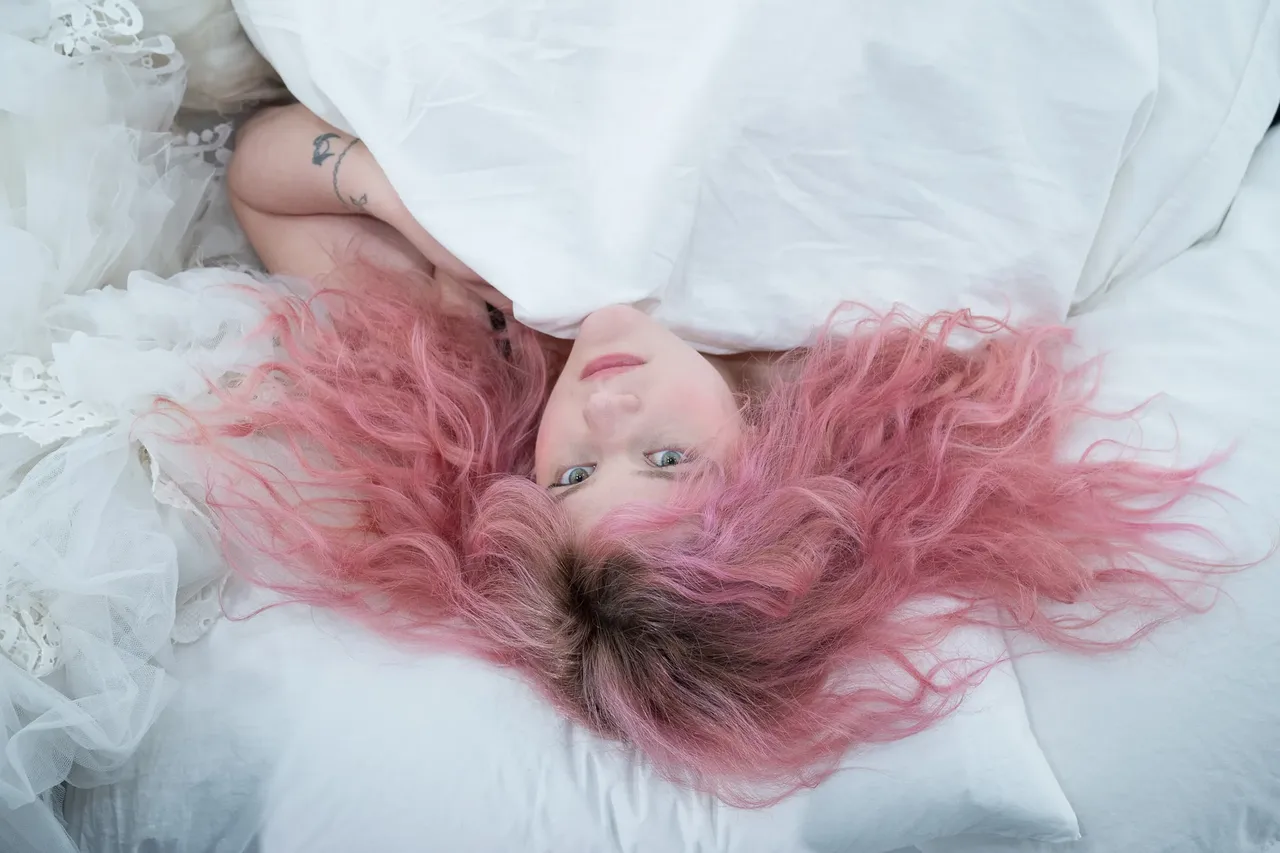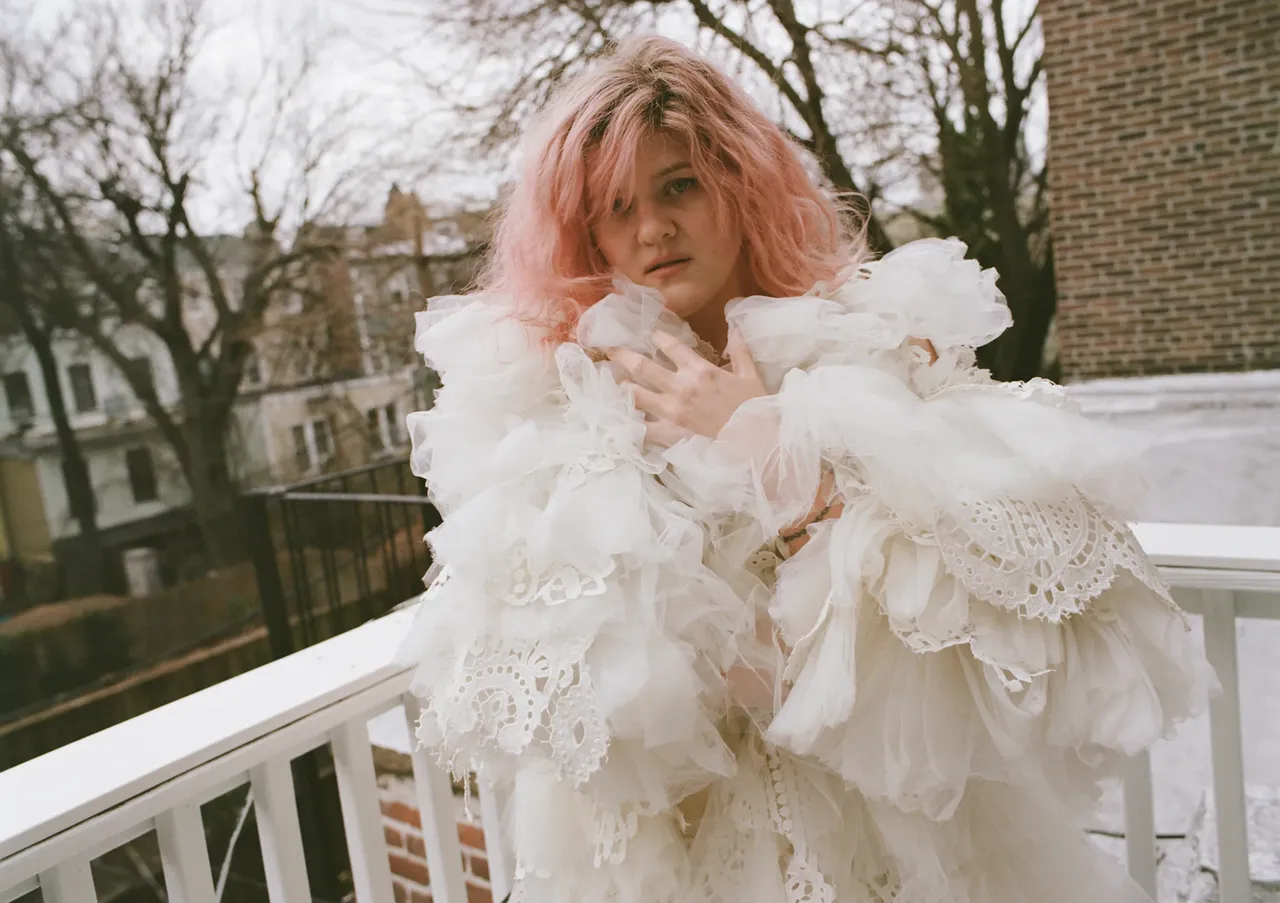
When asked about the reception to her new album, Girlfriend, Grace Ives comments: “I guess it’s been really strong.” She’s underselling it. To generalise, the reception has been definitively strong. It earned her a second Pitchfork Best New Album distinction after Janky Star. She has been profiled by just about everyone, the Spotify hits are racking up, and she is on a rigorous tour schedule that will take her to Barcelona on 6 June for Primavera Sound. It feels like a precipice moment for Ives.
Grace Ives has always written about tensions: self-doubt running up against confidence, the possibility of love cut through by insecurity, and passion meeting anxiety. The pop genre often prizes operatic emotions and experiences — grand and perfect loves, devastating heartbreak, glorious adventure, and the immortal passions of sports cars. Ives writes about smaller feelings and with a measure more honesty.
She has always been quick and quippy, lyrically and melodically, which has given her music a signature punch alongside its pop. Her first album, 2nd, is just so damn exciting; each song brings a new sound. She discussed initially working with limited gear, which became a useful creative constraint. You can hear it on that album; a playfulness works its way through the eclectic sounds and samples. On a favourite, What’s It For?, she takes us through the malaise of amnesia and lostness: “Where’s the wind? Where’s the stars in the sky? / I don’t wish anything anymore.” It’s a theme she explores further on her second album.
Janky Star refers to a stick-and-poke tattoo she has, but it is also a clever moniker for her kind of artistic persona. She has a star’s gravity, but with a bit of the whimsical miscellany of a tattoo one gets at sixteen. A standout track, Loose, hints at the bolder, more ambitious scale she explores on Girlfriend, with vocals that soar from almost spoken lyrics to an absolutely belting chorus. Angel of Business takes a hooky approach to the longest song on the album, flexing her ability to write songs that worm their way into your brain folds. Janky Star is a bit of a proof-of-concept; she sounds assured on a larger album that, through its earnestness, never loses sight of the infectious whimsy of her earliest work.
Girlfriend is a more mature album sonically and tonally, showing a cultivated restraint that doesn’t conflict with her roots. It has been described as an album of singles — not pointing to an incoherence between tracks, but rather the sheer firepower of each one. We open with Now I’m, which takes us through a lush minute of instrumentals before Ives enters, light and breathy, cascading through an adventure in progress. As soon as she builds momentum, the track fades out. At two minutes, it is the shortest on the album, though Ives has always kept her tracks brief.
On Avalanche, we get a return to the electro-pop synths she has used since her first releases. By the time we get to My Mans, she is flexing her full range in a windows-down summer ballad. As the album wraps, What If, a closing gem, takes an almost country roll through its chorus. The song takes us through a journey of facing off with the obsessiveness she circles on Girlfriend. We close with Stupid Bitches, which shows Grace Ives at her sharpest: the transitions are some of her cleanest, the swells overwhelming, the breakout nasty and, overall, the song is positively slick.
With John DeBold and Ariel Rechtshaid on production, the songs are bigger and more expansive than anything she’s done, but Ives’s sparseness and restraint keep the music from spilling into soapy territory. Relatability is what makes us go crazy for our favourite pop music, but platitude can have the opposite effect, ripping us out of the transportive world an artist creates for us. With Ives, this never happens. All art is self-reflexive, the adage goes, but for Ives, that process is also a practice of empathy. She tells me: “Everyone has had terrible, hard years the past couple of years, and I was one of those people.”
Scaling up has been a challenge many indie artists have struggled to navigate. Perhaps it’s the infectious earnestness and passion Ives seems to bring to everything she does; perhaps it’s that she takes her time in writing and releasing. Each album has been a practice of scale, and Girlfriend is a bona fide instant classic: an early entry for the album of the summer. Though, maybe it is the album of the spring; about moments of change, that delightful mania of newness, and the shaking off of old baggage.
In this interview, she talks about the process of working through Girlfriend, the self-doubt she is forcing herself to face, and making the transition to a larger stage.
To kick things off: where are you in the world right now?
I’m at a Hilton in Lawrence, Kansas, and the air conditioner doesn’t turn off. Well, I kind of figured it out by button-mashing it. The bed was okay. The lobby is really nice. The people are nice, and we’re trying to do laundry. That’s the day. That’s where we’re at.
How’s the tour going?
It’s going really well. It’s still early days, even though it feels like it’s already been months, but the shows are great and have been super packed. It has been exciting to see all the people who are interested. Overall: good energy, good crowds, good sound. It’s fun.
This week marks about a month of Girlfriend being out. What has the reception been like?
I guess it’s been really strong. The reception feels way different than it ever has for me. I’m getting a bit less underground. I’m still kind of unknown — I guess maybe one of the ‘ones to watch’, which is awesome. It does feel bigger than it ever has in terms of feedback and acknowledgement. It feels bigger. It feels better.
I was at Variety Coffee in Ridgewood this morning preparing questions. I was going to put on your music, but I didn’t have to: they were playing Girlfriend on repeat.
Really?! Shut the fuck up!
They played it twice through. A man was dancing.
That’s what it’s all about. Going into a store and having the people play you — that’s so cool. Wow, twice in a row? A superfan? Or not a superfan, maybe just an active listener.
Can you tell me about how your early work came together? I know ‘bedroom pop’ gets overused, but what’s changed in your process since those first singles?
I never realised that making music was something [unique] that I did. I always looked at it as a hobby, something that everybody did, and so I didn’t own it. Because of that, I would share it with friends as an art project but kept it mostly to myself. When I started out, I was using very limited resources: GarageBand and a microKorg — the small one everyone has. That was my first year of college. Then, in my second year, I got a 505 [Roland MC-505 Groovebox] just because M.I.A. and Peaches had them. I thought it was such a cool way to make a song.
“I think people’s relationship to music can be an antidote to the oppressive sadness and evil.”
What has it been like to work on a larger scale?
Early on, I had limitations that I could push up against—see what I could create within them. The constraints were pretty fruitful for me. As I’ve grown out of that—growing up and having a bigger room and a little bit more money to get [equipment] that doesn’t have to do everything—my process has stayed the same in terms of writing. An idea comes to me melodically and then I find the chords. The chords are kind of in there already; I can hear a full song when an idea comes to me. Then I will lay it down on as few instruments as possible, or just play it over and over again on the piano. That was always the way I’ve made music. Now I have more knowledge of how to record and more of an ability to get specific in fulfilling my vision in terms of sound, mood, and tone.
Do you have any creative rituals?
When I’m reading a book, I will log everything that hits and that I want to keep with me. I refer back to those lines when I’m trying to get a seed of language to start with in my writing. It’s a ritual of mine to get out my Electribe and my main synth, which is a broken Juno, and pair those: a beat and some synth or piano. I’ll cycle through random beats and synth sounds and try to write something to whatever happens. It’s an exercise to spark new ideas melodically or energy-wise. I’ll sit and do that for hours.
Sitting at the piano is also a ritual. Time completely goes away. I found a forgotten, two-hour-long voice memo recently; in it, I’m playing piano and at the end I’m playing the exact same thing that I started with. That day, I was sitting there for two hours playing the same thing.
Sitting at the piano is also a ritual. Time completely goes away. I found a forgotten, two-hour-long voice memo recently; in it, I’m playing piano and at the end I’m playing the exact same thing that I started with. That day, I was sitting there for two hours playing the same thing.
What were you reading when you were working on Girlfriend? What fed into those kernels of language?
A bunch of stuff. I tried to get into the classic sad, brilliant women (Joan Didion and Sylvia Plath). I read a Chris Kraus book, I Love Dick, which I really liked. It took me a second to get into, but she’s so funny. I read Rejection, The Emperor of Gladness by Ocean Vuong, a book called Molly by Blake Butler, All Fours (of course). I read Giovanni’s Room. That was my favourite. That one moved me to tears.
You took your time with this album, and it feels more tightly packaged than your earlier work. When did you know it was ready to go out into the world?
John DeBold and I took a year and a half to make it; we have so much fun working together and kept going on the songs, getting inspired [with new ideas]. Then we brought in Ariel Rechtshaid, and his instinct was to simplify things. I think John and I both look up to him. John used to engineer for him, so they have a sort of ‘big brother’ relationship. I know him as the author of some of my favourite stuff; he made some of the first pop that showed me what pop could be. He kept saying: ‘Pencils down.’ That was kind of the marker of the end of it. John and I are similar (ambitious and young) and we have a tendency to keep working and push ourselves. It took someone more seasoned being like: ‘You guys, it’s good. Stop.’
Some reviewers have called it an album of singles. Do you see one song as an anthem for the project?
I think the anthem might be Stupid Bitches because it’s hopeful. I don’t wish to be so depressive and blue. Something I express in my songs and on the album is me struggling with who I am and what I’m supposed to do. Stupid Bitches is a great ender, but it also addresses constantly changing myself for no reason to try and make everybody like me, which almost killed me. But it has an optimism: onto the next, let’s keep going. I tried to capture that ambitious, exciting energy in the song, both sonically and lyrically.
It’s cool that someone referred to it as an album of singles. There was a lot of talk about what would come out first. I had no ideas, but I’m such a contrarian: someone would say something and I’d be like, really? But there could be a reason for any of them being the first one shown.
It’s cool that someone referred to it as an album of singles. There was a lot of talk about what would come out first. I had no ideas, but I’m such a contrarian: someone would say something and I’d be like, really? But there could be a reason for any of them being the first one shown.
What was it like to bring that much intensity under one project?
Packing all that intensity was healing. I’m hesitant to say ‘healing’ because it doesn’t sound good to me, but it was. Being able to throw all my paint onto the walls, and work with people who thought that was cool, was really validating. I tend to ‘other’ myself and have grown up feeling like something’s wrong with me. Not everybody is going to like me (which is true), but I can also take that too far and feel that nobody likes me, which I’m growing out of, hopefully.
This was kind of the medicine for addressing that — having to be my own validation and being like: this is good. This is done. This is amazing. And then having two people who I truly respect and admire say the exact same thing.
This was kind of the medicine for addressing that — having to be my own validation and being like: this is good. This is done. This is amazing. And then having two people who I truly respect and admire say the exact same thing.
What made you hesitate around calling it ‘healing’?
When I picture myself making it, I still see myself not struggling, but having a hard time emotionally. Going through the changes of becoming less codependent, being sober, taking more charge, and being more confident in my process and in social settings. I close my eyes and I see myself making it… I guess that’s what healing looks like. It’s not the finished product; it’s the in-between.
I see myself trying so hard — almost too hard. But that is what everyone has to go through at some point. Everyone has had terrible, hard years the past couple of years, and I was one of those people. I am a bit shy; I don’t want to claim ‘healing’ in a way that makes me feel emotionally or spiritually superior. That’s not my game. But it was healing.
I see myself trying so hard — almost too hard. But that is what everyone has to go through at some point. Everyone has had terrible, hard years the past couple of years, and I was one of those people. I am a bit shy; I don’t want to claim ‘healing’ in a way that makes me feel emotionally or spiritually superior. That’s not my game. But it was healing.
You’ve been releasing music through a pretty intense stretch of time in the world, and you now have a fanbase that’s grown up alongside it. What has that been like?
Music, books, and movies feel so good right now and have for the past couple of years. When you find something that moves you or makes you feel cool and special… I think people’s relationship to music can be an antidote to the oppressive sadness and evil. It means something to people.
I met someone in Minneapolis who was at a basement show four years ago. Four years feels like ten. Time feels so long because things feel so impossible. Meeting people like that makes me think: You’re still here, I’m still here. It’s not because of me and my music, but it’s because of stuff like music: that will to connect with art and with other people. I feel it when I play these shows. We don’t forget about what’s happening in the world, but isn’t it so amazing that we all feel safe here right now at a show?
I met someone in Minneapolis who was at a basement show four years ago. Four years feels like ten. Time feels so long because things feel so impossible. Meeting people like that makes me think: You’re still here, I’m still here. It’s not because of me and my music, but it’s because of stuff like music: that will to connect with art and with other people. I feel it when I play these shows. We don’t forget about what’s happening in the world, but isn’t it so amazing that we all feel safe here right now at a show?
“We don’t forget about what’s happening in the world, but isn’t it so amazing that we all feel safe here right now at a show?”
You’ve talked before about winning fans one by one. With this new level of traction, do you feel more of a separation between your artistic persona and who you are? Or does it feel like the same experience, just larger?
I think I feel that separation when people are like, oh my god, I can’t believe I’m meeting you! Not to sound like a scary ego actor, but, who are you? How did that happen? That kind of parasocial separation, or relationship, can be confusing for me. I have it too, obviously. I met Lana Del Rey and I almost threw up even though she’s just chilling being Lana.
It’s confusing as a person to feel that; it’s not normal, it’s not natural. I hope what they’re responding to is me being true to myself. If it is simply the music, then that’s also cool. But I don’t know where the line is, where a separation would begin. I am a newer artist, and I haven’t found my brand — I don’t have a theme. I changed the colour of my hair because I wanted to, but I still feel very much me in my day-to-day life when I’m performing or making music. I don’t put a hat or wig on and change; I don’t really morph too much in and out of music.
It’s confusing as a person to feel that; it’s not normal, it’s not natural. I hope what they’re responding to is me being true to myself. If it is simply the music, then that’s also cool. But I don’t know where the line is, where a separation would begin. I am a newer artist, and I haven’t found my brand — I don’t have a theme. I changed the colour of my hair because I wanted to, but I still feel very much me in my day-to-day life when I’m performing or making music. I don’t put a hat or wig on and change; I don’t really morph too much in and out of music.
Can you talk about the theme of possession across the album, and in the Trouble music video specifically?
I’ve struggled with limiting myself. Someone in my personality is kind of a glitch of wanting to drink so much, not being able to stop doing something. There’s a kind of entitlement in thinking: Well, it’s mine, I deserve it. In the past, I have thought about alcohol and drugs as one of the things that I could control and give myself — things over which I could have ownership and possession. When I start thinking of things in those terms, as being what I deserve or what I’m owed, that’s where the chaos begins. I’m writing a lot about my expectations of what and who I should be to myself and other people.
But then there’s also wanting: wanting my own stuff, my own story, my own experiences. I’ve been in a relationship for twelve years. I live in a house that’s not mine, and a lot of the stuff inside of it is not mine. I’m so lucky, and these things are also amazing and beautiful, but I think I’ve struggled with feeling independent and having ownership of both material things and experiences. I tend to over-obsess and consume, and that is where a lot of the songs start. I am thinking about my story, not the story of me being somebody’s girlfriend or somebody’s daughter — belonging to somebody.
My young approach to feeling independent was a little chaotic and misguided, which was good. I don’t care, it’s all good. All experiences are good. That’s what I’m often talking about: the choices I make to separate myself from a person and gain control of my life, but not truly knowing how to do that.
But then there’s also wanting: wanting my own stuff, my own story, my own experiences. I’ve been in a relationship for twelve years. I live in a house that’s not mine, and a lot of the stuff inside of it is not mine. I’m so lucky, and these things are also amazing and beautiful, but I think I’ve struggled with feeling independent and having ownership of both material things and experiences. I tend to over-obsess and consume, and that is where a lot of the songs start. I am thinking about my story, not the story of me being somebody’s girlfriend or somebody’s daughter — belonging to somebody.
My young approach to feeling independent was a little chaotic and misguided, which was good. I don’t care, it’s all good. All experiences are good. That’s what I’m often talking about: the choices I make to separate myself from a person and gain control of my life, but not truly knowing how to do that.
You describe ‘girlfriend’ as both a fixed identity and also a temporary state. Tell me more about that.
It feels like a word that’s more about who you are to someone than who you are as a person. Like sister, mother, father, or friend, it’s an identity claim that is more about who you are to someone. In a way, it is your circumstances. It’s less about who you are as a person (your beliefs and morals, what you want from your life) and more about where you find yourself. Maybe that’s truer when you don’t necessarily choose to be someone’s mother, sister, or brother; maybe you do, whatever, but these words do feel like a complicated identity to claim. It feels like you’re somebody else’s thing, or you are your role in someone’s life.
I’ve been with this person for a very long time while making music, and with that comes questions about what I owe to my boyfriend. It feels so silly calling him my boyfriend and me being a girlfriend. That’s my person — not to sound Grey’s Anatomy. I think that’s also part of the charm of the word for me. That word is the throughline of the album. ‘Girlfriend’ does feel like the smallest word that doesn’t fit quite right. It’s sweet and playful, temporary sounding, even though it’s this thing that I think of as being my whole life and forever. It’s funny to call it something so temporary; it doesn’t totally make sense.
I’ve been with this person for a very long time while making music, and with that comes questions about what I owe to my boyfriend. It feels so silly calling him my boyfriend and me being a girlfriend. That’s my person — not to sound Grey’s Anatomy. I think that’s also part of the charm of the word for me. That word is the throughline of the album. ‘Girlfriend’ does feel like the smallest word that doesn’t fit quite right. It’s sweet and playful, temporary sounding, even though it’s this thing that I think of as being my whole life and forever. It’s funny to call it something so temporary; it doesn’t totally make sense.
And ‘partner’ doesn’t make a good album name.
Unless it was a cool country-pop album. I think that would be cool. I do relate way more to ‘partner’ than I do to ‘girlfriend’. But maybe… yeah, you’re right.
It’s a bit of a taboo word these days, too. I feel like social media has turned on ‘partner’ as a relationship descriptor.
I know! I feel like I’m not allowed to use it just because we’re both cis. Because I’m a girl and he’s a boy? But not even… that’s not even… whatever. That’s a whole other conversation!
“I am ambitious and I want to be creating; I have a natural instinct to make music. So that’s all good and cool and very powerful and strong. What clashes against this is self-doubt and being mean to myself.”
We don’t need to philosophise on ‘partner’ for the interview.
No, no, I don’t want to. No!
I am curious about the relationship between ambition and self-discovery. Do you see these things as intertwined or as processes that fight with one another?
My natural instinct is to have those two things fight with one another: ambition and self-discovery. I have limiting beliefs in terms of how I think of myself, how I see myself, and how I think other people see me. It’s been a challenge I keep bumping into. I am ambitious and I want to be creating; I have a natural instinct to make music. So that’s all good and cool and very powerful and strong. What clashes against this is self-doubt and being mean to myself. When that gets in my way, it can halt the self-discovery process. I’m going and my mind is like: Err, not so fast. Do you think this is right? Do you think this is good? That’s something that happens a lot.
I’m less ambitious in terms of being rich and famous; those things have never been my goal. I’m more ambitious in what I can do and create: like, how weird, how cool, how bad could it be? In the true moments of creating, the doubt goes away. As long as I am true to that, self-discovery follows. But I do block myself sometimes.
I’m less ambitious in terms of being rich and famous; those things have never been my goal. I’m more ambitious in what I can do and create: like, how weird, how cool, how bad could it be? In the true moments of creating, the doubt goes away. As long as I am true to that, self-discovery follows. But I do block myself sometimes.
One more. You described yourself as a very playlist-oriented person, which was helpful in putting together the album’s order. So, if Girlfriend were not an album, but rather a playlist with other people’s music as well, what else would be on it?
I would put: a Le Tigre song, a Lana Del Rey song. What else would I do…? This is so interesting. A Jai Paul song — he’s a little bit more dancey. Maybe a Tears for Fears song. Robyn, probably (probably, definitely). And then a Lorde classic, some Melodrama stuff.
What’s next for you?
We have a show in Kansas tonight. I’ve been curious to see who will come, it might be the best show ever. More shows for the next month and a half, and getting more confident. I had a moment yesterday where I was like: Nobody knows what to do with me… wait, I got this. I can do this! London is sold out, which is really cool. I’m excited to see what that feels like. And Primavera, in Barcelona, also cool.