Sometimes you reach a point where escaping into fiction no longer works. Your rent keeps rising while your wages stagnate. Cities begin to feel identical, places you are merely passing through rather than belonging to. All that talk of ‘things getting better’ starts to sound hollow when you’re the one struggling to keep up. Gorillaz’s new album, The Mountain, understands this. Damon Albarn and Jamie Hewlett don’t pretend that pop music exists in a vacuum, separate from everyday hardship. Instead, they’ve crafted a record that pays attention to exhaustion: the reality of what happens to us after work, when money is a constant weight, and when simply being alive in this moment requires a sort of relentless, humanistic reflection.
Underneath the roster of guest artists and spiritual motifs, The Mountain is about something fundamental: endurance. It’s about the people who keep going even when nothing feels certain, and how music can still foster connection when stability is scarce. Albarn shaped much of this album while travelling in the wake of a personal loss; that sense of being unmoored permeates the record. The band treats spirituality not as a means of checking out, but as a way to reset, to understand grief as part of a larger cycle of movement and migration.
The music is in a state of constant flux. Indian classical sounds bleed into electronic beats; guest vocalists appear and fade like fleeting, collective conversations. These songs don’t feel like grand statements so much as shared moments. In this sense, The Mountain reflects the fragmentation of modern life, where identity is shaped by who you meet and where you’ve been. In listening, one realises that our optimism bias is being replaced by a cold, hard truth.
The album is not without its tensions. Gorillaz have always been defined by global collaboration, but in 2026, this borderless approach sits awkwardly alongside the reality many listeners face. While the music moves effortlessly across borders, the audience is often trapped by dwindling options and precarious employment. At times, the record feels as though it is observing from a distance rather than living through the struggle. Yet, Gorillaz seem self-aware in this regard. They are older artists trying to find meaning in a harsher world, attempting to square the promises of art with the limitations of life.
The title track, featuring Dennis Hopper, Ajay Prasanna, Anoushka Shankar, and Amaan & Ayaan Ali Bangash, opens slowly. Traditional instruments dissolve into an electronic haze, as if memory itself is tuning the band. While Gorillaz have always been built on collaboration, here it feels more like an act of remembrance.
The Happy Dictator, one of the album’s standout tracks, featuring Sparks, offers a haunting refrain: “No more bad news / So you can sleep well at night / And the palace of your mind / Will be bright.” Speaking to BBC Radio 1, Albarn noted that the song was inspired by the former leader of Turkmenistan. “The point of The Happy Dictator is that turban Bashi wanted everyone in Turkmenistan to only think happy thoughts and sleep unaffected by the sort of the doom of the world and just keep everything upbeat. So he kind of banned all bad news, no more bad news. And that really struck me when I was there, I was very inspired by that. Sort of half terrifying and half well, actually. It’d be really nice, if there was I lived in a world where there was no more bad news.”
Joe Talbot from Idles brings a grittier edge to The God of Lying, tackling the explicit struggles of the working class: “Are you happy with your housing? Are you climbing up the walls? […] Are you pacified by passion? Are you armed to the teeth?”
On the powerful Damascus, Omar Souleyman and Yasiin Bey sing: “Here to navigate the waves in the dark, no map, stars in the heavens and a breezе on my back.” Albarn himself remains the rare British rock star who, despite his veteran status, still ‘gets it.’ His subtle, beautiful verse on The Hardest Thing captures the quiet ache of loss: “Do you love? Do you pray? Down inside, wondering how, how you got to the afterlife?”
Gorillaz has constantly been upping the game in pop music: their early animations helped bridge the gap between hip-hop and punk in the early 2000s; today, they continue to push boundaries. When Spanish Latin music is becoming a matter of political resistance in the USA, Argentinian artist Trueno delivers a verse of poetic resistance that paints a picture of the album with words: “Me encanta sentir el viento, subir la montaña sin aliento / Al final lo que importa es el intento” (I love feeling the wind, climbing the mountain breathlessly / In the end, what matters is trying). He then passes the torch to Proof, who raps over a jazzy, operatic base in a nod to Gorillaz’s classic narrative style.
Meanwhile, Orange County features Kara Jackson, who provides the album’s most poignant generational reflection: “And I'm not your enemy / Your legacy frightens me, will I keep it gold? / Or will it spoil / Before I get the chance to grow old?” The Shadowy Light, The Sweet Prince, The Moon Cave add substance to the richness of the album, but whether it is the length or the heaviness of the thoughts behind the songs, there’s a slight sense of density when finishing the album.
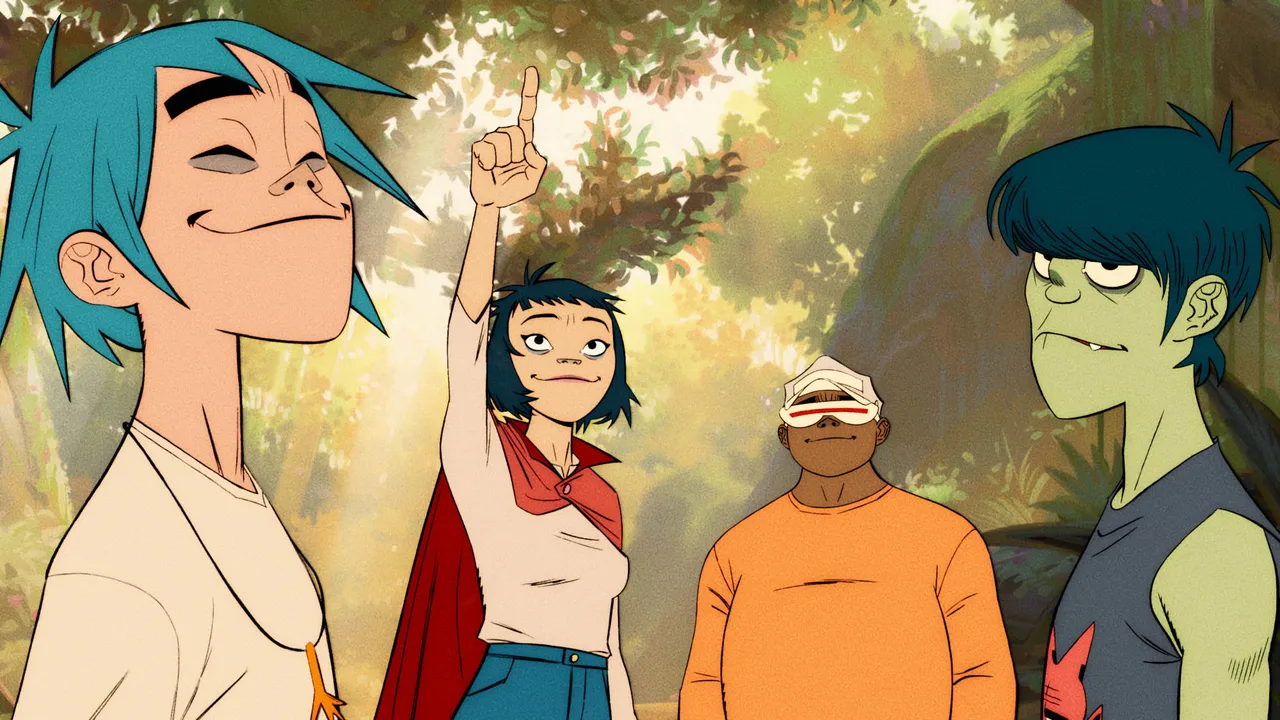
Accompanying the release is an eight-minute film, The Mountain, The Moon Cave & The Sad God, produced with London studio The Line. Following Noodle, Murdoc, 2D, and Russel through India, the film mirrors the album’s themes of searching for meaning through movement. The hand-painted backgrounds and traditional techniques – taking eighteen months to complete – favour craftsmanship over digital polish. It is a perfect visual match for an album concerned with the human touch in an automated age.
Compared to the pop spectacle of Cracker Island, The Mountain feels more mature and responsible to its era. Even the lighter moments carry an underlying weariness, as if the band is watching modern chaos from a vantage point rather than trying to shout over it. Gorillaz recorded the album in several places, from London’s Studio 13 to Damascus, Miami, New York, and, naturally, India, and it's noticeable how this movement shaped every layer of the record. Fifteen tracks bring together a wide range of collaborators including Anoushka Shankar, Bizarrap, Omar Souleyman, Johnny Marr, Sparks or Trueno, and also archival recordings from Tony Allen and Bobby Womack. The result feels less like a guest list and more like a gathering. A record suspended between generations where working together becomes continuity rather than novelty.
After twenty-five years, Gorillaz no longer need to shock. Their growth is evident in their perspective. The Mountain is the sound of artists considering their legacy, not through the lens of nostalgia, but with an awareness of how history presses against the present. It reaches for the ambition of Plastic Beach, but replaces the theme of environmental disaster with the challenge of finding inner peace.
The album marks a shift in terms of ‘business.’ Released through Kong, the band’s own label, it signals a late-career move toward independence as much as artistic growth. A planned arena tour across the UK and Ireland suggests these thoughts about loss and continuity aren’t meant to stay private. They’re meant to be shared and turned back into collective experience.
There’s a strange calm running through The Mountain. Death appears throughout, but what comes through most is movement. The album doesn’t fold in on itself; it reaches outward toward ritual, toward colour, and toward accepting that nothing lasts forever. Earlier Gorillaz records imagined dark futures or digital worlds; this one looks for what continues. Death becomes a passage, not an ending. There is a cultural war in the way nostalgic revivalism is positioned today, an ideological trick to fool our brains when looking at our black mirrors. The Mountain is the naturalisation of a political process, stripped of illusions.
We should be honest, though. An album by a British band drawing from Indian music and culture can’t help but bring up colonial dynamics. Looking at Gorillaz’s whole career, they’ve generally shown respect for other cultures in how they’ve incorporated them into their work. But colonisation and cultural appropriation run deep: it takes more than good intentions to escape those patterns entirely, even if they feel unconscious. In a music world obsessed with speed, The Mountain chooses stillness, born from both thought and exhaustion. It asks listeners to sit with uncertainty and to accept that pop music, like life itself, keeps going long after individual voices fall silent.
Gorillaz once pictured the future through cartoons and chaos. Here, they imagine what comes after (Tomorrow Comes Today), and even if they’ve somehow made it sound peaceful, the greatness of this being one of the absolute best of their career comes from the bravery of sitting in front of reality, trying to break paralysis by attempting to look from above.