Cristian Mungiu returns to Competition at the 79th Festival de Cannes with Fjord, twenty years after winning the Palme d’Or with 4 luni, 3 săptămâni și 2 zile (4 Months, 3 Weeks and 2 Days). Fjord, his first foreign-language feature, brings back the moral architecture that has defined much of his cinema since his years as a journalist in Romania, where he developed the habit of extracting fiction from real social fractures and news events. The Romanian filmmaker, known for his moral pressure-cooker cinema, shifts his gaze to Norway for a drama where institutional protection, religious conviction and cultural identity collide within a single fragile system of care. This is cinema less interested in resolution than in sustained ethical friction.
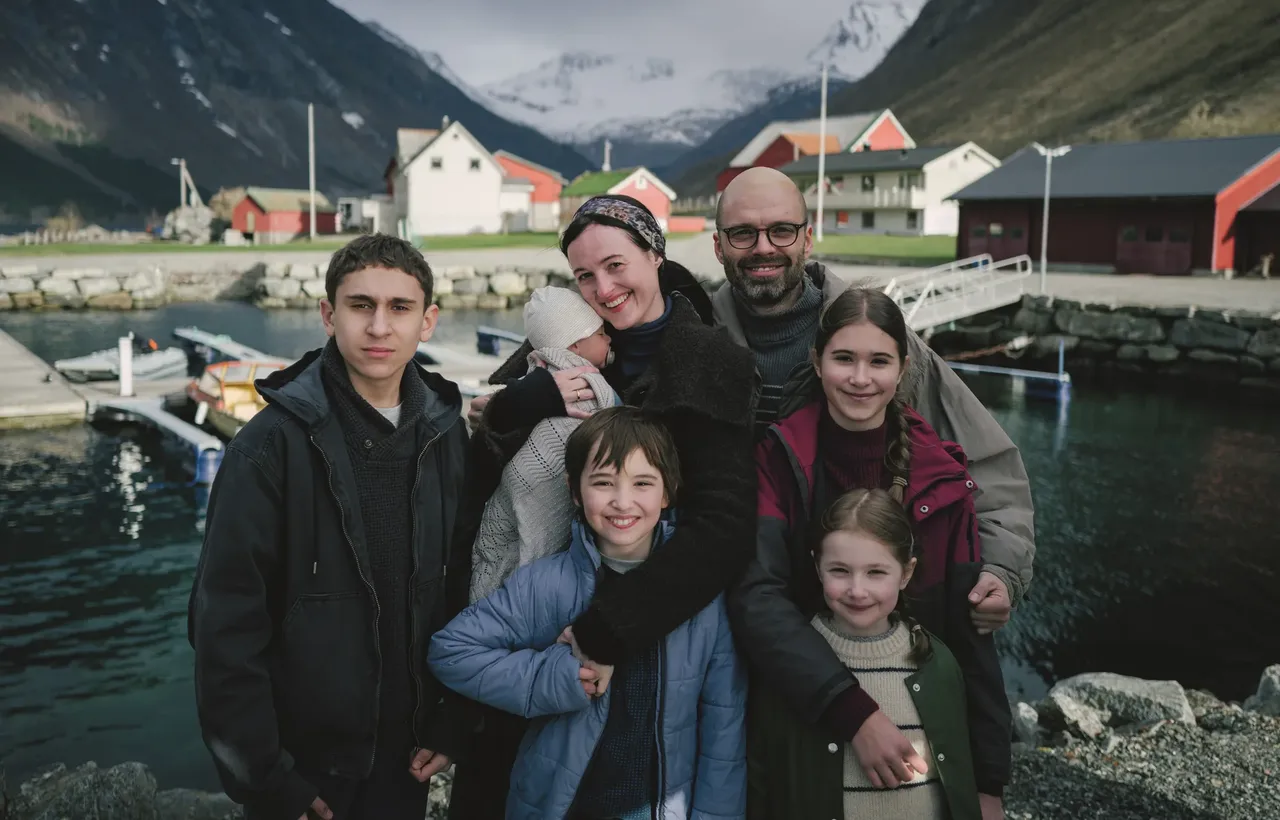
Set in a remote Norwegian fjord landscape of almost oppressive serenity, the film follows Mihai (Sebastian Stan) and Lisbet (Renate Reinsve), a Romanian-Norwegian couple raising five children under strict Evangelical Christian values. Their attempt to rebuild family life away from urban environments begins to fracture when authorities suspect physical punishment after bruises are discovered on one of the children. From there, Mungiu constructs a moral battlefield in which no position remains uncontaminated by doubt.
The strength of Fjord lies in its refusal to produce easy moral categories. Child protection services risk sliding into institutional overreach, while the family’s conservative worldview oscillates between care and control. Cultural difference becomes inseparable from ideological conflict. Rather than determining guilt, Mungiu exposes how contemporary liberal democracies negotiate competing systems of truth, protection and belief. Conflict unfolds not as confrontation but as gradual erosion, where trust deteriorates, communities fracture and certainty dissolves.
Visually, Mungiu mobilises the Norwegian landscape almost ironically. Vast fjords and natural openness contrast with an increasingly claustrophobic moral terrain. Long takes and restrained framing sustain his familiar observational style without ornament, maintaining a tension that never fully releases. Even if some critics suggest Fjord lacks the devastating precision of 4 Months, 3 Weeks and 2 Days, it retains the director’s capacity to stage uncomfortable ethical simultaneity, where opposing truths coexist without reconciliation.
If Fjord is not among my personal favourites of this year’s Competition, it is not because it lacks rigour, but because Mungiu works in a register defined by ethical confrontation rather than affective ambiguity. Yet the film persists beyond its viewing. It does not destabilise my position towards the ultra-religious family at its centre, but it does open a more uncomfortable question about the limits of tolerance within liberal societies themselves.
The Norwegian setting sharpens this tension. The director examines what happens when ways of living fall outside the frameworks that contemporary welfare states consider socially acceptable or civically legible. The film does not oppose progressivism and conservatism in simple terms; instead, it exposes how institutional systems built around care and protection can struggle when confronted with forms of life that resist normative integration. This question extends beyond Norway into broader Northern European debates, from Germany to Denmark, where welfare institutions increasingly negotiate the fragile boundary between protection, cultural specificity and intervention.
At the centre sits Renate Reinsve, once again confirming her status as one of contemporary European cinema’s most compelling performers. After returning to Cannes last year alongside Joachim Trier—whose Sentimental Value ultimately won the Palme d’Or—she appears here in a markedly different register, defined by restraint rather than volatility. Sebastian Stan matches her precision in one of his most controlled dramatic performances to date. Together they construct a marriage suspended between conviction and collapse.
Ultimately, Fjord understands social conflict as something unresolved by design. It refuses to stabilise its questions into answers, asking instead how pluralism functions when confronted not with celebrated difference, but with forms of life that liberal democracies struggle to assimilate. That unresolved tension remains the film’s most lasting force: uncomfortable, political and deliberately unsoothed.
Following Cannes, Fjord already arrives with major international momentum. The film has secured distribution in more than fifty territories, with France scheduled for August 2026, Norway for September, and Neon handling North American distribution in the United States. A broader European rollout is expected through autumn and winter 2026.