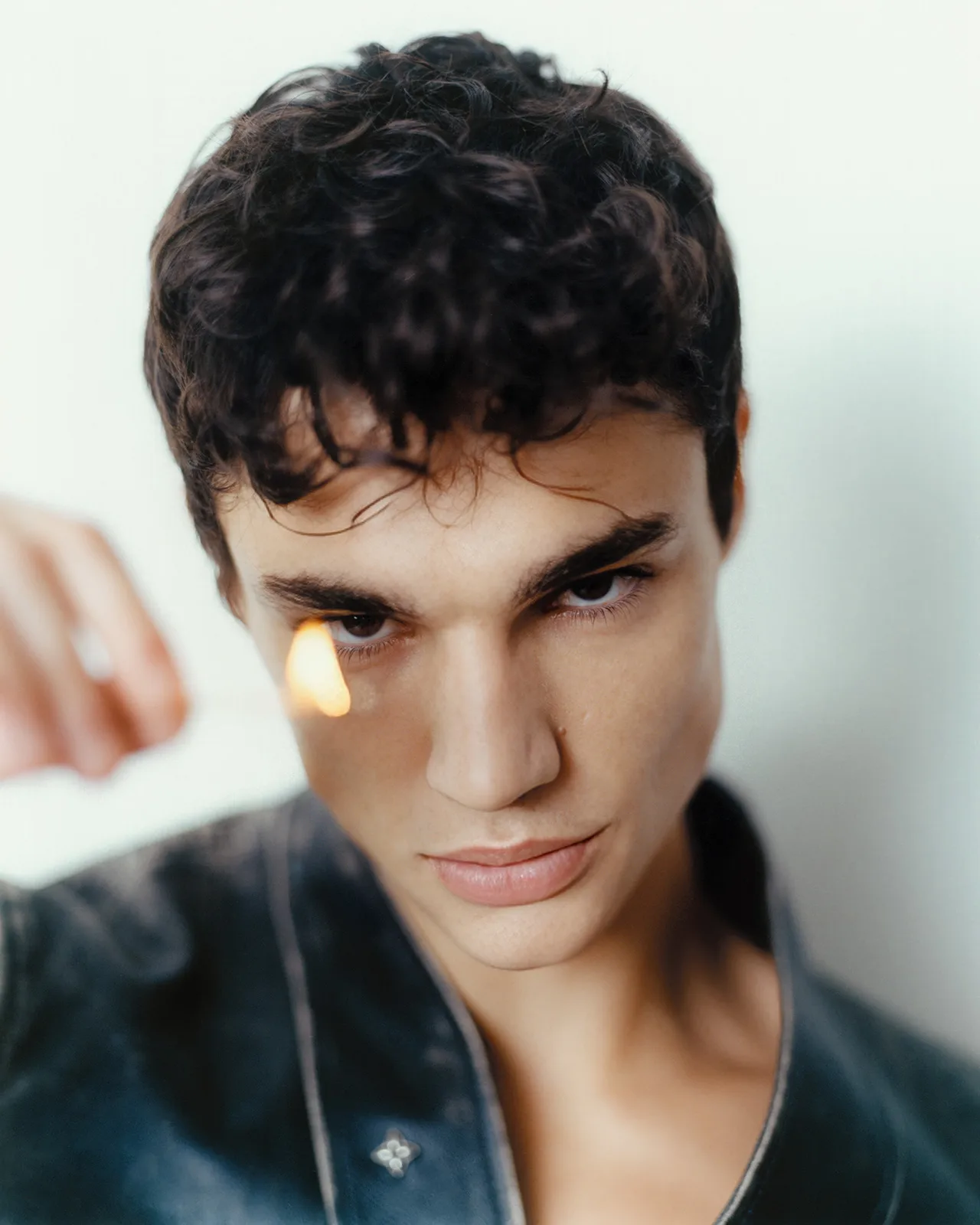
There’s a certain kind of presence that cannot be taught — a quiet gravity that draws you in without asking for attention. Fernando Lindez carries that rare quality. Over the past few years, he has become one of the most recognisable faces in the global fashion landscape, fronting campaigns and walking for some of the most influential houses in Paris, Milan and New York. His beauty is undeniable, but what lingers is something deeper: a stillness, a sense of thought that exists just behind his gaze.
Interview taken from METAL Magazine issue 53. Adapted for the online version. Order your copy here.
Fashion may have introduced Fernando to the world, but acting has given him a voice. On screen, he has found a new kind of language, one that allows him to move through light and shade, to explore the contradictions of human nature with honesty and restraint. He speaks about his craft with humility, yet there’s a quiet intensity in the way he approaches each role. Acting, for him, isn’t about visibility but about exploration: the chance to slip into the skin of another, to understand the impulses and fears that drive us all.
Outside of his work, Fernando remains private and grounded. He reads constantly, gravitates towards quiet places, and admits to a certain shyness that contrasts with the poise the world projects onto him. He prefers simplicity over spectacle, calm over chaos. And yet, within that calmness, there’s an undeniable hunger; to create, to keep learning, to confront the darker edges of emotion that art can reveal.
What’s striking is how his curiosity reaches even into the most unsettling territories. He speaks of his fascination with human psychology, especially with those who cross the moral line, whose choices terrify and intrigue in equal measure. In a culture obsessed with the sensational, Fernando’s approach feels radical in its empathy: the desire not to glorify, but to understand. To look at what is broken without fear or condemnation, and to imagine how it might have been shaped by pain. Perhaps that’s where a new kind of rebellion lies, in sensitivity, in choosing to feel deeply in a world that often rewards detachment.
In conversation, what emerges is not a celebrity, but an observer. He’s a young man in motion, curious about the world, devoted to his craft, and aware of the responsibility that comes with being seen. Fernando Lindez is not chasing perfection; he’s searching for truth, one frame, one role, one story at a time.
Fernando, it’s so good to talk to you!
Yes, Juan! It’s been so long! Where are you now?
In Barcelona. I think the population has tripled because of the Lady Gaga concerts happening here. And you?
I’m shooting a film in Galicia, in A Coruña. I’m really well, actually. I’ve been here for a month now, and I’m staying until December. I’m really enjoying it, how was the Lady Gaga concert?
It was worth it, to be honest. I don’t know if you’re a fan, but I like her, and she’s really good.
Well, I admire her as an artist, she’s amazing. But that’s it. I haven’t been to any of her concerts.
And what was the last concert you went to where you thought, wow, what a great live show?
Travis Scott.
Okay, I can understand that.
Well, what the hell, I’m not really into concerts. I think I’ve only been to two in my whole life.
Really? Why?
One was Aitana’s, because she invited me. And the other one, the one I mentioned, was Travis Scott’s.
Well, two very different experiences, right?
Yeah, honestly. I’ve been to festivals and stuff, but concerts... I don’t know. It overwhelms me a bit to be there with so many people around me in an enclosed space, you know?
You can always sit in the stands.
The stands are fine, but, for example, at Travis Scott’s concert I held up pretty well in the standing area. It was packed with people.
I enjoy being close to the stage; I think the vibes are more intense when you’re closer to the show. Plus, we’re tall, so we can see well.
It was amazing, but, well, I haven’t been back.
So, you’re filming in Galicia now, but you just finished filming in Mallorca with Eva Longoria, right?
I finished that shoot exactly a month ago! I was shooting a film for Amazon US from August to the end of September, and Eva was there too. We finished that production and then I started another one in A Coruña, which is the second part of a film that’s coming out in December called “Dímelo bajito.” We’ve been filming for three weeks now. It’s turning out great, to be honest. I’m really enjoying it. And my colleagues are great, they’re amazing. I have a lot of fun working with them. We shot the first one last year around this time too.
You’re doing a lot of back-to-back shoots.
Well, as an actor, it’s the first time I’ve done two projects in a row, because I did the American production with Eva Longoria, then I went to Milan for Fashion Week, and from there I came straight to A Coruña to the shoot I’m currently on.
It must be exhausting.
You said it. That’s why I might take a little break in January. I’m looking at destinations… Cambodia or Vietnam, or somewhere similar. To disappear for a bit. It would do me good, a few weeks.
And do you miss Madrid? Being at home, with your family.
I really do, mate. Just this year I bought a house in the centre and I’ve hardly been there, you know? I feel like going back, living there in my neighbourhood, enjoying it a bit.
What neighbourhood is it?
Cortes.
That neighbourhood is very nice and super central.
Yes, it’s really beautiful and has a bohemian feel to it.
Is this the first time you’ve lived alone?
Yes. I mean, moving into that flat has meant my emancipation. I’ve lived alone in other cities for a few months, for work, but becoming independent, having my own place, leaving the nest, this is the first time.
Congratulations! That’s an important moment!
It was about time.
Are you going to have a housewarming party?
Well, I’ve already had a few.
Well, you didn’t invite me!
It’s just that it’s a very small flat, it can’t fit many people.
Excuses, excuses.
I mean it! (Laughs).
The last time we spoke, you had just finished filming the final season of “Elite,” which you shot back to back. How would you say you have changed as an actor since then?
When you finish a project, especially one as big as “Elite,” you come away with a different perspective, with things you’ve learned, having improved yourself. Then, when you face another different project, you have more experience, more training, you’re more accustomed to and familiar with the day-to-day dynamics of working in the industry. In recent projects, I have noticed and then conveyed in my behaviour on set everything I have seen, and I think that the people around me, my colleagues, notice it.
Have you lost that nervousness you felt when you started out?
In a way, but it’s also true that when you start a new project, telling a different story, working with a new team, there’s always nerves involved. When I start something new, whatever it is, I get excited, I get nervous, and it’s good to get nervous because it’s part of the experience and the emotions that come with starting a new chapter.
Would you say that your background as a model has helped you to feel more at ease in front of the camera or on a film set?
It helps me especially when it comes to auditions, because with fashion, over the years, you get used to being in the spotlight. It’s a profession where you are examined a lot physically, where you have to get used to being constantly observed. That ultimately gives you a certain self-confidence, and when it comes to auditions or facing a new team, it helps. Then, acting is completely different. They are professions that have nothing to do with each other, but even today, before a fashion show, I still get nervous when it’s my turn to go out there.
And how do you calm yourself down in those moments?
By going out on the catwalk. As soon as I start walking, my nerves disappear. Fashion shows have that special energy: the music, the audience, the tension in the air. All of that generates a powerful adrenaline rush. It’s a very exciting feeling, with butterflies in my stomach, but I love it. It’s similar to what I feel when I’m shooting a scene and I’m really into the character, really connected to the moment. When they say “action” and you get fully immersed, that mixture of nerves and energy also appears. It’s nice, I like that feeling.
Do you remember the last time you got that rush while shooting a film or series?
In this American production I did recently, I was lucky enough to connect really well with the lead actress, Maia Reficco. We had incredible chemistry, and that shows on screen. On an acting level, there was a special connection: in the scenes, we understood each other without speaking. When that happens, when you forget everything around you and immerse yourself fully in the scene, it’s almost magical. It becomes a kind of fictional reality. And that, that’s really cool.
I’m very interested in what you said about how in fashion you’re always being observed and judged physically. Has that ever affected you mentally?
Of course. There have been times in my life, especially when I was younger and more insecure, when I felt more judged. I’ve always been quite an introverted and shy person, and that constant exposure could be overwhelming. Fashion is an industry where what you see is the exterior: your body, what conveys your beauty. And if you’re not in a place where you feel good about yourself, that can weigh on you psychologically. It has affected me at certain stages, but in the end, it’s all about working on yourself, gaining confidence and security. You’re not always going to be liked by everyone, and that’s also part of the learning process. In life in general, people say nice things to you and other things that aren’t so nice. You have to learn to live with both.
“We live in a time when it is very easy to point fingers, but it is harder to stop and listen.”
In an industry as relentless as fashion, can tenderness, that way of looking at your surroundings with calm and empathy, also be a tool for your work?
Tenderness, sensitivity, transparency, these are things that connect you with what is human, with what is fragile. And I think that, when you transfer that to a character, whether as an actor or a model, it makes them more believable, more alive. To be able to interpret something, you have to allow yourself to feel it; if you don’t let yourself be touched by what you do, it’s impossible to make it true.
Do you feel like expressing yourself in a different way, either professionally or artistically, to show more of who Fernando is beyond his physical appearance?
Well, that’s precisely what acting gives me. Fashion has given me a lot and has been great for me. I enjoy it, but cinema has always been my passion since I was a child. It’s a field where you can express yourself in a more artistic way, where you can show that there’s something more behind it, that you’re not just a pretty face. I’m on that path.
You are making your way in a world where shouting is more common than subtle gestures, but you have a restrained, serene energy. Do you find that silence, that which does not impose itself, can also have strength?
I’ve always been a calm, more introspective person. I suppose it has to do with my personality and how I grew up. Everyone expresses themselves as best they can, and that must also be respected. But I believe there is power in silence. Not everything has to be demonstrated or imposed. Sometimes what is left unsaid or implied has a different kind of power, one that is more honest, more free.
And do you think there is a certain prejudice, both inside and outside the industry, towards models who make the leap into acting?
There is. People love to judge, and there will always be comments. But at the end of the day, everyone is free to do what they want. If someone has worked for years as a model, has been able to make a living from it and then feels curious or drawn to cinema, why not do it? Everyone has the right to explore what they are passionate about. In my case, it was something that came up very early on, almost at the same time, so I grew up with both.
Do you remember a moment, or a film, where you saw it and said, “This is my thing?”
I’ve always been a big fan of Al Pacino. His career, his acting style, the films he’s made. I’ve been fascinated by him since I was a child. I always thought, I hope I can do something similar one day. I also really like the filmmaker, Guy Ritchie. I find the type of cinema he makes, his energy, his way of telling stories, very interesting. These are people who inspire me and whom I would love to work with in the future. I love “Snatch,” “The Godfather,” “Scarface” and “The Irishman.”
I was hoping you would mention “The Panic in Needle Park,” but no one ever mentions it.
I don’t know it, but I think I’ll watch it.
For sure, you should. But you haven’t mentioned Christian Bale, who I know you love.
You’re completely right! I adore Christian Bale; he’s such a chameleonic actor. His career is riddled with performances where they’ve done thrilling physical transformations with special effects on him.
Sometimes, he takes his characters to the extreme.
For “The Machinist” he lost a crazy amount of weight.
Recently, an artificial intelligence study by British production company Particle6 has brought to life the first actress created entirely by AI, Tilly Norwood. Her official presentation took place at the Zurich Film Festival. Many Hollywood actors have spoken out against this development. This affects you in two ways, as a model and as an actor. What is your point of view?
To be honest, I didn’t know about the actress made with artificial intelligence, I was completely unaware of it. It’s a world I don’t fully understand yet, and it’s so new that we’ll have to see how far it goes. It has its pros and cons. As a society, I don’t know if it’s helping us or if, in a way, it’s making us lazier or more disconnected. I see everyone using ChatGPT; I use it too, and I admit that it’s very useful and makes your life a lot easier. But I don’t know if, in the long run, it will take its toll on us. Before, if you wanted to look something up, you picked up a book, read, researched, educated yourself. And that gave you a different foundation. Nowadays, kids in university do all their work with artificial intelligence. And there’s no way to catch them. I don’t know if that will take its toll on us, but it probably will. Maybe in a few years’ time, society will be less educated or less connected to the past or to history.. Or simply lazier, more dependent on others to do things for them.
You didn’t go to university, did you?
Yes and no, I’ve always been curious because I haven’t been able to have that experience. But hey, I can’t complain. I started working very young, and that’s what prevented me from going to university. I was always travelling, working non-stop. It was also a way of taking a risk: I thought, if I can make a living from this, I’m going to go for it. And in the end, it worked out. So far, so good, and I’m still at it. Besides, I trained at acting schools, and that has actually become my profession.
But if you had had the opportunity, what would you have studied?
I don’t know, maybe Marine Biology or something similar. I’ve always been very interested in the marine world.
Perhaps a future project will allow you to explore biology. That’s the great thing about cinema; it allows you to live many lives.
The truth is that I don’t relate it to acting, it’s more of a personal interest. I prefer acting to take me down paths that allow me to choose roles similar to those in, for example, Ryan Murphy’s series “Monster,” an anthology that focuses on a serial killer each season. The third one is about Ed Gein.
Charlie Hunnam is terribly disturbing playing Ed. There are some really shocking scenes.
Doing something like that would be really cool, a real challenge. I know it’s very difficult, but it would be worth it. I like projects that require you to immerse yourself deeply in the character.
All the stars of “Monster” say they were really affected by the work they did, as it involved getting inside the head of a completely disturbed mind.
Yes, Charlie, after finishing the series, spent two weeks alone in a hotel before returning home, so he could detach himself from the character and let go of everything he had experienced during filming. These are very dark things, very dark worlds that you have to enter with caution.
What about true crime? I imagine you’re interested in that.
I love watching true crime documentaries, as you can imagine, I’m fascinated by serial killers. I saw one about a serial killer from the 80s in Los Angeles and they say I look a bit like him: Richard Ramirez.
The Night Stalker.
That’s the one!
Don’t you remember I texted you the info on a documentary about him? When I saw it, he reminded me so much of you.
Yeah, people always tell me that, mate, that he looks like me.
When you talk about these dark characters, it seems that you are more interested in understanding them than judging them. Do you think that putting yourself in someone else’s shoes, even if they have done terrible things, is also a form of resistance?
Absolutely. Trying to understand someone does not mean justifying them but looking deeper. We live in a time when it is very easy to point fingers, but it is harder to stop and listen. Sometimes empathy is also uncomfortable, especially when it is directed towards what we do not understand or what makes us uncomfortable. But that is precisely why I think it is necessary.
And, I can understand why you feel a certain connection to that dark Night Stalker character, especially since you look so much alike physically. The resemblance is really striking.
By the way, just yesterday, I started watching a documentary about Aileen Wuornos. Charlize Theron won an Oscar for playing her in a film.
She is one of the few female serial killers to have achieved a certain notoriety among so much homicidal testosterone.
I also love the film in which Zac Efron plays Ted Bundy. And since we’re on the subject, I think human beings find it curious to understand how certain minds work. I’m curious to know where these people come from, what their history is, what their traumas are and what has led them to act in this way. These are very dark things, and obviously I don’t praise or support them, but I am interested in knowing about them. I suppose it also comes from my family: my mother was a police inspector.
Are you serious?
My mother was in the force for over twenty years. She joined when she was twenty-two and has stories that will make your hair stand on end. She worked for many years in a section dealing with kidnapping cases in the Basque Country, when ETA was kidnapping politicians, she had some very tough experiences. I don’t know much about her story because she doesn’t like to talk about her work, but she has told me that many film producers have asked her to document it. It was unusual for a woman to be in the police force in the late 1990s, so her story is really interesting.
Do it yourself! Who better than you to get involved in telling your mother’s story?
In fact, I was recently thinking about sitting down with her, recording a conversation and seeing what can be done. I know her stories are like something out of a film.
If you need a scriptwriter, I’m available.
She was given a medal of honour for chasing down a cogotero on a motorbike. Incredible.
The fact that you know what a cogotero is shows that you know about the subject.
This is the name given to a thief who robs his victims by hitting them on the back of the neck.
My aunts are judges, and I have often felt that dedicating myself to writing about fashion is somewhat trivial compared to their jobs and what they contribute to society. Have you ever felt that way?
Humanely, ethically and morally, fashion is a business, something materialistic. It revolves around image, vanity, clothes; but I do believe that, artistically, you can express a lot, create beautiful things and convey messages through fashion.
I agree, we underestimate the power of feeling good about ourselves, and fashion often helps with that, which is really important.
You’re absolutely right. I really like fashion, I like to dress well and I like the confidence that clothes can give you, how you can express yourself through how you dress. It’s something we all like and that is beautiful.
Deep down, seeing beauty in everything — even in what doesn’t fit, in the strange or imperfect — is also a way of going against the grain, something that fashion and film have gradually come to understand. Is that what drives you when you choose your projects?
I would say so. I am guided a lot by intuition, but I am attracted to what is flawed, what is not perfect. In the strange or contradictory, I find more mystery, more truth. I am interested in what does not quite fit, what is outside the norm. At the same time, I try not to close myself off to anything: every project can teach you something different.
But how do you experience fashion as a spectator? Are you one of those people who pays attention to collections? Like, for example, the first collection Jonathan Anderson created for Dior? Or is fashion something you experience from within, intimately?
I like to watch fashion shows, pay attention to new collections and designers, but I’ve learned that over the last few years because I work in the industry. Personally, I wear what I feel comfortable in. I don’t follow trends or what’s in fashion, but rather what catches my eye and what I like. Luckily, that’s basics: t-shirt, jacket, trousers, boots, and lately I’m in favour of a flat cap.
Why’s that?
Because I like it.
Very Peaky Blinders.
Exactly, Peaky Blinders. Sometimes I get like that, I feel like wearing random things. I can’t explain it.
You’re lucky, my head is so big that I need my berets and hats made to measure.
No way! But that’s what I’m saying, I prefer to wear basic clothes, neutral colours and elegant fabrics. I’ve never liked to draw attention to myself.
Come on, hasn’t anything stuck with you from your years on “Elite,” where they covered your chest in glitter for the party scenes?
Not at all, besides, I’m in a much more daytime phase of my life right now. I’m not as interested in nightlife as I used to be. Now, I spend my time filming, working, playing sports and focusing on my family, my friends and my career. I’ve had my share of good nights out, I’ve done nightlife like everyone else, I’ve been a rockstar. But in this life, it’s all about balance. If you do a lot at night, you also have to do a lot during the day.
For someone who has been a rockstar, showing yourself to be more vulnerable or sensitive can also be a form of rebellion nowadays?
For me, it is an act of rebellion. We live in a society that still associates masculinity with toughness, with not showing what you feel. But being sensitive has nothing to do with weakness. On the contrary, it implies courage: being open to the world, letting things affect you. It takes more courage to show yourself without armour than to hide behind it.
Hey, if you could choose the next project you’d want to embark on, what would it be?
Look, I’m not going to stop saying it, but I want to play a psychopath. I’m going to keep repeating it until it happens. Or a film about a war, I’d like that too. I’m currently working with people in the United States who are my agents and also producers. They’ve always told me that if I have any interesting ideas or stories that could be made into a film, I should tell them, and they know how much I want to play the Night Stalker. I’m ready to terrorise Los Angeles!
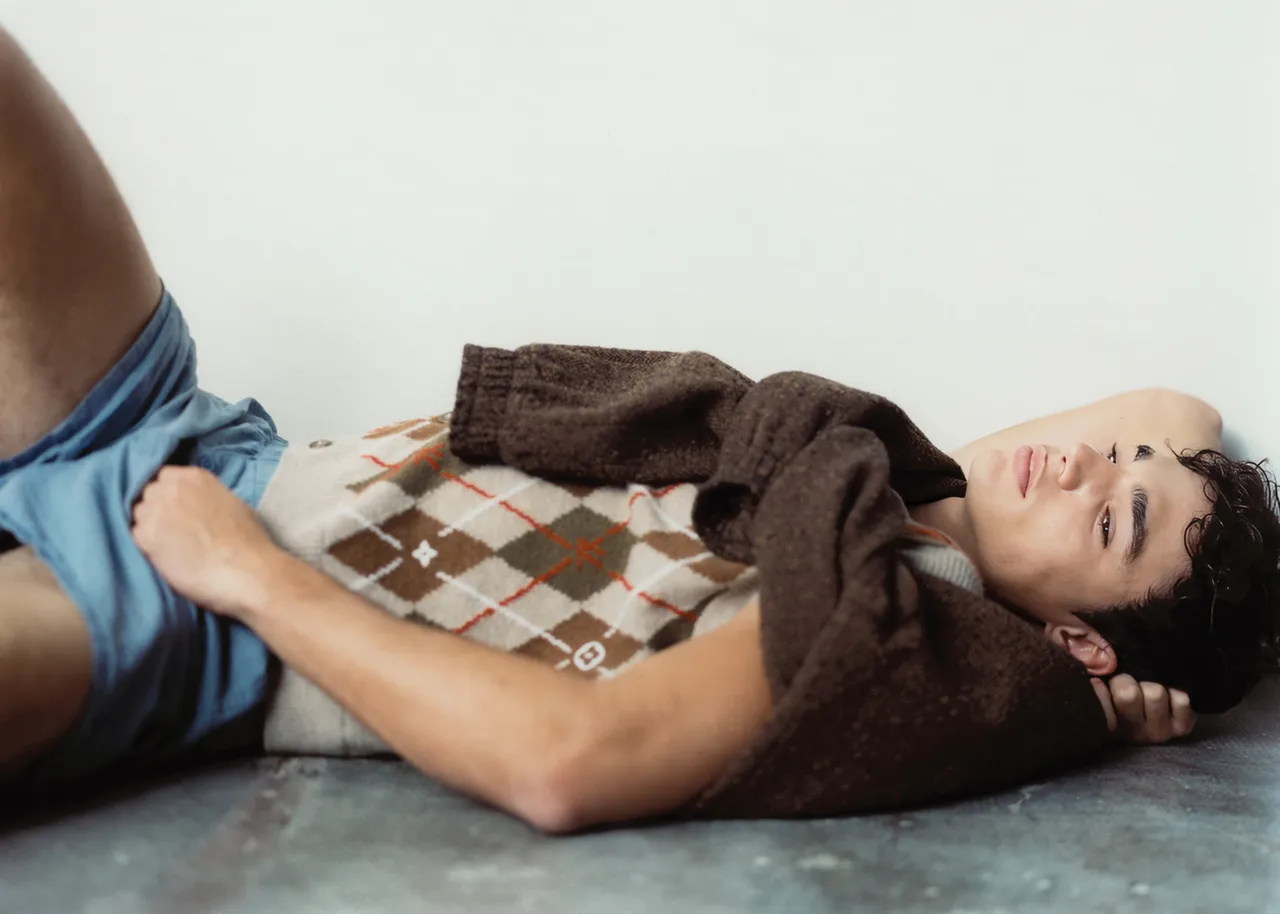
Preppy cardigan vest in fine baby merino wool, tweed outdoor jacket worn over the shoulders, all LOUIS VUITTON.
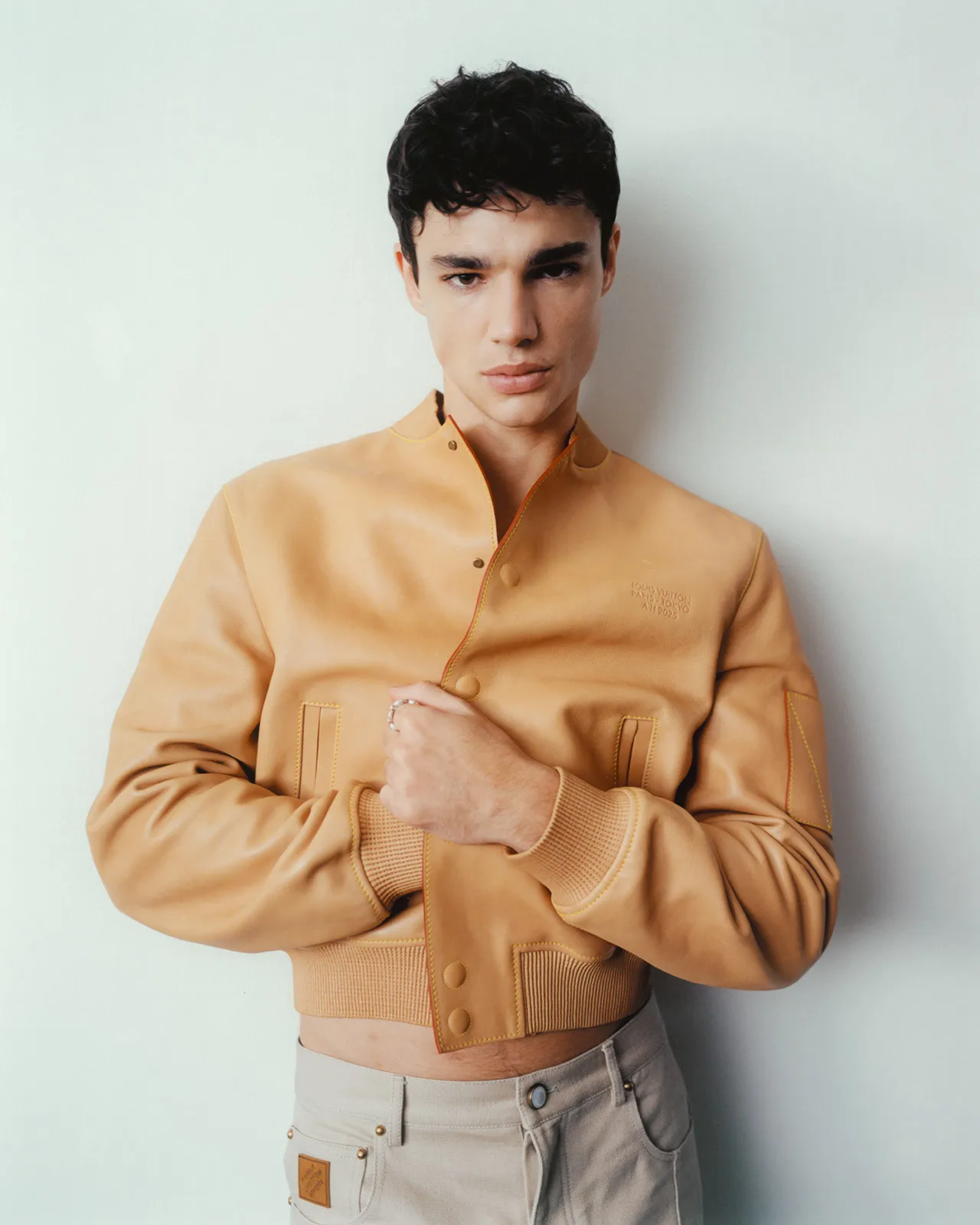
Natural leather varsity jacket in butter-soft calfskin, workwear trousers in cotton canvas, all LOUIS VUITTON.
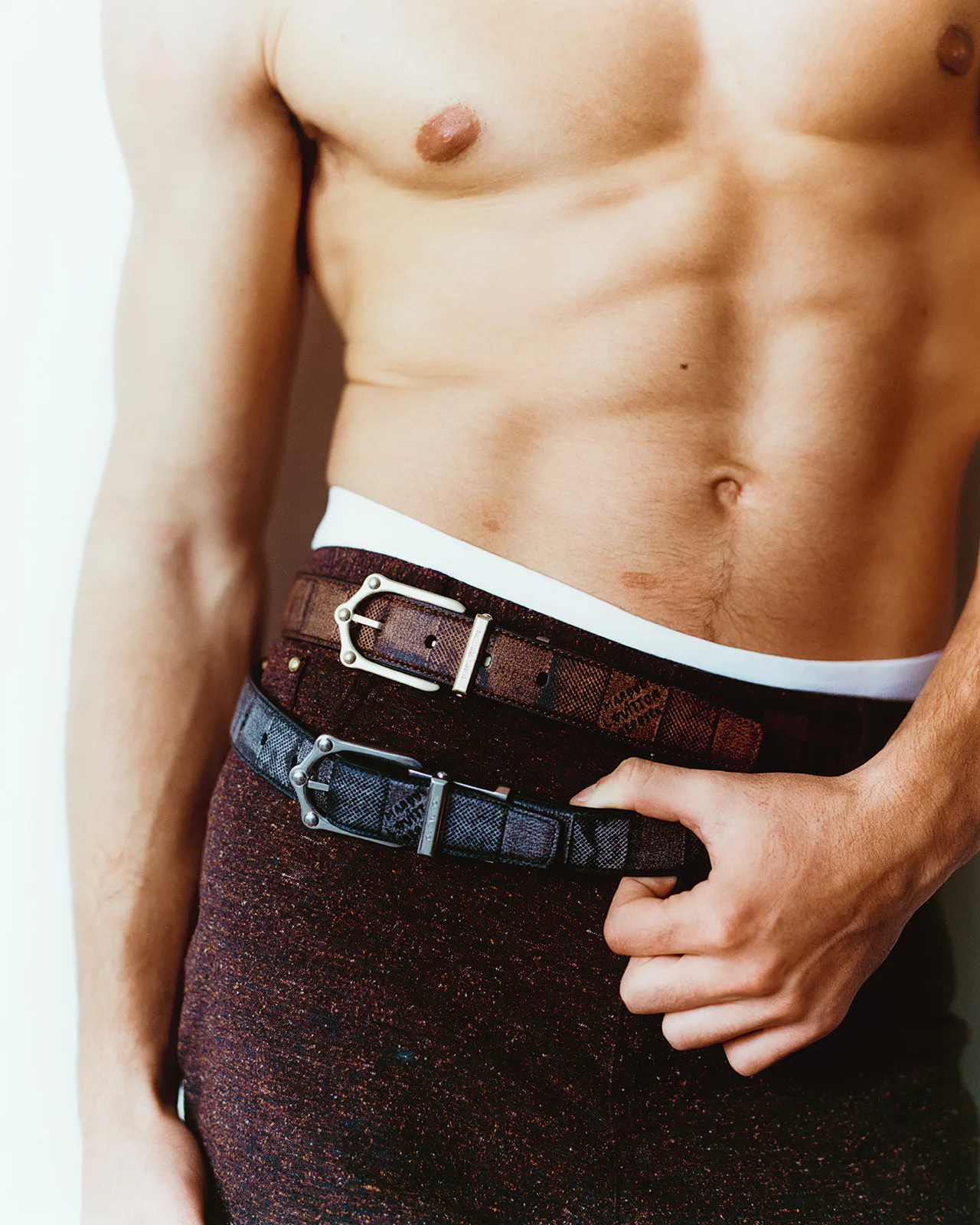
Drawstring trousers in wool tweed, Frog 30mm reversible belts, all LOUIS VUITTON.
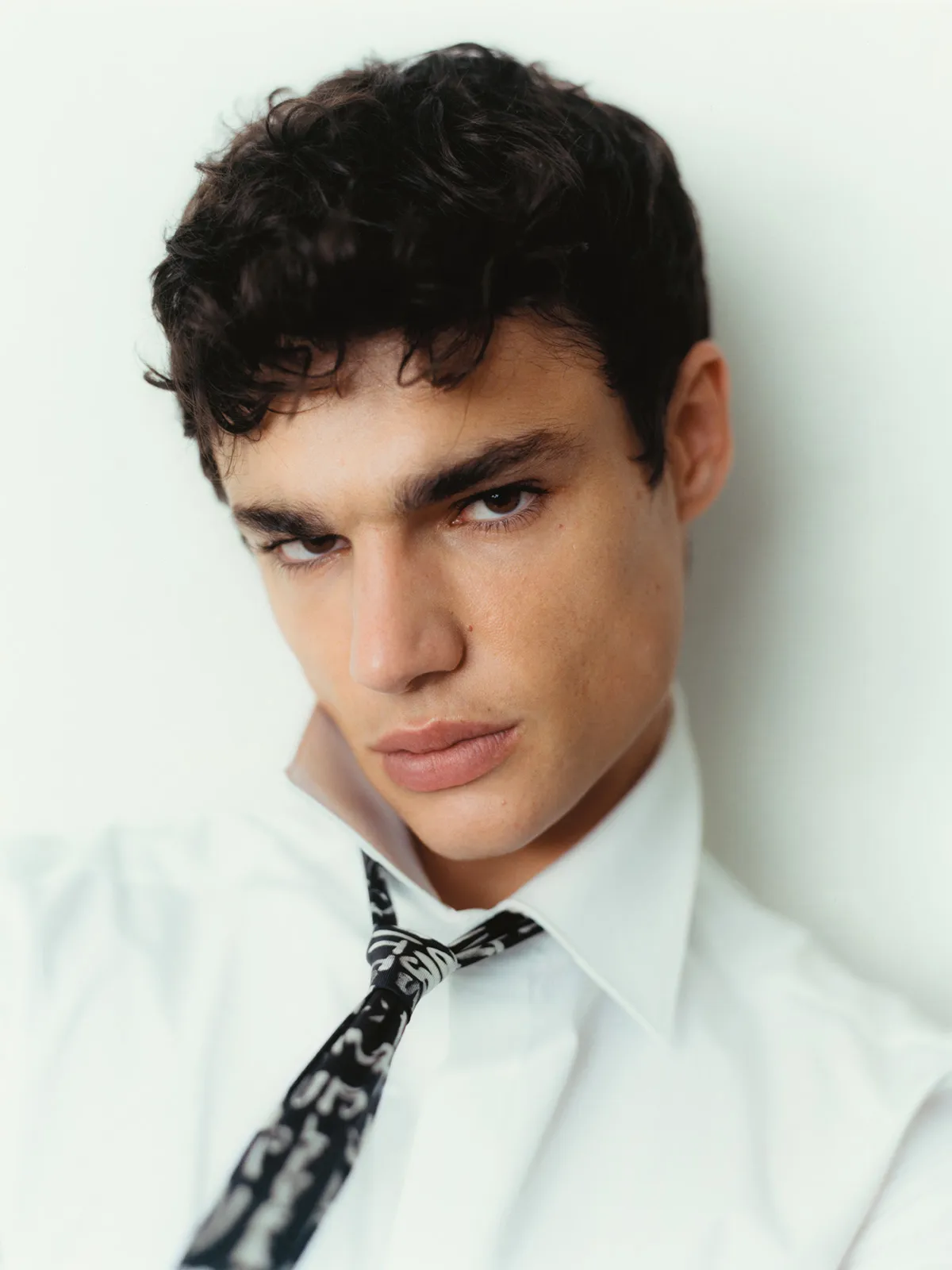
Crisp white cotton shirt, LV Scribble tie in silk, all LOUIS VUITTON.
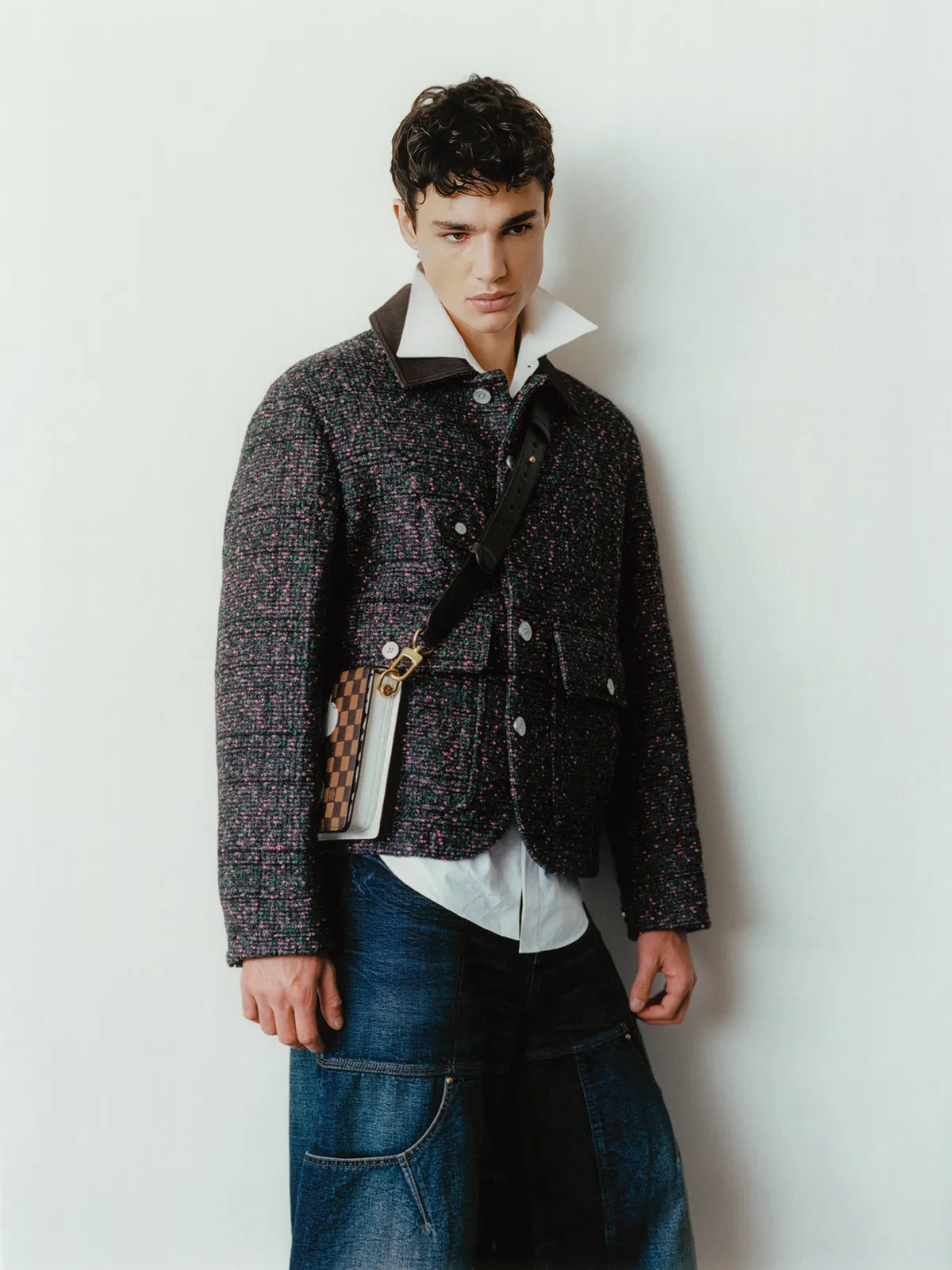
Gardening workwear jacket in brown tweed with pink and green accents, crisp white cotton shirt, wide-leg fit
jeans in washed indigo denim, Book Messenger bag made from Damier Ebene canvas, all LOUIS VUITTON.
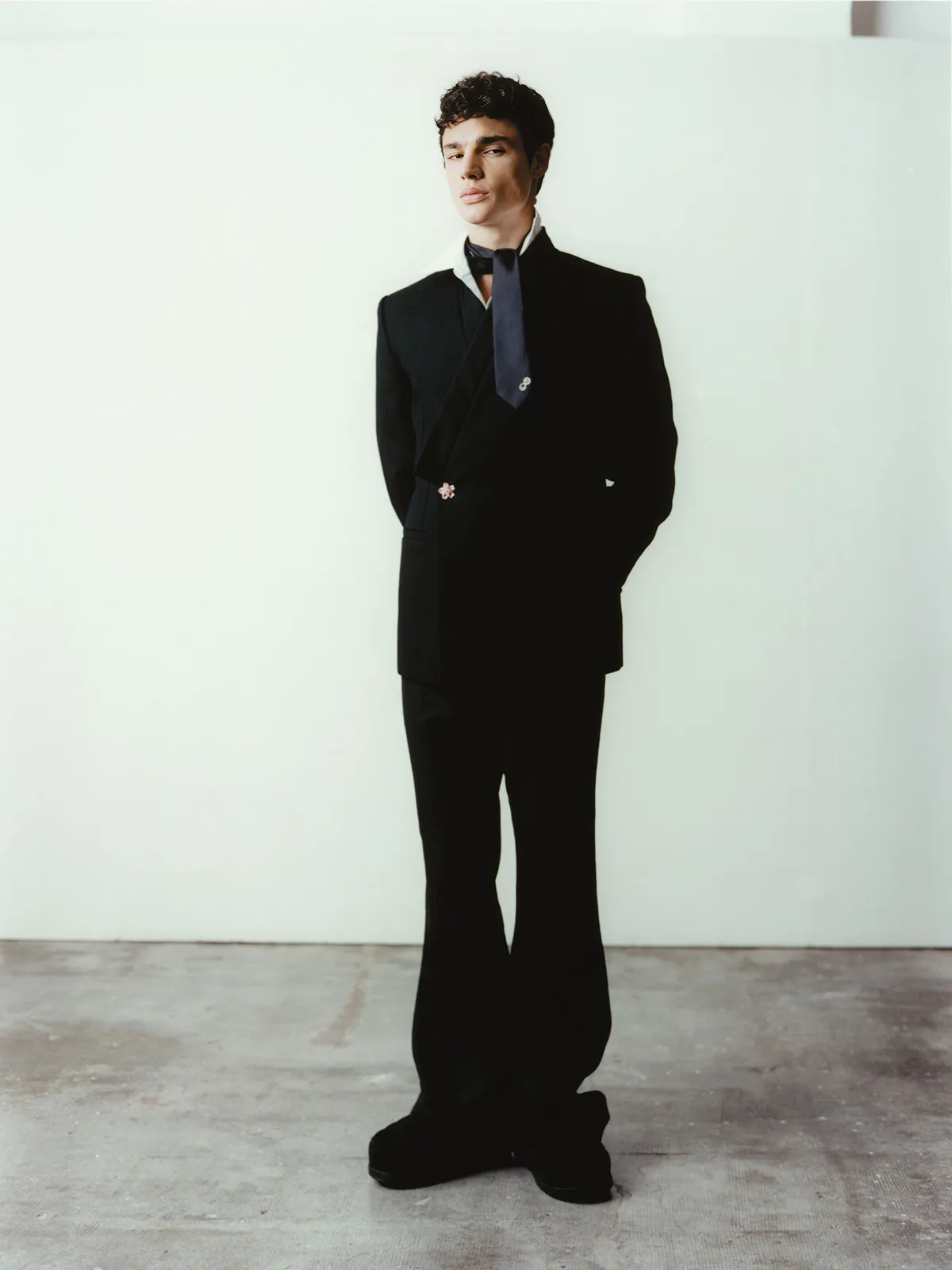
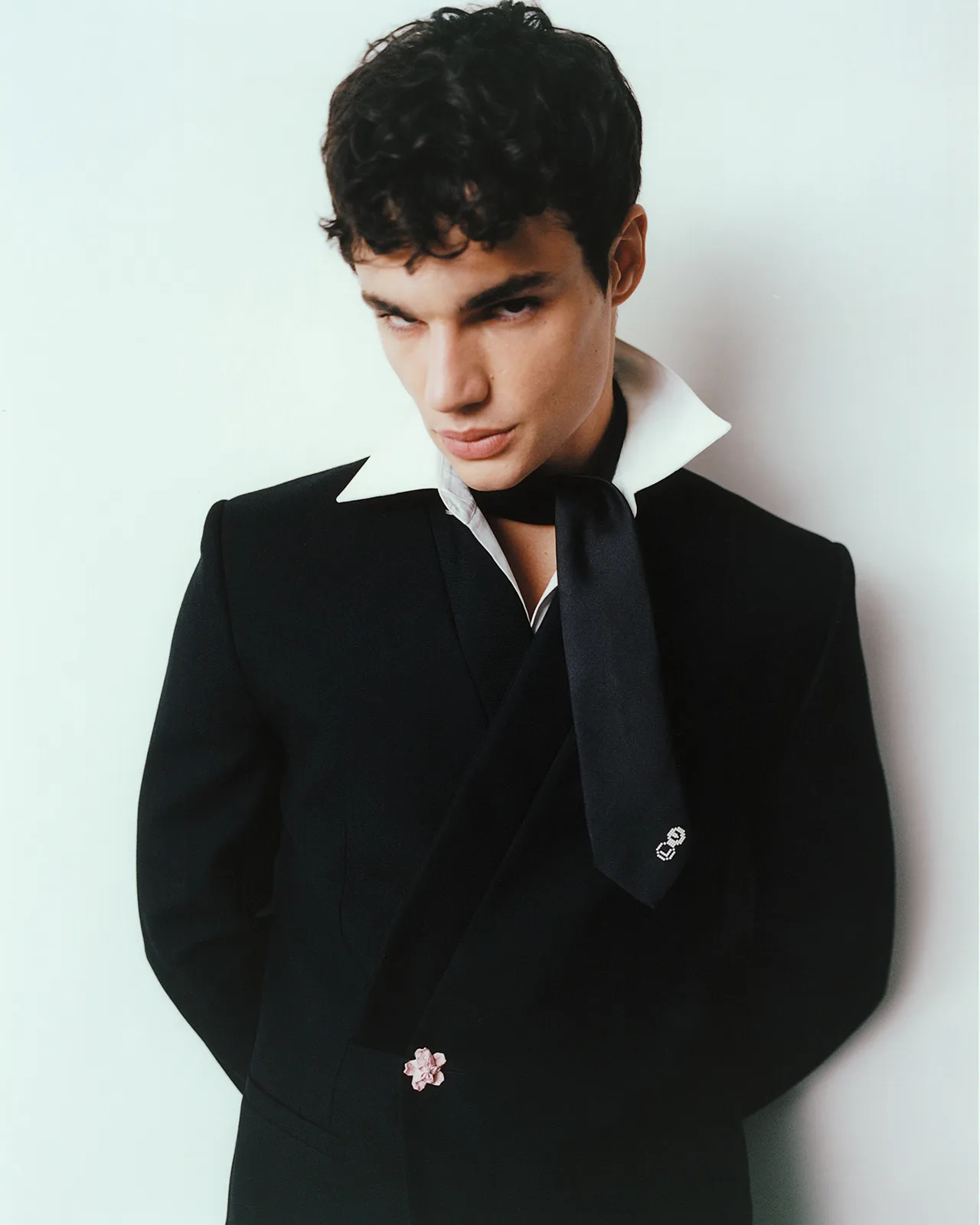
Tailored double-breasted jacket in black wool-mohair suiting with a kimono-style collar, crisp white cotton shirt, trousers in technical jersey
cut in a fitted shape with flared ankles, LV Phriendship tie in silk, LV Buttersoft sneaker in lamb and calfskin, all LOUIS VUITTON.
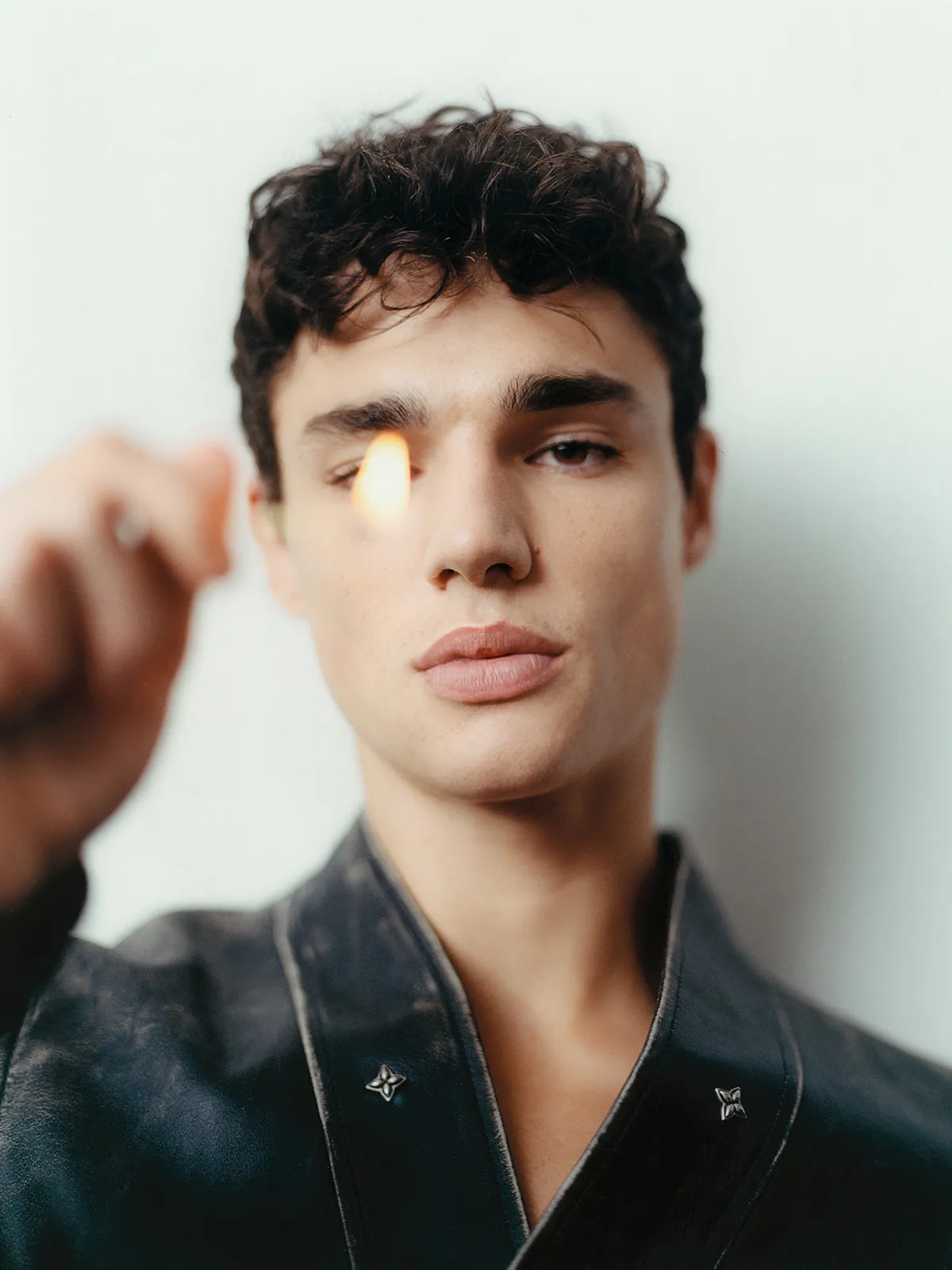
Leather karate jacket with a kimono-like wrap-over collar LOUIS VUITTON.
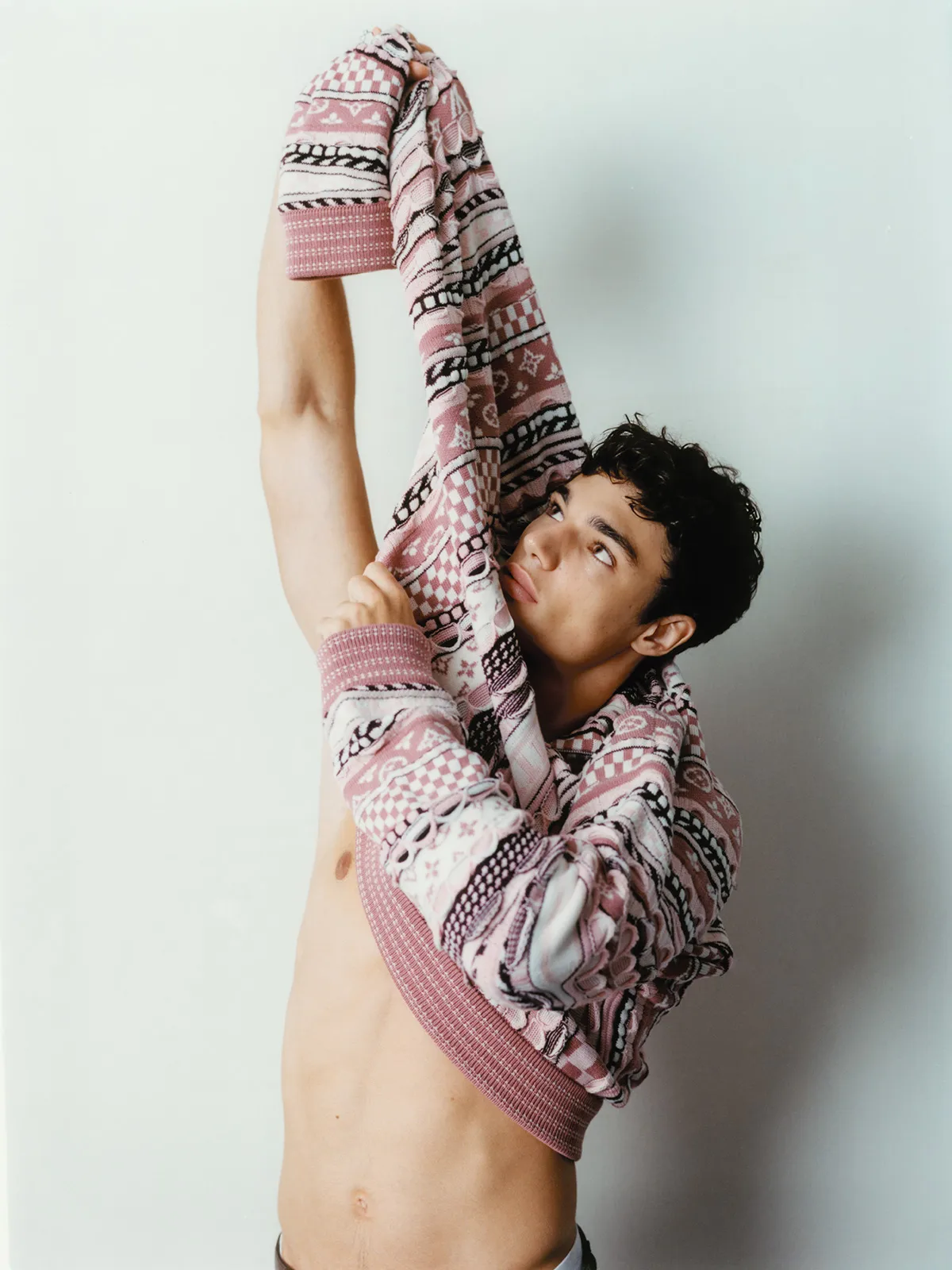
Pale pink half-zip jumper with a detailed jacquard LOUIS VUITTON.
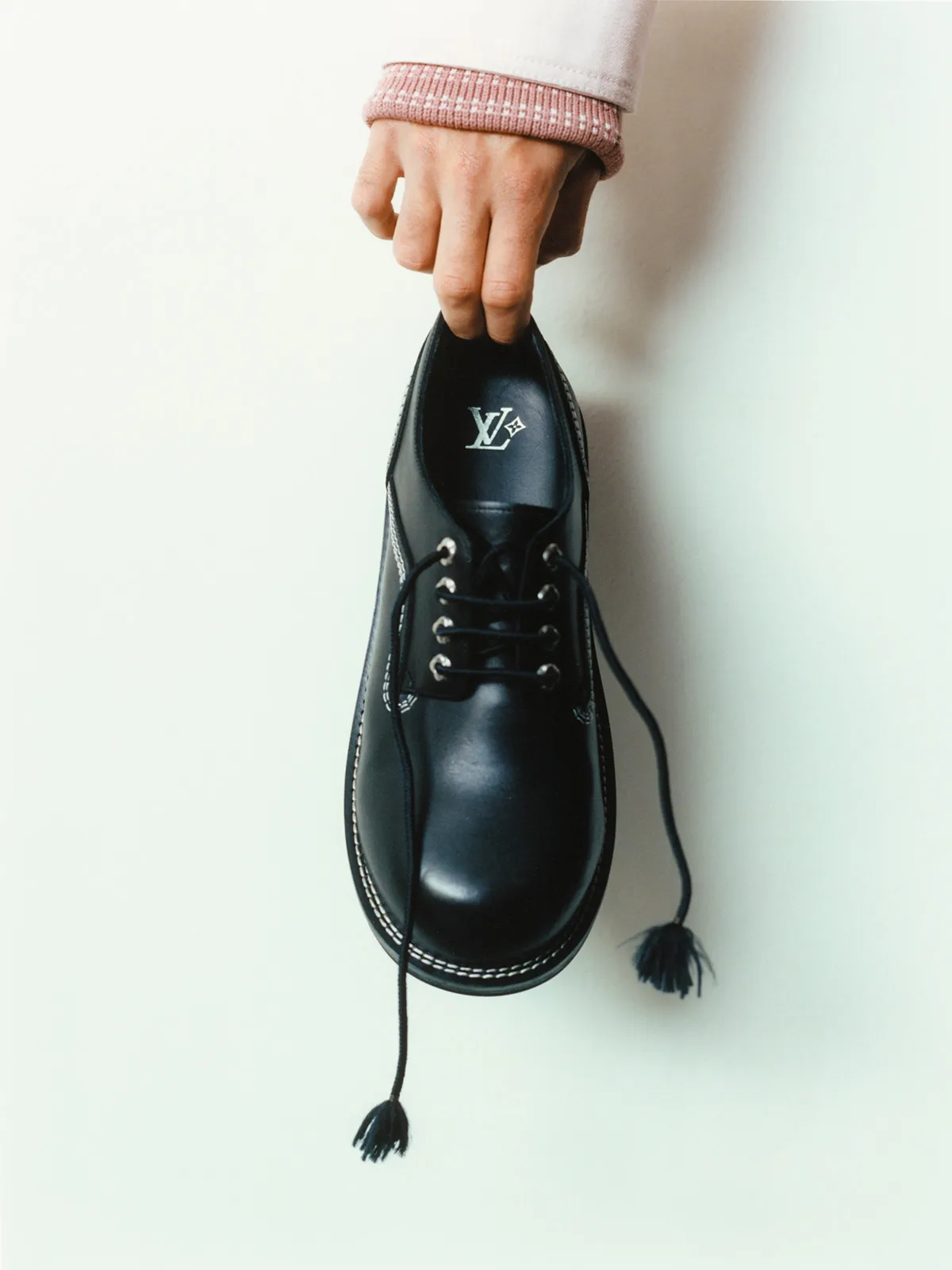
LV Bubble derby shoes LOUIS VUITTON.
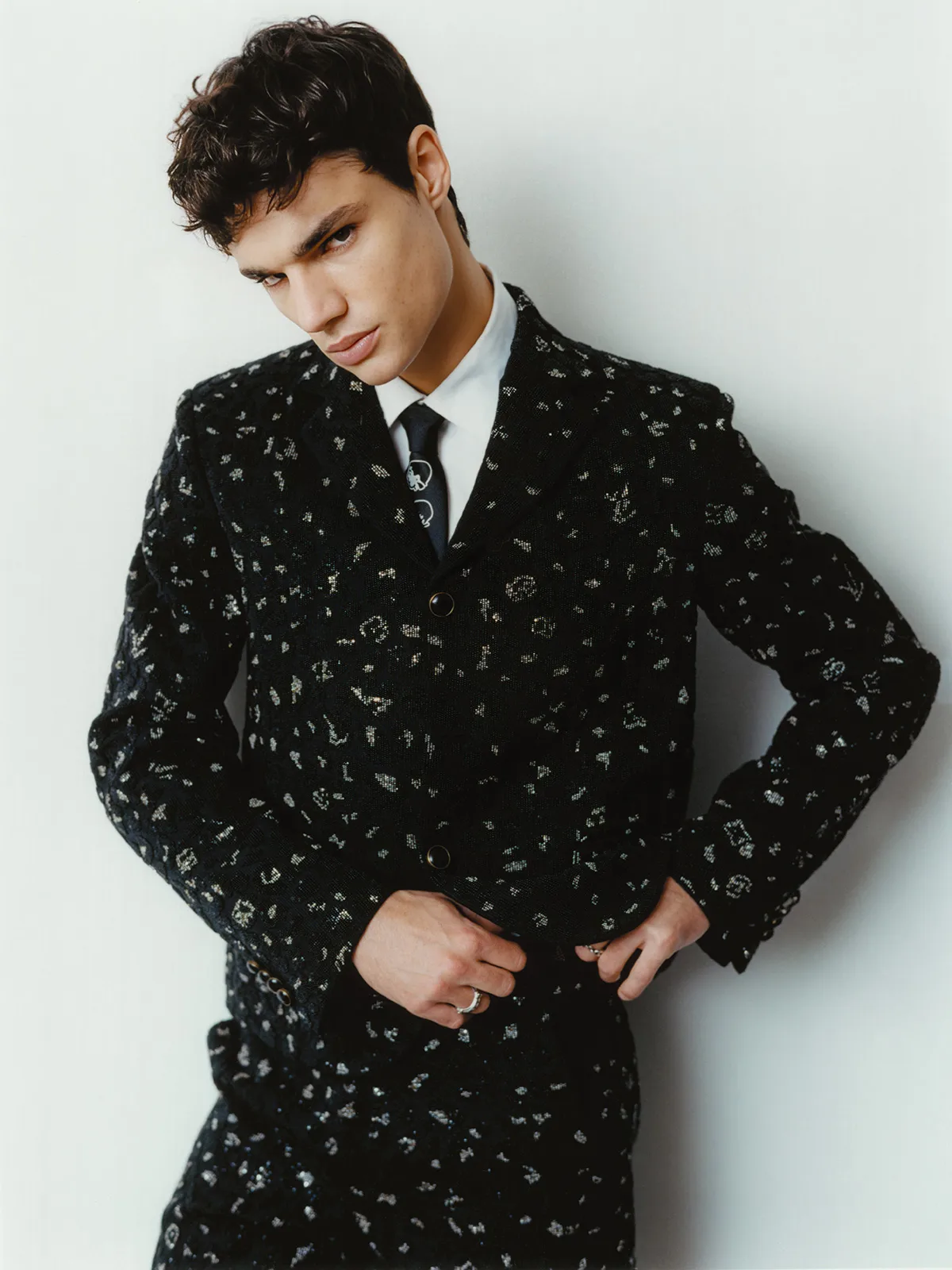
Tailored jacket and flared trousers embroidered with leopard detailing, crisp white cotton shirt, LV Phriendship tie in silk, all LOUIS VUITTON.
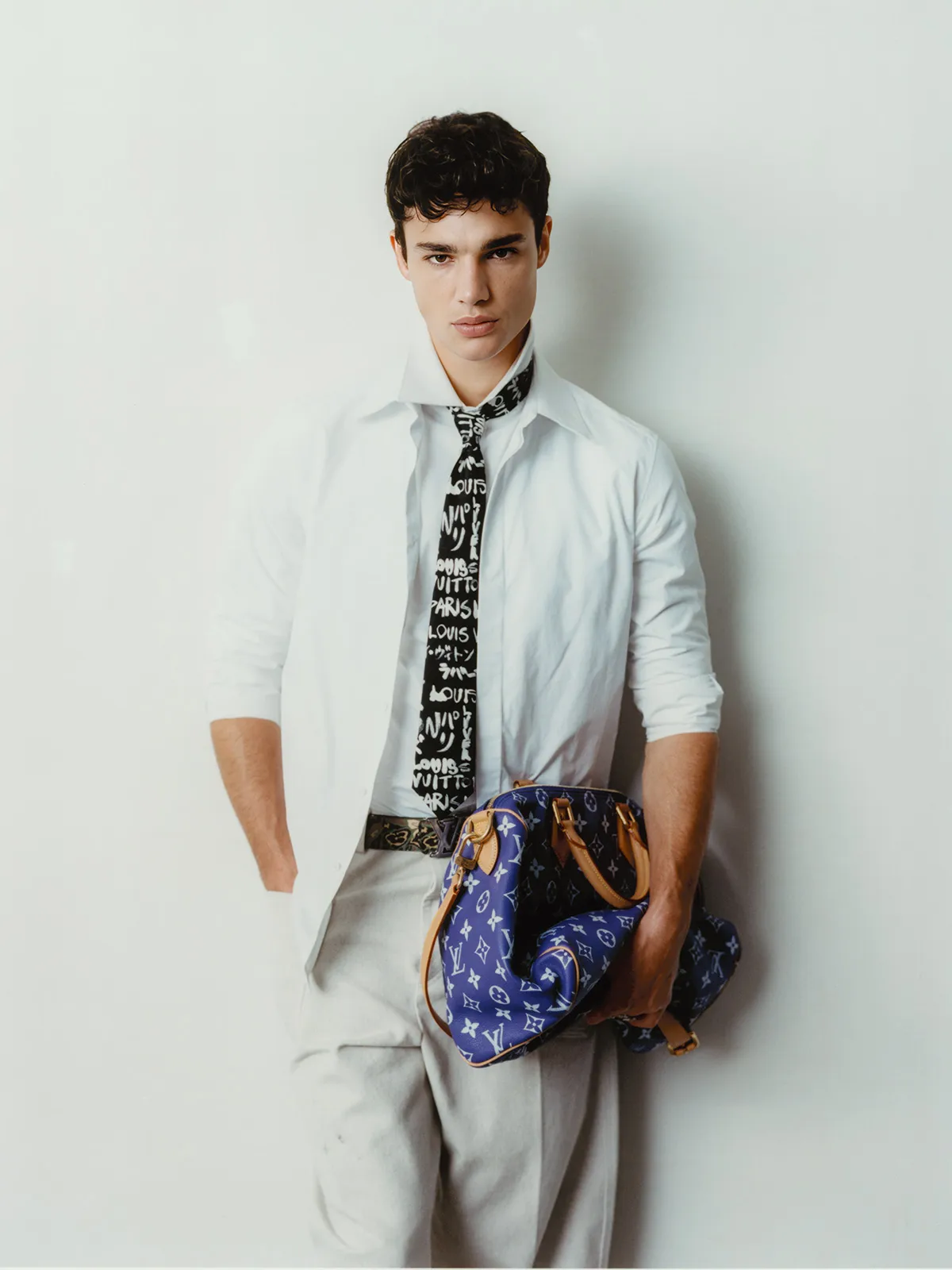
Crisp white cotton shirts, beige twill tailored trousers, LV Scribble tie in silk, LV Flower Camouflage 40mm reversible belt, Speedy P9 Bandoulière 50 bag in calfskin, all LOUIS VUITTON.