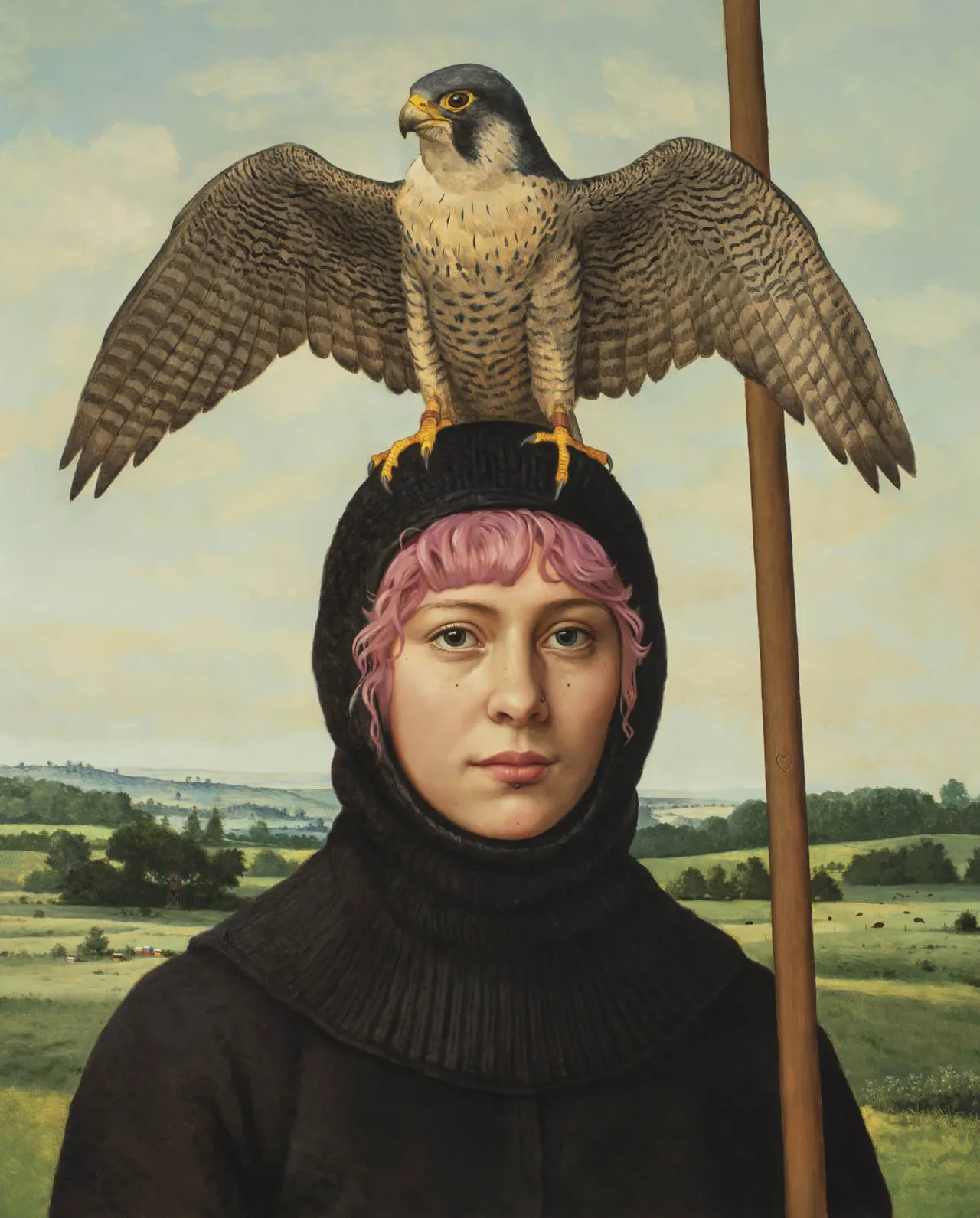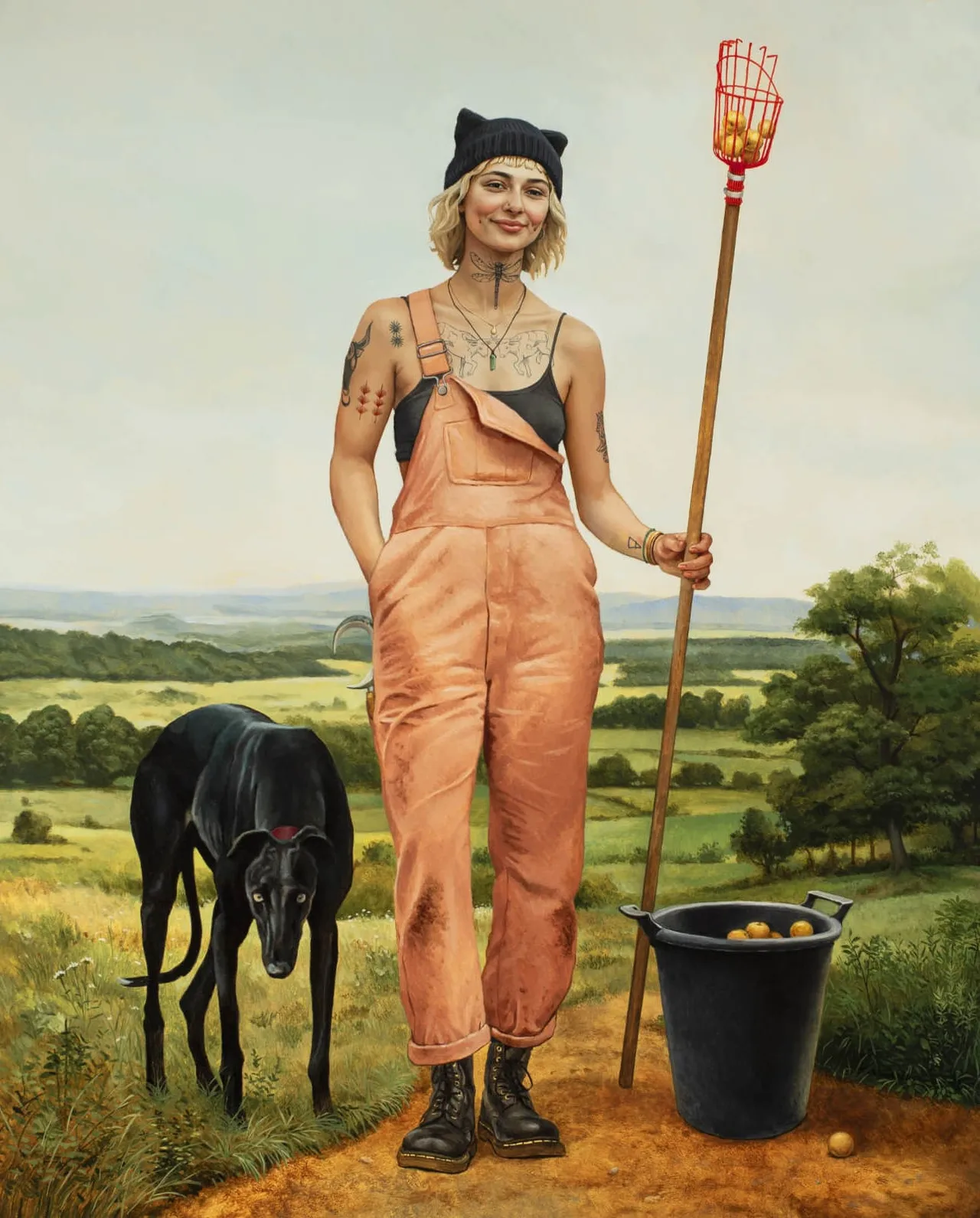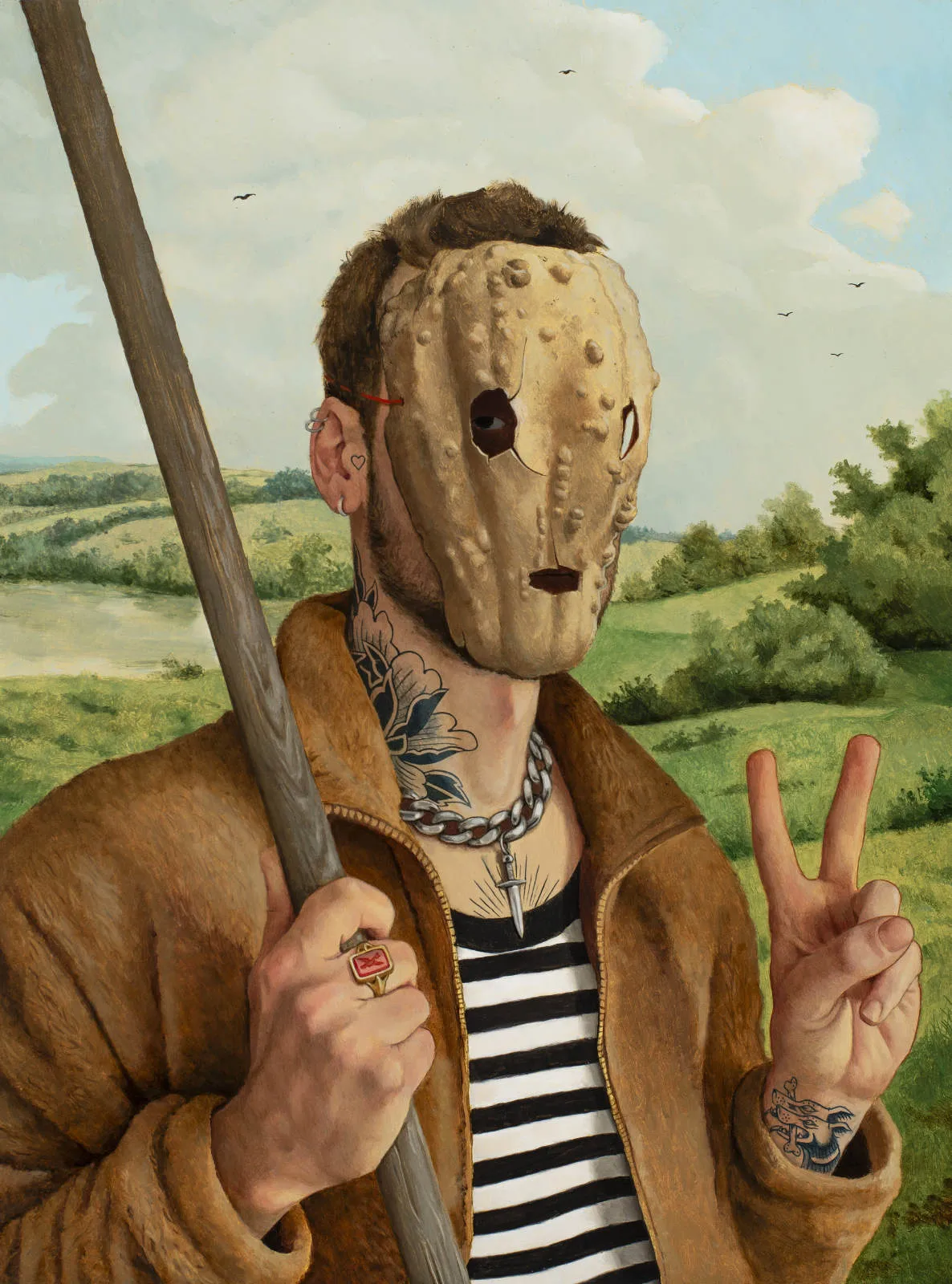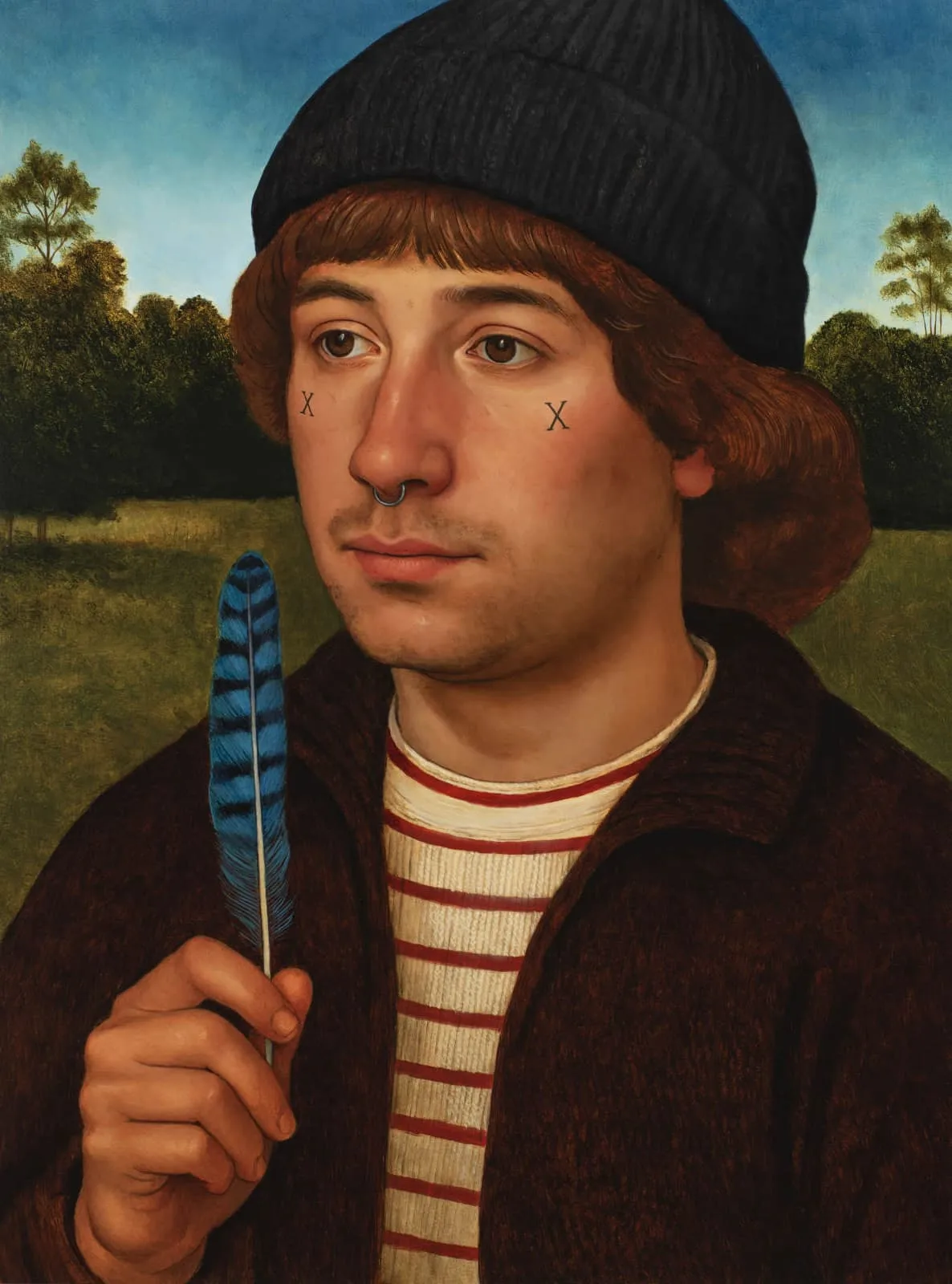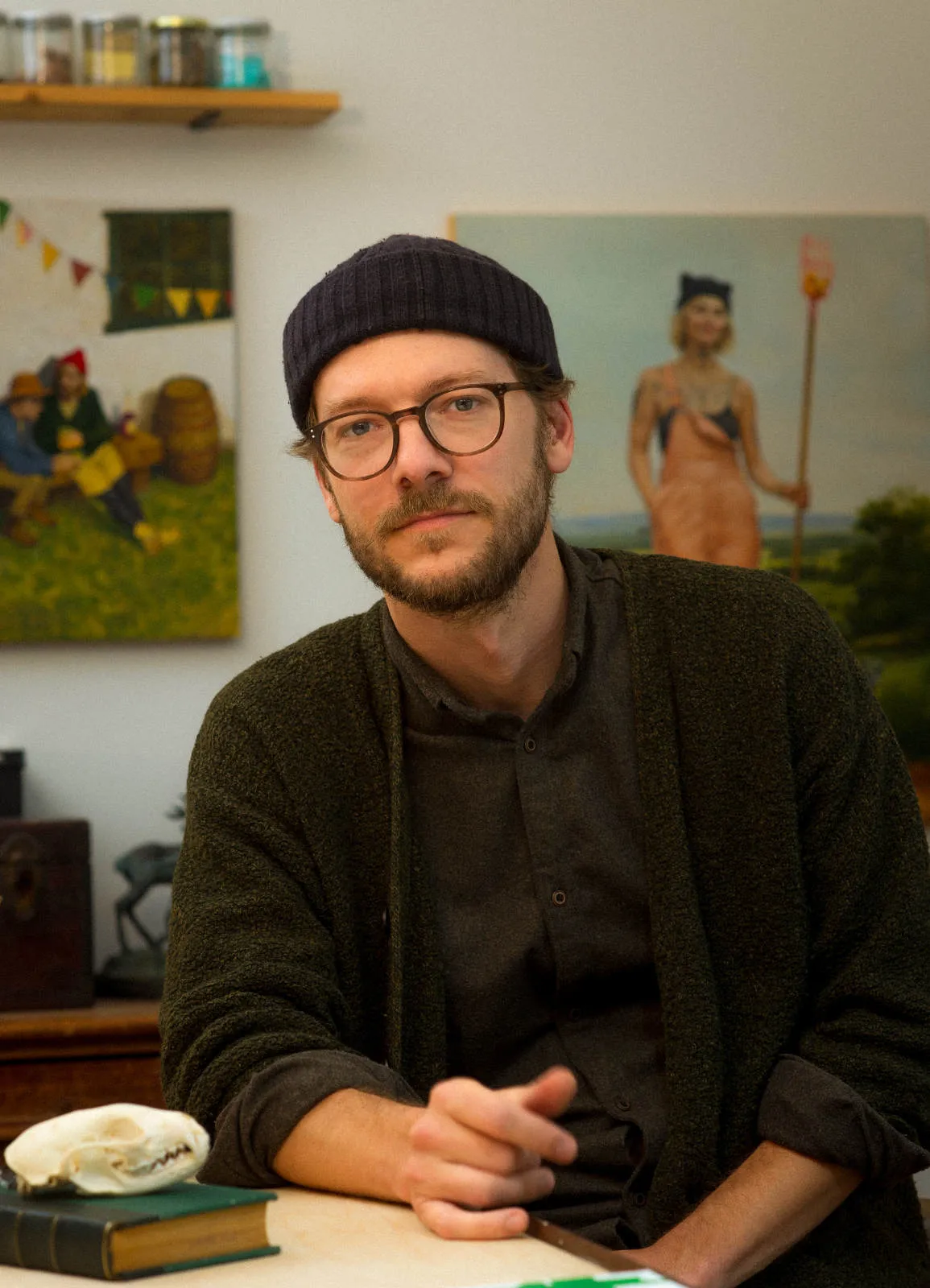
The dream of leaving the city behind and living on a rural commune, picking apples, running through fields, surrounded by nature and animals – while perhaps an idealised image of the countryside – feels like a calm alternative to the hustle and bustle of urban life that can render its inhabitants invisible. For Émile Brunet, that dream became a reality during the pandemic with his move to Stanstead, a small Canadian town, and inspired his latest collection, Are They Peasant. On display at Elena Platonova’s Plato Gallery through March 7, Brunet’s first solo NYC exhibition is a reflection on the projections of imagination and the necessity of contrast.
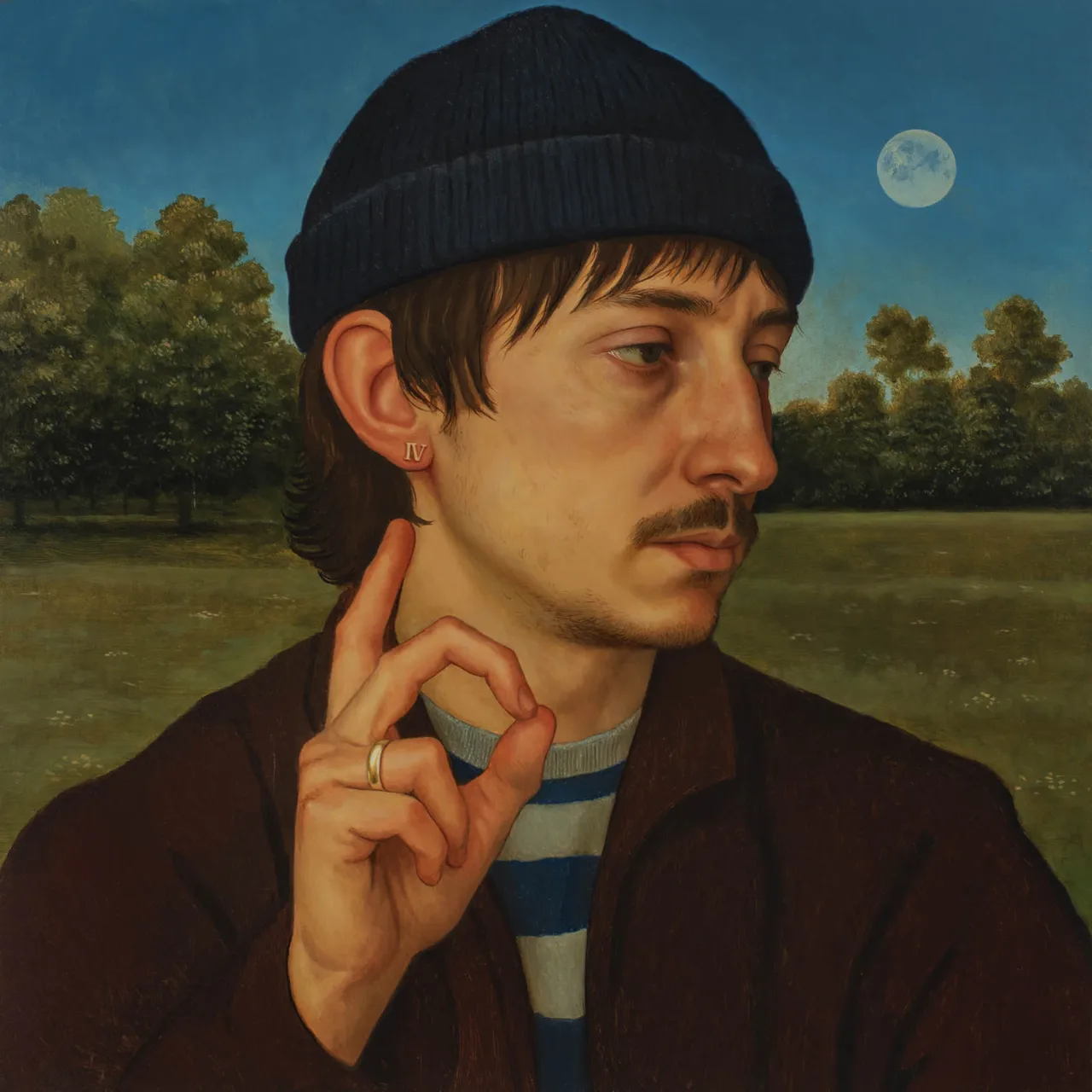
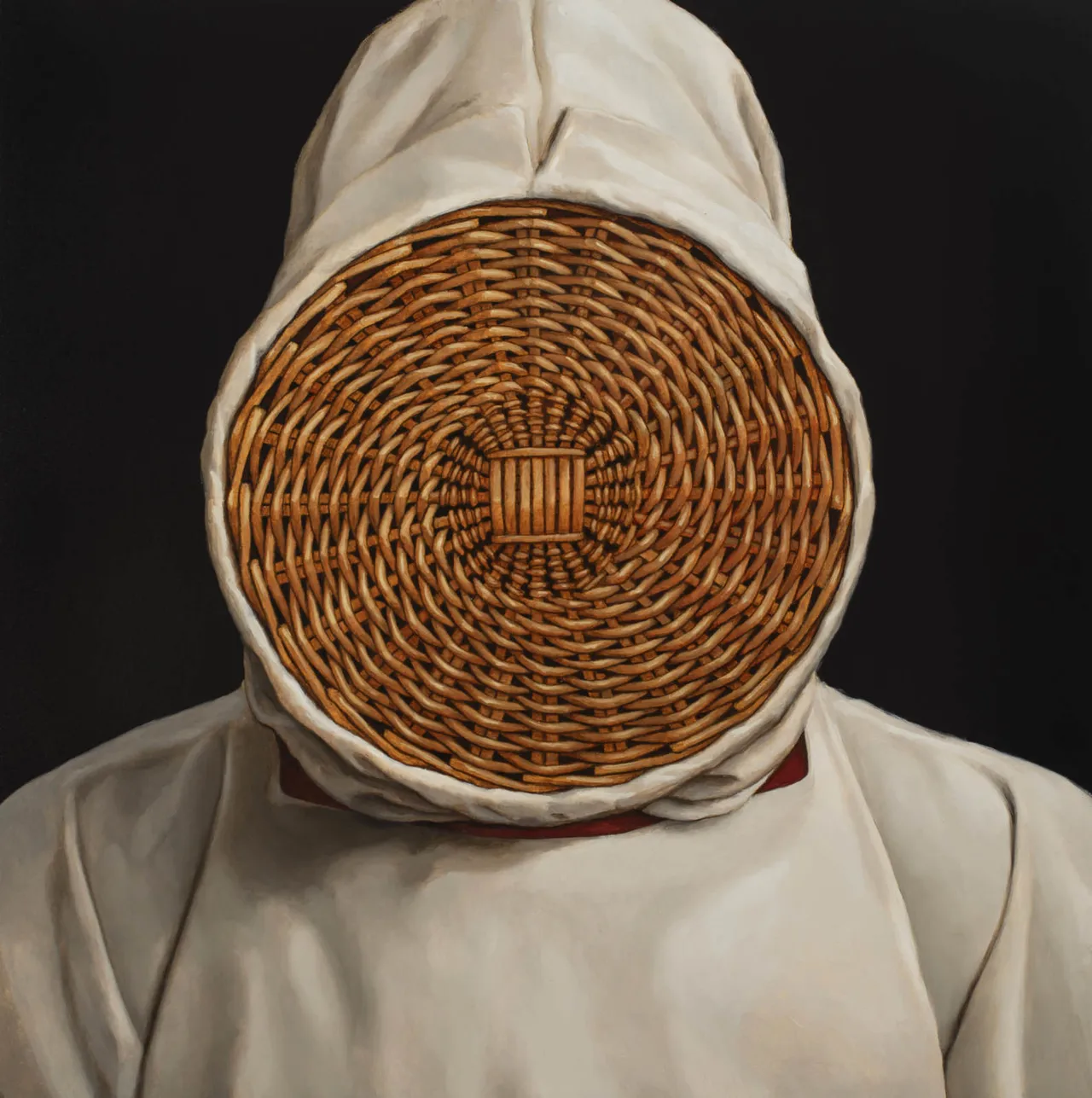
Brunet, a Canadian painter, aims to connect his Renaissance inspirations to the contemporary representations of rural living. Motifs such as tattoos and hounds mimic historical imagery of animals and personal adornments to show how the evolution of humankind has been in parallel to our past rather than an exponential growth. The characters he paints do have an air of irony to them – being constructed by supposedly opposite tools such as historical references and AI. Of this contrast, Brunet says he’s “not staging a confrontation between old and new, but revealing their structural kinship. Both are technologies of vision. Both shape how we imagine reality.” In employing superficially irreconcilable methods, he exemplifies the polarities we can hold within ourselves and, looking outward, in our society.
Are They Peasant feels like a modern fable for those who want a fairytale representation of the slower lifestyle. This is not to say that Brunet believes this legend. In fact, it goes to show the idealised and stylised reality that was fabricated for him through social media and his own expectations. However, rural life still manages to break free from the constant commotion and advancement that urban living thrives on. We speak with him about his own perception of rural life thus far, accepting contradictions, and appropriating inspirations ranging from one of Henry VIII’s wives to nature’s creations.
Given your ‘neo-alchemist’ background, what is your favourite item to make from scratch?
I particularly enjoy making lake pigments. They are organic dyes that have been chemically fixed onto a metallic salt, which renders them stable, insoluble, and therefore suitable for paint. What I find so satisfying about this process is that, from a plant you cultivate yourself or gather in the wild, a completely new and unique colour comes into being. The procedure involves so many variables (the species of plant, the season, the mineral base, the temperature, the timing) that no two results are ever identical. When I see that colour slowly emerge from what initially appears to be chaos, I genuinely feel like an alchemist.
That said, oil painting itself remains the object I love crafting the most. It is complex and precious, not only materially but conceptually. The process mobilises so many components: prepared supports, handmade pigments, oils, varnishes, brushes — each element often crafted or refined beforehand. On a trophic level, I sometimes think of it as an apex predator. A work of art sits at the top of a chain not because it is superior, but because it is denser, more costly, and more dependent. It accumulates layers of labour, resources, and knowledge.
In the end, it reaches a paradoxical state: it becomes an object with no direct practical function other than contemplation. And yet, precisely because of that, it holds a unique form of value — one rooted not in utility, but in meaning.
That said, oil painting itself remains the object I love crafting the most. It is complex and precious, not only materially but conceptually. The process mobilises so many components: prepared supports, handmade pigments, oils, varnishes, brushes — each element often crafted or refined beforehand. On a trophic level, I sometimes think of it as an apex predator. A work of art sits at the top of a chain not because it is superior, but because it is denser, more costly, and more dependent. It accumulates layers of labour, resources, and knowledge.
In the end, it reaches a paradoxical state: it becomes an object with no direct practical function other than contemplation. And yet, precisely because of that, it holds a unique form of value — one rooted not in utility, but in meaning.
How does your DIY attitude help in your creative process and analytical eye?
First, adopting a self-sufficient, DIY attitude pushes you to engage with a wide range of materials, techniques, and tools. This breadth of experience builds confidence because it increases both control and flexibility. As skills accumulate, they begin to intersect and inform one another. Technical knowledge strengthens conceptual thinking, and manual experience sharpens analytical perception. Over time, this network of competencies naturally refines both the creative process and the critical eye.
Secondly, when you make something from scratch, you hold every piece of the puzzle in your hands. Taking the time to understand where each element comes from, how it is made, and what it is composed of creates an intimate relationship with the materials. With understanding comes attachment; with attachment comes passion; and passion sustains motivation. Ultimately, this awareness fosters sensitivity. By perceiving the complexity embedded in each component, you begin to see systems rather than isolated objects. That broader perspective not only sharpens judgment but also keeps the practice alive, driven by curiosity rather than habit.
Secondly, when you make something from scratch, you hold every piece of the puzzle in your hands. Taking the time to understand where each element comes from, how it is made, and what it is composed of creates an intimate relationship with the materials. With understanding comes attachment; with attachment comes passion; and passion sustains motivation. Ultimately, this awareness fosters sensitivity. By perceiving the complexity embedded in each component, you begin to see systems rather than isolated objects. That broader perspective not only sharpens judgment but also keeps the practice alive, driven by curiosity rather than habit.
Moving from a city to a small town, you drew inspiration from the eclectic characters in your daily life. How is social media shaping the perception of self in the countryside as opposed to the city?
Life in the countryside is still new to me, so I remain cautious in my observations. If I think in terms of ecosystems, which often informs my work, density inevitably intensifies competition. In urban environments, visibility becomes a scarce resource, and social media extends that competitive field. The self must constantly assert, refine, and differentiate itself. Identity becomes something composed and displayed, almost like a form of contemporary ornamentation. In less densely populated environments, the pressure to perform appears reduced. Social media functions more as connective tissue than as spectacle — more infrastructure than theatre. Function tends to precede aesthetic assertion.
That said, the neo-rural figures I depict, and in some ways inhabit myself, are not directly drawn from the town where I currently live, which has remained relatively untouched by gentrification. They are informed by experiences in other, more visibly transformed rural villages, but also by the images and narratives circulating through social media. My perception of these inhabitants was therefore never entirely immediate; it was already filtered, aestheticised, and subtly idealised. In that sense, these characters are less documentary than constructed, a form of auto-fiction shaped by lived experience, projection, and digital mediation. Just as landscapes shape the figures within them, ecosystems of attention shape the identities we come to embody.
That said, the neo-rural figures I depict, and in some ways inhabit myself, are not directly drawn from the town where I currently live, which has remained relatively untouched by gentrification. They are informed by experiences in other, more visibly transformed rural villages, but also by the images and narratives circulating through social media. My perception of these inhabitants was therefore never entirely immediate; it was already filtered, aestheticised, and subtly idealised. In that sense, these characters are less documentary than constructed, a form of auto-fiction shaped by lived experience, projection, and digital mediation. Just as landscapes shape the figures within them, ecosystems of attention shape the identities we come to embody.
“I am fascinated by the human capacity to fetishise what once threatened us. We domesticate fear, refine it, and reintroduce it into culture as status, sport, or ornament.”
Rural life is often missing from pop culture representation, but many millennials moved to escape the social and economic status of urban life. Why is it important to show a new generation of countryside dwellers?
Because it reflects a deeper tension that runs through our time. Just as individuals experience an internal struggle between desire and restraint, our societies oscillate between acceleration and the need for measure. The movement toward the countryside can be read within that same dynamic. I see it not as a nostalgic return to origins, but as an attempt to step outside the logic of constant expansion — the frenzy of urban productivity and the extractive intensity of industrial agriculture. It signals a search for recalibration. From an artistic perspective, this generates a compelling visual structure: the contemporary figure (stylised, self-aware) set within cultivated land and seasonal rhythms. The image itself becomes a negotiation between control and surrender, artifice and soil.
Although this phenomenon remains entangled with gentrification, it also carries an aspiration toward rebalancing. Many who relocate are not simply seeking possession, but experimenting, however imperfectly, with slower temporalities, smaller-scale cultivation, and a more conscious relationship to labour and land. What interests me is that this gesture mirrors the inner moral conflict I described earlier. If the city embodies unrestrained desire — speed, growth, optimisation — the countryside becomes a site of resistance, or at least of reconsideration. These figures inhabit that threshold. They are neither fully renouncing modernity nor entirely submitting to it. They stand in the borderland between indulgence and restraint, searching for a form of harmony within contradiction.
Although this phenomenon remains entangled with gentrification, it also carries an aspiration toward rebalancing. Many who relocate are not simply seeking possession, but experimenting, however imperfectly, with slower temporalities, smaller-scale cultivation, and a more conscious relationship to labour and land. What interests me is that this gesture mirrors the inner moral conflict I described earlier. If the city embodies unrestrained desire — speed, growth, optimisation — the countryside becomes a site of resistance, or at least of reconsideration. These figures inhabit that threshold. They are neither fully renouncing modernity nor entirely submitting to it. They stand in the borderland between indulgence and restraint, searching for a form of harmony within contradiction.
Contrast seems to be a big theme in your work. Where do you find the most contrast in your life? Why is it important to the human experience?
For me, the most radical contrast is the one that divides us internally: the pull of desire against the gravity of reason. I experience it as a constant oscillation. On one side, the luminous promise of technological progress, speed, and limitless stimulation; on the other, a quieter, almost ancestral voice urging restraint, depth, and continuity with the past. This tension feels symbolic of our condition: we stand between acceleration and memory, between expansion and rootedness. Contrast is essential because it is the space where consciousness emerges, where we become aware of ourselves, not as unified beings, but as fields of opposing forces.
You build on many references ranging from the Roman goddess, Diana, to 15th and 16th century painters while also occasionally employing AI. How do these supposedly opposite tools support the overall message of this exhibition?
Diana and AI may seem irreconcilable at first glance: one rooted in myth, nature, and archaic symbolism; the other in algorithms, data, and technological acceleration. Yet I see them as operating on the same threshold. The show explores how apparent opposites can coexist within a shared, ambiguous terrain, a kind of murky borderland where categories dissolve. On a visible level, there is the encounter between urbanity and rurality, between the cultivated and the wild. But more fundamentally, it is about the dialogue between past and present, origin and projection, memory and simulation.
By placing these tools side by side, I’m not staging a confrontation between old and new, but revealing their structural kinship. Both are technologies of vision. Both shape how we imagine reality. I am convinced that any perception of truth that aspires to universality must contain its opposites. Harmony, to me, is not the absence of contradiction, but its orchestration. The exhibition inhabits that unstable equilibrium where the archaic and the hypermodern momentarily recognise each other.
By placing these tools side by side, I’m not staging a confrontation between old and new, but revealing their structural kinship. Both are technologies of vision. Both shape how we imagine reality. I am convinced that any perception of truth that aspires to universality must contain its opposites. Harmony, to me, is not the absence of contradiction, but its orchestration. The exhibition inhabits that unstable equilibrium where the archaic and the hypermodern momentarily recognise each other.
The tall, muscular hounds have a long history of nobility, hunting, and protection. What is the purpose of integrating these into your paintings?
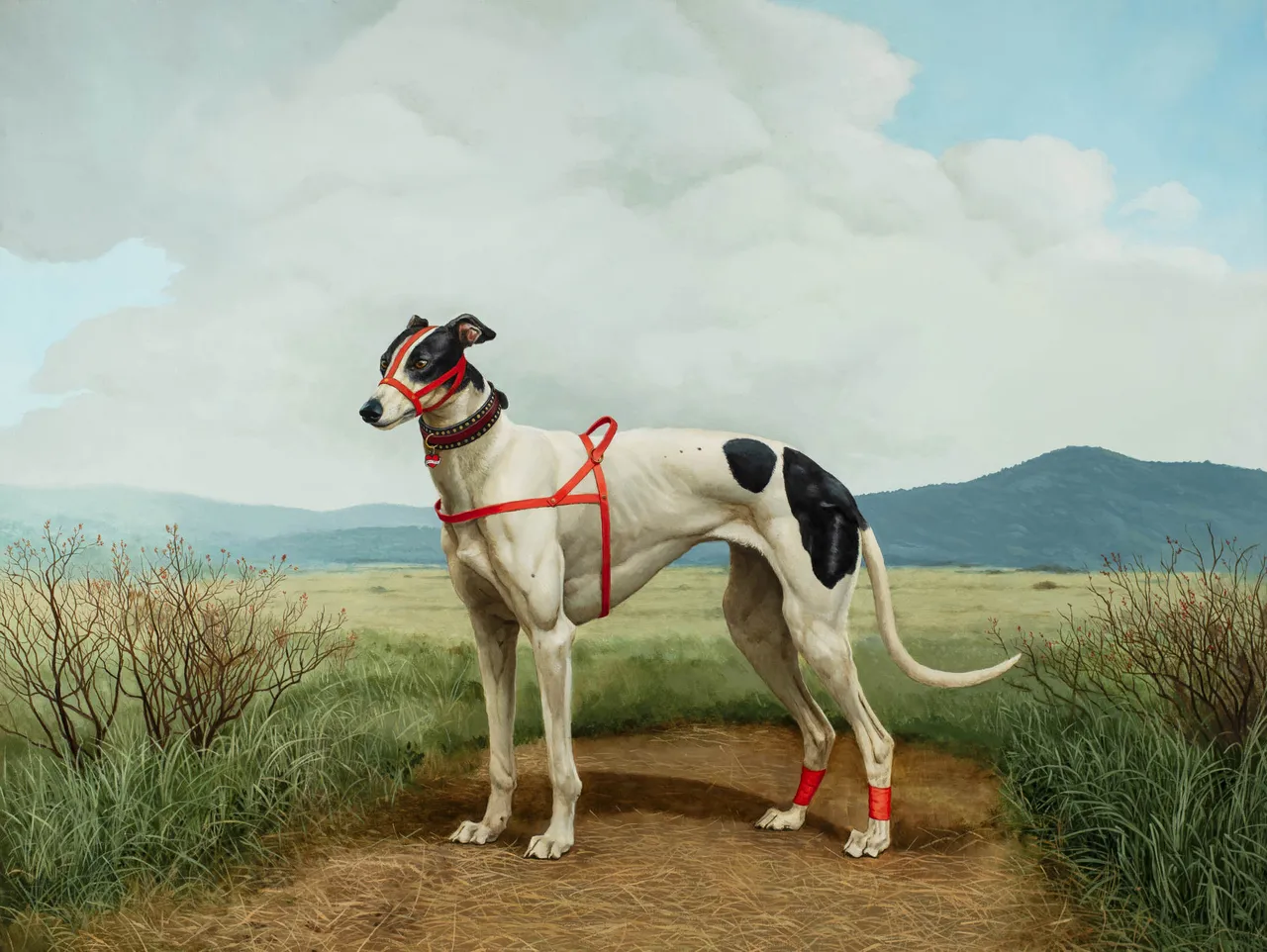
The hounds embody, for me, a particularly striking example of how humans aestheticise and instrumentalise nature at the same time. They carry within them a long lineage of nobility, hunting, warfare, and protection, yet beneath that cultivated history remains the wolf. Their presence in my paintings points to this transformation: how a predator becomes an emblem, how survival becomes ritual, and eventually spectacle.
I am fascinated by the human capacity to fetishise what once threatened us. We domesticate fear, refine it, and reintroduce it into culture as status, sport, or ornament. Turning the wolf into a hunting companion is not merely practical; it is symbolic. It reveals something essential about our species: our impulse to convert danger into mastery, instinct into strategy, and terror into aesthetic form. In that sense, the hound parallels fire: both once uncontrollable forces, both absorbed into the sphere of human agency.
There is also a more personal tension at play. I am not naturally a ‘dog person,’ which makes my persistent return to painting them somewhat paradoxical, even ironic. Where many see loyalty, charm, and companionship, I perceive something more ambiguous: a grotesque elegance, a latent violence, a creature that is both noble and absurd. They are loud, theatrical, almost excessive in their physicality. This excess interests me.
What intrigues me most is not simply that we transformed the wolf into a tool, but that we went further, turning it into a symbol of prestige, then into a fashion accessory, and ultimately into the figure of unconditional friendship. The hound becomes a mirror of human projection. In domesticating it, we also domesticate our own anxieties about power, aggression, and vulnerability. They are not there to reassure; they are there to remind us that what we call ‘nature’ is often something we have already reshaped in our own image.
I am fascinated by the human capacity to fetishise what once threatened us. We domesticate fear, refine it, and reintroduce it into culture as status, sport, or ornament. Turning the wolf into a hunting companion is not merely practical; it is symbolic. It reveals something essential about our species: our impulse to convert danger into mastery, instinct into strategy, and terror into aesthetic form. In that sense, the hound parallels fire: both once uncontrollable forces, both absorbed into the sphere of human agency.
There is also a more personal tension at play. I am not naturally a ‘dog person,’ which makes my persistent return to painting them somewhat paradoxical, even ironic. Where many see loyalty, charm, and companionship, I perceive something more ambiguous: a grotesque elegance, a latent violence, a creature that is both noble and absurd. They are loud, theatrical, almost excessive in their physicality. This excess interests me.
What intrigues me most is not simply that we transformed the wolf into a tool, but that we went further, turning it into a symbol of prestige, then into a fashion accessory, and ultimately into the figure of unconditional friendship. The hound becomes a mirror of human projection. In domesticating it, we also domesticate our own anxieties about power, aggression, and vulnerability. They are not there to reassure; they are there to remind us that what we call ‘nature’ is often something we have already reshaped in our own image.
Many of the tattoos are inspired by nature. What was the motivation behind this?
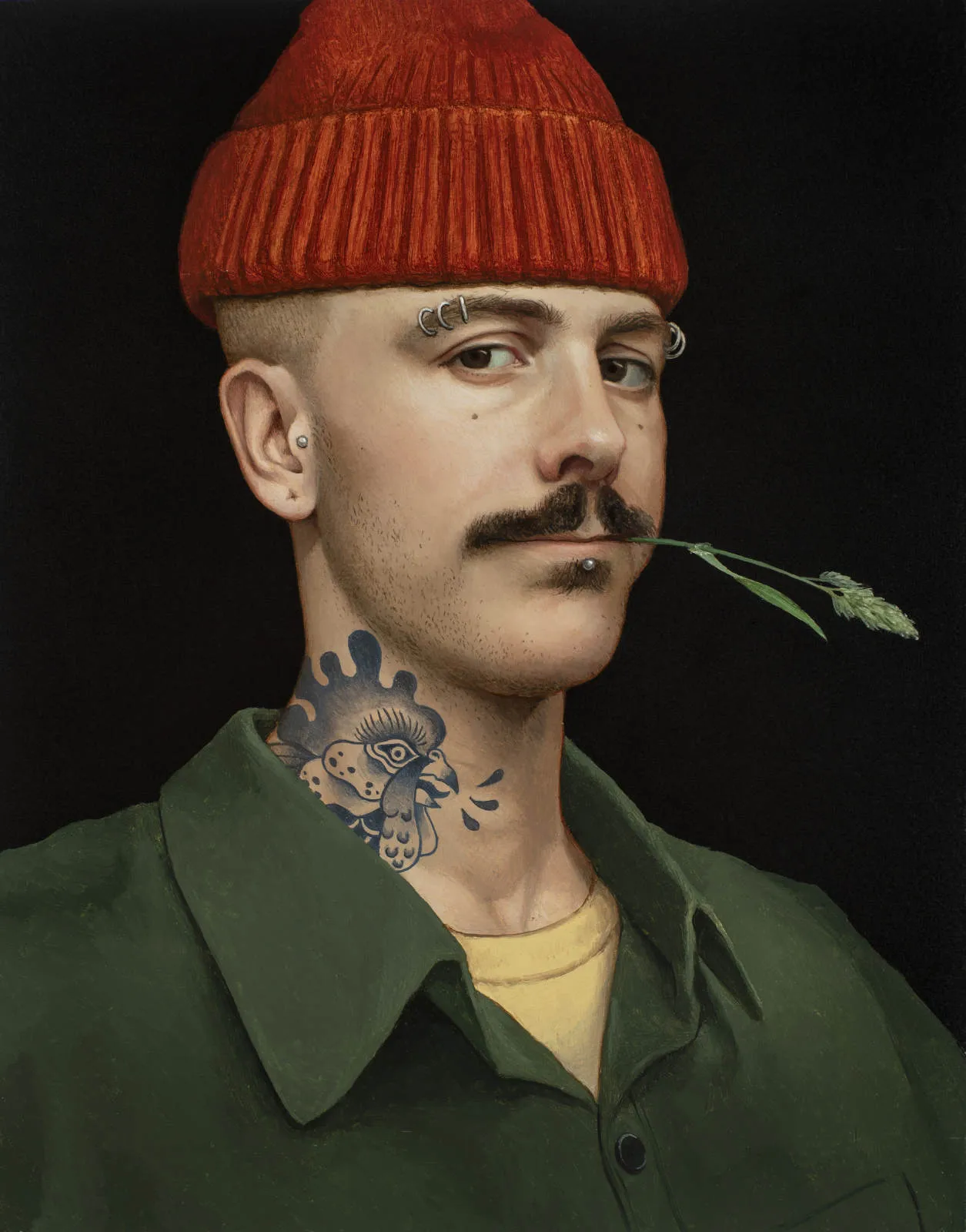
They function as another strategy to widen the field of interpretation. In my work, there is often a strong presence of human-made elements — architecture, garments, tools, posture, cultivated animals. Introducing natural motifs onto the skin allows the image to breathe beyond a purely cultural reading. It prevents the painting from becoming a closed circuit about human construction alone. Instead, it creates a loop of meaning: nature is represented within culture, and culture re-inscribes nature onto the body.
This gesture also echoes my broader interest in how we aestheticise and instrumentalise the natural world. A flower, a bird, a fly, or a cow, once autonomous and living, becomes pattern, emblem, personal mythology. Nature is appropriated, stylised, and carried as ornament. In that sense, the tattoos are not simply decorative; they reveal our persistent desire to possess what we cannot fully master. They are traces of domestication at the scale of the skin.
This gesture also echoes my broader interest in how we aestheticise and instrumentalise the natural world. A flower, a bird, a fly, or a cow, once autonomous and living, becomes pattern, emblem, personal mythology. Nature is appropriated, stylised, and carried as ornament. In that sense, the tattoos are not simply decorative; they reveal our persistent desire to possess what we cannot fully master. They are traces of domestication at the scale of the skin.
You described tattoos as the “spices” for each portrait. In the reference work, the “spices” could be considered their attire, pose, props, or the setting. What did you hope to show with this evolution of self-adornment and expression?
I describe the tattoos as the “spices” of each portrait because like spices in a dish, they are not structural necessities. One could remove a specific motif without collapsing the composition. Yet their symbolic charge can rebalance the meaning, amplify certain tensions, or subtly redirect the viewer’s reading. They operate as inflections rather than foundations — small elements with disproportionate semantic weight.
In earlier portrait traditions, Renaissance painters meticulously rendered velvet, gold thread, pearls, and heraldic insignia as markers of identity, power, and taste. I see tattoos as a contemporary evolution of that same impulse toward self-adornment and coded self-expression. The surface has shifted, from fabric to skin, but the desire to signal belonging, status, belief, or aspiration remains constant.
Conceptually, even if we no longer wear garments embroidered with gold and precious stones in everyday life, our appetite for adornment has not diminished. It has simply migrated. Expensive tattoos, elaborate piercings, cosmetic interventions — these become contemporary equivalents of historical luxury. They testify to a continuous, perhaps unquenchable thirst for beauty, distinction, and self-fashioning. In that evolution, the body itself becomes the ultimate site of display, both canvas and costume, both subject and ornament.
In earlier portrait traditions, Renaissance painters meticulously rendered velvet, gold thread, pearls, and heraldic insignia as markers of identity, power, and taste. I see tattoos as a contemporary evolution of that same impulse toward self-adornment and coded self-expression. The surface has shifted, from fabric to skin, but the desire to signal belonging, status, belief, or aspiration remains constant.
Conceptually, even if we no longer wear garments embroidered with gold and precious stones in everyday life, our appetite for adornment has not diminished. It has simply migrated. Expensive tattoos, elaborate piercings, cosmetic interventions — these become contemporary equivalents of historical luxury. They testify to a continuous, perhaps unquenchable thirst for beauty, distinction, and self-fashioning. In that evolution, the body itself becomes the ultimate site of display, both canvas and costume, both subject and ornament.
“When reality resists the myth, we interpret it as deficiency rather than recalibrating the myth itself.”
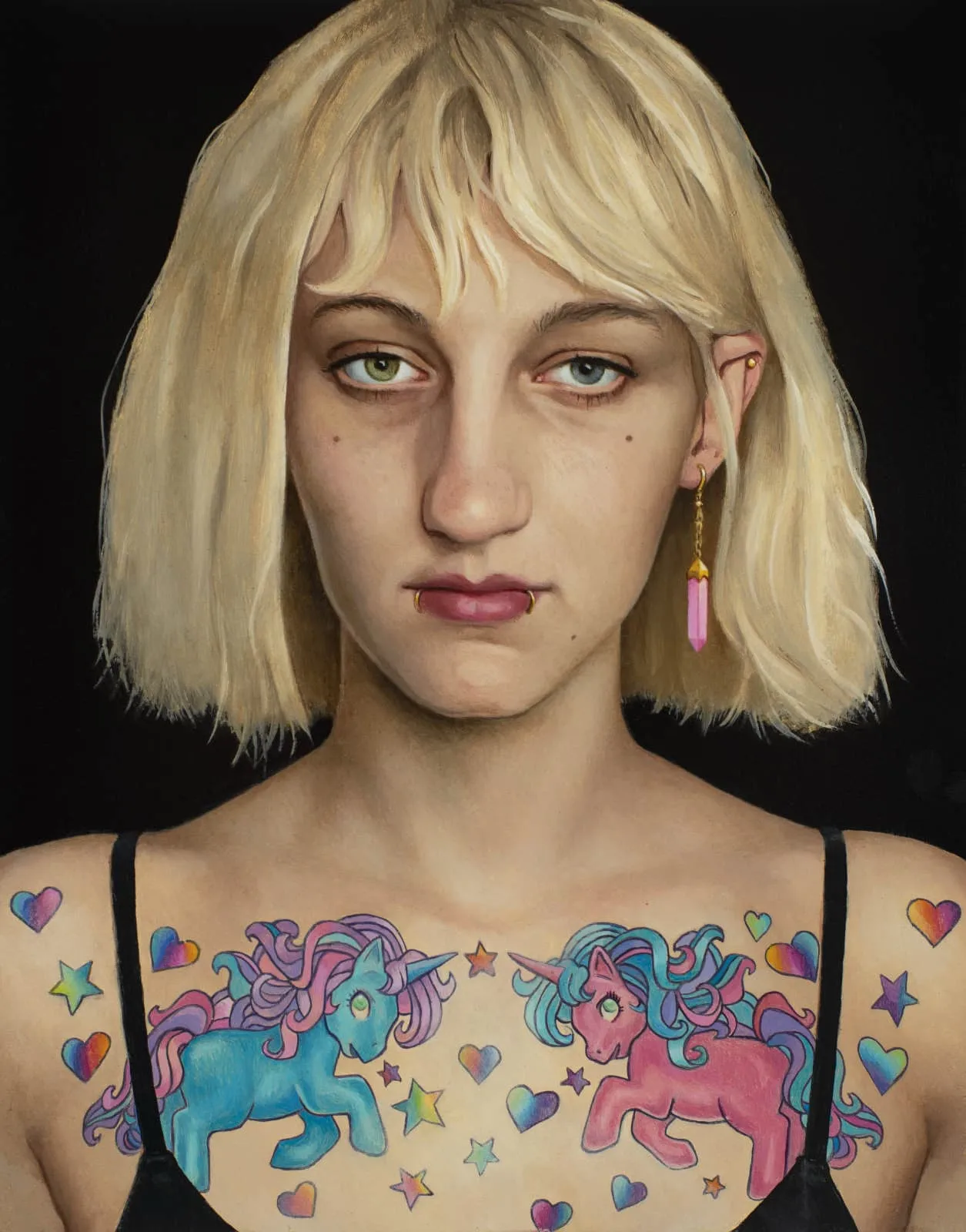
Two Unicorns is inspired by the portrait of Henry VIII’s wife, Anne of Cleves, commissioned to assess her beauty which he was ultimately disappointed by. What does the disappointment in myths and fantasies that we can’t prove – or stop believing in – communicate about our own psyches?
What fascinates me in the story of Anne of Cleves is not simply Henry VIII’s disappointment, but the mechanism behind it, the gap between representation and reality. A portrait was commissioned to assess beauty in advance, to transform a living person into an image capable of sustaining fantasy. When the encounter failed to match the projection, the disappointment was not only romantic or political; it was mythological. The fiction collapsed. The portrait itself remains undeniably beautiful. The image did not fail on its own terms. It is Henry’s projection that failed. His disappointment exposes how powerfully expectation can distort perception. We often do not see what is before us; we see what we hoped would be there. When reality resists the myth, we interpret it as deficiency rather than recalibrating the myth itself.
In Two Unicorns, the unicorn amplifies this tension. It is a creature sustained entirely by belief — pure, symbolic, unattainable. Pairing this mythical figure with a historical moment of misaligned expectation highlights something fundamental about the human psyche: we are not only capable of creating myths, we are structurally dependent on them. Perhaps the defining characteristic that separates us from other living beings is this need to generate collective fictions. Nations, religions, politics, beauty standards, economics — these are stories we construct and inhabit together. We may abandon one myth when it disappoints us, but the void it leaves is rarely tolerated. In that sense, Two Unicorns is less about the failure of illusion than about our attachment to it, revealing how our projections can blind us to what is actually present.
In Two Unicorns, the unicorn amplifies this tension. It is a creature sustained entirely by belief — pure, symbolic, unattainable. Pairing this mythical figure with a historical moment of misaligned expectation highlights something fundamental about the human psyche: we are not only capable of creating myths, we are structurally dependent on them. Perhaps the defining characteristic that separates us from other living beings is this need to generate collective fictions. Nations, religions, politics, beauty standards, economics — these are stories we construct and inhabit together. We may abandon one myth when it disappoints us, but the void it leaves is rarely tolerated. In that sense, Two Unicorns is less about the failure of illusion than about our attachment to it, revealing how our projections can blind us to what is actually present.
What made Plato the right space for your first New York City solo exhibition?
Primarily because I feel that Plato’s founder, Elena Platonova, genuinely understands my work. She has a discerning eye and a refined sensitivity that allow her to engage thoughtfully with a wide range of artistic languages and approaches. I deeply value this kind of stylistic neutrality, which reflects a true openness rather than adherence to a specific aesthetic agenda. I really appreciate that Plato’s focus seems to rest on the intrinsic relevance of the artists they present — not on validation through conformity to trends, but on something more essential and enduring. That position creates a space where the work can exist on its own terms, without being forced into a predetermined narrative.
And, of course, they are exceptionally professional and remarkable ambassadors. It felt like the right environment — both critically and humanly — for a first solo exhibition in New York. I’m thrilled to be preparing my next solo exhibition at Plato for Spring 2027!
And, of course, they are exceptionally professional and remarkable ambassadors. It felt like the right environment — both critically and humanly — for a first solo exhibition in New York. I’m thrilled to be preparing my next solo exhibition at Plato for Spring 2027!