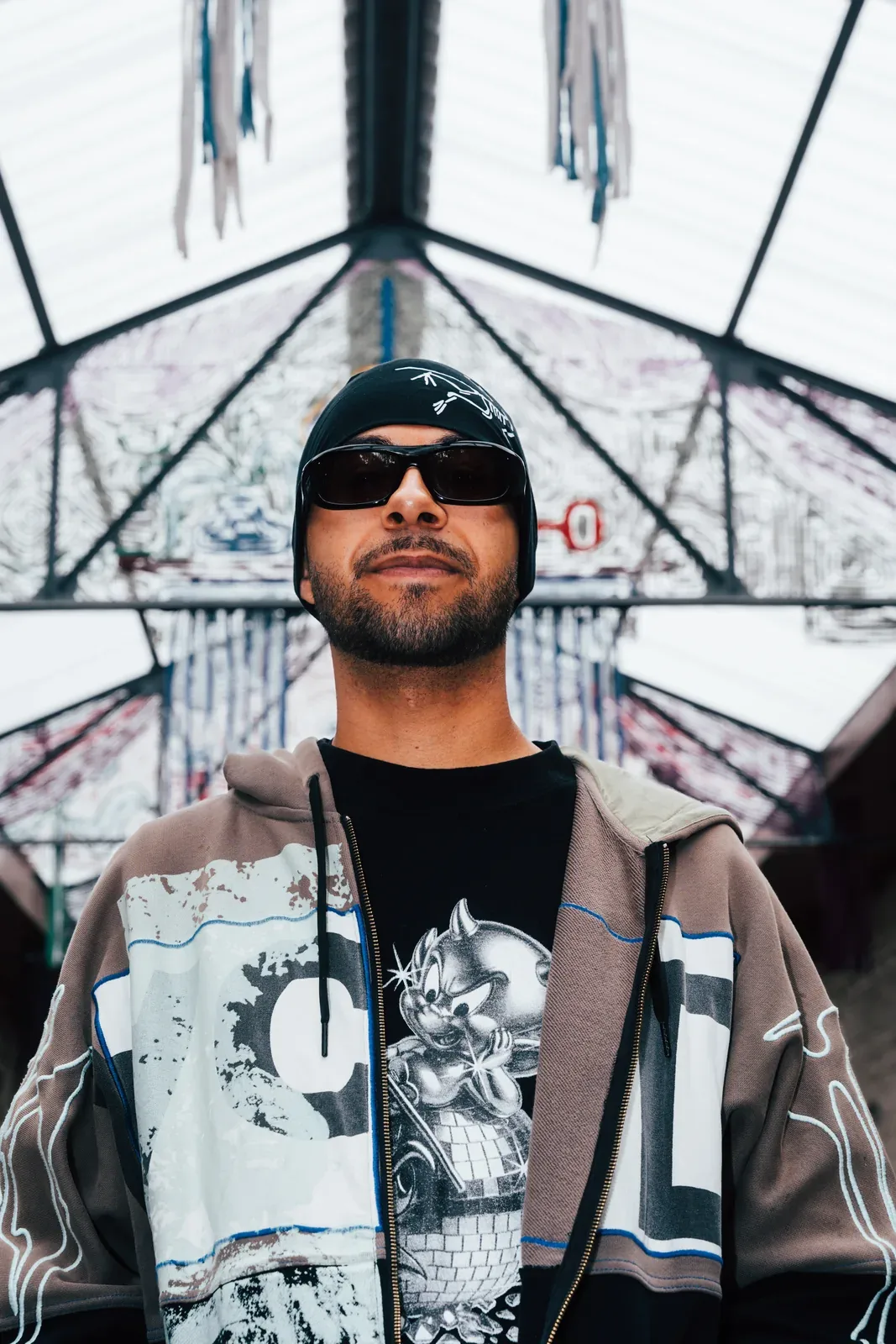
You’re probably familiar with Jersey club now, but the genre hasn’t always been famous. Like all things, trends come and go, and that includes music genres. However, artists like DJ Swisha prove that it matters to stay true to yourself and DNA regardless of what’s in vogue — in music, but also in life. After a wild ride across Philly, LA, and NYC, the DJ and producer has found his ground: footwork, Jersey, juke. But he goes beyond that and also includes rap or house in his sets.
He proved that a few days ago at Horst, a festival on the outskirts of Brussels, Belgium where an open-minded community of electronic music lovers get together every May. DJ Swisha’s set was energetic, fun, and took unexpected twists and turns sonically that kept the audience on their toes. It was an exercise marrying technical precision with free-flowing creativity. Ahead of that, we sat down with him to discuss the fruitful outcomes of the pandemic, whether or not NYC is as competitive as they say, and pioneering a genre that is now trending.
You have lived in three wildly different cities in the US: Philadelphia, Los Angeles and New York. How do you think each one has shaped your sound today?
Philadelphia definitely taught me about the history of club music: Jersey club, Baltimore club, Philly club. That is the music I grew up hearing at parties, so I give Philadelphia credit for that. Los Angeles is where I mostly grew up, so it gave me my experience as a human being. I met the collective I am part of, Juke Bounce Werk, there. I definitely got my roots in music in LA, but I was also kind of an outcast because I was playing music from the East Coast. That is also where I got into footwork. I was already producing and DJing before that. I built my context in LA because I was one of the few people playing the music I was playing. But New York is what made my career. I have been in New York for ten years now, and I would never have thought I would get this far if it was not for New York.
Did you feel resistance in LA? Was being an outcast helpful in that sense?
Yes, being an outcast definitely helped me stay in my lane. Now, fast forward ten years, everyone is playing Jersey club and footwork, which makes my job more fun and easier. I liked growing up with distance and privacy because it made me start producing and doing everything I do. In New York, I’m surrounded by people all the time. It’s good, but I don’t have much time to myself anymore.
“A lot of times I remaster music, like vinyl rips. I will go in and clean it up so I can play it in my set. I’m very meticulous with how things sound.”
You have a background in audio engineering. When you’re behind the decks, does that technical side shape how you approach music, or is it more emotional?
I do a lot of mastering and mixing for people, and that informs my DJ sets because of how sensitive my ears are. I don’t play a song if it isn’t mastered well. A lot of times I remaster music, like vinyl rips. I will go in and clean it up so I can play it in my set. I’m very meticulous with how things sound.
Does that technical background give you a more distant point of view when you approach music? For example, choosing not to play a song because it’s not mastered well, instead of playing it simply because you love it.
It always depends on where I’m playing. If it’s somewhere like Horst, with a big sound system, I’m very meticulous about playing songs that sound good. But if I’m in a small club, or on radio, I’ll play whatever. I still play SoundCloud rips and all that stuff. It definitely depends on the stage, because on a big sound system you can hear the difference in quality.
Have the technical conditions of a festival or a club ever changed the way you play because something was not sounding as good as it should?
Yes, it taught me to refine my selection. Sometimes I feel like I can’t play certain things because they won’t translate on the sound system. But I see that as inspiration, because the genres I play aren’t known for clean sound. They’re known for being kind of distorted, but there’s a fine line between the two. I have found that line now, and it’s always going well. Early on, during my first festival experiences in 2017, I learned a lot. I realised that songs I had been playing didn’t sound the way I thought they did. It doesn’t feel hindering. It’s more of an inspiration to refine everything.
2021 was a very fruitful year for you. You released four EPs. Was that because of the pandemic?
Yes. Bandcamp Friday started, and that was what I was surviving on. My money was coming from audio engineering work and from my music career. Before that, I always had a side job. Bandcamp was really paying my rent, and I’m glad people were sitting at home wanting to buy music. I thought my career would be over during that time, but that was when it got better than ever. I’m really grateful for that. Now I’m touring all the time, so I can’t put out that much music. It’s hard.
Now that the pandemic is over and you are touring worldwide all the time, where do you find the time and space to be creative and make something new?
I do a lot more collaboration when I’m out of town, which is cool because I go to somebody else's studio and learn what they do. But I don’t do as much solo stuff. If you look through my discography, I have always been very big on collaboration, so I don’t feel weird about it. But my fans are always asking for more independent projects because they want to hear my stuff. It has been hard to find that balance. I live in New York, so when I’m home, I immediately feel like I need to work. I get in the studio and work all day, and I have another project ready to go. I have albums I’m sitting on, but I feel like I need to curate them in a way that makes sense for where I am right now. I put out my first serious original album in October, and since then I have kind of chilled out. Now I am going to put out another release that is more true to my old form: twenty songs, all collaborations, just a bunch of fun stuff. You always have to adapt to the time. I do not try to force it. I can force DJing, but I can never force producing.
Speaking of your 2025 album, First Hand Smoke, it felt more relaxed in terms of BPMs and overall vibe. How did the project come to be, and what different headspace were you in compared to the rush and heaviness of 2021?
I guess it was unintentional. There are a few sample-based songs on there, but I feel like most people only know me as the edits guy, and I don’t really like that. I make a lot of original music outside of the genres people know me for. I took a lot of my knowledge from producing rap records and working with vocalists, and I switched gears because it was more original. Naturally, my melodies are more emotional and moody, not so hard and crazy. I was also working in a new studio with a lot of my friends, my friend Sammy’s studio. He makes a lot of music with bigger artists, like Eartheater, and produces for all types of people. I learned a lot about scales and chords through him, and also with AceMo. It is a group studio, so they all knew I was making an album and were helping me along the way. There are a few people on the album who helped me with the production. I was just making music with my friends for a year, and then I had to figure out what I could release from that. I never really make music for a project. I make music to make music, and then I figure out how to piece it together after. It was pretty unintentional. I never thought it would come off so relaxed, but now, listening to it six months later, I hear that it is very chill. I was also very stoned every day making that album, so I was in more of a ‘let me just chill out’ mode. A lot of the songs came from being in that group studio. I made many of them when everyone else was asleep and I was the only one awake. I would make a melody, come back the next day and add the drums. It was a weird project. I had not really thought about the process of making it, but I’m always trying to switch it up.
When people think of New York, they often imagine an incredibly competitive city. But you speak a lot about collaboration and about other artists helping shape your last record. How do you see the New York music scene? Is it collaborative, competitive, or a bit of both?
In New York, there is enough happening that it doesn’t feel that competitive. I feel like people are more competitive about the stuff you do outside of New York. In the local scene, people might ask, ‘How are you playing this or that festival?’ And I am like, ‘I have made music for fifteen years and DJed a lot’. I’m just grateful that I get these opportunities. The biggest thing I tell people is that someone else’s career is never going to work for you. My perspective on music in New York is very different from a lot of people because, when I moved there in 2017, I was living in the Bronx, which most people who live in New York or go to parties in New York will never go to. All my friends were born and raised there. I met them when I was in high school, so a lot of those people, including AceMo and the friends I still make music with, watched me grow up. Now I’m thirty.
So there is a sort of camaraderie with your friends.
My friend group is very much about all of us winning together. Outside of that, there’s a bit more competitiveness, but it’s friendly competition, and I like that. Especially when I DJ, my goal is to absolutely murder the DJ before and after me. A lot of people don’t have that. They just want to play their thing. I’m listening to your set and acting off it. I’m trying to show up every time. There’s nothing wrong with that. It’s bad when you have resentment; that’s a different thing. But I like friendly competition, especially in New York, where there are a million DJs. I’m glad people are getting inspired to make music more. There’s less gatekeeping and so much more knowledge. I taught a lot of people how to make music because they came to me wanting to make footwork, juke and Jersey club. I didn’t feel weird about that. If someone genuinely excels in it, I love to see that.
That’s nice! When did you feel confident enough in your craft to teach others how to do it?
For me, it took four years of producing before I ever showed somebody. Now I can teach someone and see them releasing music within six months, and they become a known person. That happened a lot. During COVID, teaching people taught me a lot about myself. I think people can open up more and share resources. I did that for as long as I could, but once I started touring, I was like, ‘All right, you guys are on your own’. New York in general is very cutthroat, but there are a million clubs and a million scenes. Everyone could DJ somewhere. Some people definitely get a little jaded. Once you leave the city, your eyes open. People I was not very close with back home, I will run into at a festival like Horst and it’s a different connection. They see I’ve been doing this for ten years at this rate, and they ask how I do it. You just have to stay on top of your shit. It’s nice to connect with people from back home in different countries, because automatically it’s a different vibe. We’re here together, even if we don’t really hang out back home. That’s cool.
“I never really make music for a project. I make music to make music, and then I figure out how to piece it together after.”
Back to the album, the closing song is Playa Hatas Ball. It plays on the ‘Player Haters Ball’ reference, which is also connected to hip hop culture. Were you trying to build on that legacy from an electronic point of view, or how did it come to be?
That’s a funny question. I feel like no one really knows what the reference is. It’s from Chappelle’s Show. Dave Chappelle is a legendary comedian, and his was the best show I had ever seen as a kid. I watched it too early, but it taught me a lot about racism and race dynamics. It’s one of the funniest shows ever. Now, when I show it to friends who don’t know what it is, it comes off as very problematic. But when you watch it and think about when it came out, it was doing something different. One of the first episodes, I think the first one, is about a blind KKK member who’s Black and doesn’t know that he’s Black. That was on Comedy Central. Now Dave Chappelle has become more of a problematic older-uncle comedian, but back then, watching that when I was maybe nine opened my mind. My mom is white and my dad is Black, and because I was born in Philadelphia, I grew up with more of a Black upbringing culturally. Watching that was insane. It was traumatising, but also not. It goes to the furthest depths of stupidity, but it’s real. Long story short, there’s a segment called the Player Haters Ball, with Charlie Murphy, Ice-T and other people. It’s a very problematic skit, and it’s pretty much about how much you can hate on somebody. At that moment, I felt like the song was so happy and nice but people really be hating on me. So I thought, I’m going to call this song Playa Hatas Ball.
Horst is held at an open-air park, kind of idyllic, where music and nature merge. How does that environment translate into your set compared to playing in a small club in Brooklyn or the Bronx?
Sadly, I actually rarely play in the Bronx. I have only done it a few times, and it’s very outside of the electronic music world. It’s more connected to the culture of the Bronx. Festivals are very different because the stages are bigger. Like I said earlier, I definitely play more dynamic music. In a club, I might play a hundred songs in one hour and go as crazy as I can. At a festival, I try to plan the set a bit more. I can never fully plan a set because any time I try, I get there and realise it isn’t going to work. But I also have a background as more of a working-class DJ, because I grew up DJing from when I was fourteen, playing house parties in Los Angeles. Back then, it was hip hop, Steve Aoki and stuff like that. No matter how far I go in my artistry, I always know I can be the DJ who makes sure everyone has fun.
What about this festival?
Somewhere like Horst, I try to take that route. I want to play something that will make everyone feel a moment at some point, or at least I hope that happens. I also try to keep it true to form and inform people about what I do and where I’m from. Not a lot of people play house music with rap, Jersey club, jungle and all that stuff. It seems natural, but especially in Europe, I feel like a lot of people don’t play in such an open format across genres. When I’m in Europe, I’m automatically digging back into my old sets rather than always looking for new stuff. I think, ‘These sets really were a moment, even in the US.’ If I play those kinds of sets in Europe at a festival, it helps cement my mission statement with a wider audience that doesn’t really know me yet. Even yesterday, people were coming up to me saying they recognised me from when I played here two years ago. It’s crazy, and it works. I’m glad people see that. I guess my music taste can come off as ADHD, but a lot of people want that. Other people want something very form-heavy and seamless. My mixing is still very smooth, but I’ll jump from one genre to the opposite side. Some people like that, some people don’t.
Your 2019 Boiler Room is incredible, but a lot has happened since then. How has your philosophy in the booth changed from that viral performance to now, after the pandemic and after years of playing constantly?
That Boiler Room taught me a lot. It was my first experience of having a big group of people comment on a culture they didn’t know about, which was Jersey club. It was also the era when viral clips first started. I remember Shrelle’s Boiler Room being one of the only ones that had a big viral moment. When we did the party, the owner took us to dinner and said it was going to be a cute little small private thing. We were like, ‘No, we have five hundred people coming to a space that holds around a hundred’. It was really cool in the moment, but I didn’t realise what it would do after. I grew up watching Boiler Room, and I always wanted to play it.
What did that experience teach you?
It taught me that I can’t take things personally, and that I have to wear my sound on my chest. I have to represent where I’m from with my chest. People will always have opinions. My clip was a Show Me Love Jersey club remix, and at the time the person who made it was in jail. A lot of people wanted the song, but even with Boiler Room, I wouldn’t let them license it to distribute on Apple Music because I wasn’t comfortable with them profiting from that culture when I know these people personally and they’re in jail. That experience unexpectedly made me more critical about my cultural involvement. Footwork and Jersey club are from the hood. They come from a culture where music is escapism, a way of dealing with bad situations and bad upbringings. People hear it and think it sounds funny and fun, but I grew up around these areas and I know what people’s real lives are like. Someone can be known for their music and still be doing illegal things. I went on a tangent, but Boiler Room definitely made me more unapologetic. I don’t want to conform to techno. I don’t want to conform to house. I want to keep pushing these sounds. I play house and techno now and then in my sets, but if I wanted to go for the big bucks, I could easily make a techno project and start playing techno.
That’s right. But Jersey is now pretty popular too.
A lot of people now play these sounds. Because of those years of doing it, I’m kind of a staple in these genres, even though I’m also removed from them in a way because I grew up in Los Angeles. But I know the people from New Jersey, Philly, Baltimore and DC. That experience really solidified my position. A lot of people who were my idols, like Paul Johnson and DJ Deeon, gave me my props. It woke me up and made me realise I needed to take this seriously. I had always done music for the love. I used to play drums in death metal bands, so DJing and producing were fun and easy. But that was when I realised this was something I had to take seriously.
You didn’t take it seriously before, you’d say?
I always took music seriously, but I didn’t realise it was like that. Seeing the aftermath of the Boiler Room online, I felt it was different from anything I had done before. I’m really grateful for the opportunity. I didn’t get paid for it, which is still crazy. Back then, no one was getting paid for Boiler Room, but it was still a case of exposure.