Today, Wanderer is out in the world. After months of quiet signals and half-reveals, Claptone opens a new chapter that feels instinctive rather than calculated. We spoke to him a few days ago, right in that final stretch where everything is finished but still echoing in your head. That strange space where you start letting the music go, even as it still feels deeply yours.
“There is something about those final days before a release where the music starts to feel like it no longer belongs to you,” he confesses. That shift runs through Wanderer, shaped as much by real dance floors as by studio time. “The dance floor and crowd do not lie,” he tells us, describing how some tracks clicked instantly while others had to grow into themselves. It’s an album built on feeling, one that asks you to lean in and stay with it a little longer than usual.
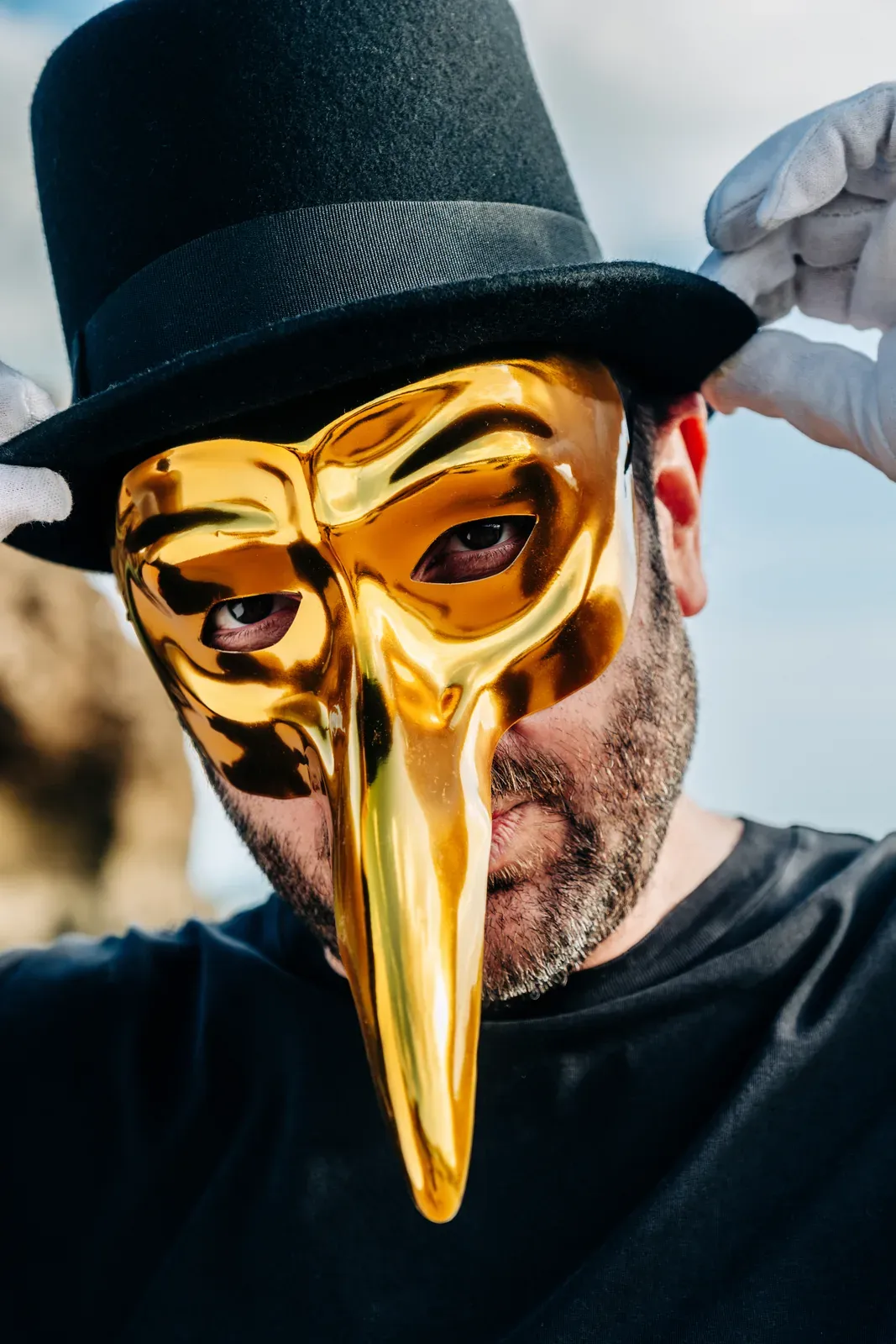
In the interview below, we talk about the new record but also about the way his music carries memory, the relationship with the crowd, long-term collaborations, and The Masquerade as it continues to grow. And, inevitably, the mask. Not as a gimmick but as a symbol, a way of keeping distance in a moment that demands constant visibility, where the character can take the spotlight while the person quietly steps aside.
Thanks so much for taking the time to speak with us, especially in the middle of the countdown to Wanderer. Where are you answering us from today, and what was the very first thing you did this morning?
I am somewhere between two cities, and that is usually where Claptone lives. This morning I made coffee, sat with it for a while, and listened to the album one more time. Not to change anything. Just to be with it. There is something about those final days before a release where the music starts to feel like it no longer belongs to you, and that is exactly how it should be.
You’re just days away from releasing the record. Do you sleep better when everything is finished and ready to go, or worse because you’re thinking about how people will receive it?
Neither, really. I sleep the way I always sleep, restlessly, with too many ideas. The anticipation before a release is neither anxiety nor excitement; it lives in that space between the two. The music is done. What happens next is no longer mine to control, and I have made peace with that. The work is the answer to whatever question the world might ask of it.
You’ve described the album as existing “in the fragile tension between clarity and haze, dream and reality.” What does that tension look like for you in practice?
It is the moment just before a melody resolves, and when it could go either way. It is the feeling of being in a club at four in the morning, where everything is slightly soft at the edges. In practice, it meant resisting the instinct to over-clarify. Every time I was tempted to make something sharper or more direct, I asked myself whether the haze was actually carrying more meaning. Often it was. Wanderer is an album that asks the listener to lean in rather than sit back.
At what point did Wanderer stop being a collection of tracks and start feeling like a complete world?
There was a specific moment, I cannot tell you exactly when, but I remember the feeling. I was listening to three tracks in sequence and I noticed that something invisible was holding them together, which was a shared emotional air. That is when I understood that Wanderer was a cohesive universe, not just a record. From that point, every decision, every addition, and every cut was about protecting and further creating that universe.
“Wanderer is an album that asks the listener to lean in rather than sit back.”
You’ve been playing some of these tracks for months. How did it feel testing them in front of people before they officially belonged to an album?
It is one of the most honest forms of feedback available to me. The dance floor and crowd do not lie. When a track lands, you feel the shift in the room, like something collective happens, and that can’t be manufactured. Some tracks that I loved in the studio needed time to find their place in front of a crowd. Others connected immediately in ways I had not fully anticipated. The touring was as much a part of making this album as the studio sessions were.
And now, looking back at those moments, do the tracks feel different to you today than they did then?
They do. When I hear certain tracks, I am back in specific rooms, in specific moments, watching a specific crowd. Music is strange that way; it becomes a container for everything that surrounds it. The tracks are the same but I am not quite the same person who made them. That distance is actually something I treasure.
The singles have revealed different layers of the record, from Put Your Love On Me to Black and Gold. Did you think about how these would introduce the album, or did they feel like the right moments to share?
Both, honestly. There was intention in the sequencing, and I wanted each single to open a different door into the world of Wanderer before the full picture was revealed. But intention and instinct are not always separate things. Sometimes, the right moment to share something announces itself. You feel it before you think it. The singles were carefully chosen, but each one also felt inevitable.
You recently shared new remixes of Black & Gold. What do you find interesting about seeing your work through someone else’s lens?
It is genuinely one of the more illuminating experiences in music. When you hand a track to another artist, you discover things about it that you could not see from the inside. They hear the architecture differently. They pull on threads you had not noticed. The best remixes do not replace the original, but they exist alongside it and make it more dimensional. A good remix is a conversation, and I am always curious about what the other person has to say.
Sandcastles brings you back together with Nathan Nicholson, someone you’ve been working with for years now. There’s a sense that some creative relationships evolve slowly over time. How would you describe that journey between you two?
Nathan has a voice that carries something rare, like an emotional honesty that does not perform itself. Over the years, we have built a shared language. We understand what the other is reaching for without having to explain it fully. That kind of trust takes time to build. With Nathan, there is a comfort that actually creates more room for risk; paradoxically, the safer the foundation, the further you can go.
“Music is strange that way; it becomes a container for everything that surrounds it. The tracks are the same but I am not quite the same person who made them.”
When you return to that collaboration, does it feel like continuing a conversation or starting something new each time?
There is continuity, which means the language is already established, and the shorthand is there. So it feels like it always keeps going and doesn’t really stop. But we have both changed, so what we bring into the room is never identical to what we brought before. That is what keeps it alive. If it were purely a continuation, it would become a repetition. If it were purely new, we would lose the depth. The richness is in navigating exactly that tension.
The Masquerade has taken on a life of its own over the years. When you see where it is now, do you still feel connected to it in the same way as at the beginning?
The connection is different now, which is not the same as being less. Initially, The Masquerade was an idea I was testing, and now it has become something that carries its own weight and community. People come with expectations, with histories, with memories of previous editions. That means the responsibility is greater, but so is the reward. I am proud of what it has become. It has grown beyond me in the best possible way.
You’ve just released the weekly line-ups for The Masquerade at Chinois, running on Saturdays from May 16 to October 10.
Yes, the full season is confirmed, and I am genuinely excited about what we have put together. Chinois is a very special place for Claptone, and every summer the residency takes on a slightly different character depending on the guests, the energy, and the moment. This year feels particularly strong. I would encourage anyone who has the chance to be in Ibiza this summer to come and experience it. The Masquerade is always more than a night out.
You’ve managed to keep your anonymity for so long, which feels increasingly rare today. Do you ever feel that the mask gives you a kind of freedom you wouldn’t have otherwise, or has it become inseparable from who you are as an artist?
I think the mask is freedom. It creates a clean separation between the private person and the public figure, and that separation is something I guard carefully. In a world where artists are expected to be constantly visible, constantly accessible, Claptone chooses a different kind of presence. Anonymity is not a gimmick, but a genuine artistic and personal position. And yes, it has become inseparable from who I am. The mask and the music are the same statement.
There must have been some surreal or funny moments because of the mask, whether at airports, backstage, or right after a show. Is there one that really stayed with you?
There have been many. The most surreal are always the ones where people treat Claptone with a kind of reverence in the room, and then five minutes later, the person behind the mask is standing next to them completely unnoticed, listening to the conversation. There is something both humbling and quietly amusing about that. It reminds me that the mystique belongs to the character, not the person, and that is exactly the point.
“A good remix is a conversation, and I am always curious about what the other person has to say.”
Looking back to when everything started gaining momentum globally, do you feel people began to treat you differently? Did anything change with those around you, or even with people who suddenly wanted to get closer once you became more visible?
Of course. That shift is one of the stranger experiences that come with visibility; suddenly, the room changes before you have changed at all.People who were distant become attentive. Attentive people become something else entirely. The mask has been a useful filter in this regard. The people who genuinely connect with Claptone tend to connect with the music and the world first. That tells you something true about their intentions.
More broadly, do you think fame actually changes people, or does it just reveal parts of them that were already there but hidden before?
I think it amplifies. Whatever is already present, like the generosity, the insecurity, the ego, or the curiosity, fame turns up the volume on all of it. It is a pressure system. Some people expand under pressure. Others compress. What I believe is that the work itself is the best protection. If the music is always the centre, then everything else orbits around something real. The moment the music becomes secondary to the fame, the foundation starts to shift.
How has your life actually changed over these past fifteen years?
Everything has changed, and almost nothing has. The scale is different, the rooms are larger, the distances are greater, and the team around me has grown. But the fundamental motivation is identical to what it was at the beginning: to make music that matters, to build something lasting within this universe, to connect with people through sound. If that core intention had changed, I think you would hear it in the work. I hope you do not, hahaha.
You’ve mentioned wanting the record to feel “alive and breathing, gently reshaping the moment instead of demanding it.” Was that in reaction to the way music is consumed now?
Partly, yes. There is an enormous amount of music competing for attention, and much of it is designed to assert itself immediately. I was interested in the opposite. A record that earns its place slowly, that rewards patience, that reveals itself differently depending on when and where you listen. That is a deliberate choice in a landscape that rarely makes it. I wanted Wanderer to be the kind of album people return to, not just discover once.
You also mentioned dreaming about what’s coming this summer. What are you most looking forward to: the release, the shows, or…?
The shows. Always the shows. The release is an important moment, meaningful, but singular. What follows is the real conversation. Taking Wanderer out on the road, playing these tracks in rooms full of people who now know the album, because that is where the music completes itself. The Masquerade season at Chinois, the touring, the festival moments that are still to come. That is what I have been building toward. Summer is when the universe of Claptone feels most alive.
Is there anyone you haven’t worked with yet that you’d genuinely love to collaborate with?
There are several, but I will keep the specific names within the universe for now. What I look for in a collaboration is not reputation but resonance. A voice or an artist whose sensibility speaks to something in the world of Claptone that has not yet been explored. Those conversations tend to reveal themselves at the right moment. I trust that process. The best collaborations are rarely planned; they just arrive.