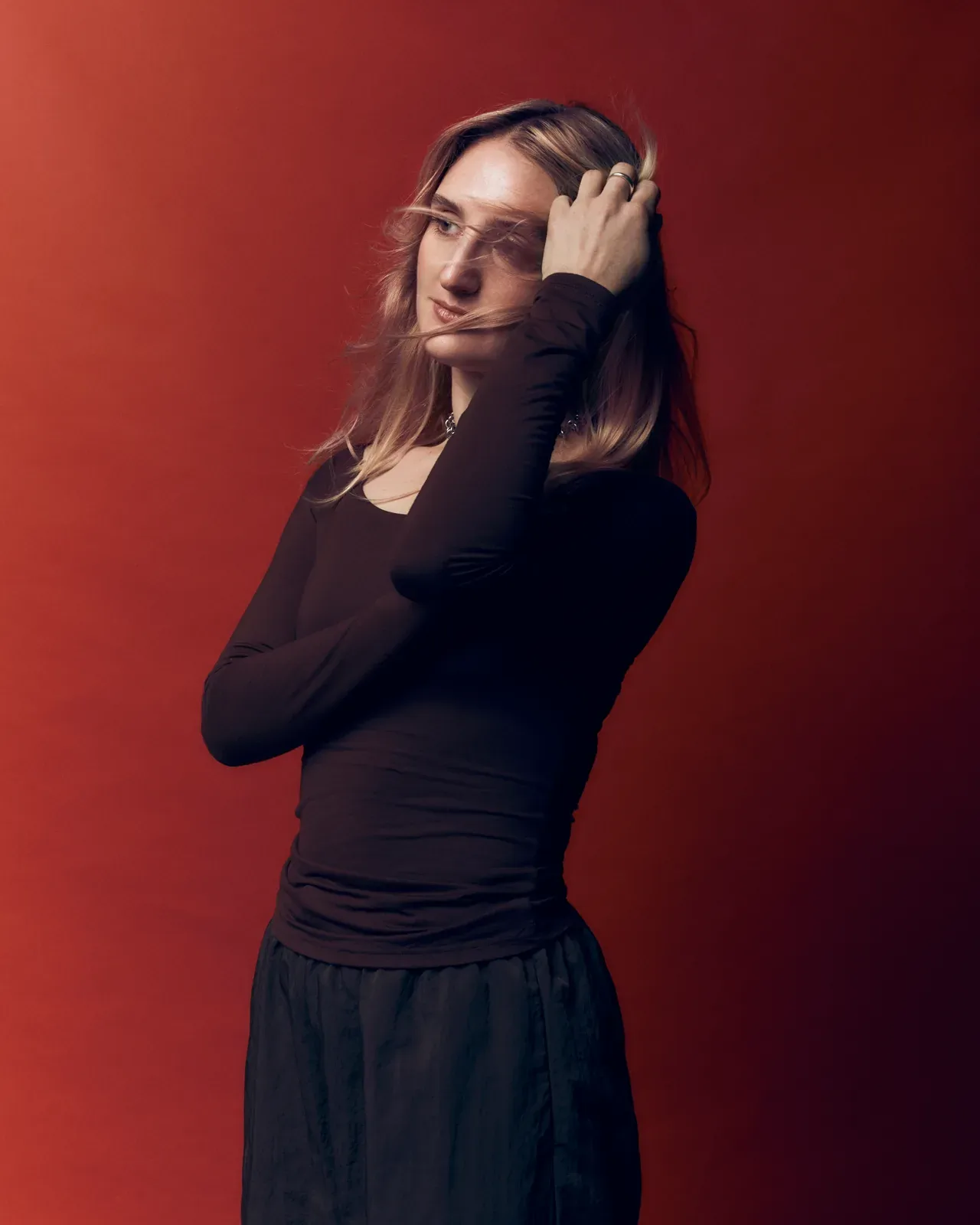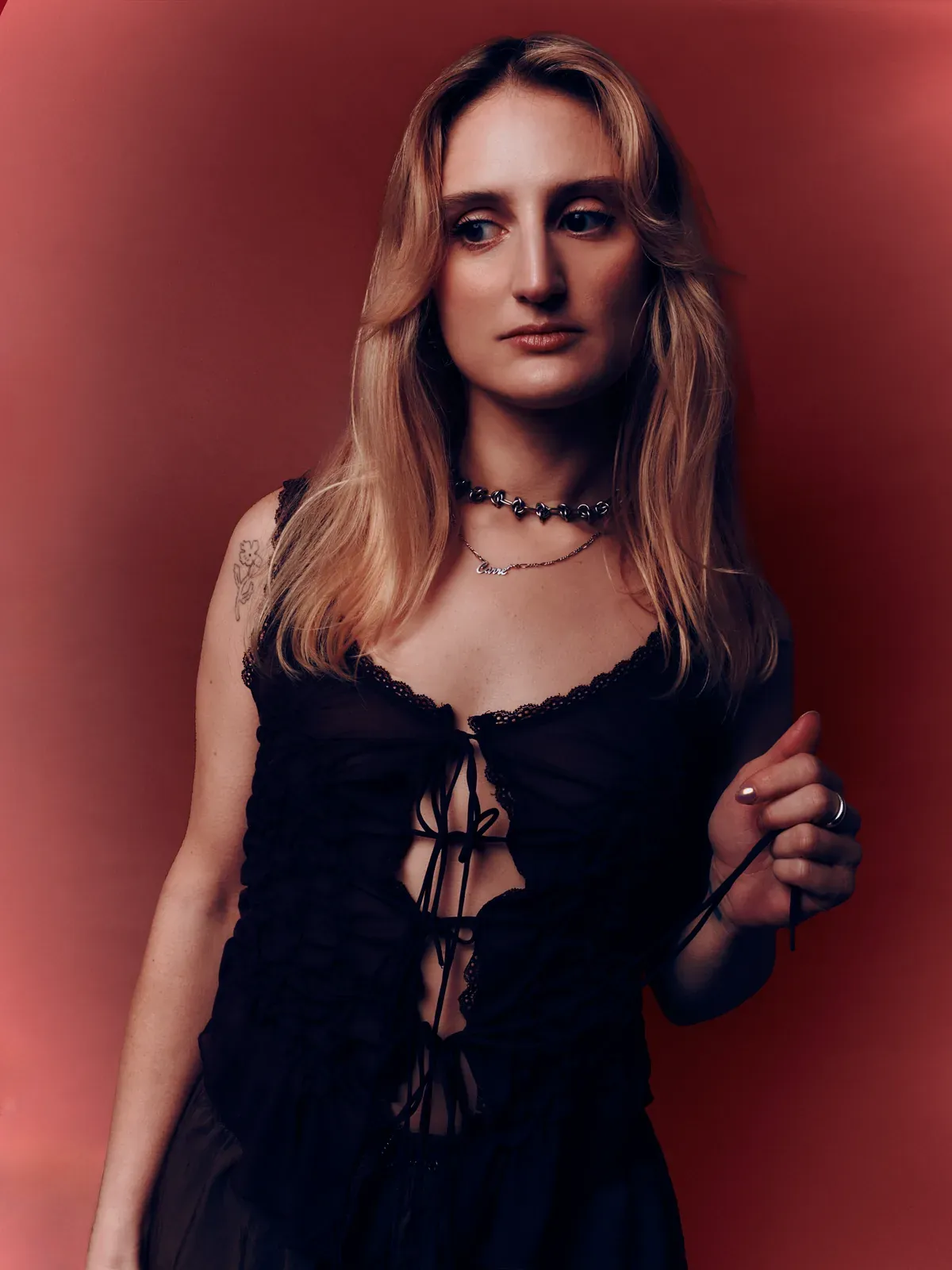
Who would’ve thought that what started as a series of bass music warehouse parties in LA would bloom into such a successful project? The story of Carré is one of risk-taking, believing in oneself, and flowing according to life’s unexpected rhythm. The DJ and producer first started Fast at Work in California, where she felt “like I was one of a few, or maybe even one of one”. But everything changed when she moved to London, a place that had always inspired her and which popularised genres like the ones she plays (especially bass music). “London shaped things from the beginning, and it has continued to push me to grow as an artist”, she comments.
She brought that unique approach to Belgium’s Horst festival a few days ago, a DIY project known for its unique setting (a beautiful park next to a river, with several open-air stages and immaculate vibes). Playing the Ring stage, where the DJ is front and centre and the audience surrounds them, Carré definitely knew what buttons to press (literally and figuratively) to make us dance and enjoy her sunset set. A few hours before, we sat down with her to discuss moving across the pond, releasing on legendary label Tempa, and the differences between producing music and playing it.

You grew up in California and started Fast at Work in LA, but now you're based in London. What prompted the move across the pond, and how has that shift affected your creative process, if at all?
The move to London was a long time coming. A lot of my early inspiration, and the parties I went to when I was twenty and studying abroad there, shaped my taste. Then it was a chain reaction of things: I got a Global Talent visa and was able to move. It felt like all the right things aligned.
My first record came out on Tempa around the same time I moved, so it was an amazing way to land in the UK, meet everyone and plug into the scene. London shaped things from the beginning, and it has continued to push me to grow as an artist.
My first record came out on Tempa around the same time I moved, so it was an amazing way to land in the UK, meet everyone and plug into the scene. London shaped things from the beginning, and it has continued to push me to grow as an artist.
Do you feel it’s a more competitive city compared to LA?
I’m definitely now part of a community of people who are playing the same or similar music, both in the UK and Europe. In California, it felt a little more like I was one of a few, or maybe even one of one. I don’t think of it so much as competition, but being around people I find inspiring pushes me. I will see someone DJ and think, ‘Now I want to level up’. I can feel how that has happened, and it’s the same with production. Being around so many people doing similar things is really inspiring.
LA’s underground scene is quite distinct from London’s club culture. What do you miss most about the parties back home? And what has been your favourite discovery about the UK scene since you landed?
I miss the experience of throwing warehouse parties in LA; I’m not really throwing many parties in London. I have done a few, but pulling off a warehouse party that is successful, where the artists have a great time and maybe you don’t lose loads of money, is extremely special and satisfying. The fact that it’s so challenging makes it really rewarding when it works.
In London, I love the access to amazing music and really great clubs. People talk about the city clubs shutting, but I find that new spaces are opening too. Even just having Fold means you can’t really complain. The easy access to clubbing, music, different cultures and different sounds is one of the best parts of being there.
In London, I love the access to amazing music and really great clubs. People talk about the city clubs shutting, but I find that new spaces are opening too. Even just having Fold means you can’t really complain. The easy access to clubbing, music, different cultures and different sounds is one of the best parts of being there.
“Making music and releasing it feels very pure to me. I can feel that I have much less imposter syndrome around that now, which is great. But DJing is still scary.”
Fast at Work started as an underground party and evolved into a label. Did you always envision it taking this trajectory, or did it happen more organically?
No, from the beginning I didn’t think it would take the shape it did. At the same time, I also didn’t think my career would take the shape it did. It started very DIY: just me and my friends wanting to play music that we were not hearing in LA. Within a year of doing it, we could feel that it was something special.
The idea of turning it into a label came into our minds quite naturally. I’m really excited about the way it’s developed. I feel like it has a unique voice and takes the brand further than just parties, while still being rooted in the aesthetics and energy of the parties themselves.
The idea of turning it into a label came into our minds quite naturally. I’m really excited about the way it’s developed. I feel like it has a unique voice and takes the brand further than just parties, while still being rooted in the aesthetics and energy of the parties themselves.
Your latest EP, Hibiscus, just dropped on Tempa, arguably one of the most legendary labels in UK bass. What was it like bringing your forward-thinking sound to such a foundational imprint?
Getting asked to put out a record on Tempa, especially out of the blue, was an immediate yes. I almost couldn’t believe I was going to have the opportunity to do that. Then to do another release a year later made me realise how much I have grown. The label has facilitated so much of that growth and allowed me to explore new territories. It’s continuing in that direction, and I’m very grateful to have the Tempa ecosystem and vision helping me push forward as an artist.
When Tempa first reached out, and then wanted to do more because it worked, did you start believing in yourself more? Or do you still get imposter syndrome from time to time?
I definitely have less imposter syndrome in that regard. I feel more and more confident as a producer now. First of all, I love it so much. Making music and releasing it feels very pure to me, and the reception to everything has felt really authentic. I can feel that I have much less imposter syndrome around that now, which is great. DJing is still scary. It’s a little more challenging because the landscape is so competitive, and trying to carve your own lane within it is difficult.
Would you say you enjoy the quiet time in the studio more, thinking and trying things out? Or are you more motivated by the dynamic of a live setting and seeing people react? Or is it impossible to compare?
It’s hard to compare. The experience of making music is the most special process, but then playing those tracks out and realising that people know the songs and want to hear them is amazing. They really feed into each other. Playing my own music and having people request my music is great. Being able to see that through is kind of the ideal scenario: people loving my music and then booking me off the back of it is really special.
When you sit down in the studio, where do you usually start building a track? Is it a melody, an atmosphere, or a sound that helps you convey a certain energy?
Sometimes I’ll be listening to music and think, ‘This bass is really inspiring’, or I will hear a weird, gritty bass sound and wonder how to make something in that world. Other times I’m listening to non-dance music with vocals and I get really inspired. I’ve been building things around melody a lot lately because I have been so inspired by working with vocalists, so I have been writing melodies to start some of the tracks. Sometimes it’s more direct: I want to make a track with a really big bass, something with impact that I can play out. Then I build loops, click through presets on a synth I like, find a strange sound and think, ‘What can I do with this?’ It’s pretty free-flowing.
How do you approach programming a radio mix, like The Lot Radio, versus a club set or a festival set?
I love doing radio mixes. The Lot Radio specifically is so fun, and the experience of playing there is really great. I do like to plan those sets because I know I don’t have to worry about maintaining a certain energy. You can explore more chilled material.
Most of the time, those sets end up being more trippy because they don’t need to keep moving upwards in energy. With club or festival sets, I wouldn’t say I am the kind of DJ who’s always building towards one big moment. I like peaks and valleys: bringing it up, taking it down a little bit and moving like that. But when I was figuring out my set for today, I was thinking about where I could bring the energy up, where I could take it down, and which bigger tracks I wanted to have ready. That is probably the main difference.
Most of the time, those sets end up being more trippy because they don’t need to keep moving upwards in energy. With club or festival sets, I wouldn’t say I am the kind of DJ who’s always building towards one big moment. I like peaks and valleys: bringing it up, taking it down a little bit and moving like that. But when I was figuring out my set for today, I was thinking about where I could bring the energy up, where I could take it down, and which bigger tracks I wanted to have ready. That is probably the main difference.
You’re playing the Ring stage at Horst, an incredible open-air location with a very characteristic metallic structure. Today is sunny, which is rare after the weather we’ve been having. Does the environment change your track selection or the mood you want to convey? How do you balance your identity as an artist with the context of a warehouse, a London club or a sunny open-air festival?
I have spent many, many hours on dance floors, so that helps. I’m mindful of the context. It’s 3 p.m. now, but if this set were at 9 p.m., a more peak-time slot, I would feel like I had to push myself a little harder and create more moments than I might in an earlier set, where I could feel it out a bit more.
For tonight, I was thinking: this is a nighttime festival set, so I want to make it darker. But because I’m weaving my own music in there, everything will always sound like me. As I grow as a DJ, one of the things I’ve learned is that I can play a spectrum of music that all feels like me, even when it changes based on the context. That is always the guiding thing when I am planning.
For tonight, I was thinking: this is a nighttime festival set, so I want to make it darker. But because I’m weaving my own music in there, everything will always sound like me. As I grow as a DJ, one of the things I’ve learned is that I can play a spectrum of music that all feels like me, even when it changes based on the context. That is always the guiding thing when I am planning.
What do you do to unwind after a late-night gig and heavy touring?
Right after a gig, hopefully I’m buzzing and extremely excited. But when I go home, I hang out with my dog in London. He is my best friend.
How do you manage having a dog while touring as a DJ?
I have some really lovely friends who love to watch him, but I wouldn’t recommend any DJ to get a dog.