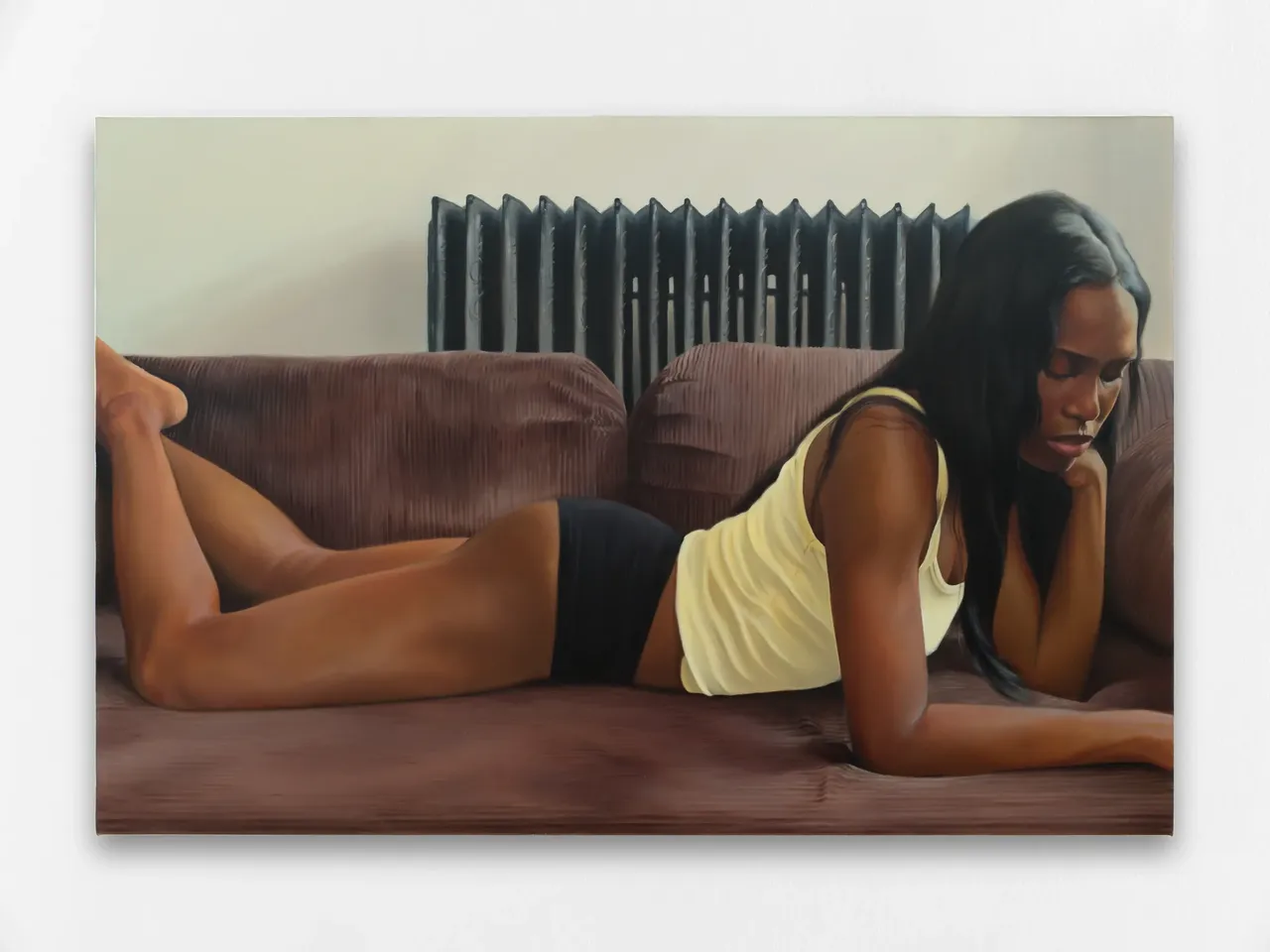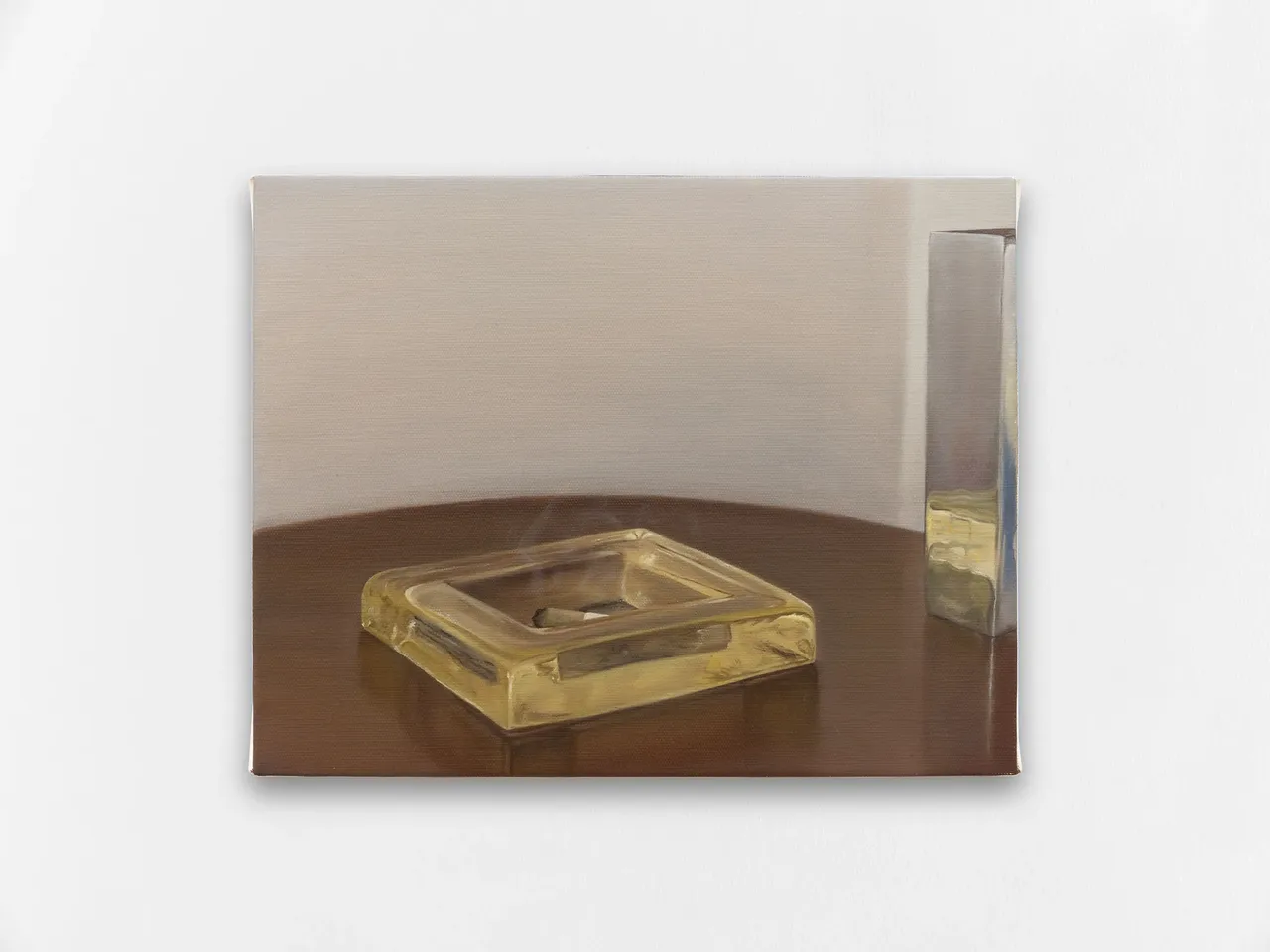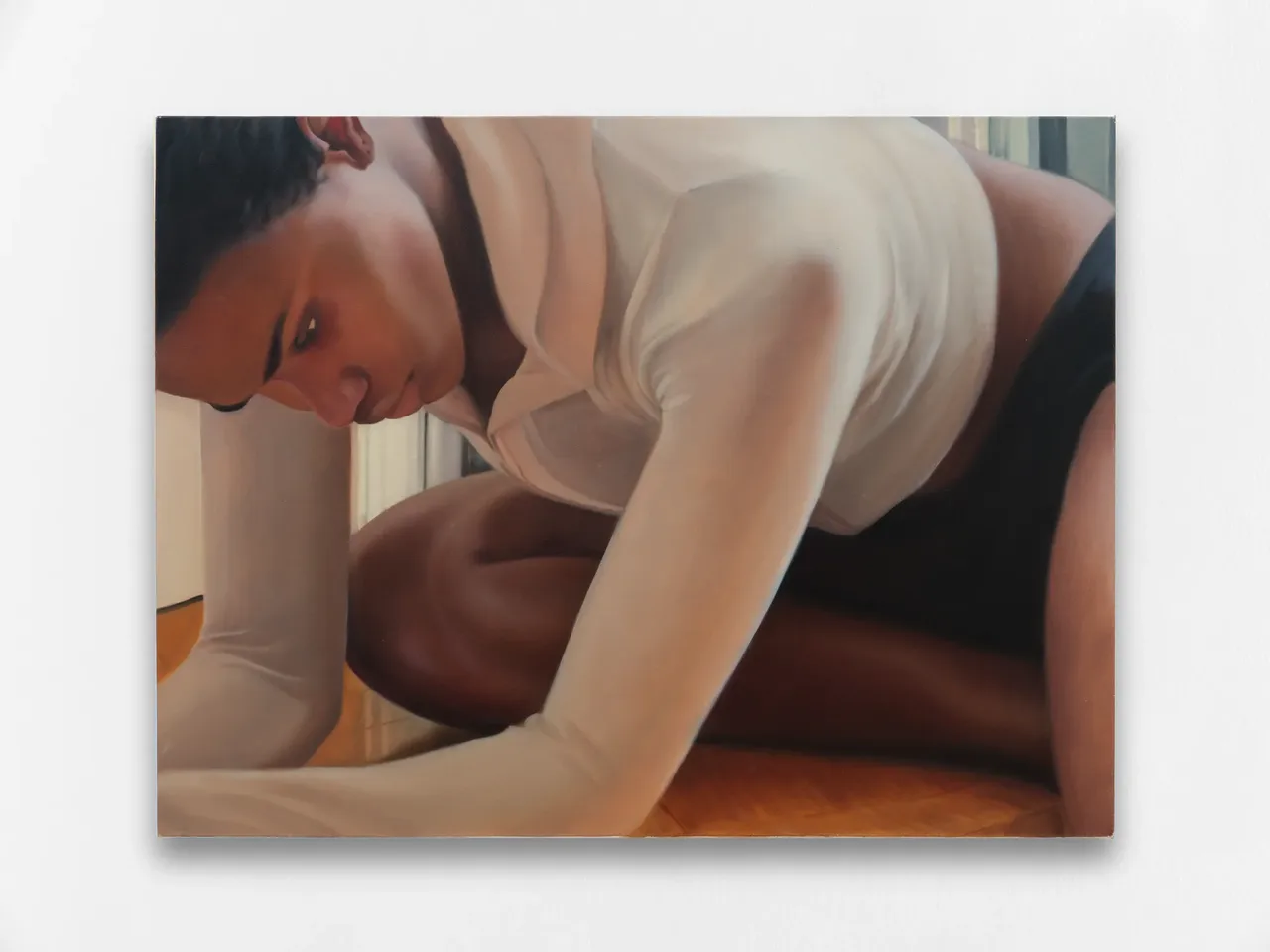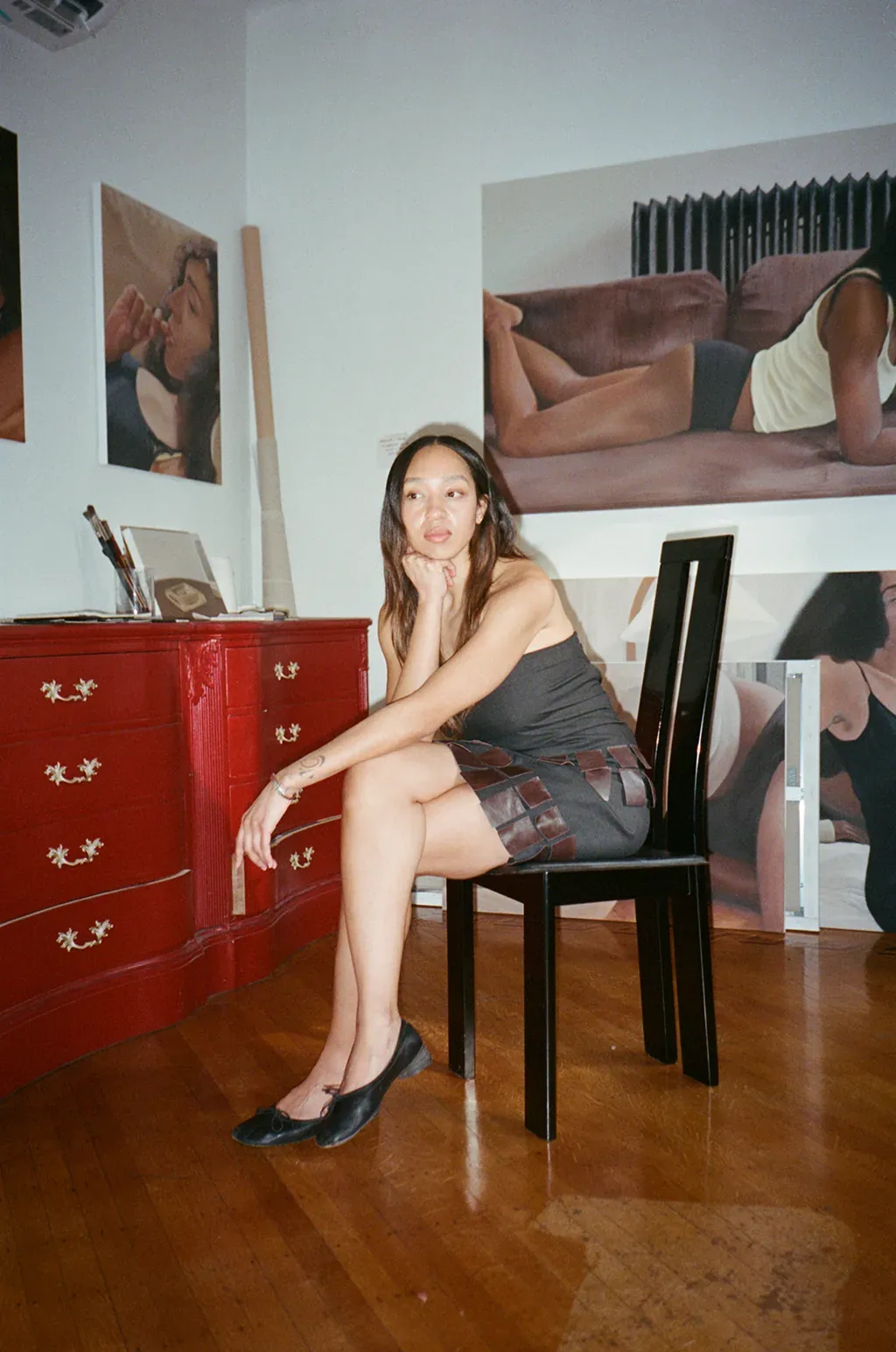
The pressure to excel in every aspect of life has become almost inseparable from contemporary womanhood. But in Bre Andy's universe, stillness becomes a language of its own. A pause to think, breathe, and introspect. Through soft, dreamlike brushwork and intimate domestic scenes, she invites viewers into a quieter exploration of femininity, one that feels calm, liminal, and almost ethereal.
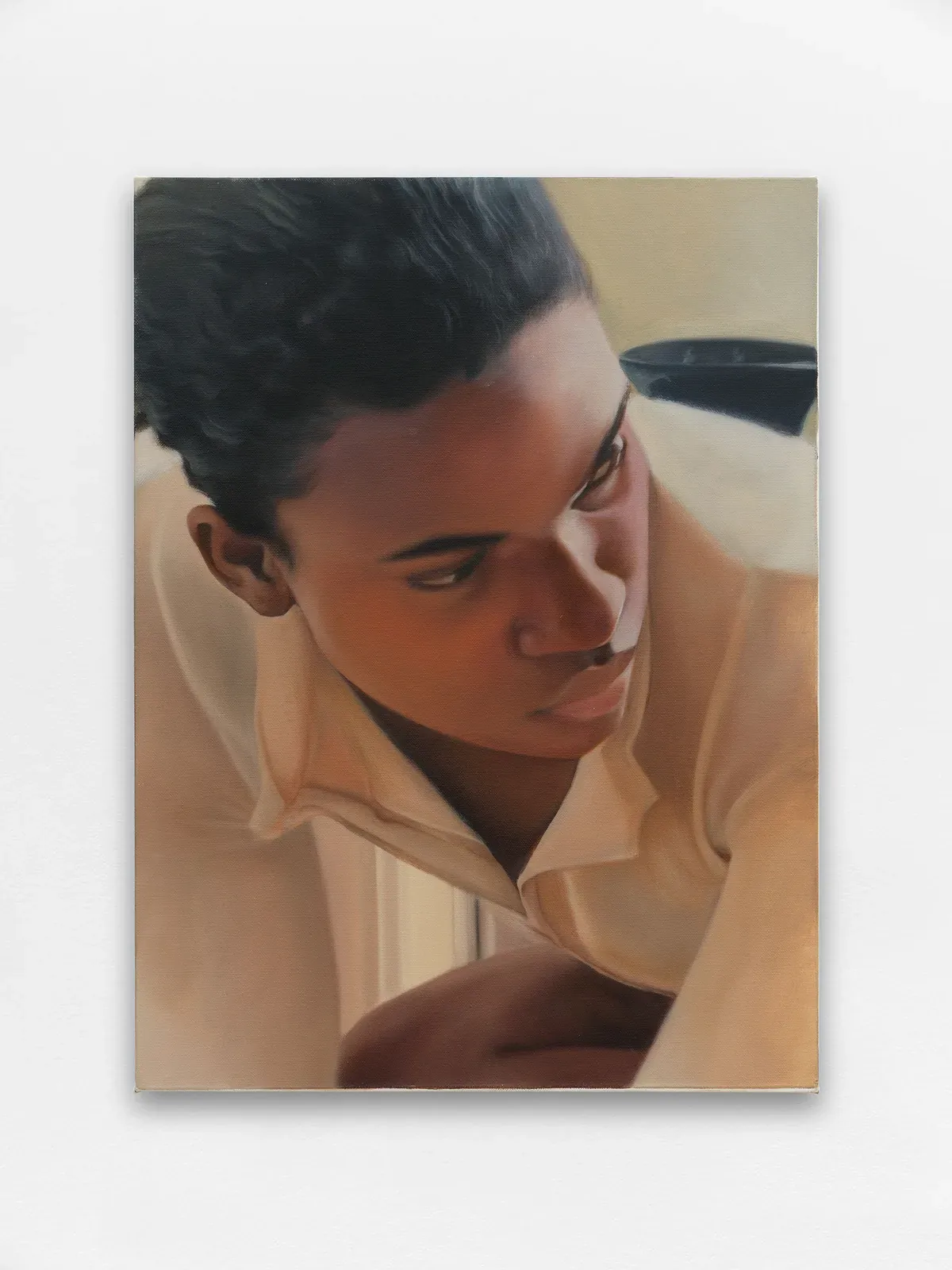
Whether depicting a woman resting on a sofa, lost in thought on a bed, or surrounded by everyday objects, Andy's paintings draw from her own experience of life and the influences that have shaped her perspective. The result is a body of work that is both deeply personal and universally resonant, a fresh take on what it means to become, and to be, a woman.
We first encountered your work during your debut international solo exhibition, Waiting Room, in Paris a few months ago. How has everything evolved for you since then?
Having a solo show in a different country for the first time was certainly an accomplishment. Somehow, those circumstances also felt completely natural for me. I’ve always wanted to be able to work in this capacity, and it personally became sort of a proof of concept for myself as an artist. It granted exposure to a new audience, both in person and for those discovering my work as it was shared online. I’m very happy with the experience, and I look forward to seeing where else my work will be welcomed.
Your paintings feel deeply intimate, though not in an explicit sense but rather in a quiet, internal way, like the kind of intimacy one has only with oneself. What draws you to depict women in this manner?
I feel my paintings are pretty reflective of my personality and inner monologue. I can see the quiet side of me, the evolving femininity, the moodiness that’s subconsciously been placed into it. The more work I’ve made, the more I think I’ve created a visual diary, combined with elements of the outer world I’m interested in — my environment, clothing, hair, and different art forms that inform my aesthetic overall.
I’ve always loved nude compositions, fabrics, and drapery. I love watching films and reading books that depict complex or unorthodox stories of women and the ways they navigate life. I just want to take all of that stuff I like and filter it through my own lens. I create based on emotion and rely on body language and space within the paintings to portray that emotion.
I’ve always loved nude compositions, fabrics, and drapery. I love watching films and reading books that depict complex or unorthodox stories of women and the ways they navigate life. I just want to take all of that stuff I like and filter it through my own lens. I create based on emotion and rely on body language and space within the paintings to portray that emotion.
How would you describe your trajectory within the art world so far? It’s not always easy to carve out a distinct voice. Has that been a challenge for you?
Baby steps (laughs). I wouldn’t yet describe it, as I’m still growing, but I’m thankful for how my work has been received so far. I think the art world can feel like this intimidating, manufactured construct, but I’m figuring it out as I go and focusing on maintaining both my creative flexibility and stability as an artist. I was recently talking to a few peers about the difficulty of making a statement about our work too definitively, because we may get the feeling that everything we make or want to make won’t fit under that statement. So that can be the challenge: to not impose a purpose onto the work and overpower what's happening naturally. I do try to focus on what makes my work distinct. I've contemplated what it conveys on the surface versus what I want it to say as the painter, and considered how technique also comes into play and becomes the thread between everything I make.
Was there a specific moment when you realised you wanted to become an artist, or did it emerge more gradually over time?
I’ve always known and have always pursued art in different ways. The only change is my own understanding of my capabilities and my focus.
“I can see the quiet side of me, the evolving femininity, the moodiness that’s subconsciously been placed into it.”
Your recent exhibition, Waiting Room, refers to a liminal space, a moment of transition, both physically and metaphorically. What does this concept mean to you in the context of your work?
Waiting Room was essentially a reflection of where I felt I was in 2025, and during the making of the paintings. Metaphorically, I could apply it to different aspects of my life — growing in age, endings of relationships, changes in my career, life challenges, etc. Seeing everything I was mentally shifting out of, and knowing there was a version of myself I was still looking to embody. I wanted to capture the stillness required to process these transitions.
For me, there's an interesting reading of womanhood as a kind of waiting room, a space where women are often expected to embody multiple roles at once: professional, partner, mother, caretaker. Even today, when these roles appear more fluid, there seems to be little space for stillness. Do you see your work as engaging with this tension?
Unintentionally, yes. Maintaining the multidimensionality of oneself takes diligence. Women have always had to manage multiple roles, some chosen, some imposed, and the amount of leisure we have to step outside of those roles varies and is a privilege. But I think the paintings can represent any moment you carve out for yourself to address that tension, however brief. At its core, the work is highlighting the necessity of doing so.
Throughout art history, women have often been represented through idealised or objectified lenses. Your work, however, feels grounded and intimate, almost like a glimpse into the quieter moments of becoming an adult woman. Is this a conscious response to those historical narratives?
I’ve always been drawn to depictions of women I’ve seen throughout art history; my understanding of painting and sculpture seemed to be centred around women, essentially iconising them, whether it was an admiration of their shape, clothing, place in society, or an allegorical fantasy of them. There's one layer, as a Black woman, of wanting to see myself within that kind of iconography but not as the background figure or the exotic. The women I am depicting are not linked to me in a way that subjects them to my gaze in the same way it could if a man were to capture them. I want to portray their agency and, in the painting, replicate the sense of closeness from the space where I originally photographed them.
Even so, I’ve used my work as a way to process my growth and to shake away any feelings of objectification or discomfort with being perceived. If I can use my own sensibility to represent or convey a different story of a woman, one that feels relatable and internal, I’m fulfilled.
Even so, I’ve used my work as a way to process my growth and to shake away any feelings of objectification or discomfort with being perceived. If I can use my own sensibility to represent or convey a different story of a woman, one that feels relatable and internal, I’m fulfilled.
I’ve noticed that certain characters seem to reappear across different works. Are these recurring women intentional? Do they have individual identities or narratives behind them?
In my solo show, it was intentional to paint different compositional perspectives of the same women, mostly to tie the images together aesthetically. However, to your point, I also believe it can help string a narrative together as if you’re seeing the subjects at multiple points in their day. I’d like for viewers to insert their own experiences or stories into the paintings in that way. I don’t want to tell the whole story, but I’m setting the scene.
“There's one layer, as a Black woman, of wanting to see myself within that kind of iconography.”
Your brushwork has a dreamlike, almost ephemeral quality, like fragments of a memory or a scene suspended in time. How do you approach the balance between realism and this more atmospheric sensibility?
I love those words as descriptors, thank you. My painting technique is something I’m having to make a conscious effort to play with now. Particularly with skin tones, I’ve often disregarded the techniques I was taught in painting because I’ve over-blended, glazed, and buffed my colours together very softly from the first layer. I’ve treated them delicately. As I’ve progressed, I find I want to break up that perfection of the paint application without eliminating the softness and depth I’ve been able to achieve. I’ve tuned my eye to understand light and colour, but I don’t mind allowing more expressive brushstrokes and imperfections to show through.
Seeing your work made me think about Edward Hopper. Although your styles differ, I can find a similar sense of emotional solitude that feels almost comforting in both. Do you see any connection there? Are there particular artists, influences, or personal experiences that have shaped your visual language?
This is a new perspective! I haven't considered this comparison, but I love his interiors and the way natural light is placed in his work and around his subjects. It makes you curious about the moment they’re in.
When I first started working in oil, I was looking at artists like John Kacere and Gérard Schlosser. The paintings felt like looking through their eyes, and I liked the overall sense of voyeurism. I leaned into that and focused on close-up, detailed images, and wanted to challenge taking on similar perspectives from a female gaze. Somaya Critchlow’s work reminds me that portraits can be playful, yet pensive, yet erotic all in one. I genuinely enjoy so many styles of figuration, it’s hard to pin down just a few.
When I first started working in oil, I was looking at artists like John Kacere and Gérard Schlosser. The paintings felt like looking through their eyes, and I liked the overall sense of voyeurism. I leaned into that and focused on close-up, detailed images, and wanted to challenge taking on similar perspectives from a female gaze. Somaya Critchlow’s work reminds me that portraits can be playful, yet pensive, yet erotic all in one. I genuinely enjoy so many styles of figuration, it’s hard to pin down just a few.
Finally, what’s next for you? Are you currently working on new pieces or projects you can share with us?
I’ve taken a bit of time out of the studio to explore and get inspired, but I’m working through concepts for another series of paintings. More soon!