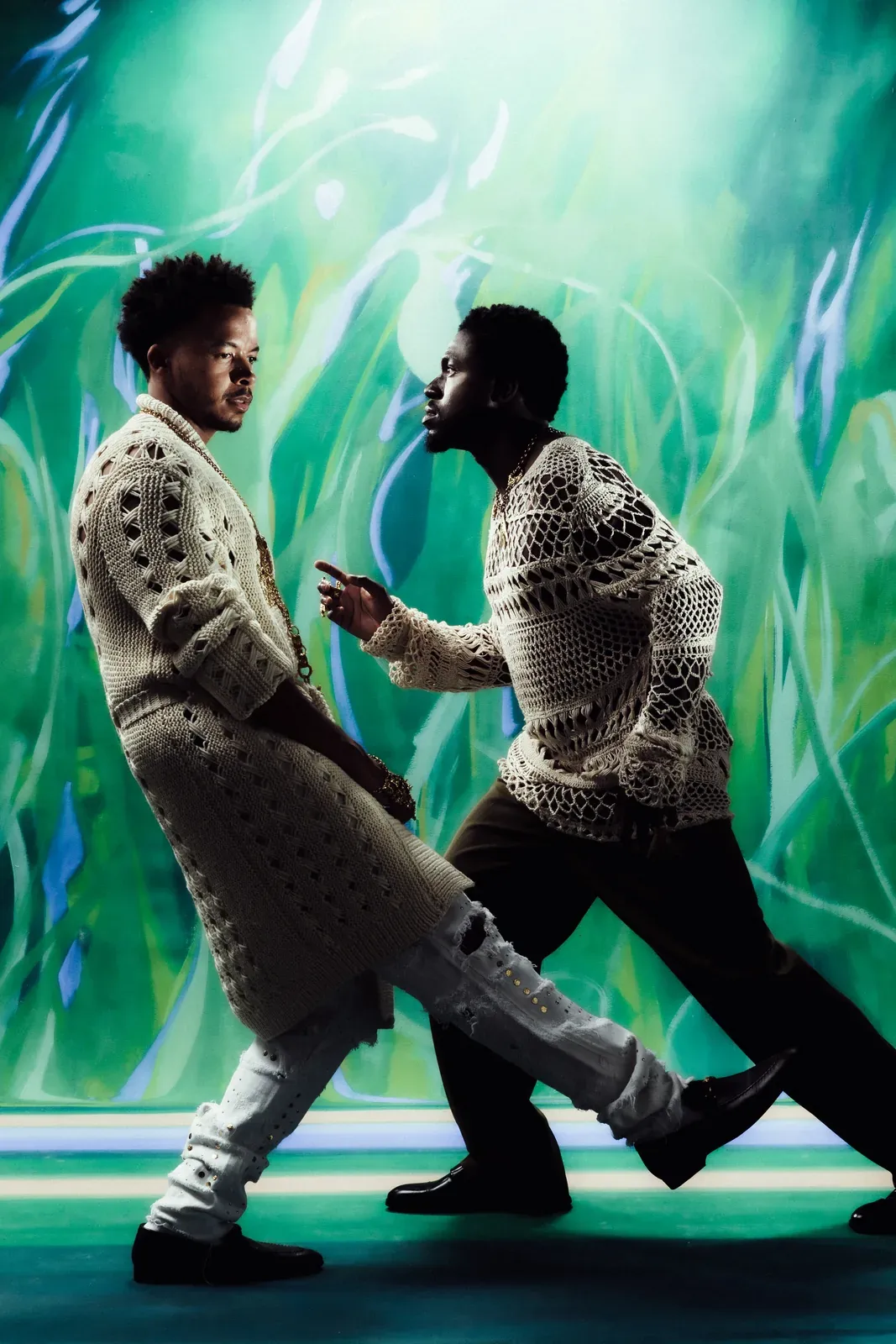
Ten years in, Blue Lab Beats still sound impossible to pin down. Jazz, hip hop, broken beat, soul, Afrobeats, electronica — their music moves freely between genres and moods without ever feeling fragmented. Today, The Blue Lab Beats Show finally arrives, marking another turning point for NK-OK and David Mrakpor as their first independently released album. “There’s a lot more responsibility and pressure, but also more control,” the duo NK-OK and David Mrakpor tell us in this interview.
That openness runs throughout the entire project. One moment, the duo drift through lush jazz fusion and dancehall rhythms; the next, they move into intimate instrumental passages that completely shift the atmosphere of the record. “When you’re at a house party and the DJ is free to just play whatever they like genre-wise, to create a journey, that’s how our sets are,” they say. “We don’t see it as needing to be part of one scene,” NK-OK adds. That feeling shapes The Blue Lab Beats Show, an album built through movement, exchange, and community across different spaces.
How do you usually move through those final days before a major release?
NK-OK: After it’s finished, I listen to it over and over and over again, then we usually need a bit of space at that point. You’ve been living with it for so long that you almost have to step away a bit, then come back and listen afresh. But at the same time, we’re getting ready to perform it live, so you’re still very connected to it in that way. It’s a balance between distance and preparation.
When you first shared the news that this would be your first album as independent artists, it felt like a real shift. What did that moment mean to you personally?
NK-OK: It’s a massive shift. There’s a lot more responsibility and pressure, but also more control. When you’re independent you wear multiple hats, so you have to adapt and learn quickly. It can be challenging, but at the same time, it brings you closer to your audience — everything feels more direct.
What has changed the most in you over this decade?
NK-OK: My hair! Joking aside, over time it’s been about understanding purpose. That’s something that constantly evolves, so you have to stay open and not get stuck in one lane. Music is always changing, and so are we.
If you return to Blue Skies, back in 2016, what’s the first image or feeling that comes to mind?
NK-OK: It feels like rawness and freedom. At the time, we didn’t fully know what we were doing — and that’s what made it exciting. We made a lot of those demos when I was fifteen years old, so there’s a real sense of growth when we look back now. We’re grateful for that period.
“It’s about understanding purpose. That’s something that constantly evolves, so you have to stay open and not get stuck in one lane. Music is always changing, and so are we.” NK-OK
There’s a sense that this album moves through different energies, from the more intimate, emotionally-driven Slow Heart to the rhythm-led, dancehall-inflected Fire Up. Did you think about contrast while building the record?
NK-OK: We love going across different genres because musically we appreciate so many different styles, as most people do. Because we perform a lot of shows, we see the audience enjoying all the music we play, from R&B to Afrobeats. When you’re at a house party and the DJ is free to play whatever they like genre-wise, to create a journey, that’s how our sets are. There is something for everyone; it’s a proper journey.
Tracks like Champions League or Find Your Way feel more direct in their message, while others open up into something more atmospheric or instrumental, like Watermelon or Stones Of Truth. How do you decide when to say something clearly and when to leave space?
NK-OK: There’s a mix of changes; moving between live, soulful moments and more rhythmic, energetic ones. It’s about letting different moods sit next to each other and feel natural. With FourNine, we had wanted to work with him for a while! With Find Your Way, which features Essosa, we drew on sonic lines from the beach clubs of Rio de Janeiro. Pieces Of Life’s Puzzle, we loved playing with the time signature changes: adding the strings took that track to another place; that is one of our favourite instrumental tracks on the album.
Clarity and space are important. It’s about understanding the energy of the room first, then building on that rather than forcing something. Sometimes it’s about saying exactly what needs to be said, and sometimes it’s about leaving space for people to feel it in their own way.
Clarity and space are important. It’s about understanding the energy of the room first, then building on that rather than forcing something. Sometimes it’s about saying exactly what needs to be said, and sometimes it’s about leaving space for people to feel it in their own way.
Collaboration has always been part of your world, but here it feels especially intentional. What made someone like Jamila Woods or Denzel Himself feel right for this moment?
NK-OK: Jamila came to us about three years ago; we wrote Slow Heart back then but in the end, it didn’t get used for her project, so we totally reworked it for our album. Jamila loves the new version! Similarly, we’ve admired Denzel for some time; he is an amazing lyricist, we were so happy with what he did with Hear It Pop.
Is there a collaboration on this album that completely surprised you, where the track became something you didn’t expect at all?
NK-OK: The process itself can always take you somewhere unexpected — tracks evolve, arrangements change, and what starts one way can end up somewhere completely different. That’s part of what keeps it exciting.
“I hope the music industry will understand that it’s completely fine for musical artists to create whatever music they please and that they don’t have to follow a set formula.” David
You’ve built a way of working that connects different scenes (the UK, Brazil, the US) while still holding onto a very distinct identity. Do you feel part of a scene, or more like something moving between them?
NK-OK: We don’t see it as needing to be part of one scene. It’s more about understanding each other’s strengths and building community across different spaces. At the same time, our community is Jazz ReFreshed, Women In Jazz, Tomorrow’s Warriors and Power Up. For us, it’s about showing that people can be their unique selves, while still connecting and supporting each other, and creating something meaningful together.
You’re also one of the few UK acts to have received clearance from the estate of Fela Kuti. Did that moment shift how you see your place within a wider musical lineage?
David: In regard to receiving a green light from Fela Kuti’s estate, for me it was unsurprising and yet still mind-blowing. I always think to myself that an artist’s sound will eventually reach the attention of their heroes.
Looking ahead, what do the next ten years look like for you? Is there something you’re still chasing, or something you want to build?
David: In the next ten years, we hope to expand our sound even more and rub shoulders with some more cool artists around the world and to experiment and exchange ideas with them.
And finally, in a time where connection, freedom and joy feel more necessary than ever, what do you hope the music industry holds onto, or rethinks, over the next decade?
David: I personally hope the music industry will understand that it’s completely fine for musical artists to create whatever music they please and that they don’t have to follow a set formula that deliberately appeals to commercial crowds.