The canvas is bustling with colour, movement, sparkles, and texture. At first glance you feel overwhelmed—there’s too much to focus on, and you need another pair of eyes to absorb it all. Bea Scaccia’s new collection, Mood Swings, evokes a sense of discomfort and intrigue that draws you in until your nose is almost pressed up against the painting trying to take in every little detail. Her work is now on display at Maruani Mercier in Brussels until December 12th, 2025, and at the Quadriennale di Roma, co-curated by Francesco Bonami, among others, until 21 December 2025.
As a woman, I recognised the cosmic joke of looking for your lipstick in an overstuffed bag in On Sundays, she cleaned herself or the annoyance of losing a clip in your hair in Even though it was the season of Carnival. But most of all, I recognised the weight of the expectations that come with being a woman, or rather, the weight of the masks we use to perform a different version of ourselves.
Scaccia’s work shows us how complicated femininity is—quite refreshing in a world where men’s hollow conceptions of what it means to be a woman have permeated our culture. She uses movement to show the fluctuating definitions of womanhood and humanity in general, reflecting a broader societal phenomenon of constant change and ‘swings’.
We talk with Scaccia about performance, the absurd existence of humankind, fairy tales, and women’s greatest ally: the cat.
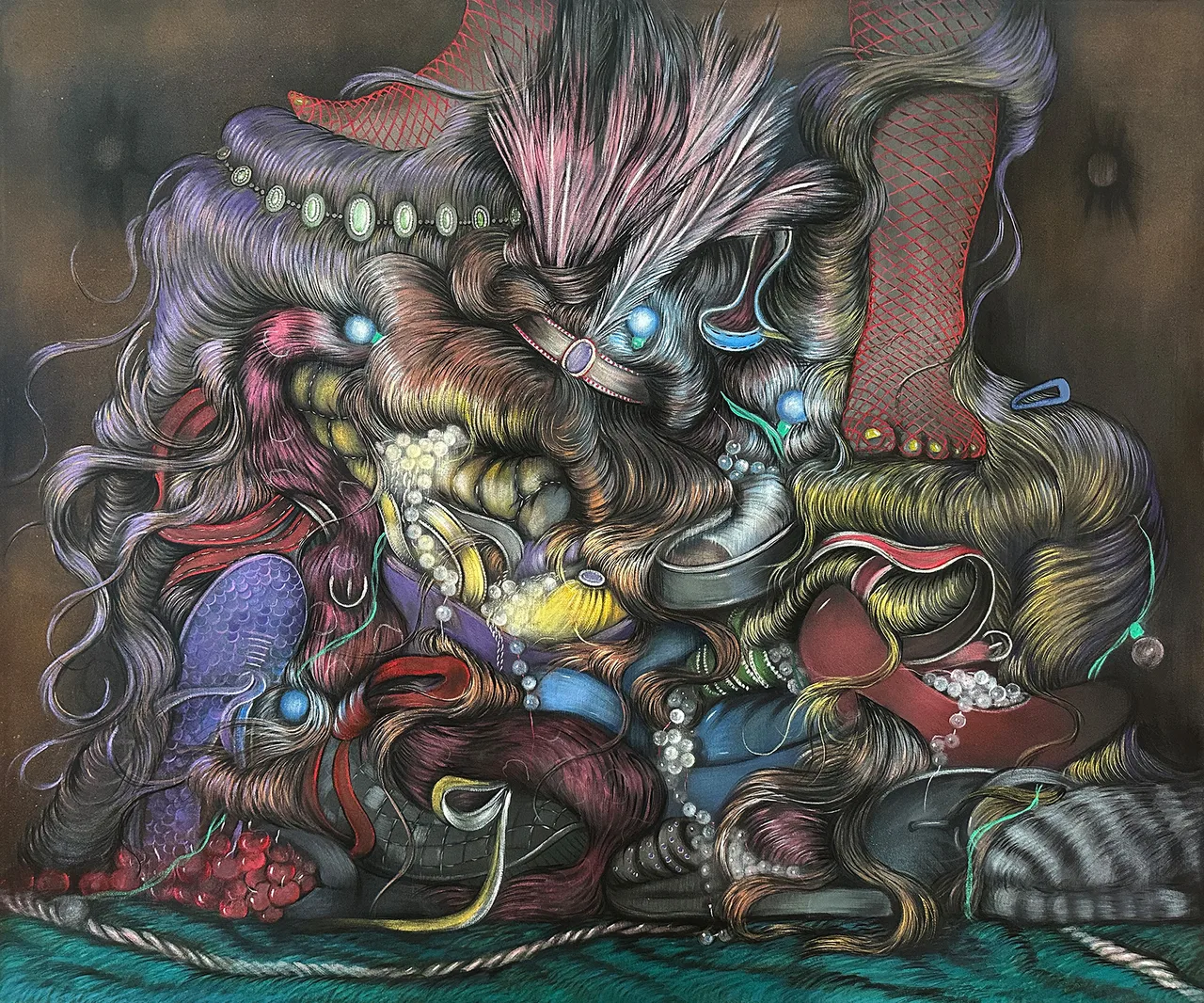
I don't mischievously lose my shoes anymore, 2025 © Bea Scaccia
Your work feels so whimsical when studying the objects, the positions of the figures, the jewels, the hair, the background—everything. I feel like I am in Alice in Wonderland. What fairy tales do you remember from your childhood? Which ones inspire you in your art?
I can’t blame just one fairytale—it was all of them. I grew up enchanted by stories and animated movies. Like many, I discovered Walt Disney before I ever fell in love with books. I have vivid memories of being obsessed with Robin Hood and Beauty and the Beast, and I treasured an illustrated Snow White book with the original, unsweetened ending—not the Disney-fied version. There was a full-page illustration of Snow White’s face as she slept, her lips glossy. I remember studying that image intently. Even then, I knew I loved stories and pictures more than most kids my age.
Your earlier works are more sketch-like: a lot of use of pencil and paper, wax, some watercolours. What made you change your technique from pencil on paper and wax to painting?
After finishing the Academy in Rome, I spent years chasing painting but never quite found my path. Eventually, I decided to wipe the canvas clean—literally—and start again with just drawing, stripping away colour to get back to basics. When I moved to New York City, drawing became a practical necessity as much as an artistic one: it was all I could afford. Strangely, though, drawing always left me feeling as though I were incomplete. Uprooting my life for another country was its own kind of trauma, and it took me longer than I care to admit to figure out what my work was missing. To make ends meet, I was often painting for other artists, and that didn’t help. Then I began experimenting with stop-motion animation, and while shooting for the frames, I began playing with the lighting and the movements in a more consistent way. That is when I started to see how my paintings were supposed to “feel like”.
In your current exhibition, Mood Swings, movement is a central theme, representing both human nature to change and shift as well as society’s precarious fluctuations. What societal fluctuations are catching your attention right now? Are these represented in your paintings?
Movement has always taken centre stage in my work, sometimes quite literally. We’re living in an intriguing twilight in Western society—a period of uncertainty and ambiguity. Naturally, my paintings grapple with questions of gender and existence. But the elements I choose to highlight are deeply intertwined with Western culture itself. They reflect a society that, for many reasons, often escapes real scrutiny.
In these paintings, there is one spot that lights up, sometimes around jewels, sometimes in the hair, sometimes with a perfume bottle. What do you hope to show with this illumination?
There’s a visual logic behind my use of lighting. I highlight certain parts of the composition simply because the piece demands it. The process isn’t calculated or deliberate—sometimes, it’s almost serendipitous which object ends up catching the light. But without those lights, my paintings wouldn’t work. Theatre has been an important component of my work. I love the verb “staging”… Staging my lights, turning them on, in some area or another, makes the whole process more complex. I also need my lights to add a bit of “bad taste” to the composition. I consider all my elements fake, like every costume is. Pearls are not real, hair is wigs, and fabric is cheap. Lights add something in that sense. Another layer of “fakeness”.
“If a woman follows society’s script without realising it, it’s a cage. But if she chooses to play with those expectations and twist them, it becomes her weapon.”
The human figure is central to much of your work, in Mood Swings and in past collections; however, you hide a central part of the human figure: the face. Why?
Adding a face would transform the entire piece—it’s a temptation I sometimes feel, but it never quite seems right. Honestly, I wish someone could explain it to me. There’s a big part of my work that remains mysterious even to myself.
In fairytales and mythology, you notice women are often either pegged as monsters or innocent waifs who do no wrong, as though multifacetedness and complication are aspects reserved for men. Yet, more recently, in the fields of psychology and emotions, women are hailed as being intelligent and more complex in this sense. What do you make of this dichotomy?
Society has a habit of flattening what it can’t fully grasp. Women, for so long, were cast as outsiders, villains, or objects to be possessed. Make something one-dimensional, and suddenly it’s less threatening. We are in a much better position right now: think about all the complex female characters in pop culture. There are so many female tricksters nowadays. It is refreshing. We now talk about the heroine’s journey in contrast with the hero’s journey and so on. We know female artists and writers.
I grew up in the eighties in a provincial reality; I was obsessed with literature, and yet, I wouldn’t realise that I was studying only male writers. I would dismiss my mother as lesser and respect my dad, only for the simple fact of being a man. So much awareness to be built in my generation! Now, this is even impossible to conceive. But something disturbing is happening more and more: there is an attempt to go back in time. Some kind of dangerous nostalgia for a past where women were relegated to domestic roles. We have to be careful.
I grew up in the eighties in a provincial reality; I was obsessed with literature, and yet, I wouldn’t realise that I was studying only male writers. I would dismiss my mother as lesser and respect my dad, only for the simple fact of being a man. So much awareness to be built in my generation! Now, this is even impossible to conceive. But something disturbing is happening more and more: there is an attempt to go back in time. Some kind of dangerous nostalgia for a past where women were relegated to domestic roles. We have to be careful.
In Cake, candle, swing, flying shoe, colourful stockings. Am I not perfectly alive? the figure is swinging across the canvas while carrying jewels, mounds of hair, a cake, furs, lights, and clips. As she swings, she does so freely despite the objects that should be weighing her down, and it reminds me of how effortlessly women carry themselves in spite of all the things people want us to be. How do you find joy in being a woman, walking that tight rope of performance, carrying the expectations of your gender?
It is interesting to see how the painting gets perceived through other people’s eyes. I don’t see the “puppet-like performer” of that specific painting being free. I see a frozen movement, cluttered with too much stuff. But it’s humorous, and there are happy aspects to it—that’s for sure. There is always a connection to childhood and playing dress-up, too. That is why it probably irradiates something light and playful. We always contain both sides. I see our shadows even in the most illuminated moments.
I have to say, I’m genuinely happy to be a woman, and I find the ageing process fascinating. I like who I am. I try not to overperform, reminding myself that our time here is brief and that I owe it to myself to be strong enough to live authentically. I choose to stay a little unsettling, to defy the expectations placed on my gender—through my work, my actions, and a healthy dose of conversation. It doesn’t mean I succeed; sometimes, I fail miserably.
I have to say, I’m genuinely happy to be a woman, and I find the ageing process fascinating. I like who I am. I try not to overperform, reminding myself that our time here is brief and that I owe it to myself to be strong enough to live authentically. I choose to stay a little unsettling, to defy the expectations placed on my gender—through my work, my actions, and a healthy dose of conversation. It doesn’t mean I succeed; sometimes, I fail miserably.
You said once you wanted to combine beauty, femininity, pop culture, and domesticity in a way that is disturbing and unsettling because nothing can exist in one dimension; there is always contrast. Why do you find it important to expose the underbelly of these concepts that, at first glance, may have a light air to them?
Beauty, femininity, and domesticity—as we know them—are ideas handed down to us in a very particular, prescriptive way. Ageing, for instance, is treated almost like a sin, because femininity and beauty are so tightly knotted to youth. And domesticity? That’s still stuck to women like a stubborn label. Pop culture is the glue that keeps these old concepts firmly in place, passing them from generation to generation. Just think: A single iconic movie character can shift society’s perspective far more than even the most complex theoretical book ever could.
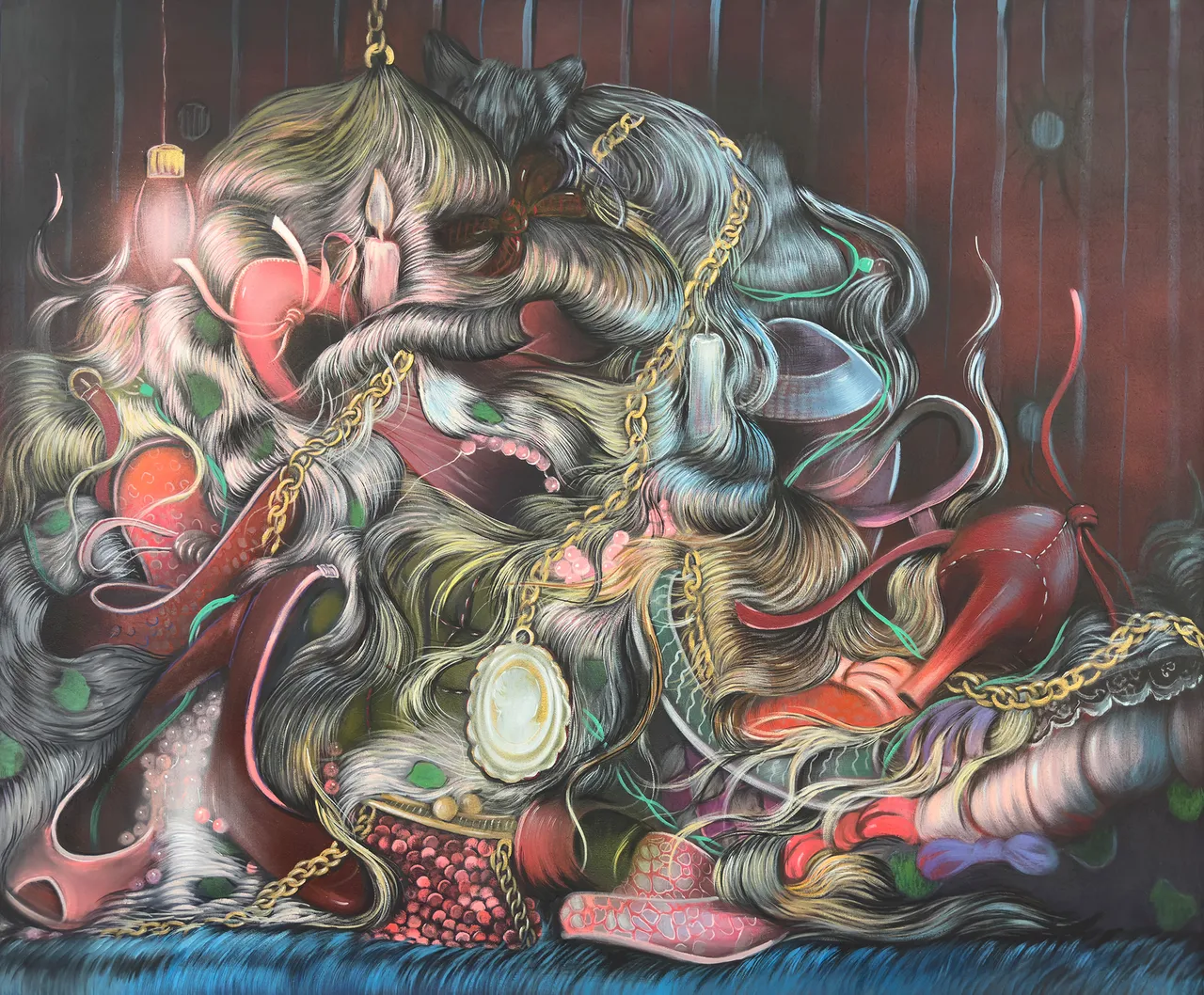
(I heard that shiny red attracts the eye) Are you intrigued?, 2025 © Bea Scaccia
Artifice and performance are central themes to your work, and you’ve mentioned that they are not necessarily negative, that everything we adorn ourselves with and each mask we wear are tools to get closer to our interior selves. How does one find and perform their interior self?
Since reading Bergson’s Laughter, I have been intrigued by the concept of existential performance with its own grotesque aspects. He conveys that we laugh every time a person gives us the impression of being a thing. It is “the mechanical encrusted upon the living” that makes us laugh. Even though we sometimes overlook our ridiculous aspects, it is in those, probably, that we can see some truth. Paradoxically, then, by embracing our own puppet-like identity, we can perform more genuinely.
You must choose your own masks and costumes; you don’t have to passively wear the ones society, family, or your hometown hands you. We’re all fragile performers—even when we think no one’s watching—and becoming the person you want to be means picking a costume that’s truly yours. We’re more malleable than we realise, which is why, when societies unravel quickly, you often see it first in what people start to wear—their roles and uniforms shifting quietly along with the times.
You must choose your own masks and costumes; you don’t have to passively wear the ones society, family, or your hometown hands you. We’re all fragile performers—even when we think no one’s watching—and becoming the person you want to be means picking a costume that’s truly yours. We’re more malleable than we realise, which is why, when societies unravel quickly, you often see it first in what people start to wear—their roles and uniforms shifting quietly along with the times.
I think the concept of artifice is especially concentrated on women in a very negative way. There's a famous quote from Hindu saint Nirmalananda that goes, “Our modern society is engaged in polishing and decorating the cage in which man is kept imprisoned.” I think this concept of decorating your cage of oppression is brought up a lot in conversations about feminine practices like putting on makeup, wearing jewellery, having an interest in fashion, colouring our hair, etc. To what extent do you think that’s true? How would you elaborate on this statement?
I like this idea a lot, and like most things, it holds both truth and contradiction. Sometimes, it’s hard to recognise you’ve been caged; it’s the comfort of a familiar hell. But anything can become a strength when wielded with awareness. Take makeup: it can also be a tool for power. It always comes back to the question—are these masks chosen or imposed? If a woman follows society’s script without realising it, it’s a cage. But if she chooses to play with those expectations and twist them, they become her weapon.
Gendered performance, specifically, is very apparent in your works. Judith Butler says gender is not a fixed identity but rather actively formed (and performed) and therefore ever-changing. How do you represent this in your work? And how do you think women’s gender performance is changing today?
We’re in a constant state of change, and my work is often an over-the-top, shapeshifting composition of leftover identities. Gender is shaped; roles are constructed. It is challenging to pinpoint how women’s gender performance is evolving right now. As I mentioned already, we’re living through an especially confusing era, where a new surge of conservative values collides with more relaxed ones. It’s not easy to say exactly what’s going on. We always have to face contradictions and different ways of embracing gender. How do we perform gender? Through behaviour, choices, and fashion. That is how I represent it. Of course, I am mostly focused on the performative nature of the feminine gender. By adding too much, I like the idea of transforming into threatening material elements that are usually considered gentle and harmless.
You’ve spoken about how women have to be very careful not to become grotesque, but they can become grotesque in so many ways. Sometimes on purpose to evade unwanted attention from men, other times because of a non-feminine performance or even just ageing. While being labelled grotesque may sound unsettling to most, you speak about it as something that is almost freeing. Can you tell me a bit about that?
Even before we talk about gender, our very existence on this planet is already a bit grotesque. We strut around as if we’re immortal, acting in ways that defy logic. There’s an absurdity—a fundamental glitch—at the heart of human experience. That’s why it’s liberating to really consider it. Montaigne wrote something about it. Contemplating mortality, in all its grotesque glory, sharpens our focus on what matters most. This applies universally but also to specifics like gender. They’re all connected: the relentless pursuit of perfection demanded of women is tied to our fear of ageing, dying, and remaining unresolved. Women and ‘villains’ have often been the targets, but this struggle is everywhere. Western society, in particular, seems locked in battle with its own dark, fragile, mortal nature.
“The relentless pursuit of perfection demanded of women is tied to our fear of ageing, dying, and remaining unresolved.”
You’ve also noted Goya to be an inspiration. His Black Paintings are considered to be some of the most grotesque and unsettling works. They’re much more obviously disconcerting with bulging eyes, cannibalism, and death, whereas your paintings subtly present unsettling themes like overconsumption and artifice. Why do you find confronting these themes important to your art?
When I moved to New York, I remember feeling as if I’d landed in a society determined to reject its own shadow. Progress, I realised, is just an illusion if it isn’t rooted in something deeper and more sensitive. That struck me as a kind of collective madness, and it still does. I feel compelled to confront these themes—overconsumption and artifice—because they’re woven into daily life, shaping the way we operate, whether we notice it or not.
During the pandemic, you worked on the Homemade project by Magazzino Italian Art, where you focused on hoarding and accumulation. In Mood Swings, the figure seems to have accumulated all these objects and taken them with her, unable to detach herself from them. Is this a practice of hoarding? Could hoarding be considered in some ways a gendered practice?
I don’t think hoarding is inherently gendered; it’s a distinctly contemporary habit. But overperforming—now that’s a different story. Women are expected to juggle countless roles, and on top of that, maintain physical perfection, style, and class. The more power a woman has, the more pressure there is to look the part. That’s where the link to hoarding comes in: you can accumulate stuff, but you can also hoard roles and expectations. Sometimes, overperforming takes over to the point where even relaxation needs to be scheduled and perfected. I see this everywhere, including in myself. Noticing it and developing awareness is important.
You’ve noted cats to be inherently feminine because of their attitude and discussed their association with the “lonely cat lady” trope. On the outside these women are sad and alone without children or a husband, but really, they have found a companion who won’t dim their light or will them to change. Cats are also closely associated with witchcraft and female monsters. Historically cats have been the allies to women. In Mood Swings, cats are featured in a few paintings without their faces showing, just like the human figures. Is this meant to be a commentary on the correlation between women and cats—almost like an anthropomorphism of women being one with cats?
It’s not exactly anthropomorphism, but animals are definitely allies in my paintings. There is a strong link, in my opinion, between animals’ unpredictability and women. And this connection is even stronger with cats. Cats are feminine, and one of the things people, and more specifically men, don’t like about cats is their independence. Artists like Leonor Fini played the part of the independent, femme fatale cat lady/witch to such an extent that she even posed for a photo of herself on a broom. I was in awe when I saw that image.
Cats also represent a peculiar aspect of domesticity: a bit darker, a bit less welcoming. Cocteau wrote that they are the real soul of one’s home. But there is always something mysterious and unmanageable about them. In my paintings, they are allies, portals, witnesses. There’s even a secret cat’s eye hidden in one of my recent works in Mood Swings. More in general, the bond between women and animals runs deep, stretching far back in cultural history. Nature itself has a feminine nature in our narratives, and it has long been something men were taught to hunt and conquer.
Cats also represent a peculiar aspect of domesticity: a bit darker, a bit less welcoming. Cocteau wrote that they are the real soul of one’s home. But there is always something mysterious and unmanageable about them. In my paintings, they are allies, portals, witnesses. There’s even a secret cat’s eye hidden in one of my recent works in Mood Swings. More in general, the bond between women and animals runs deep, stretching far back in cultural history. Nature itself has a feminine nature in our narratives, and it has long been something men were taught to hunt and conquer.
To finish with a curiosity, do you have a cat?
No, I don’t have a cat—yet. One day, I hope to leave the city behind and adopt a cat… and maybe a few goats (laughs).
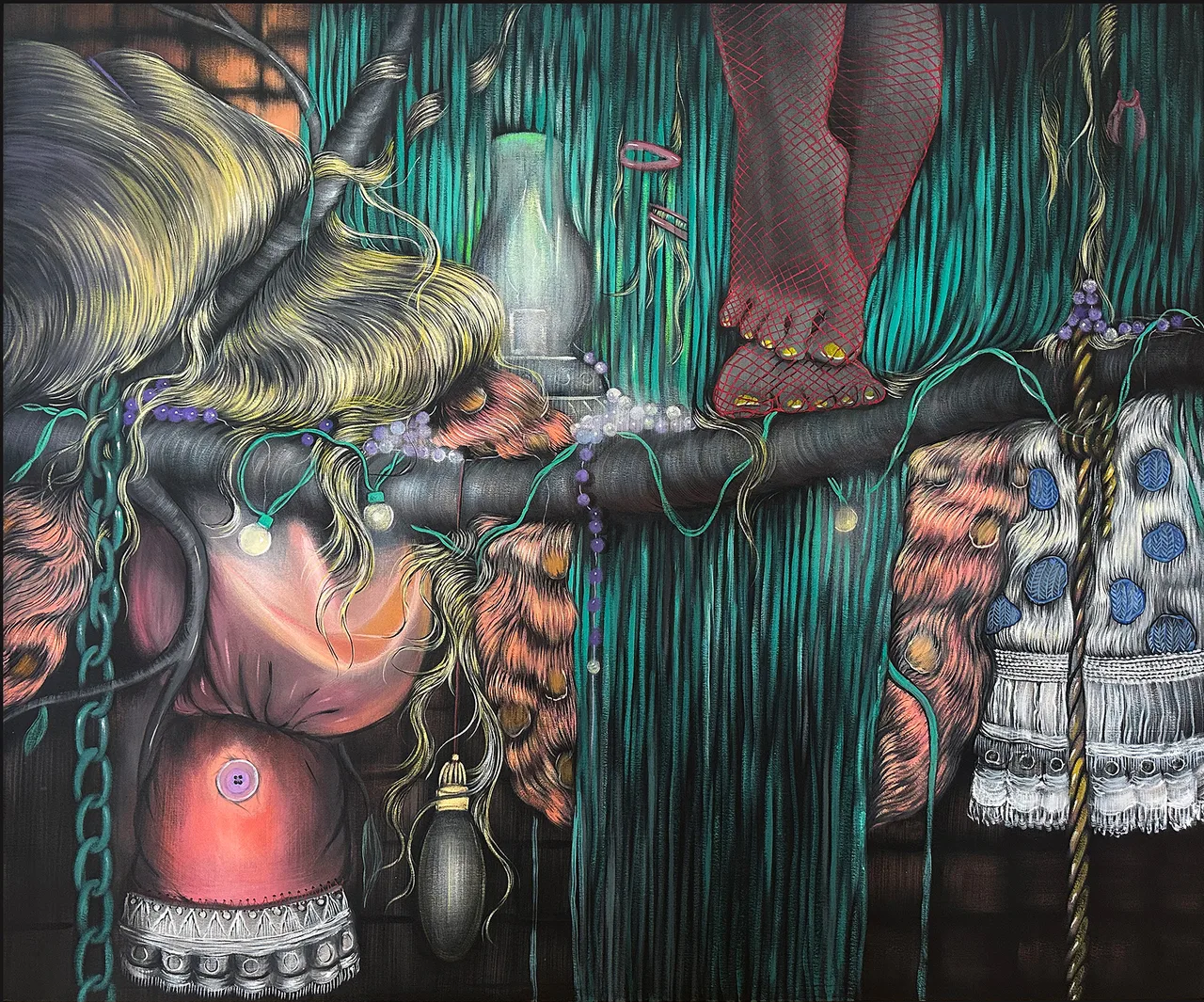
May I live on a tree and look at my mood swings from above?, 2025 © Bea Scaccia
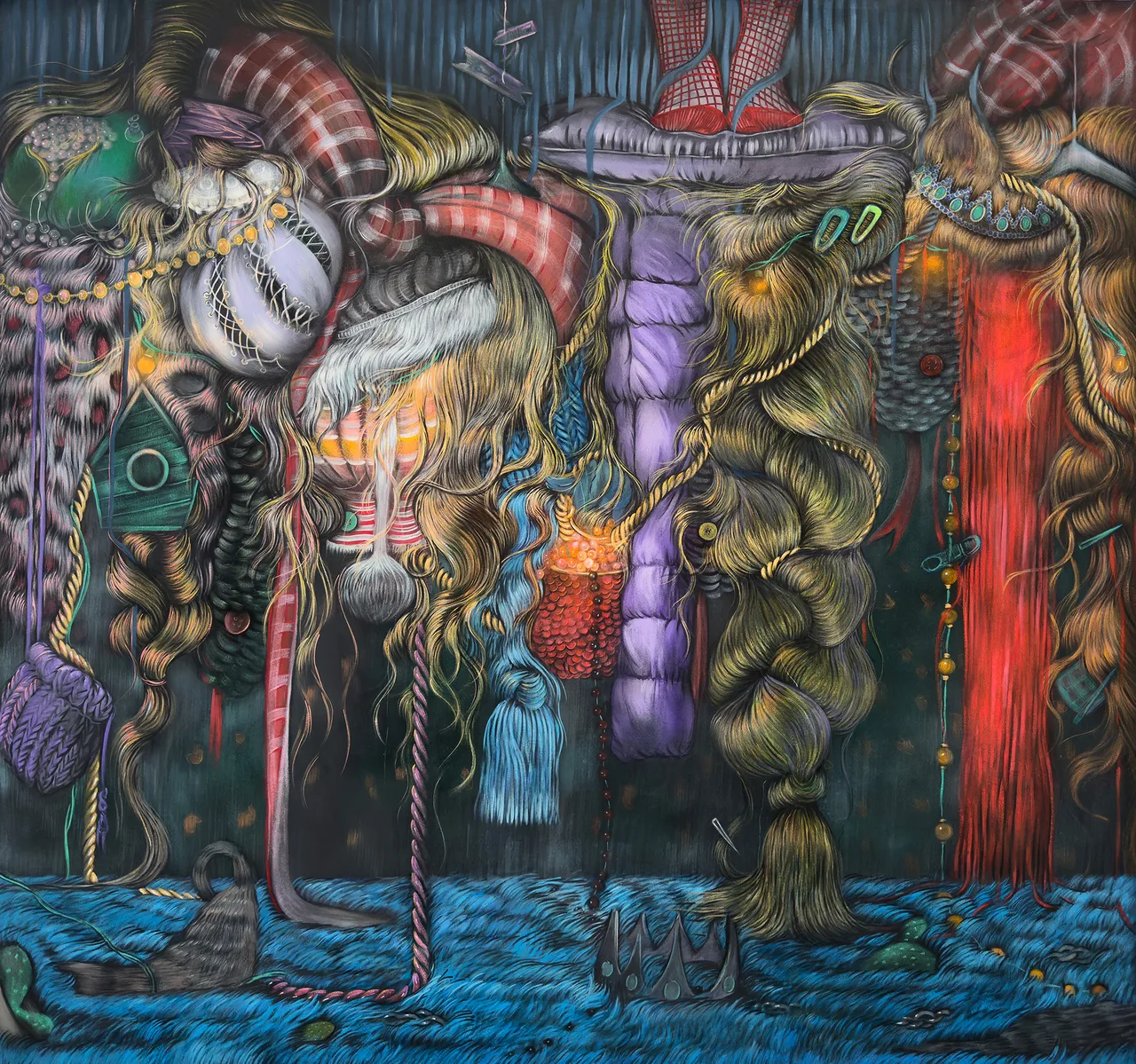
When tongues came out, we weren’t ready, 2025 © Bea Scaccia