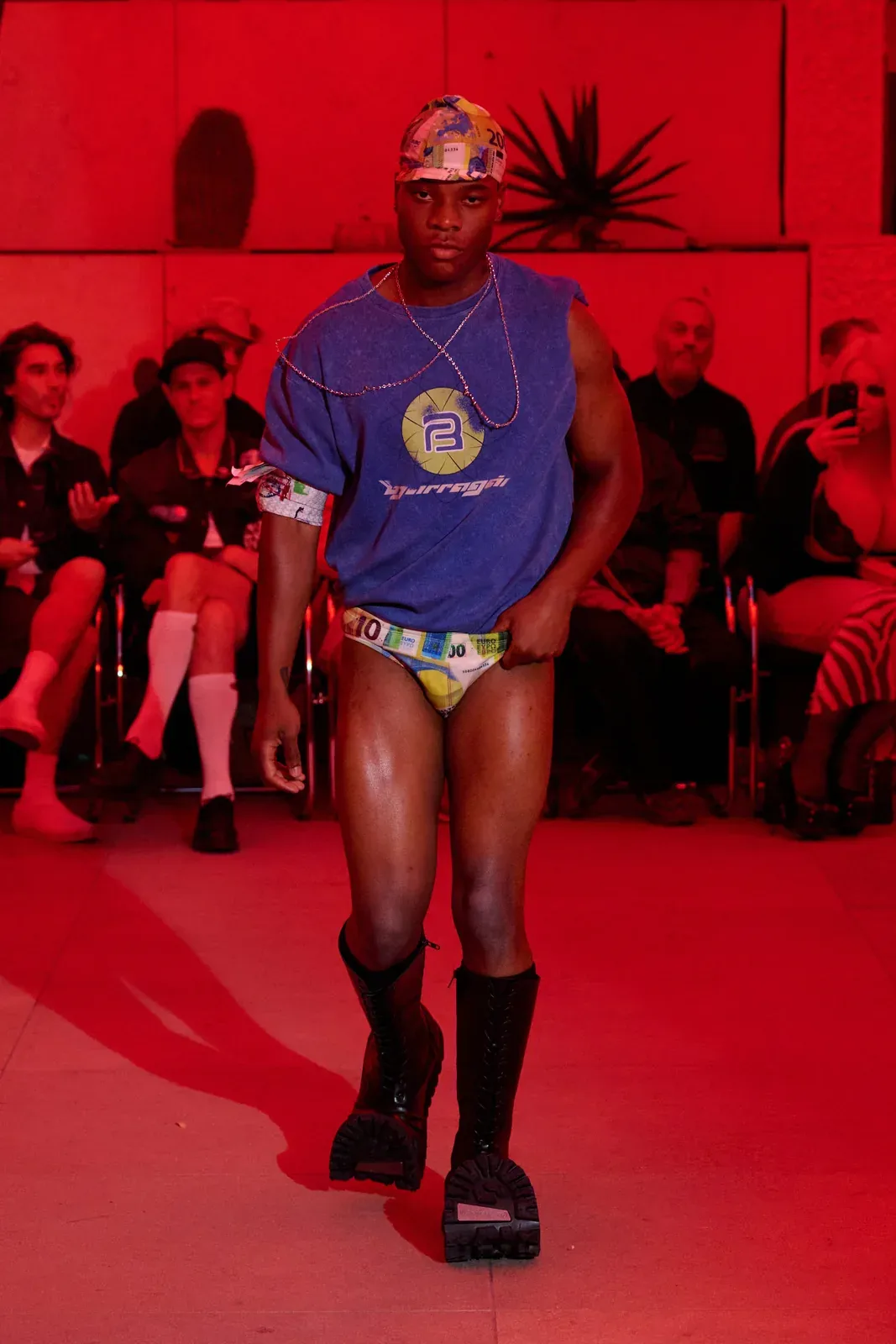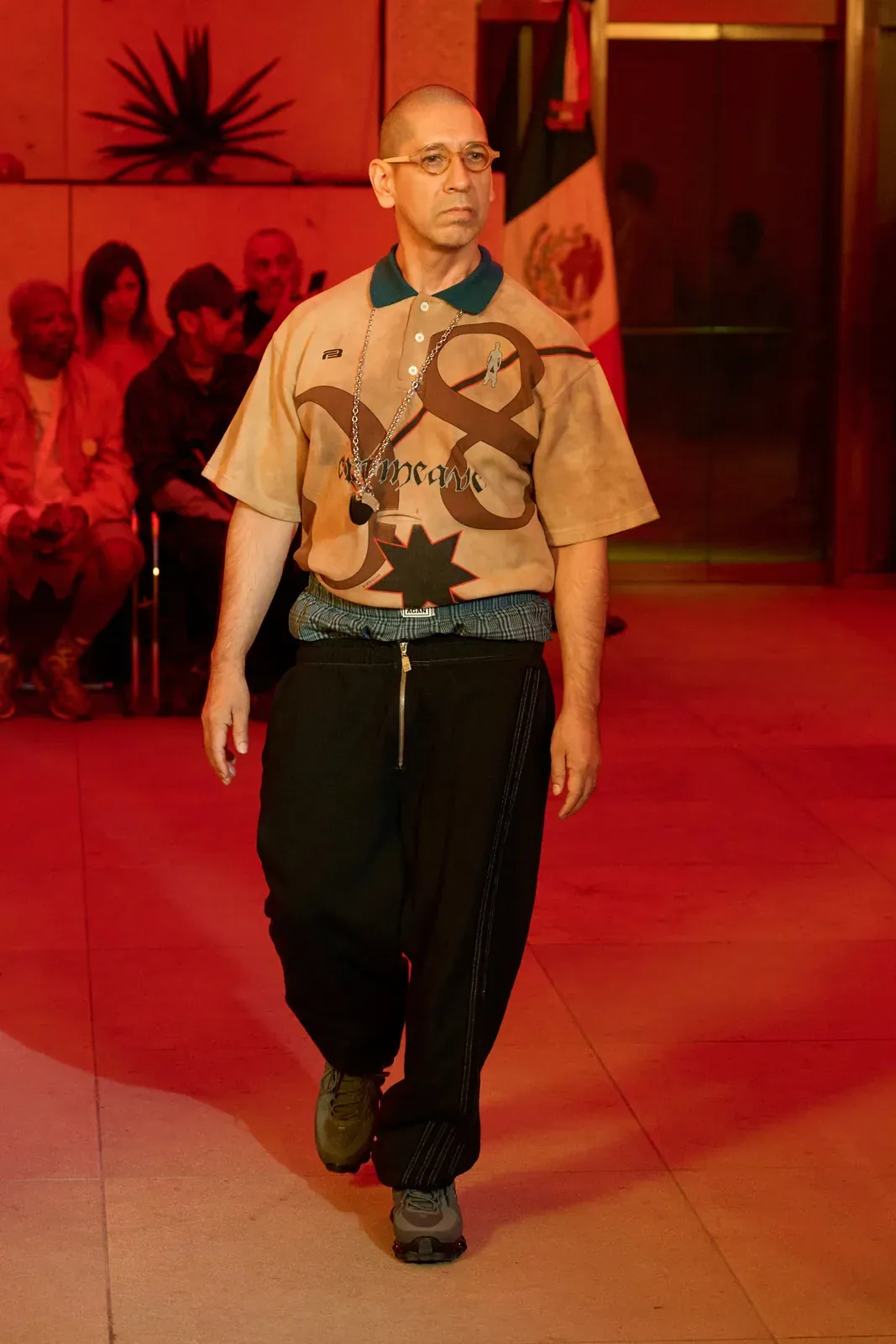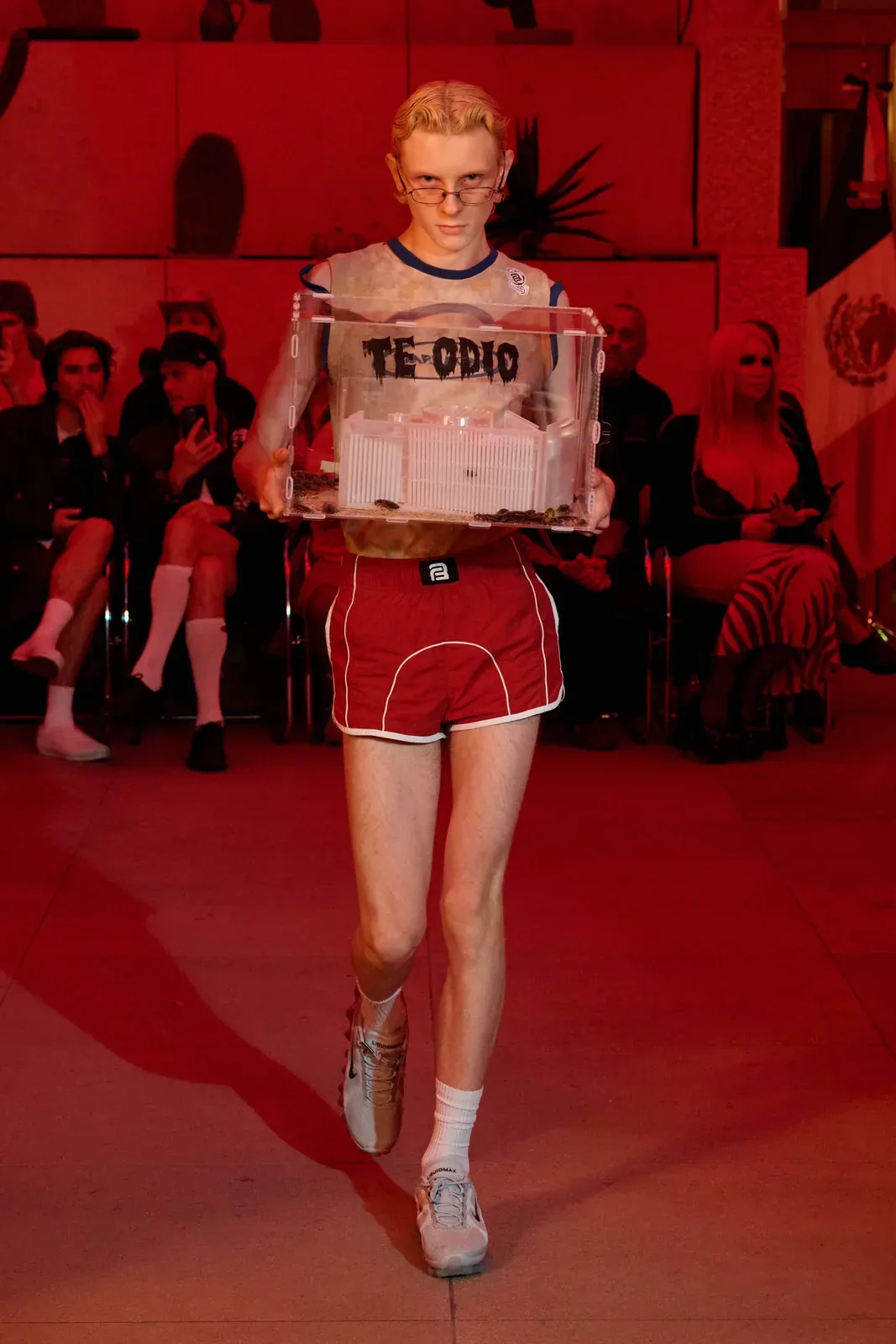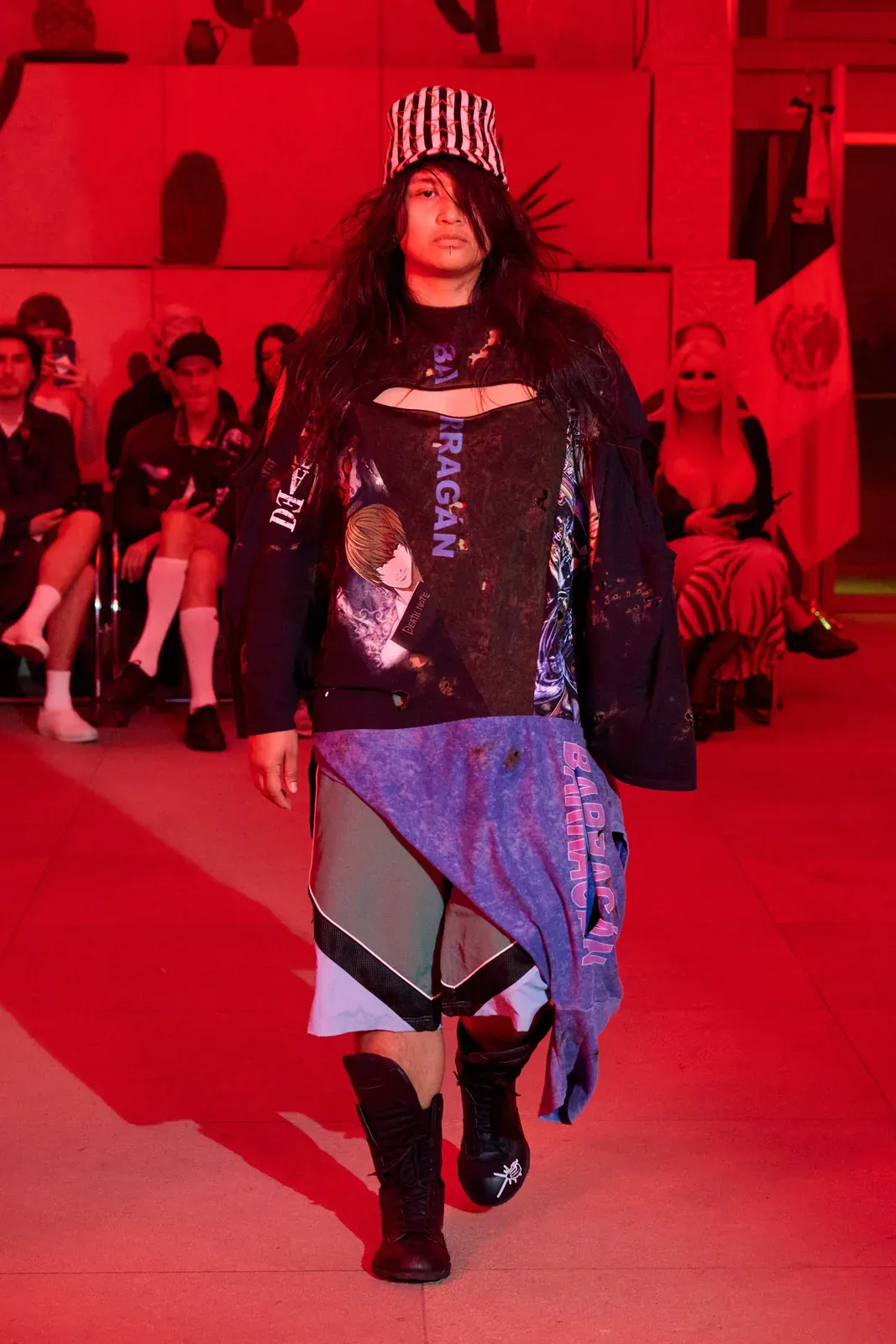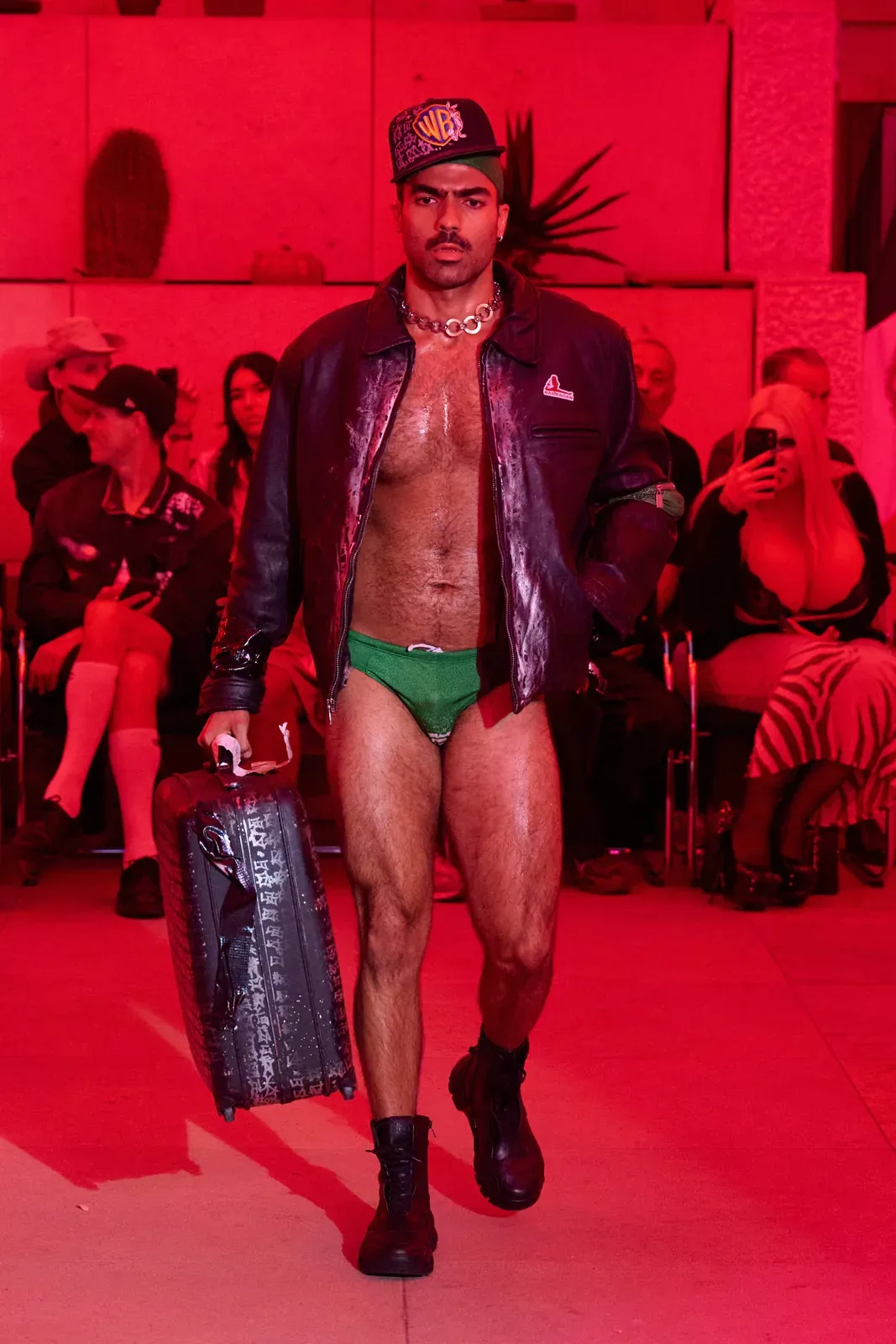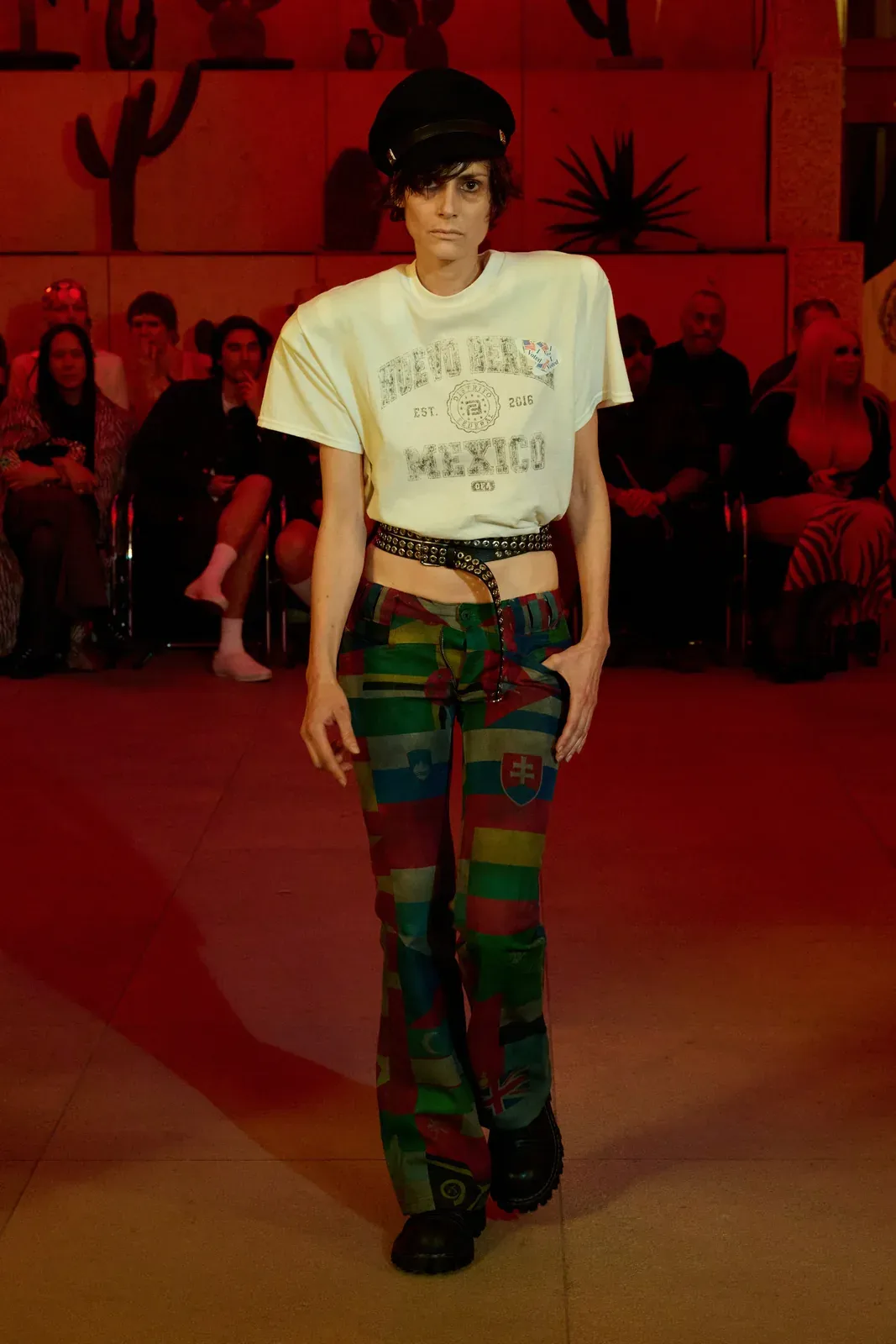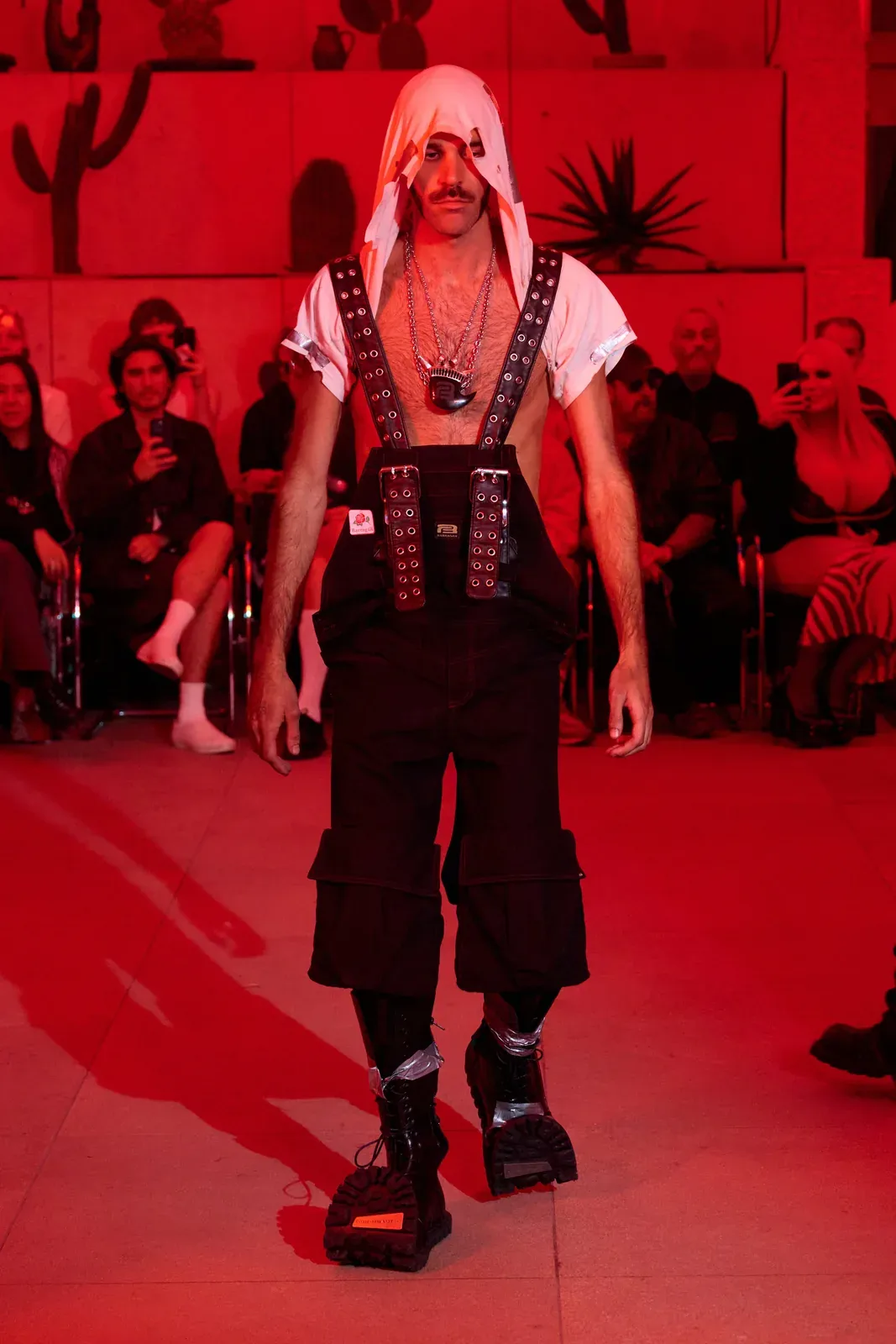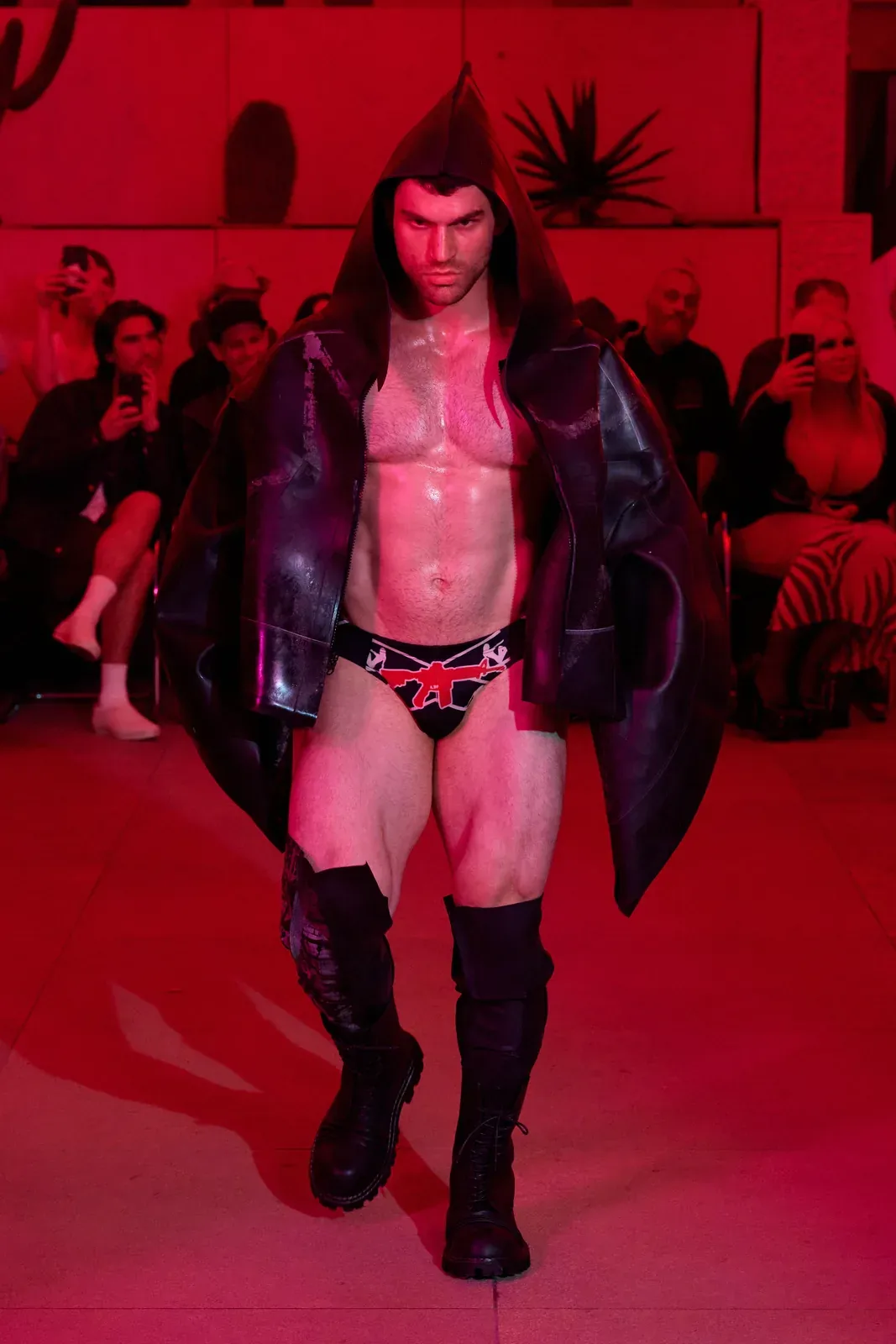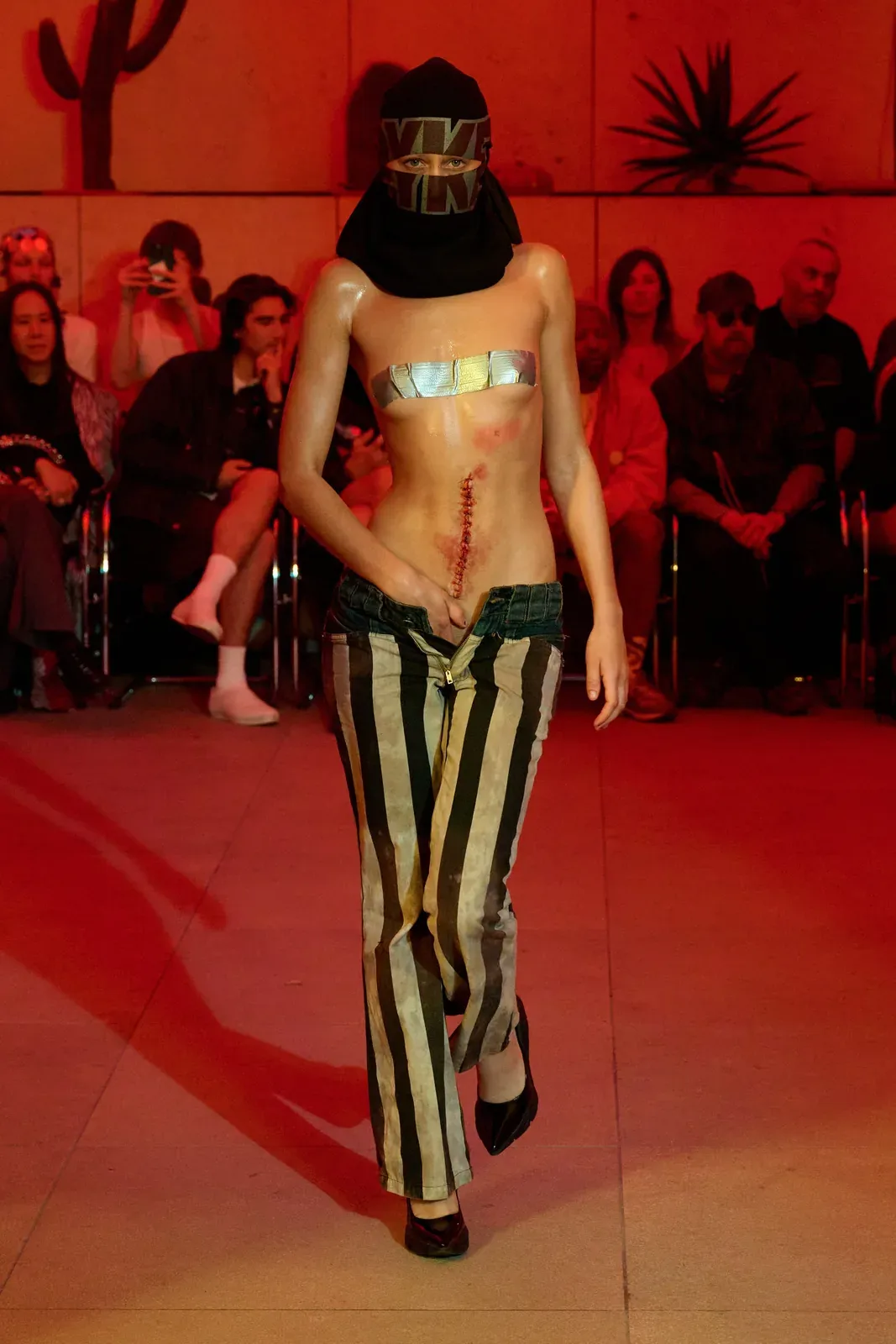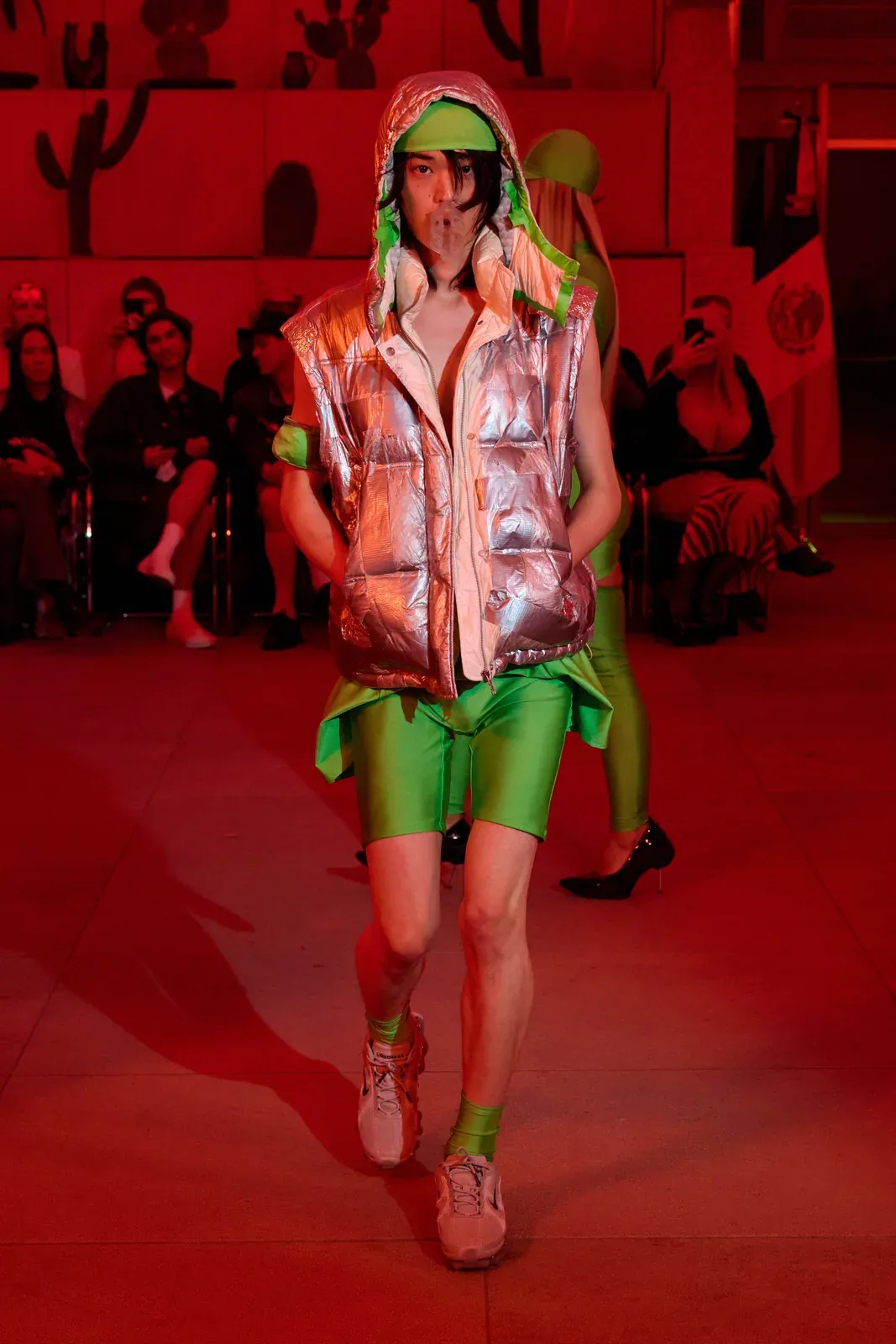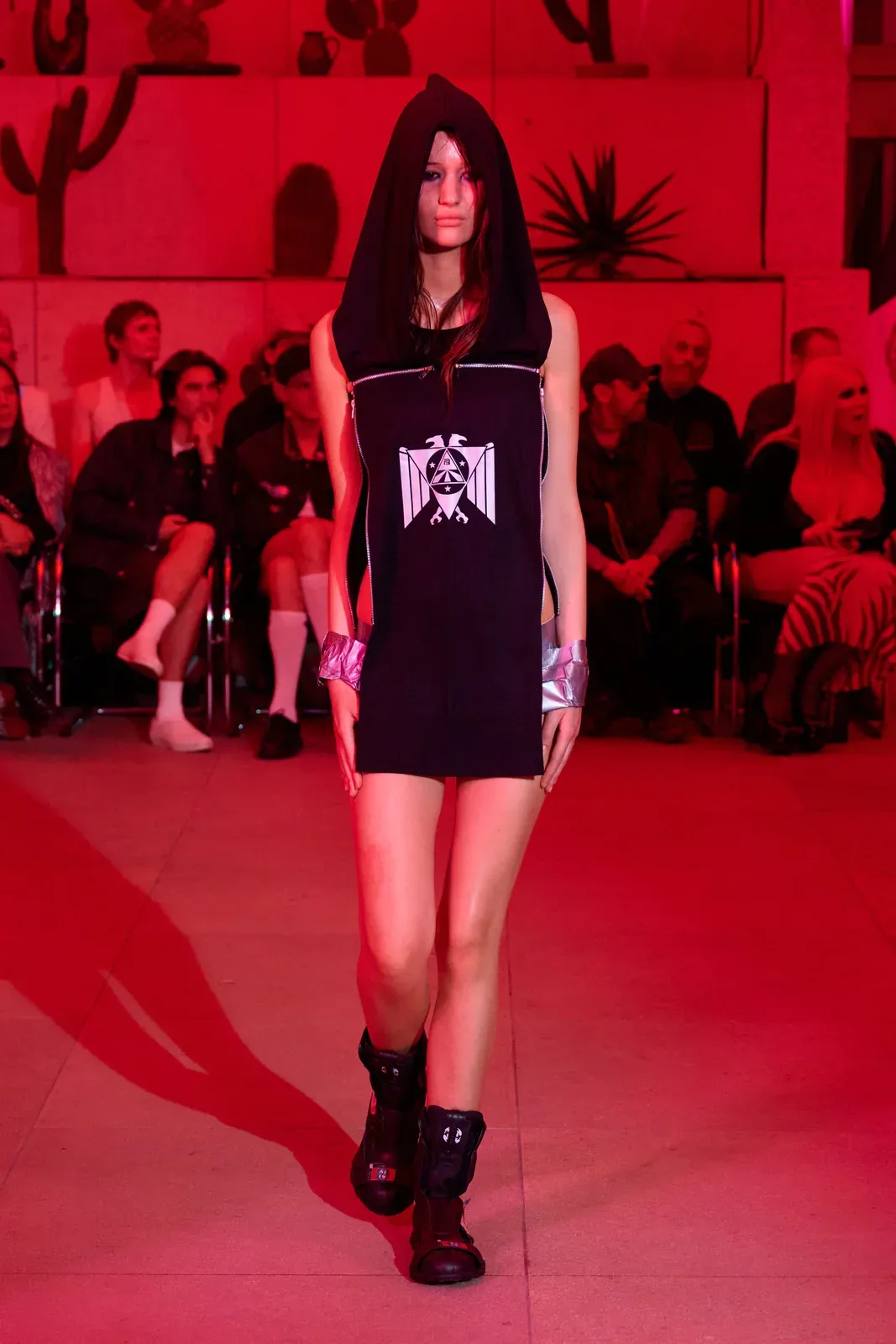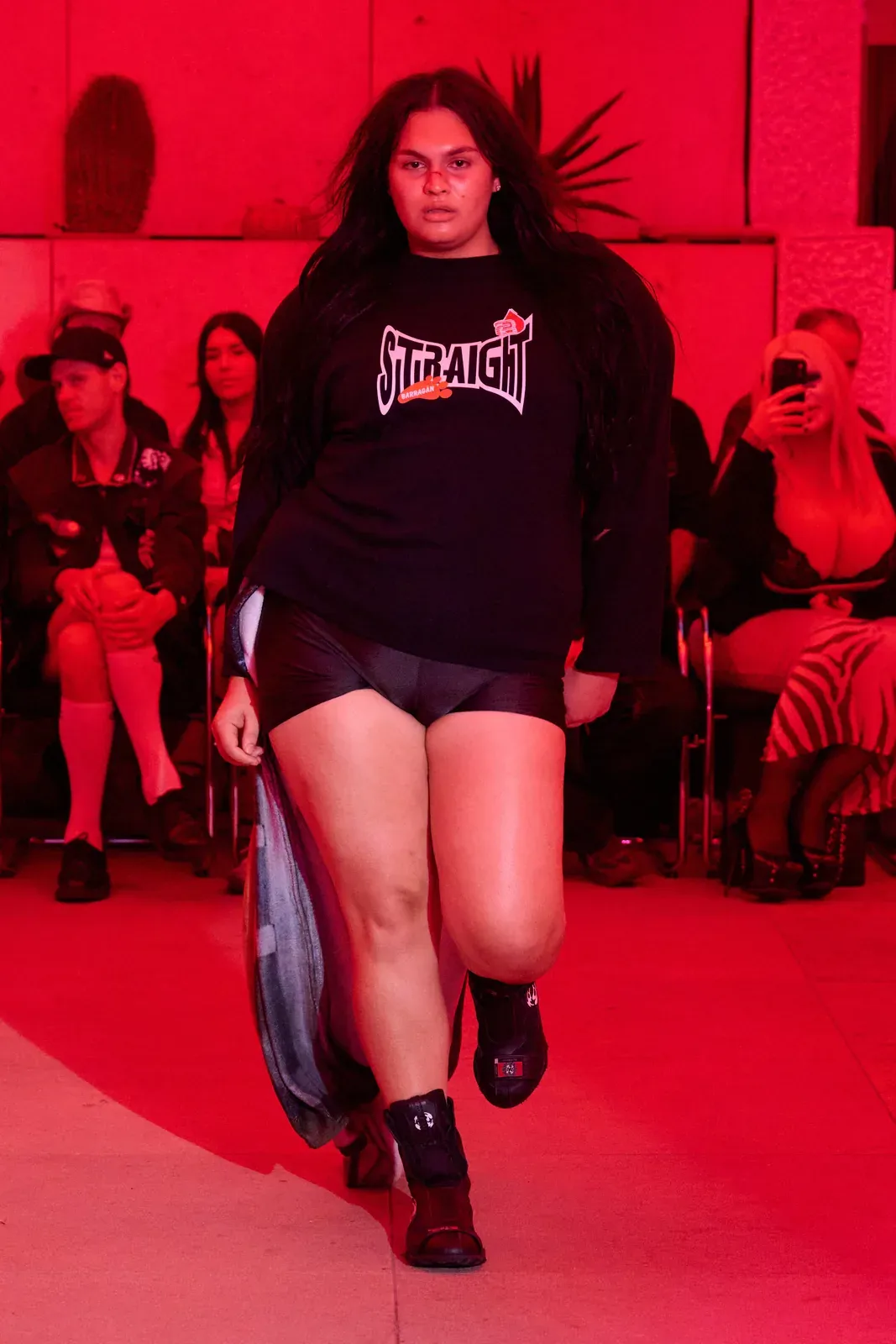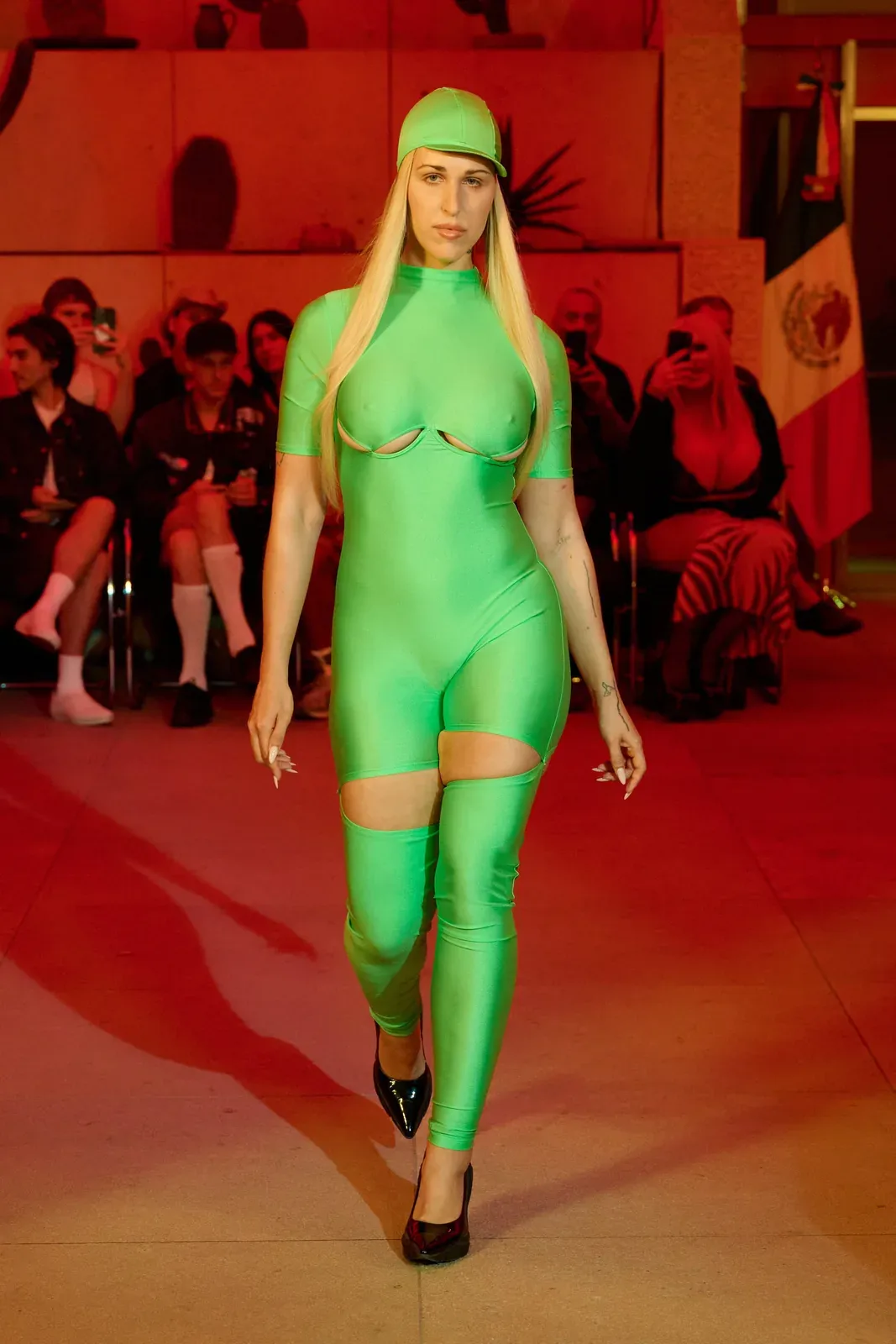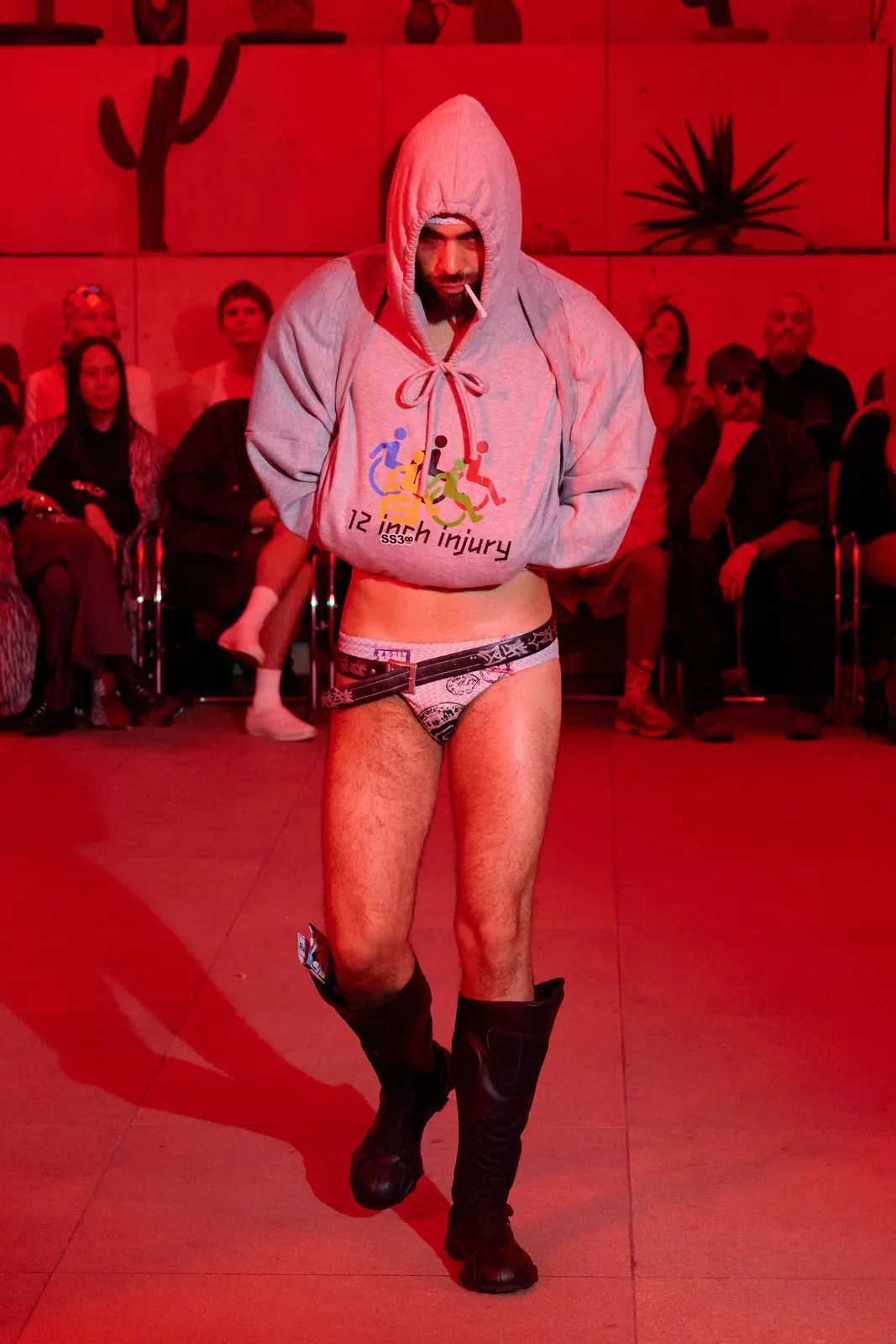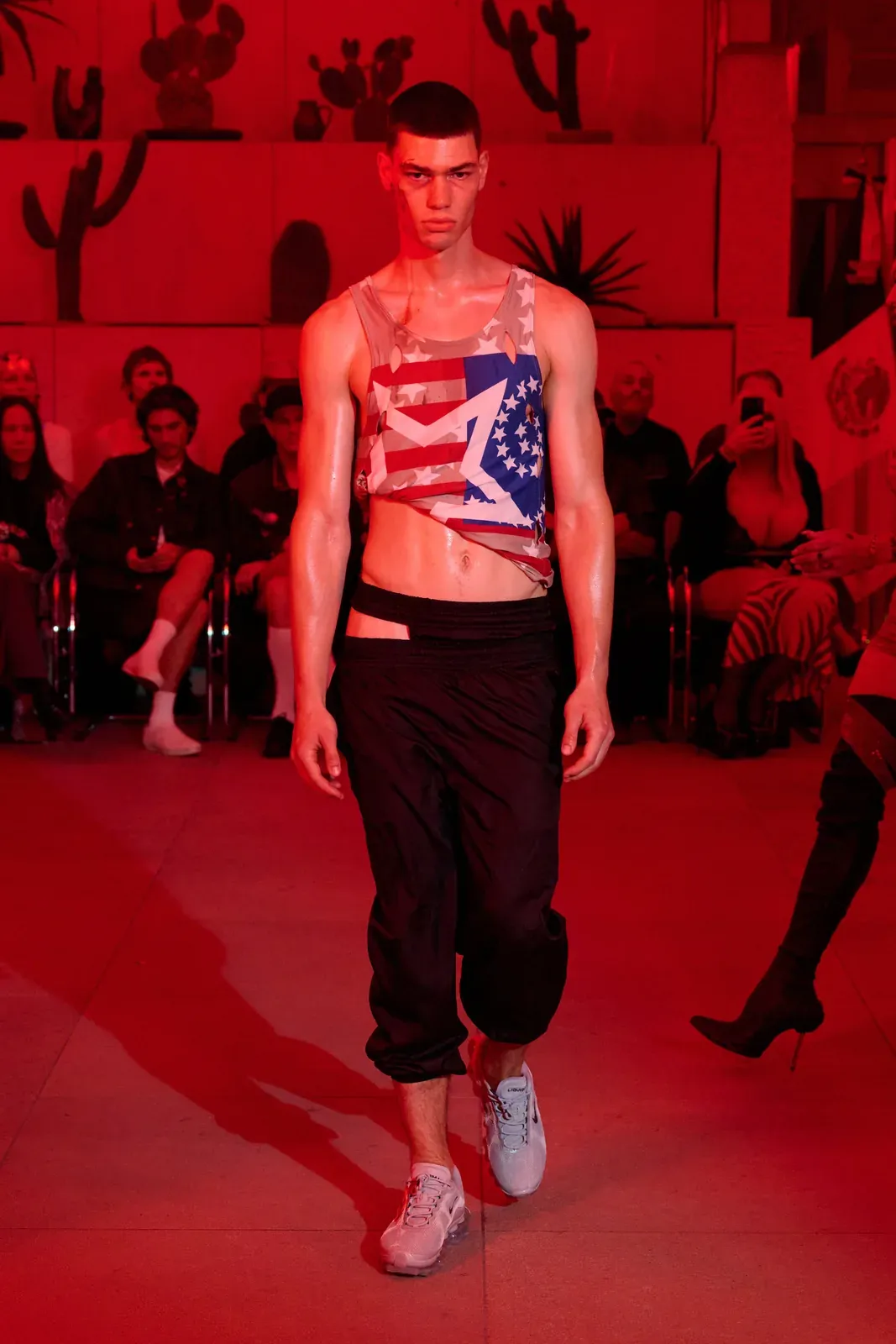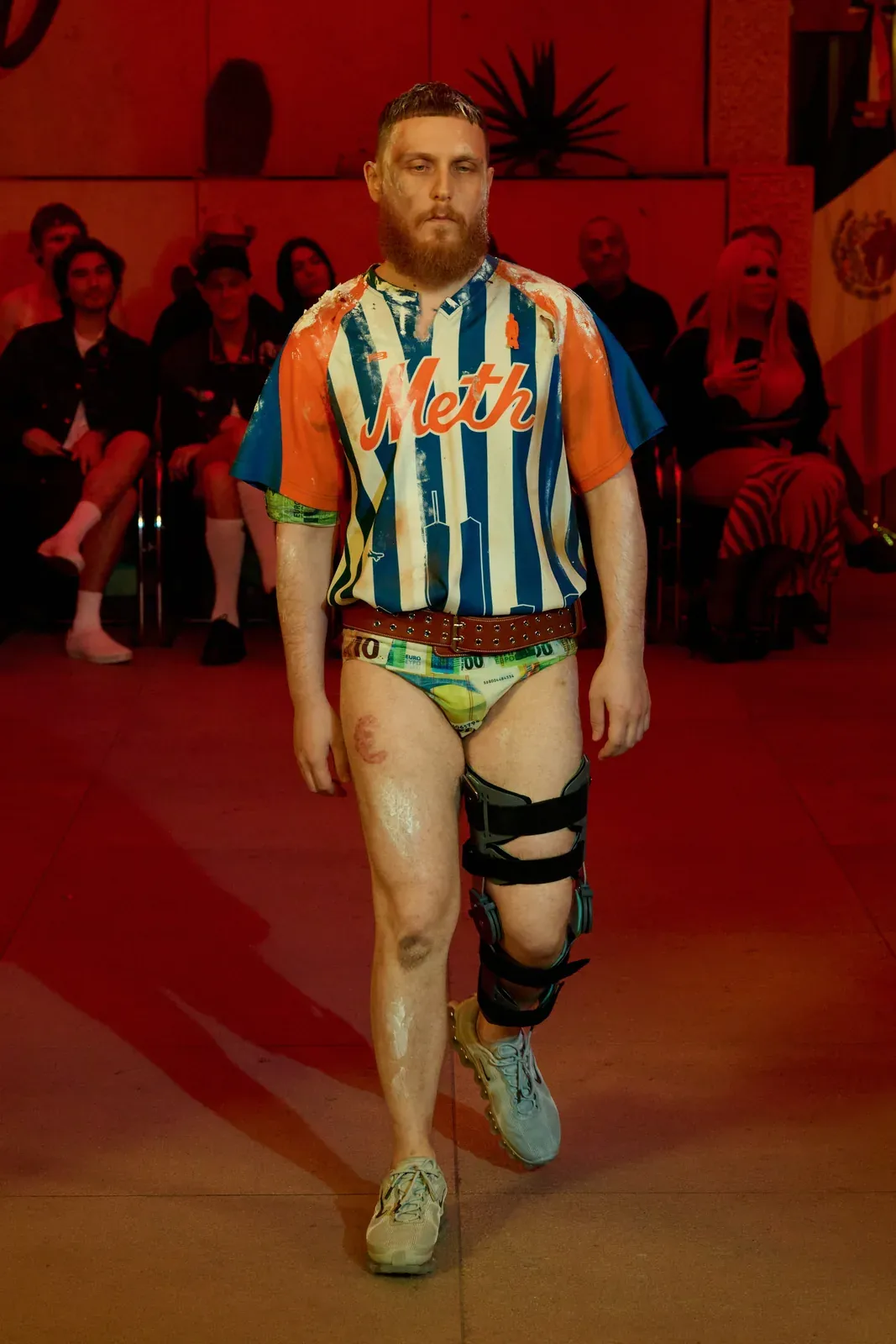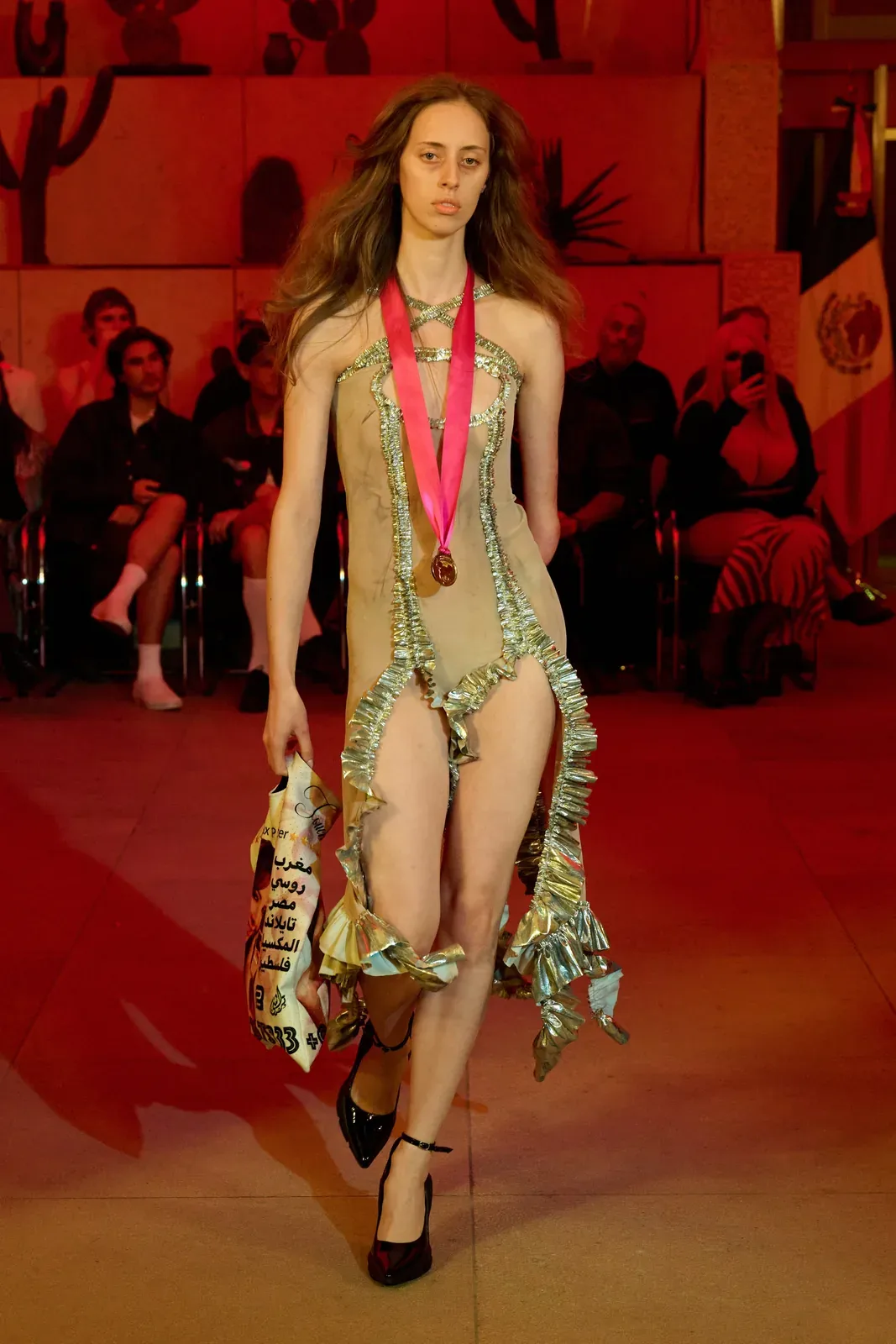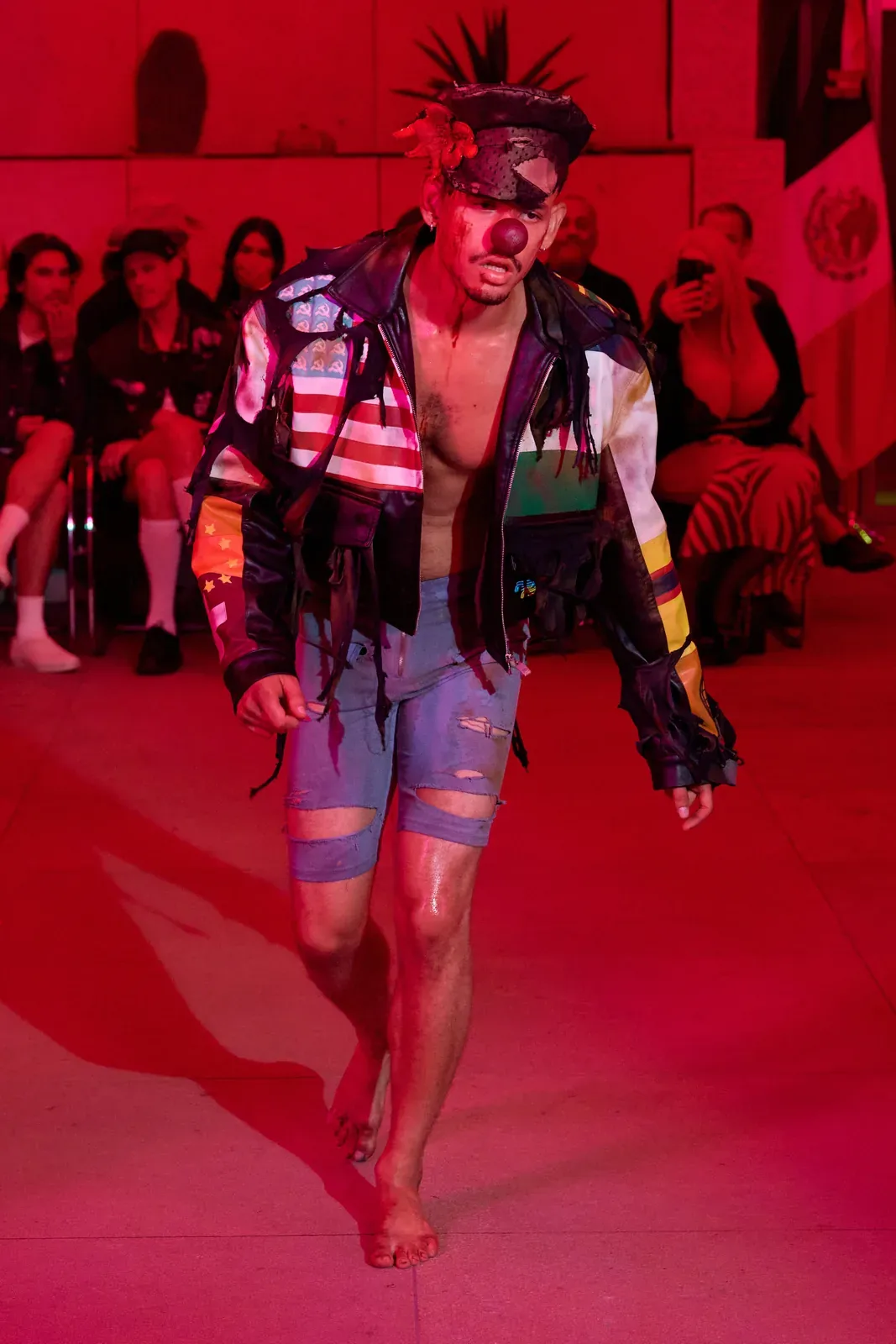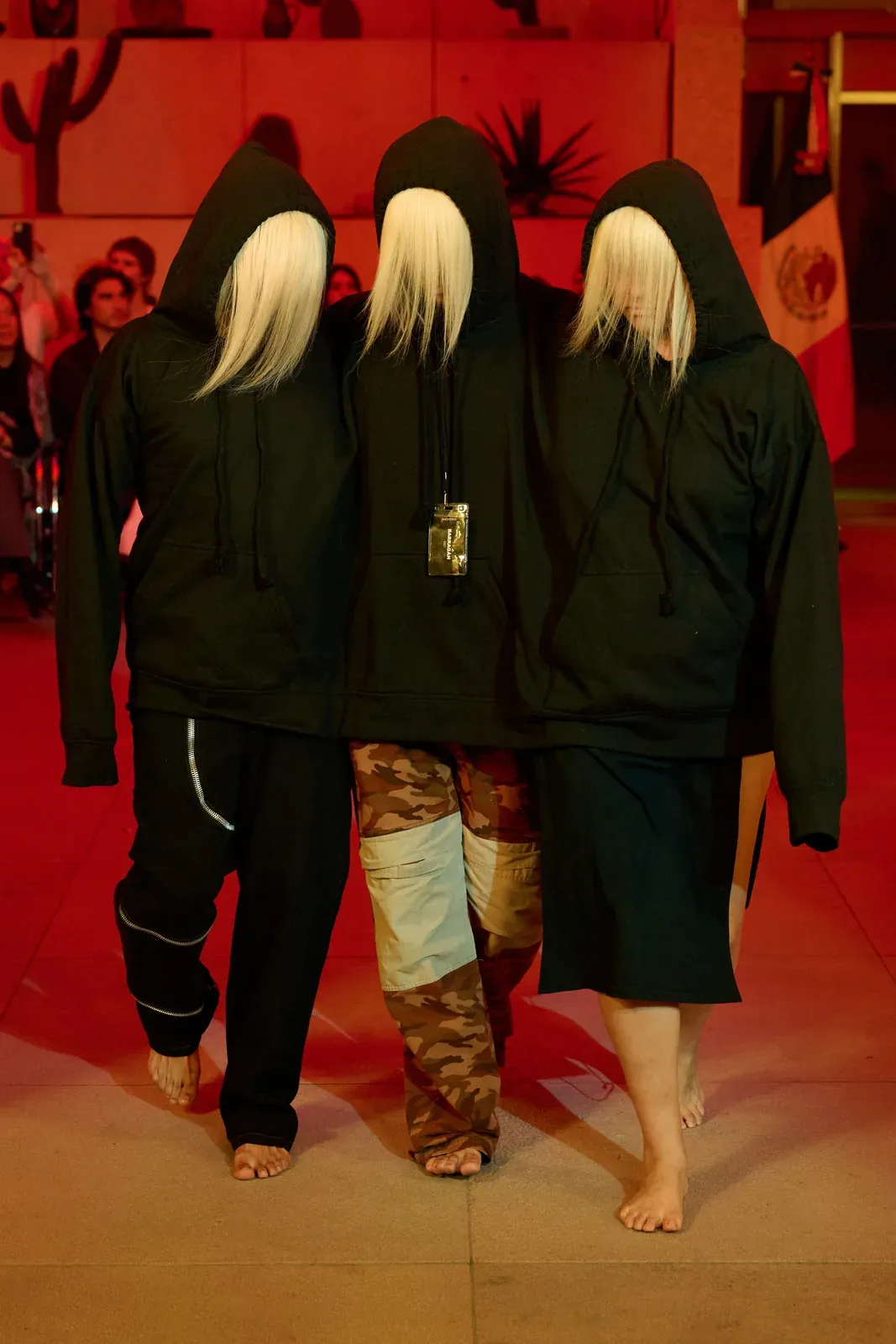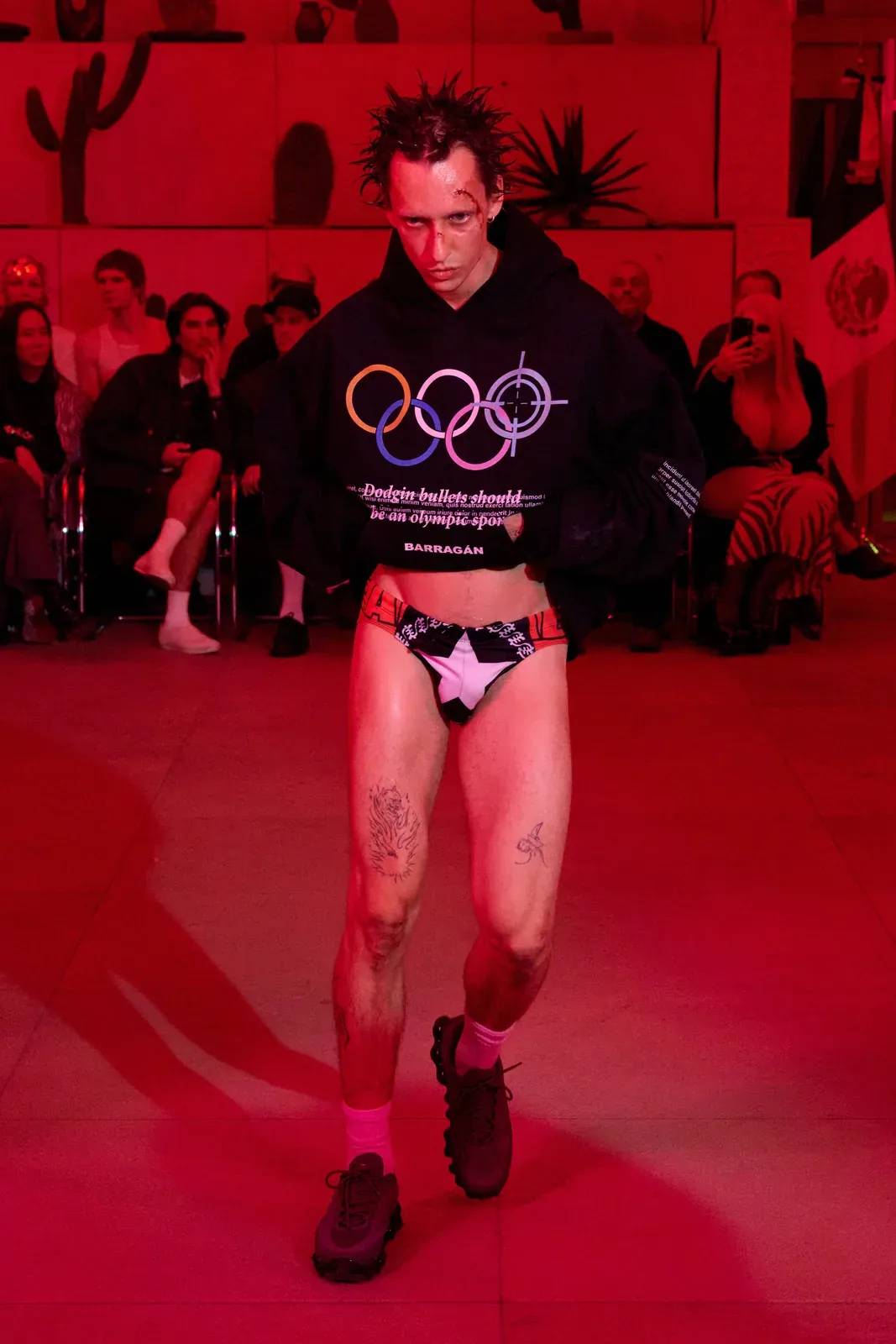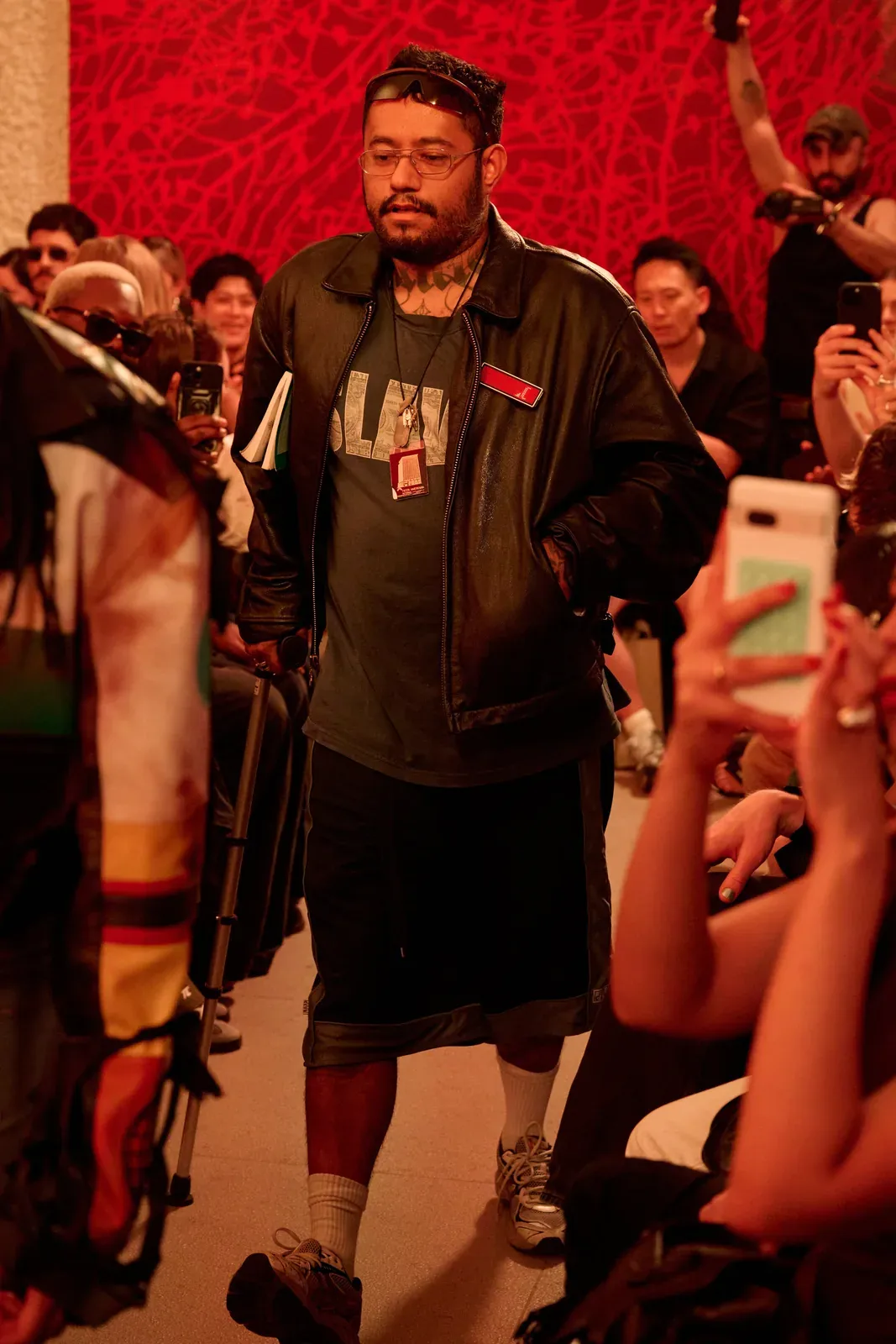
“Fashion has become very fluent in the language of risk while growing increasingly afraid of actual risk. A great deal of provocation now arrives already explained, branded and made safe for circulation,” Víctor Barragán tells us in this interview. The fashion designer and provocateur knows a thing or two about taking risks and shocking the audience and the media; in 2023, for example, he held a show at AIFA, Mexico City’s new airport, dressed as Charles Manson, handcuffed, and being extradited to Europe. A few weeks ago, he completed that story by presenting the Spring/Summer 2027 collection at the Mexican Embassy during Berlin Fashion Week.
As usual, the collection wasn’t really inspired by a unique place, experience, or colour-coordinated moodboard; instead, it presented a wide range of characters, from Tom of Finland-esque hunks to US-American bigots. “I wanted the collection to feel like a collision between people who would not normally occupy the same room. Some characters are grotesque, some are seductive, and some move between the two,” he clarifies. Because to him, “identity is not a press release, and a community is never one coherent thing.” His work as a designer goes way beyond that. “I can speak from where I stand and from what I have lived, but I do not want that experience to become a formula for representing everybody else. The work should make room for contradiction, desire and even discomfort.” Today, we sit down with Víctor to discuss provocation, humour, gentrification, and exoticism.
Berlin has always had a reputation for embracing outsiders. Did showing your latest collection there allow you to push ideas that might have landed differently in Paris or Milan?
I think it would have landed completely differently outside ‘Mexican territory’. The Mexican Embassy in Berlin became a kind of international liminal space; a fragment of Mexico in Europe where the concept could become reality. We had been considering this presentation since our show at AIFA, Mexico City’s new airport, in September 2023. We waited until the transition felt right: me dressed as Charles Manson, handcuffed at the airport, extradited to Europe, and finally showing inside the Embassy. It completed the story I had already made in my head.
Tor Studio was essential in translating that narrative into architecture. Rather than treating the Embassy as a neutral venue, they worked with its spatial, institutional, and symbolic character, creating a dialogue between the collection and the building. Their architectural vision and support on the ground in Berlin allowed the space itself to become part of the story.
Tor Studio was essential in translating that narrative into architecture. Rather than treating the Embassy as a neutral venue, they worked with its spatial, institutional, and symbolic character, creating a dialogue between the collection and the building. Their architectural vision and support on the ground in Berlin allowed the space itself to become part of the story.
Some people still see provocation as a shortcut. Do you think they’re missing the point, or is provocation sometimes the point?
I’m an artist who uses clothing as a medium. Some people understand it, and some don’t. That tension is part of the work.
Your collections often blur gender, sexuality and cultural references. Do you feel pressure to represent communities, or do you resist the idea that a designer should be a spokesperson?
I resist the idea that a designer has to become a spokesperson. Identity is not a press release, and a community is never one coherent thing. I can speak from where I stand and from what I have lived, but I do not want that experience to become a formula for representing everybody else. The work should make room for contradiction, desire and even discomfort. The moment I am expected to explain an entire culture, the person disappears and only the label remains.
“I’m an artist who uses clothing as a medium. Some people understand it, and some don’t. That tension is part of the work.”
Your work often feels less interested in making garments than in constructing characters. At what point does clothing stop being fashion and become a form of fiction?
Clothing becomes fiction as soon as it proposes a life beyond the body wearing it. A garment can suggest a history, a social position, a fantasy or a threat. I’m interested in the instant when a look stops behaving like a product and begins behaving like a person you think you recognise. The character doesn’t need a complete biography; the gaps matter because the audience fills them with their own prejudice and desire.
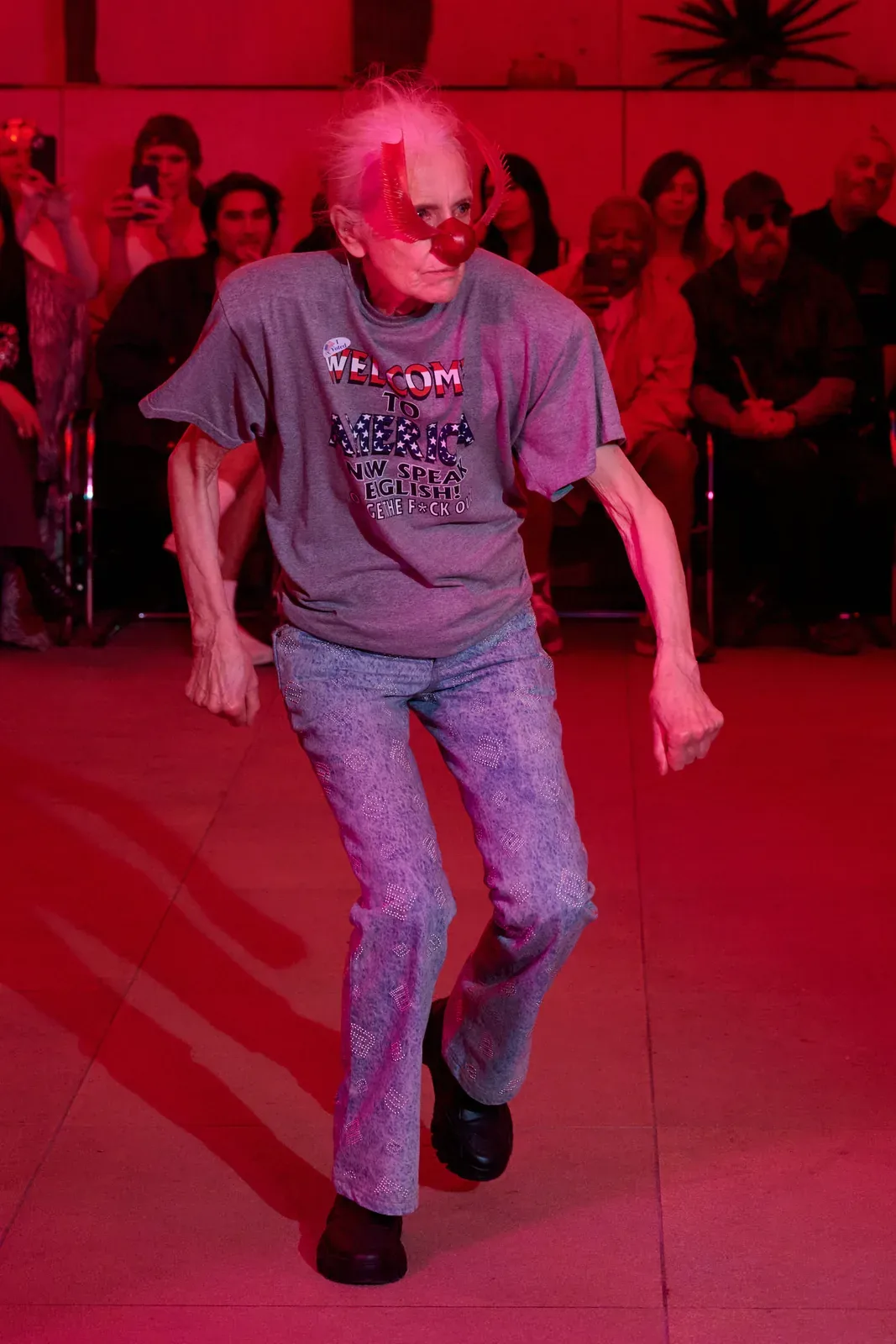
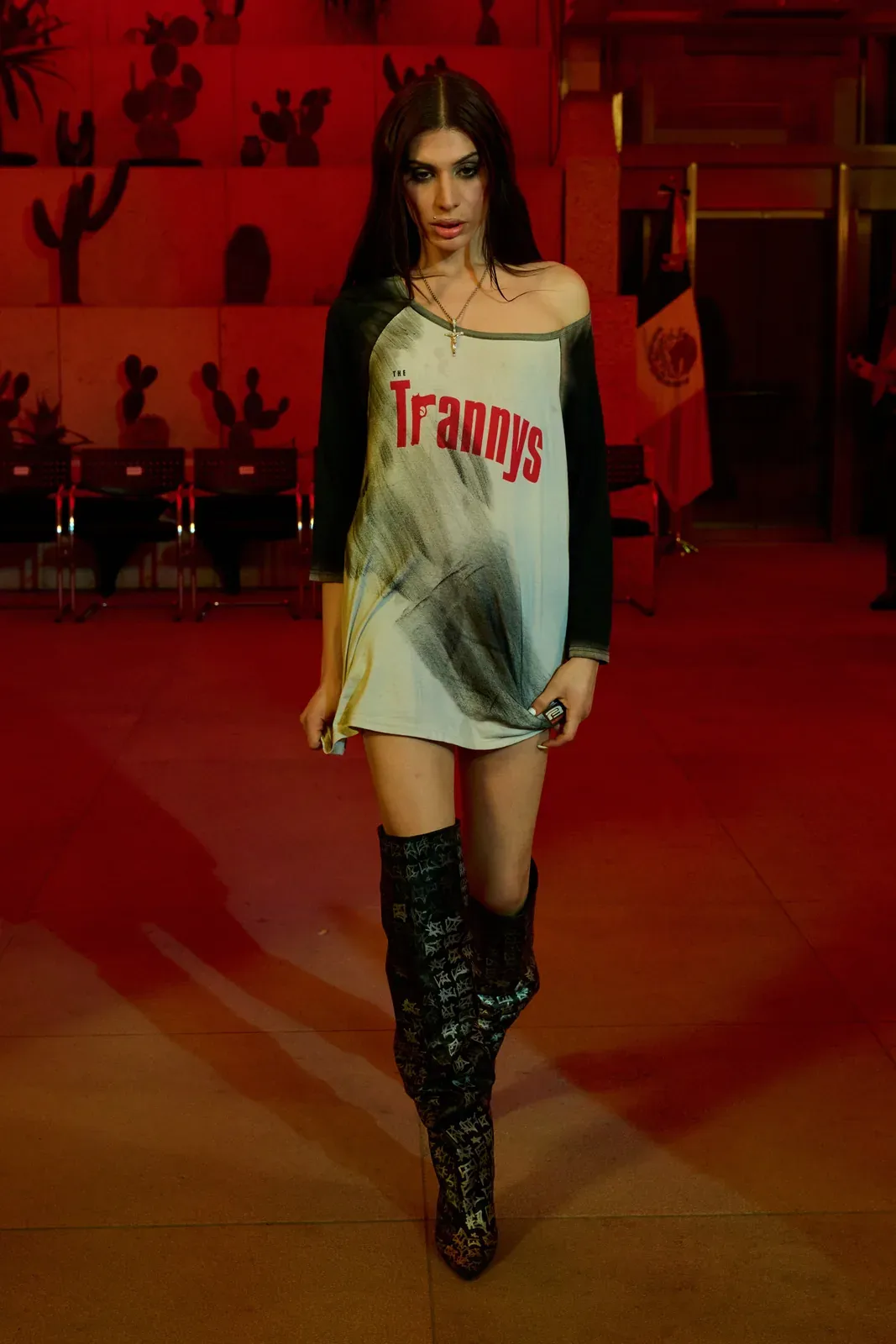
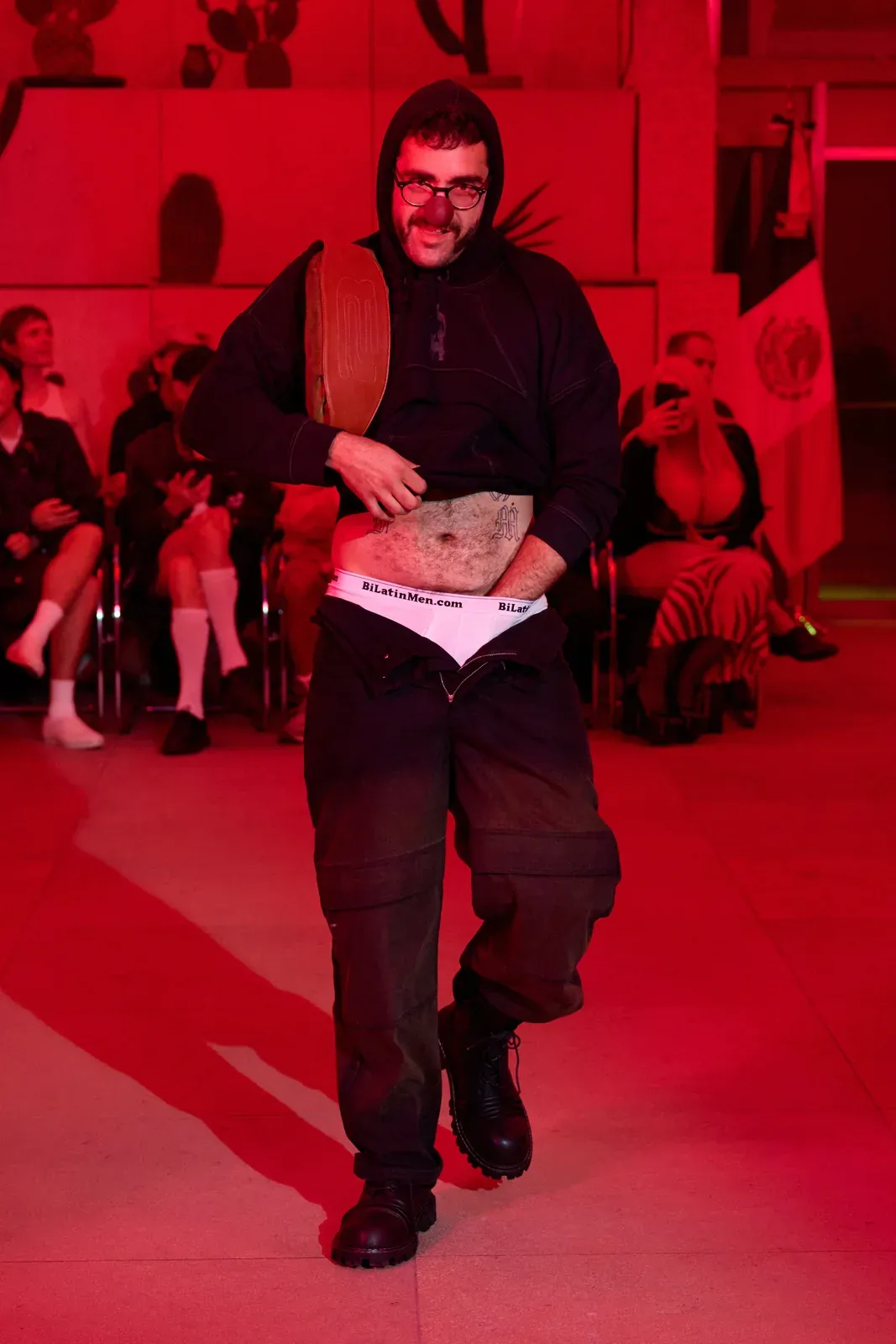
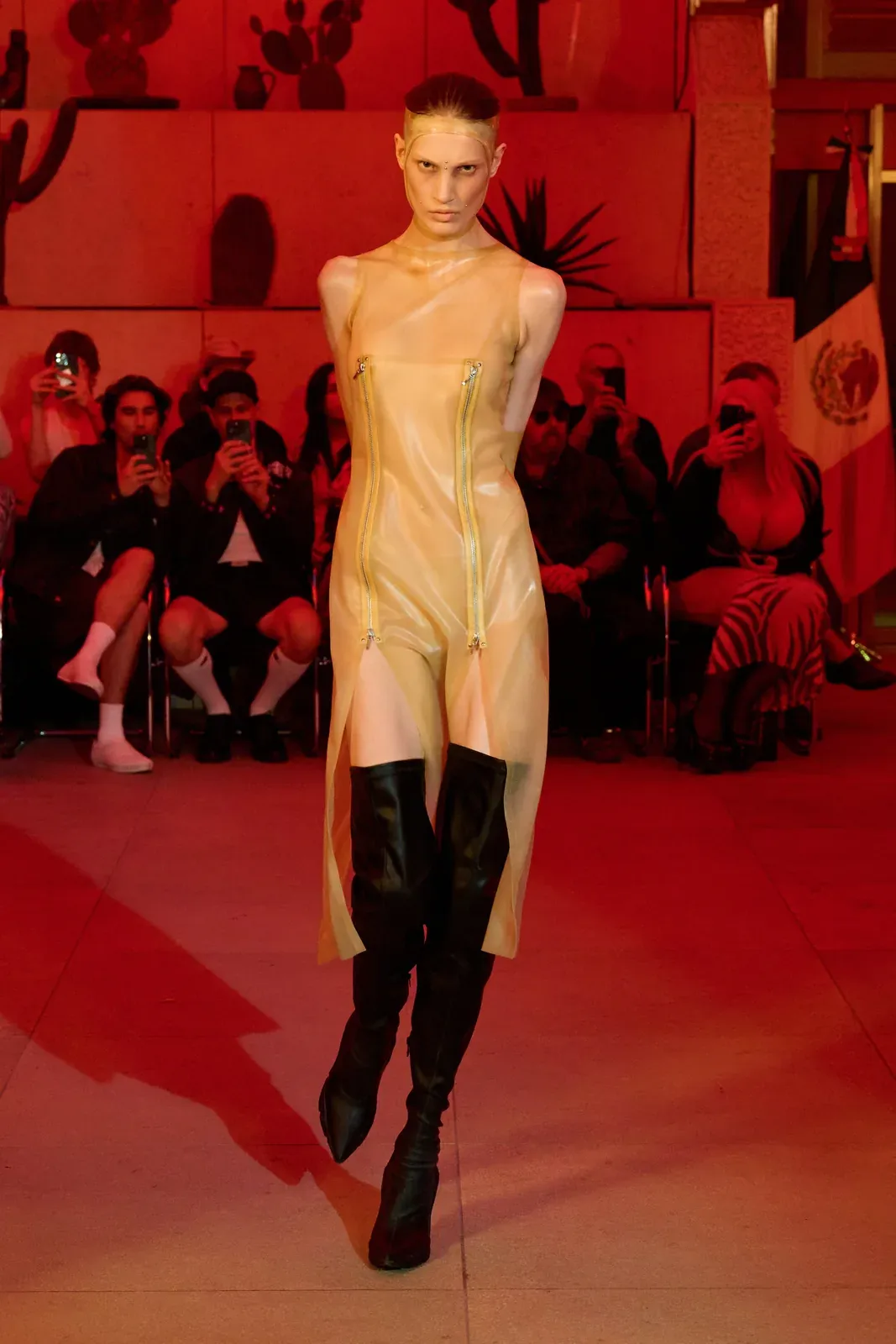
In your latest show, for example, it’s easy to recognise some characters: the old, bigoted US-American wearing the ‘Welcome to America. Now speak English’ t-shirt and a clown nose (I guess you’re mocking that character); or the dolls who love underground parties, sporting thigh-high boots and dresses (one in sheer latex, the other with the word ‘trannys’ in bright red); and, of course, the Tom of Finland-esque hunk. Tell us more about the world- and character-building behind this collection.
I wanted the collection to feel like a collision between people who would not normally occupy the same room. Some characters are grotesque, some are seductive, and some move between the two. I’m less interested in issuing a moral verdict than in exposing how quickly we read a body through clothing: who appears respectable, dangerous, ridiculous or desirable. The clownish gestures make those social performances visible. They exaggerate what is already there.
We also made a version that says, “Welcome to Mexico. Now You Speak English.” The other garments and the rest of the full collection will be released in September. We created ninety-five looks, but because the Embassy is both a diplomatic institution and an architecturally significant space, we made a curatorial decision not to present certain looks in that context. It was important to respect the nature of the building without compromising the collection, which will be shown in full in September.
We also made a version that says, “Welcome to Mexico. Now You Speak English.” The other garments and the rest of the full collection will be released in September. We created ninety-five looks, but because the Embassy is both a diplomatic institution and an architecturally significant space, we made a curatorial decision not to present certain looks in that context. It was important to respect the nature of the building without compromising the collection, which will be shown in full in September.
There’s an interesting tension in your work between sincerity and camp. Sometimes it’s difficult to tell whether a look is celebrating an aesthetic or mocking it. Is that ambiguity something you consciously cultivate?
Yes, the ambiguity is conscious. Camp loses its force when it becomes only an inside joke, and sincerity can become sentimental when it’s protected from ridicule. I often begin with something I genuinely love and push it until it becomes unstable. Mockery and celebration can coexist in the same look. That uncertainty asks more from the viewer than a clear instruction about what is tasteful or correct.
You’ve consistently embraced visual codes that have historically been dismissed as vulgar, cheap or even ‘bad taste’. There’s a lot of debate now, for example, about how subcultures like ‘chola’ or Mexican maximalism only become ‘acceptable’ when they’re embraced by the Western gaze. How do you hope to disrupt that through your work?
I’m suspicious of how Chicano culture has become the dominant visual shorthand for Mexico abroad. It can turn an enormous, contradictory country into a cartoon and make a specifically Mexican-American experience stand in for every Mexican experience. I don’t deny the reality or importance of that ‘culture’, but its proximity to the United States gives it access to media, language and cultural platforms that people creating from Mexico do not encounter in the same way. That is a form of privilege, even when it exists alongside discrimination.
For me, disruption means refusing to perform the version of Mexican identity that an international audience already knows how to consume. I’m not interested in proving that so-called bad taste can become acceptable once it has been polished for a Western gaze. I would rather question who gets to define Mexico in the first place and why some images travel more easily than others.
For me, disruption means refusing to perform the version of Mexican identity that an international audience already knows how to consume. I’m not interested in proving that so-called bad taste can become acceptable once it has been polished for a Western gaze. I would rather question who gets to define Mexico in the first place and why some images travel more easily than others.
“I resist the idea that a designer has to become a spokesperson. Identity is not a press release, and a community is never one coherent thing.”
Several designers have been named ‘enfants terribles’ throughout recent history by fashion media — Jean Paul Gaultier, Alexander McQueen, John Galliano. Now, perhaps, Duran Lantink. Do you see yourself as an ‘enfant terrible’ as well, or not at all?
I suppose I need to embrace my French background somehow. XD
Do you think fashion has become too polite?
Fashion has become very fluent in the language of risk while growing increasingly afraid of actual risk. A great deal of provocation now arrives already explained, branded and made safe for circulation. Politeness is not the problem by itself; predictability is. I want fashion to leave room for something that can’t be resolved immediately into approval or outrage — that’s what we encounter in our day-to-day lives.
You’ve spoken through clothing about identity rather than simply dressing bodies. Do you think fashion still has the power to change minds?
Fashion rarely changes a mind through an argument. It changes what a person can imagine seeing in public. A body, a gender or a kind of beauty can move from unthinkable to familiar through repetition and desire. That power is limited and easily absorbed by commerce, but it’s still real. Fashion can shift the image before society finds the words.
You’re often described as a ‘Mexican designer’. Is that a label you embrace, or does it risk flattening the complexity of your work?
I’m Mexican, so I don’t reject the label. I reject the assumption that the label explains the work. It often becomes a demand for recognisable symbols, as if nationality were an aesthetic category with a fixed palette and vocabulary. Mexico is part of my perspective, not a theme I apply to a collection. I want the freedom to be specific without being reduced to a national costume.
“A body, a gender or a kind of beauty can move from unthinkable to familiar through repetition and desire. That power is limited and easily absorbed by commerce, but it’s still real.”
Do you ever worry that international audiences consume Latin American fashion through an exoticising lens?
Constantly. Exoticism is a way of looking without having to understand. It rewards whatever appears colourful, excessive, sensual or politically legible while ignoring work that doesn’t confirm those expectations. The answer is not to make the work neutral. It is to remain specific enough to resist being converted into a generic idea of Latin America.
Mexico City has been quickly, even violently gentrified in the last five or six years. The city’s landscape is totally different now. What’s your view on that, and how has it affected your relationship to the city, if at all?
I left the city when it was still called Distrito Federal, D.F. By the time I was able to return a few years later, it had become Ciudad de México, CDMX, and now, increasingly, Mexico City. That shift in names reflects something of my own relationship with the city: it remains familiar, yet at the same time it feels like a different place.
Gentrification has made that relationship both more protective and more conflicted. I still love the city’s capacity for transformation, but transformation is not innocent when access to the city is determined by wealth. These days, my main reason for returning is to visit my family. I feel somewhat disconnected from the city itself, yet strangely connected to the wider world through my phone. It may sound odd, but the digital era shapes so much of our daily experience that I now find my strongest sense of home in food, family, and the closeness we share.
Gentrification has made that relationship both more protective and more conflicted. I still love the city’s capacity for transformation, but transformation is not innocent when access to the city is determined by wealth. These days, my main reason for returning is to visit my family. I feel somewhat disconnected from the city itself, yet strangely connected to the wider world through my phone. It may sound odd, but the digital era shapes so much of our daily experience that I now find my strongest sense of home in food, family, and the closeness we share.
Looking across all your collections, what is the obsession you keep returning to without ever fully resolving?
I keep returning to the moment when someone tries to become acceptable and something unruly remains visible: sexuality, class, vanity, aggression, humour. Clothes promise control, but the body always interrupts. I don’t think I want to resolve that tension. It’s where the characters begin. Fiction always mesmerises me.