I meet American artist Banks Violette post festum, the day after the opening of Wish You Were Here, his solo show at Tick Tack, one of Antwerp’s edgiest art spaces. The venue occupies a modernist building designed by Belgian architect Léon Stynen, celebrated for his refined strain of brutalism. It is also known as The Sundial, taken from the street’s name. I spent the first years of my life just around the corner, in the narrow cobblestone alley of Maanstraat (Moonstreet). The cycles of time are embedded not only in the building’s architecture; they also subtly shape the tonality of our conversation.
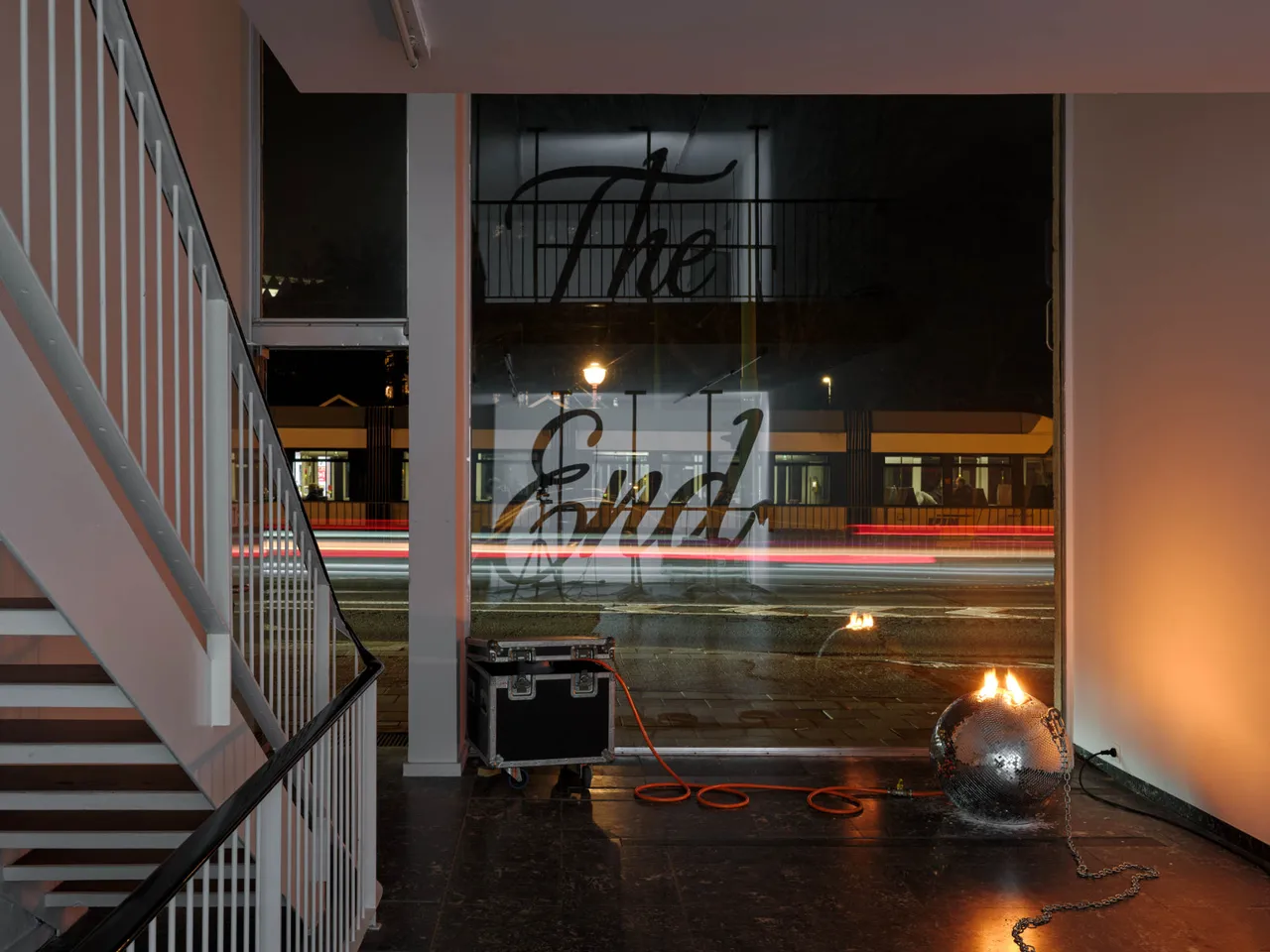
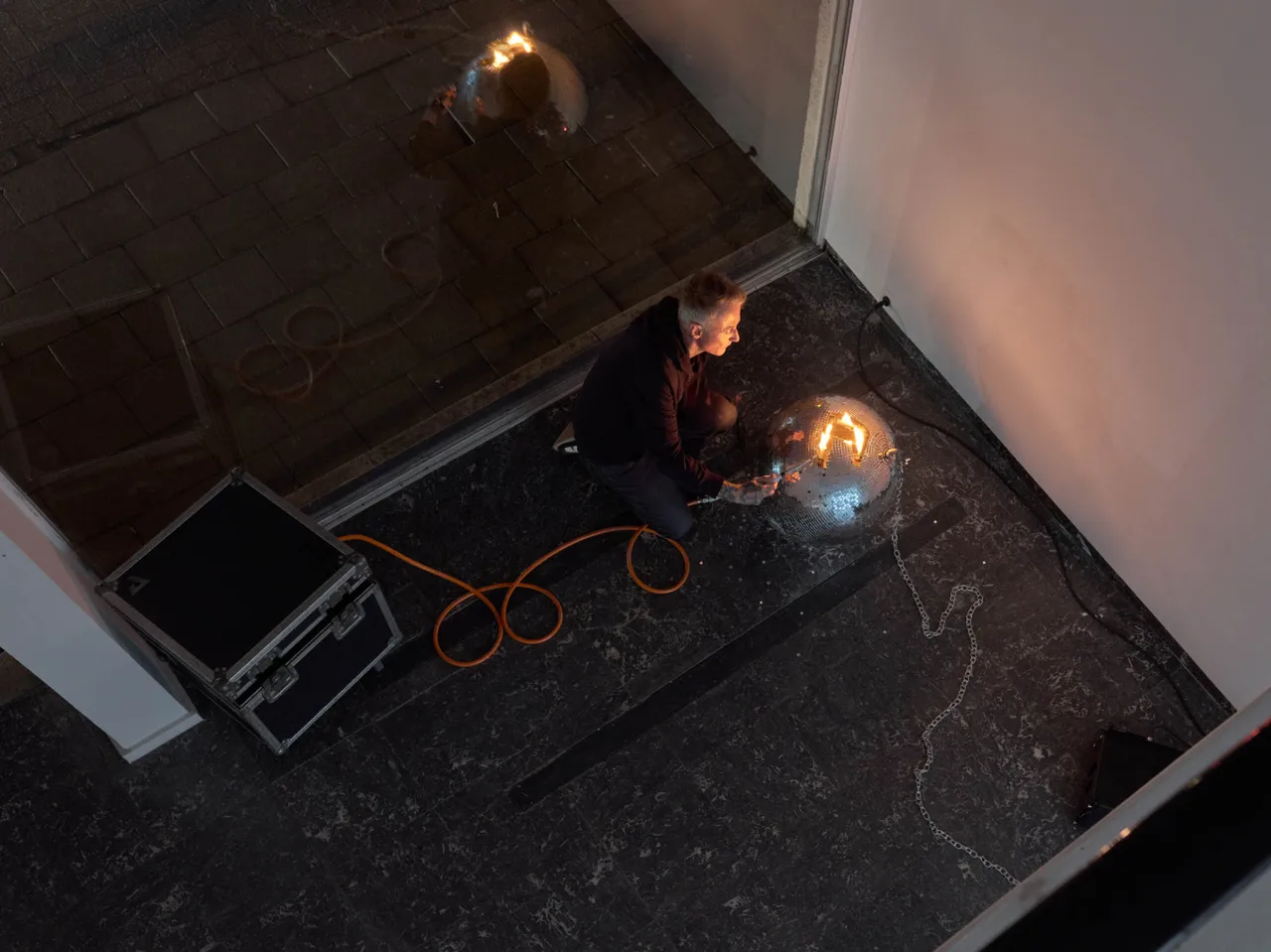
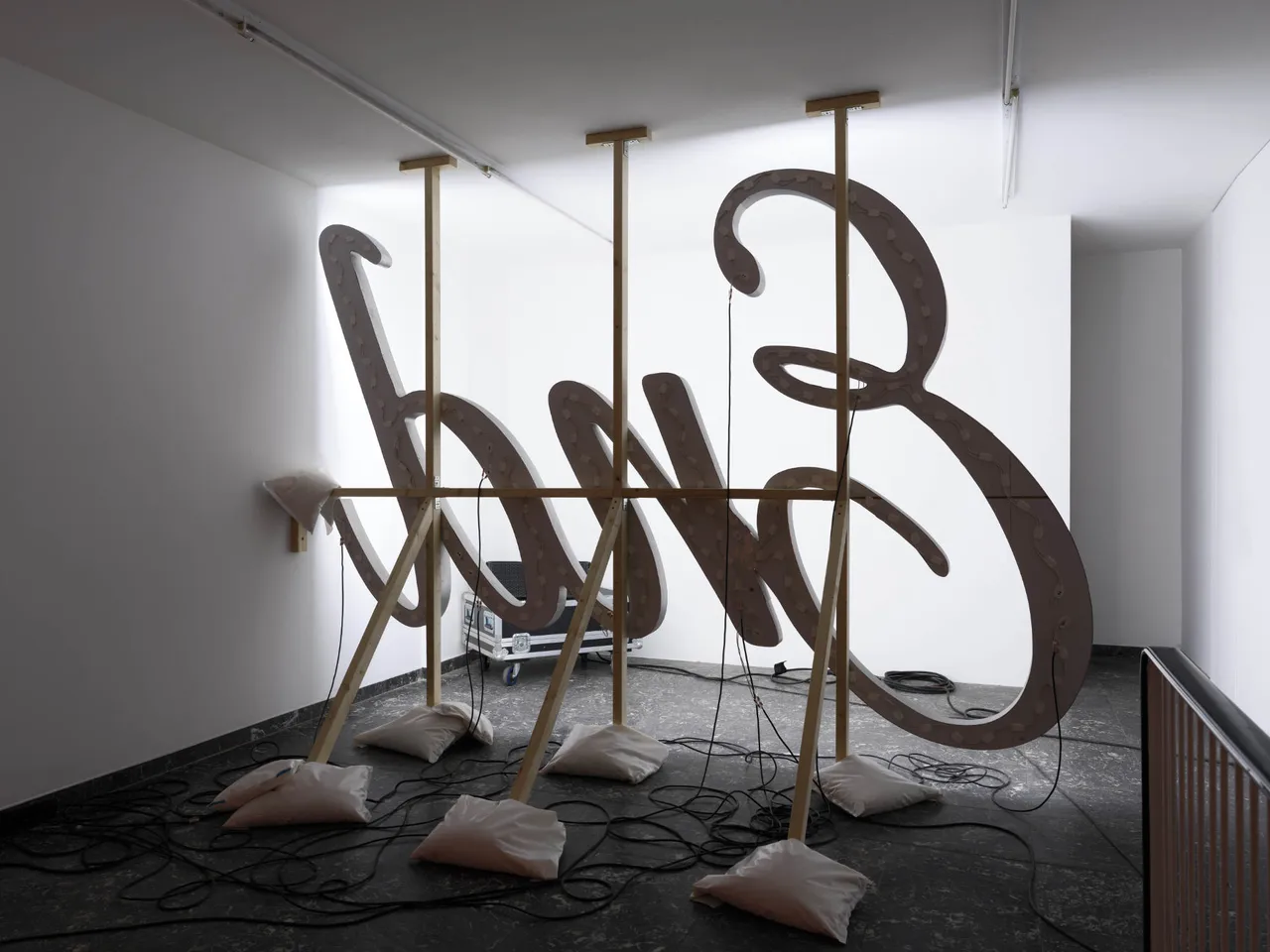
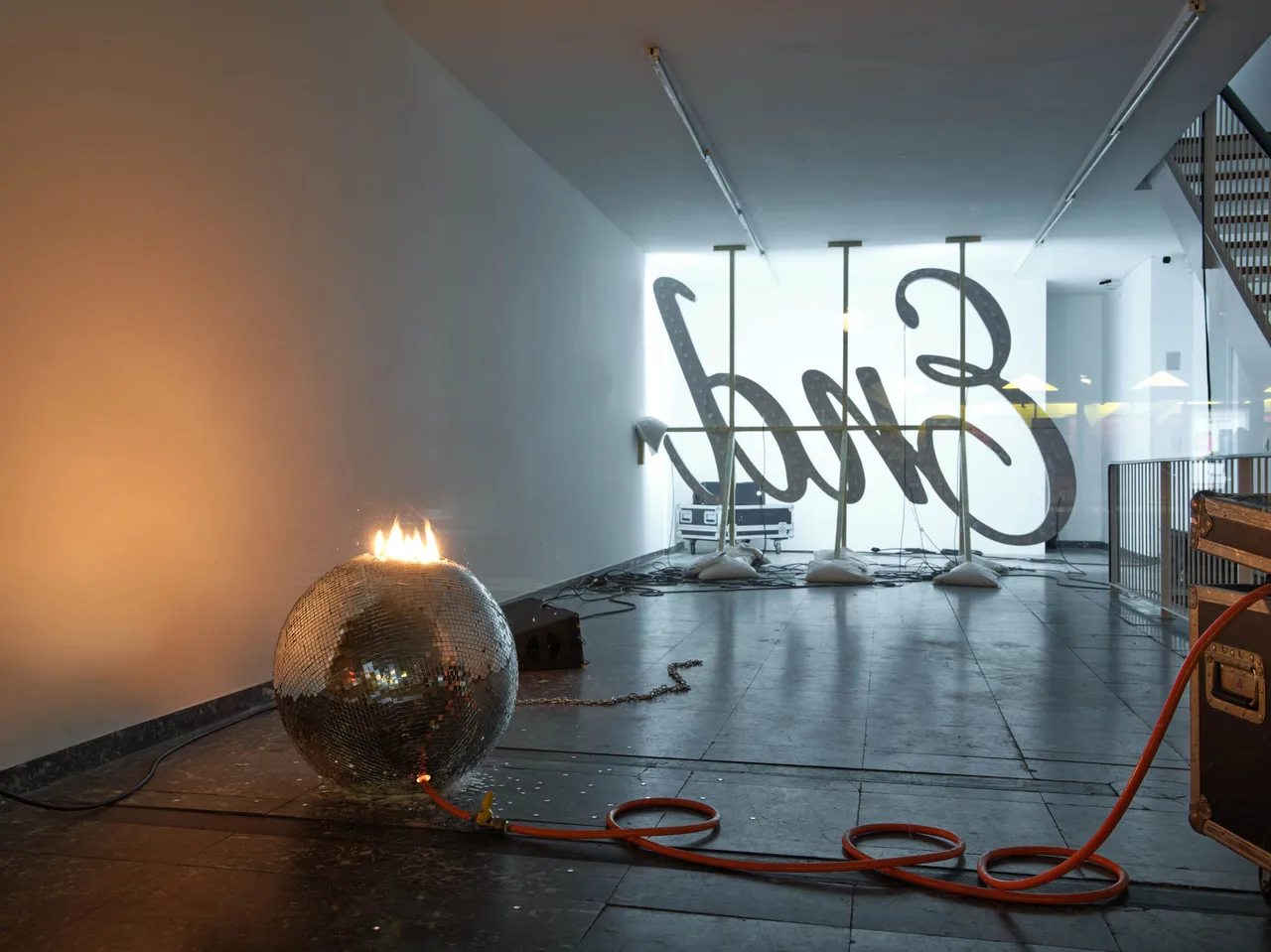
The space is quiet and awash in daylight, yet a distinct melancholy lingers in the air: a burning disco ball casts its ephemeral reflections across the room, while a monumental letter sculpture spells out “The End” in an elegant typeface across two floors. The artist is casually dressed in a grey hoodie and jeans, tattoos emerging along his neck and hands. He speaks in a calm, thoughtful voice about his show.
Your current exhibition, on view through March 21, moves between glitter and gloom. In that sense, it exemplifies your artistic approach of combining elements from pop and mass culture with a dark undercurrent. How did this project take shape?
I don’t remember exactly how I received the invitation, but I know that the curator of the show, Maria Abramenko, knew the people who run the space. I’d seen a few of their shows and their programming before, and I’m really interested in people doing things in unusual spaces. While it’s a normal thing to open a gallery in New York City, regardless of its scale, I find it much more interesting to work with, for instance, a gallery in Washington, DC, where there is much less of an audience for contemporary art.
The team behind Tick Tack is doing something similar. This is not Brussels. Antwerp isn’t one of those ‘art capital’ kind of places. They’re trying to build an audience, infrastructure, and community of people interested in contemporary art. To me, this seems like a much more interesting way to work, especially now.
The team behind Tick Tack is doing something similar. This is not Brussels. Antwerp isn’t one of those ‘art capital’ kind of places. They’re trying to build an audience, infrastructure, and community of people interested in contemporary art. To me, this seems like a much more interesting way to work, especially now.
It’s not your first time in Belgium. Your work has previously been shown at Museum Dhondt-Dhaenens (2010), or, more recently, BPS22 in Charleroi (2024).
I also used to show with Rodolphe Janssen Gallery in Brussels, and I still work with Gladstone Gallery, who are also there. I’ve been to Belgium many times, and I’ve been back recently, since I started showing again a few years ago. It’s a very comfortable place, and it’s great that I did this big retrospective project in Wallonia [BPS22 in Charleroi]. Now I’m in Antwerp, a different part of the country, with an entirely different project. Many people from Charleroi came to the opening last night. There is a sense of community, a larger conversation happening.
Your show seems tailored to the building’s distinctive architecture and its large, street-facing glass facade, which easily draws in visitors.
Yes, there’s a roadway, a bike path, a sidewalk, a tram platform, a park… Whatever form of navigating an urban space exists is reflected outside that window. It’s extraordinary to look out on this from an art space. Art spaces generally tend to be insular and exclusive. This is the fucking opposite, which makes it fascinating. The show attempts to play around with that. The text you see from the street isn’t legible unless you’re in the back of the gallery. Then, you can read the text the way it’s meant to be read: from left to right, but because it’s split between two floors, it can’t be read in its entirety. Viewed from the interior, that text is then superimposed over the outside world.
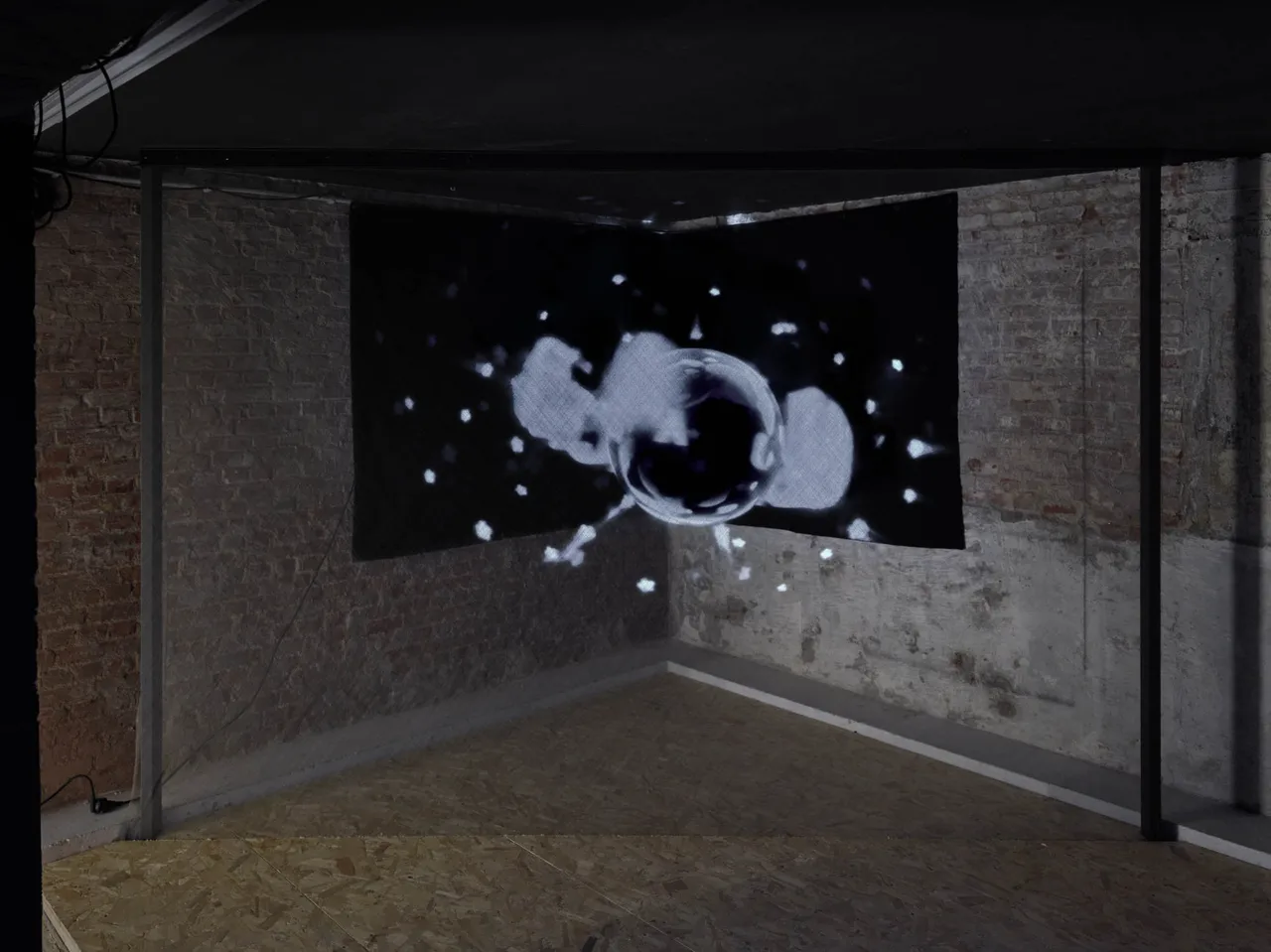
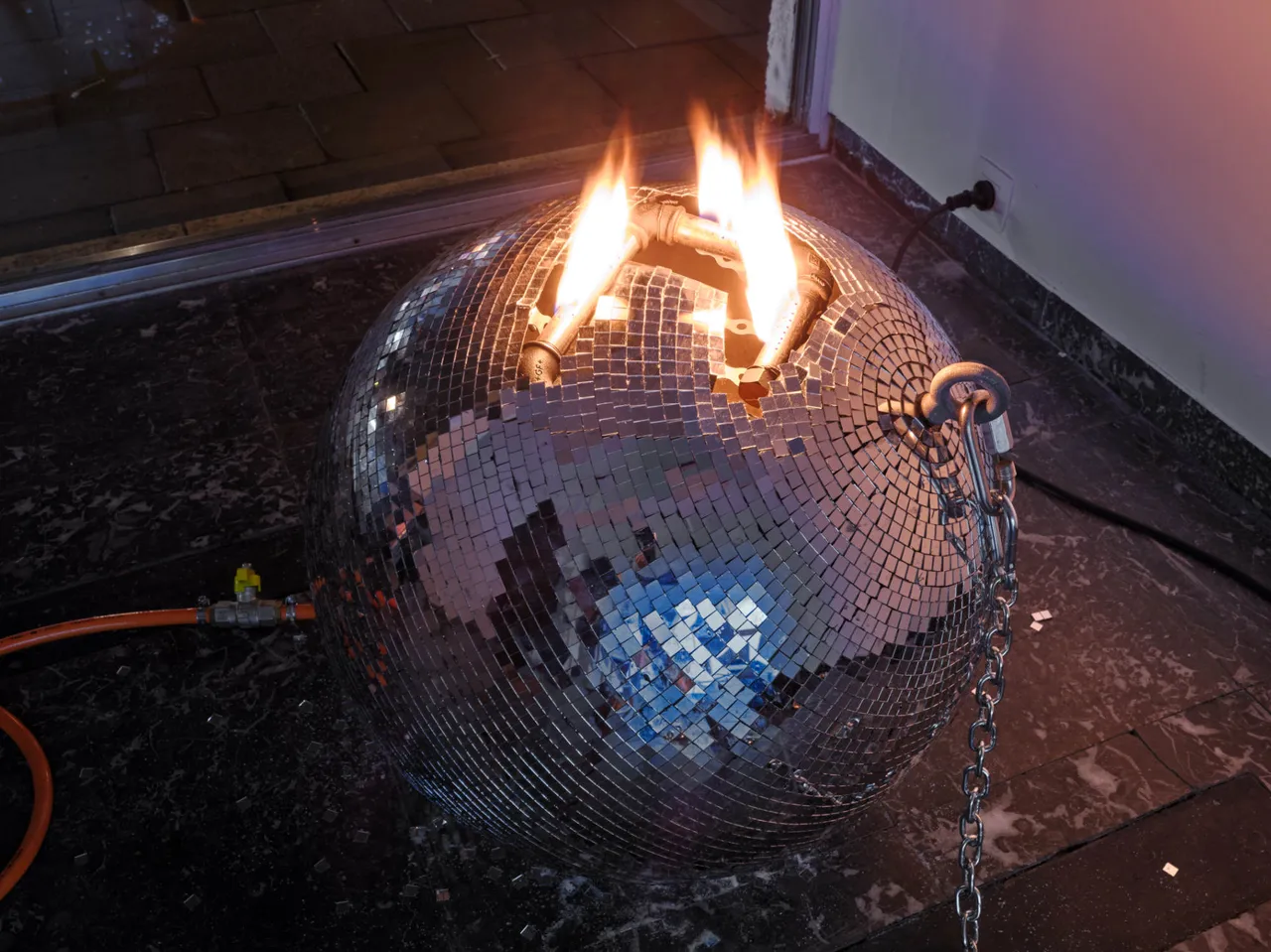
There are these intentional polarities throughout the show. There’s an inside and an outside, an upstairs and a downstairs. The show is never supposed to congeal into one cohesive whole with a perfect vantage point. There’s a smashed disco ball on the street level and a revolving animation with a globe in the gallery’s basement. Stephen O’Malley [a musician best known for his work in the drone band Sunn O)))] composed the soundtrack, incorporating an acoustic phenomenon that is both a central component of the show and a structural analogy to the exhibition’s layout. He worked with phase cancellations which, when represented as waveforms, are the moments when those soundwaves interpenetrate at 180-degree angles, essentially annihilating themselves. This creates a sound similar to a compression in the air or a beating of wings. So there is a structural analogy between the acoustic element of the show – Stephen’s contribution – and the materials in the show itself.
There are these intentional polarities throughout the show. There’s an inside and an outside, an upstairs and a downstairs. The show is never supposed to congeal into one cohesive whole with a perfect vantage point. There’s a smashed disco ball on the street level and a revolving animation with a globe in the gallery’s basement. Stephen O’Malley [a musician best known for his work in the drone band Sunn O)))] composed the soundtrack, incorporating an acoustic phenomenon that is both a central component of the show and a structural analogy to the exhibition’s layout. He worked with phase cancellations which, when represented as waveforms, are the moments when those soundwaves interpenetrate at 180-degree angles, essentially annihilating themselves. This creates a sound similar to a compression in the air or a beating of wings. So there is a structural analogy between the acoustic element of the show – Stephen’s contribution – and the materials in the show itself.
You two have a long history of working together in the band Sunn O))).
Stephen is an extraordinary person to work with. We’ve been collaborating for over twenty years. He has an incredibly sophisticated approach to how sound relates to an environment. He spent over two days here, just walking around and tuning the speakers and the levels. The sound in the exhibition is meant to condition your experience as you move through the space. The speakers are positioned very precisely for this purpose.
“Art spaces generally tend to be insular and exclusive. This is the fucking opposite, which makes it fascinating. The show attempts to play around with that.”
Your sculpture, which reads ‘The End,’ is spread across two floors. The typeface looks familiar somehow.
It is an intentional reference to the end credits of classic cinema. It is supposed to evoke the Golden Age of cinema instantly, which corresponds to the animation in the basement. The entire show is loosely based on one particular evening: New Year’s Eve twenty years ago, when the artist Steven Parrino left my house and died. We were having a New Year’s Eve celebration at my Brooklyn apartment that night. Steven also lived in Brooklyn and died on his way home. So, the first thing I experienced the next morning – New Year’s Day – was someone calling me to tell me he had died. The night before, Steven had told me that he was working on a project in which he was appropriating the opening animation sequence of Universal Pictures from 1936. He was really fascinated by it and wanted to play around with it. I don’t think he ever created a piece based on it, or at least I never saw one. So, to me, it was just a project he had explained to me the night he died.
Later that evening, my wife at the time got on the back of his motorcycle and went to his studio. She saw the project in person. She came back and explained what it looked like. I’ve always associated this incomplete project with that horrible night. I will never see the finished project. It will always be incomplete. It will always be a void. In the bluntest possible way, just as the text revolves around that globe in the animation, there is a void, a gravitational centre. In my experience, this corresponds to the experience of loss.
Now, the video animation downstairs is not an appropriated sequence. I collaborated with music video director Zev Deans to digitally reconstruct the 1936 Universal Pictures animation. We went through about twenty different iterations to make it the correct degree of illegibility. When you watch it, you think you know how to read it or what it says, but if you really look at it, it hovers just on the edge of legibility without ever resolving into something literally comprehensible. Everything else in the show builds off of that idea. In the generic sense, the disco ball is a great metonym for all kinds of celebrations. In the context of New York City’s Times Square on New Year’s Eve, it represents the moment when the ball drops. In the show, the burning disco ball is framed by a cinematic experience of the end, but somehow in reverse. It’s related to a specific event but also to what the fuck is happening on a planetary scale right now and to my response as an American citizen.
Later that evening, my wife at the time got on the back of his motorcycle and went to his studio. She saw the project in person. She came back and explained what it looked like. I’ve always associated this incomplete project with that horrible night. I will never see the finished project. It will always be incomplete. It will always be a void. In the bluntest possible way, just as the text revolves around that globe in the animation, there is a void, a gravitational centre. In my experience, this corresponds to the experience of loss.
Now, the video animation downstairs is not an appropriated sequence. I collaborated with music video director Zev Deans to digitally reconstruct the 1936 Universal Pictures animation. We went through about twenty different iterations to make it the correct degree of illegibility. When you watch it, you think you know how to read it or what it says, but if you really look at it, it hovers just on the edge of legibility without ever resolving into something literally comprehensible. Everything else in the show builds off of that idea. In the generic sense, the disco ball is a great metonym for all kinds of celebrations. In the context of New York City’s Times Square on New Year’s Eve, it represents the moment when the ball drops. In the show, the burning disco ball is framed by a cinematic experience of the end, but somehow in reverse. It’s related to a specific event but also to what the fuck is happening on a planetary scale right now and to my response as an American citizen.
A shattering of the American Dream?
Precisely, and that’s how the audio functions, too. Two identical waves intersect and overlap at 180 degrees, annihilating one another. This creates an absence, a vacuum. You’re actually hearing a void. It’s a clumsy way of describing it, but how do you listen to an absence and build something around it? Ideally, it’s not a passive surrender to the idea of an absence. Instead, it’s a thing around which meaning is created.
Many artists dream of creating their final, ultimate piece. However, the contingency and brutality of death can put a random end to artistic practice, which, in a paradoxical sense, completes it.
I deliberately stopped engaging with and showing my art to the world for over a decade. For a bunch of reasons, including personal health. But I’ve never been particularly happy or comfortable in the art world, I didn’t want to engage with it. I had a number of negative experiences, and I also lost friends. Essentially, I think we’ve all learned the wrong lessons from Warhol. There’s this idea that you have to be a persona and die young and tragically for your story to be considered important. This isn’t fun or glamorous. It is a fucking tragedy, and it needs to be treated as such.
When you watch that happen repeatedly and it’s skipped over because it’s more palatable to frame it in terms of glamour and excess, youth and decadence, and all that bullshit, then I realised, why the fuck would you want to engage with it at all? It’s funny you mention the way artists imagine grand statements, while I can barely wrap my head around engaging with the art world in any way.
When you watch that happen repeatedly and it’s skipped over because it’s more palatable to frame it in terms of glamour and excess, youth and decadence, and all that bullshit, then I realised, why the fuck would you want to engage with it at all? It’s funny you mention the way artists imagine grand statements, while I can barely wrap my head around engaging with the art world in any way.
In your references to mass media, I’m reminded of the Pictures Generation. To what extent did those artists inspire you?
In terms of the people I've had to respond to, they’ve helped me clarify the way I think about things. In the case of Richard Prince, for instance, I also appropriate aspects of culture, but I think I do it very differently from the way he does. It has been necessary for me to clarify that difference. When I look at his work, I see a kind of ironic or critical disdain for the things he references. That's fine, but it’s not what I’m interested in. I’m interested in collapsing that critical distance. I don’t want any distance. This isn’t meant to be an ironic quotation of something. The cultures I quote are the ones that metastasize into horrific shit because people believe too much. Voiding out distance is a very different kind of posture and position to adopt.
The Pictures Generation has been important to me in figuring out what I am not, at least in that regard. However, within that group of artists, there are some to whom I can fully relate. Jack Goldstein, for instance. A few years ago, I made a video projected on a screen of water vapor. It featured a quotation of the TriStar Pictures animation with the white horse running. It was meant to be a deliberate evocation of the MGM lion, or specifically Jack Goldstein’s version, with the lion roaring repeatedly. He’s another artist who died tragically and had a difficult relationship with the art world. The art world still doesn’t know how to relate to him. So, again, this ties into Steven Parrino’s story and the video downstairs.
The Pictures Generation has been important to me in figuring out what I am not, at least in that regard. However, within that group of artists, there are some to whom I can fully relate. Jack Goldstein, for instance. A few years ago, I made a video projected on a screen of water vapor. It featured a quotation of the TriStar Pictures animation with the white horse running. It was meant to be a deliberate evocation of the MGM lion, or specifically Jack Goldstein’s version, with the lion roaring repeatedly. He’s another artist who died tragically and had a difficult relationship with the art world. The art world still doesn’t know how to relate to him. So, again, this ties into Steven Parrino’s story and the video downstairs.
What about the Golden Age of American cinema in the 1920s and ‘30s fascinates you?
The uncritical, pre-ironic idea of cinema. I’m talking about Ben-Hur, produced by Metro-Goldwyn-Mayer. Not that film specifically, but the idea of film being our first heroic display of that most American export product, fiction. Violence is the other American product, of course. But fictions are usually predicated on violence, so there isn’t much of a difference between them. I like to refer to Tinseltown glamour as well as the Hollywood Babylon of Kenneth Anger. This precedes any kind of ironic relationship with mass and pop culture.
Economically and politically, the roaring and glamorous 1920s were followed by the Great Depression in the 1930s. Is that where the melancholy of your artistic gesture comes from?
Yes, it’s this tone or affect I’m always interested in, but not in a passive way. It’s not the melancholy of sitting in a corner and sobbing; it’s the active, potentially repugnant melancholy of Caspar David Friedrich that led to national socialism. These aren’t benign or innocent ideas. They imply a whole constellation of ideas that are fucking difficult to digest historically, culturally, and personally.