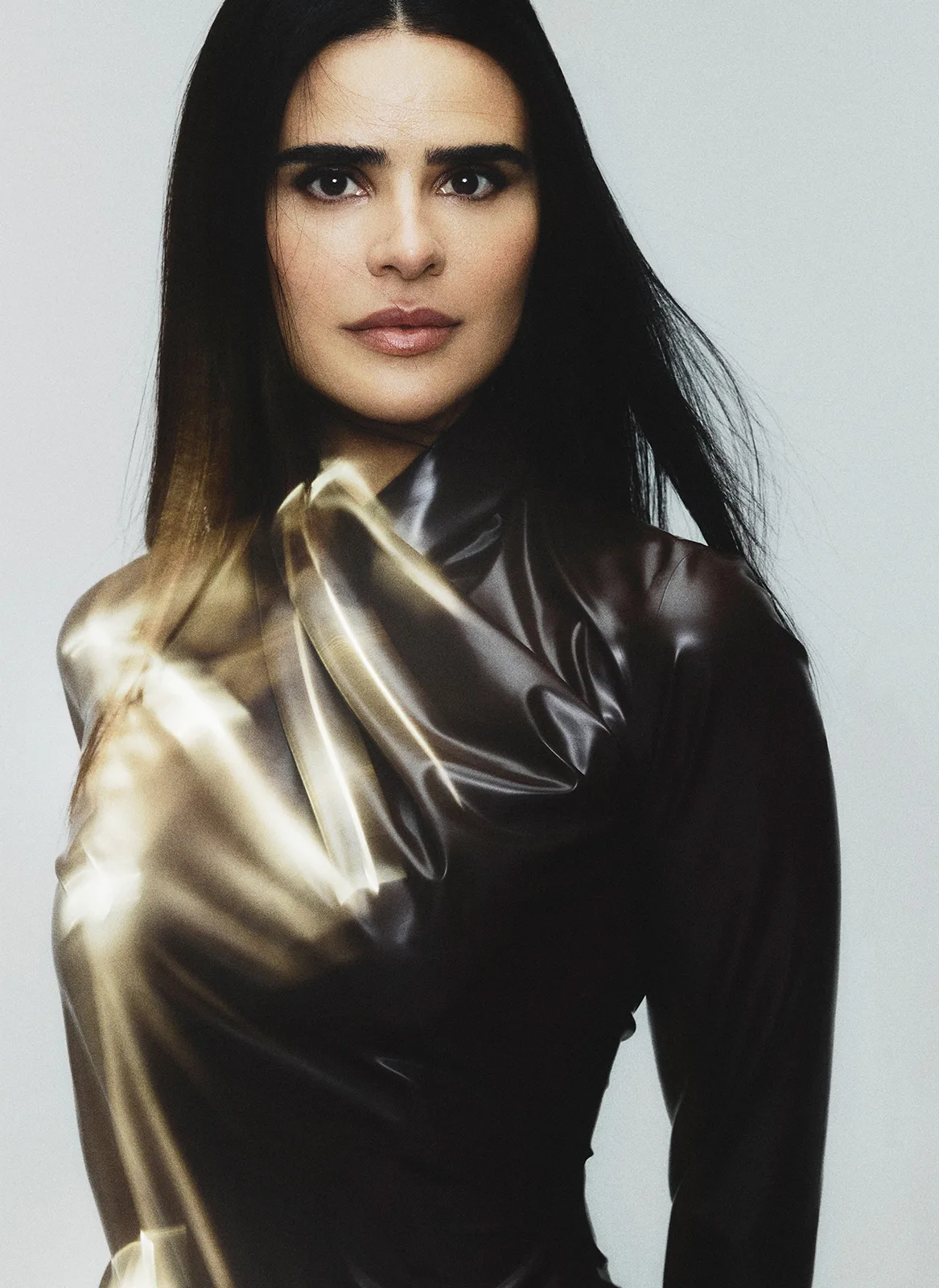
Today, ANNA releases Astralis, her new collaboration with Antdot and Ravid. We spoke with her a few days before the track arrived, just after she had spent some time back in Brazil celebrating Carnival with family and friends. Now she’s back on the road. Tonight she plays KOKO in London and tomorrow Ampere in Antwerp before heading to cities including Barcelona and Paris in the coming months.
Looking back, she traces much of what she’s doing today to a turning point around 2017, when her relationship with music began to change. “It wasn’t a rebrand. It was a natural evolution of my inner world becoming audible.” That perspective runs through Astralis, a track that grew out of connection, friendship and shared moments rather than strategy.
Her idea of success has shifted as well, as she explains in the interview you can read below: “Now, it’s about meaning. If what I create feels truthful and moves something real, in me and in others, that’s success.” Between releases, travel and long nights on stage, that idea seems to guide everything, keeping her connected to something quieter beneath the movement.
We’ve heard you’ve been in Brazil for Carnival. When you return home after being away for a while, what’s the very first thing you do? Is there a ritual, a place you always go to eat, or someone you need to see before anything else?
No matter where I land in Brazil, the first thing I look for is pão de queijo, our famous cheese bread. I honestly never get tired of it. And of course, it has to come with a Guaraná. It’s the most cliché Brazilian combo ever… but it never gets old. Beyond that, it really depends on my schedule. When I can, I love going to the countryside to see my family. That’s what it feels like coming home. But touring life can be intense, so it’s not every time that I get to do that. When I do, though, it grounds me in a way nothing else does.
There’s just over two weeks until Astralis is released on March 6. In that space between finishing a track and letting it go into the world, what usually happens inside you?
That space between finishing a track and releasing it is never the same. It really reflects where I am in my life. There are moments when I’m in complete flow, very clear about my direction, very confident in what I’m expressing. In those phases, the music moves more easily. There isn’t much back and forth. The track almost knows what it wants to be, and I just follow it. And then there are other moments when I’m questioning new directions, refining my identity, or exploring something unfamiliar. In those times, the process becomes longer. There’s more testing, more doubt, more refinement. It can feel cyclical: clarity, then doubt, then clarity again.
But no matter the phase, one thing is very important to me: the music has to be an honest expression of where I am. Not an attempt to impress. Not an attempt to fit. Not something calculated for attention. The only thing that truly gives me peace after releasing a song is knowing that I allowed it to come through without filters. That I honoured what I wanted to be expressed in that moment. When I feel that, I’m fulfilled, independent of the results, the numbers, or the external reaction.
But no matter the phase, one thing is very important to me: the music has to be an honest expression of where I am. Not an attempt to impress. Not an attempt to fit. Not something calculated for attention. The only thing that truly gives me peace after releasing a song is knowing that I allowed it to come through without filters. That I honoured what I wanted to be expressed in that moment. When I feel that, I’m fulfilled, independent of the results, the numbers, or the external reaction.
When you started working on Astralis, what was your emotional state? What were you trying to understand or express at that moment?
When I met Bruno, we instantly felt this strong sense of friendship. There was an immediate ease between us, something unforced and genuine, and that energy naturally carried into the music. When we started working on Astralis, it didn’t feel like we were trying to “make a track”; it felt like we were capturing a moment. We were about to play a B2B at Tomorrowland, and there was this shared excitement that we wanted to celebrate. What we were really expressing was the frequency of connection, friendship, community, and togetherness. And that’s the energy we want people to experience when they dance and listen to it.
When you listen back to the track now, what does it remind you of?
When I listen back to the track now, the first thing that comes to mind is the first time we played it together. It was during our B2B at Tomorrowland. The track wasn’t released yet, so no one knew it was ours. And right at the moment it dropped, a huge Brazilian flag opened up in the middle of the dance floor. I couldn’t believe it. It felt surreal, like the universe was winking at us. I remember turning to Bruno and saying, “Bruno, this is a sign. We did something good.” It wasn’t about recognition; it was about that feeling of connection between us, the crowd, and where we come from. That moment is forever attached to the track for me.
Your recent collaborations, first with Vintage Culture at the end of October and now with Antdot, feel like dialogues between different energies. What have these exchanges revealed to you about your own sound?
I think what these collaborations have revealed to me is that I value real connection more than style. Both Vintage Culture and Antdot are artists I have a genuine bond with; there’s real friendship, real respect, and real love there. When that foundation exists, the music becomes a natural extension of the relationship. It feels like a conversation rather than a strategy. Something I’ve realised over the years is how diverse my musical language has become. After so much experimentation and expansion, I feel comfortable collaborating across very different worlds, from sound therapy and more introspective spaces to energetic techno. And that freedom is something I value deeply. I don’t feel the need to fit into one box. I like being able to produce and play whatever feels aligned with where I am in my journey at that moment. For me, it’s less about genre and more about truth.
After more than twenty years in electronic music, what still feels new?
After more than twenty years, what still feels new is the inner experience of it all. The music itself keeps evolving, but what feels different now is how consciously I relate to it. In the beginning, it was about learning the craft and experimenting with the technical side, really pushing my skills. Now, what feels new is the depth. The way sound can be intentional. The way a set can become a shared energetic experience rather than just a performance. What still surprises me is how music continues to reveal new layers of connection to people, to silence, to something beyond us. Even after all these years, I’m still discovering how sound can move energy, shift states, and create presence. That’s what feels new to me, the limitless space of where music can lead us.
You’ve gradually integrated meditation and sound healing into your creative world. Was there a specific experience that shifted your perspective on what music could do?
There was definitely a turning point around 2017. It was a moment of deep spiritual expansion for me, and naturally, my relationship with music began to change. As I went deeper into myself, everything started revealing itself on a deeper level, including sound. I became more curious about melody, frequency, and resonance. I began experimenting with new instruments and sound-healing tools, at first completely in private. It wasn’t a project. It wasn’t a strategy. It was something I was exploring alone in my meditation room, using sound to expand my own emotional and conscious states.
There was no intention to share it with the world, but over time, life started opening doors. Opportunities to bring that side of my work into public spaces began to appear. That’s when Intentions was born, and with it, a new chapter of understanding music not only as entertainment but also as something that can regulate, heal, and shift consciousness. Since then, I’ve continued to explore that field through releases, live experiences, and conversations around music as medicine. For me, it wasn’t a rebrand. It was a natural evolution of my inner world becoming audible.
There was no intention to share it with the world, but over time, life started opening doors. Opportunities to bring that side of my work into public spaces began to appear. That’s when Intentions was born, and with it, a new chapter of understanding music not only as entertainment but also as something that can regulate, heal, and shift consciousness. Since then, I’ve continued to explore that field through releases, live experiences, and conversations around music as medicine. For me, it wasn’t a rebrand. It was a natural evolution of my inner world becoming audible.
You’re about to play EDC Mexico, then London, Antwerp, Warsaw, Barcelona, Miami… It’s a very intense run of dates in a short period of time. How do you mentally prepare for a stretch like that without losing yourself in the movement?
Touring can easily pull you outward, so I make a conscious effort to stay anchored. I focus on the fundamentals: eating well, moving my body, and sleeping properly when possible. I also keep my rituals close. I meditate and create moments of silence to restore and rebalance.
When you arrive in a city like London to play KOKO or Barcelona for Nitsa, do you experience each place differently, or do venues start blending into one continuous journey?
I really do experience each place differently. Cities have very distinct energies, and I’m quite sensitive to that. The atmosphere, the people, the rhythm of the streets — it all affects the way I feel and, ultimately, the way I play. It’s not always that I have time to properly explore, go sightseeing, or sit down at a yummy restaurant. Touring can be very fast. But even in a short window, I can feel the shift. London feels different from Barcelona. The crowd at KOKO carries a different intensity than Nitsa, for example. For me, it never blends into one continuous blur. Each city feels like a new chapter, a new energy to tune into. And that’s part of what keeps touring alive and inspiring for me.
Club Space in Miami during Music Week is always charged with expectation. Do you approach high-pressure moments like that differently from more intimate shows?
There’s something I’ve reflected on over the years: I don’t really feel that kind of pressure anymore. The stage feels very natural to me. In a humble way, it feels like I’m doing what I came here to do. I’ve been doing this for a long time, and what helped me most wasn’t just experience; it was the inner work. Pressure usually comes from wanting to impress, to prove something, to be the best or even just “good enough". When you slowly remove that from the equation, what’s left isn’t pressure; it’s excitement. It’s awe. It’s a connection. So whether it’s a high-expectation moment like Club Space during Music Week or a more intimate setting, the energy is different, yes… but the internal state isn’t about pressure anymore. It’s about presence. And when I’m present, it doesn’t matter if it’s two hundred people or thousands. The exchange is what makes it meaningful.
Do you feel audiences are changing, or is it your perception of them that has shifted?
I think both things are true: audiences evolve, and so does my perception. We’ve lived through a huge social media revolution, and that definitely changed the dynamics of the dancefloor. At times, it can feel more individualistic, more about capturing the moment than dissolving into it. There’s more awareness of being seen. But I don’t see that as purely negative. It’s simply a reflection of the world we live in. Every generation experiences music differently.
And at the same time, there are still many spaces where people forget their phones, forget themselves, and truly merge into one organism. Those moments still exist, and they’re very powerful. So I don’t romanticise the past or criticise the present. The audience changes as the world changes. What matters to me is creating an environment where people feel safe enough to let go, regardless of the era we’re in.
And at the same time, there are still many spaces where people forget their phones, forget themselves, and truly merge into one organism. Those moments still exist, and they’re very powerful. So I don’t romanticise the past or criticise the present. The audience changes as the world changes. What matters to me is creating an environment where people feel safe enough to let go, regardless of the era we’re in.
You move so fluidly between ambient and techno. Do those genres feel like two separate languages to you, or two sides of the same conversation?
I see them as different frequencies within the same spectrum. At their core, both ambient and techno carry the same intention: connection. The difference is how that connection is experienced. Ambient feels more introspective to me. It invites expansion inward, a kind of elevation of awareness. It creates space. It softens the edges. It allows people to travel internally. Techno, on the other hand, feels grounded. The strong beat anchors you in the body. It’s about movement, release, celebration. It’s dancing with your friends, sweating, losing yourself in rhythm. One moves upward and inward. The other moves downward and outward. But ultimately, both are pathways to expansion, just through different doors. For me, they’re not separate identities. They’re two expressions of the same energy.
When you’re not travelling, what does grounding look like on a normal day?
Solitude, sunlight, my sacred instruments, good food, early sleep, and me happily cancelling plans.
What part of your work feels the most aligned with who you are right now?
The part that feels most aligned right now is creating from intention, whether it’s a dancefloor track or something more meditative. I feel more in tune than ever with the energy behind the music. And of course, playing for an audience, that’s what makes it all come alive. That shared energy is the real meaning of my work.
And what part still challenges you?
What still challenges me is the external pace of the industry. Staying centred while everything moves fast is a constant practice. But I know that tension is part of the way.
Has your idea of success softened or hardened over the years?
In the beginning, success was about performance and external milestones. Now, it’s about meaning. If what I create feels truthful and moves something real, in me and in others, that’s success.
Beyond releases and festivals, what are you quietly dreaming about for yourself?
I’m dreaming about creating experiences where music becomes immersive, intentional, and transformative. Spaces where people come to dance, to feel, to reconnect, to expand. And some dreams… I’ll keep to myself for now. A little mystery is healthy, right? But at the core of it, what I’m quietly dreaming about is resonance, work that feels truthful and that moves something real inside people.
When people press play on Astralis on March 6, maybe alone, maybe in a club, what do you hope lingers after the track fades out?
A sense of connection. Whether someone is listening alone with headphones or in the middle of a crowded club, I hope the track leaves them feeling less separate, more open, more connected to themselves and to the people around them.
And if you had to describe this chapter of your life in one word, what would it be?
MULTIDIMENSIONAL.