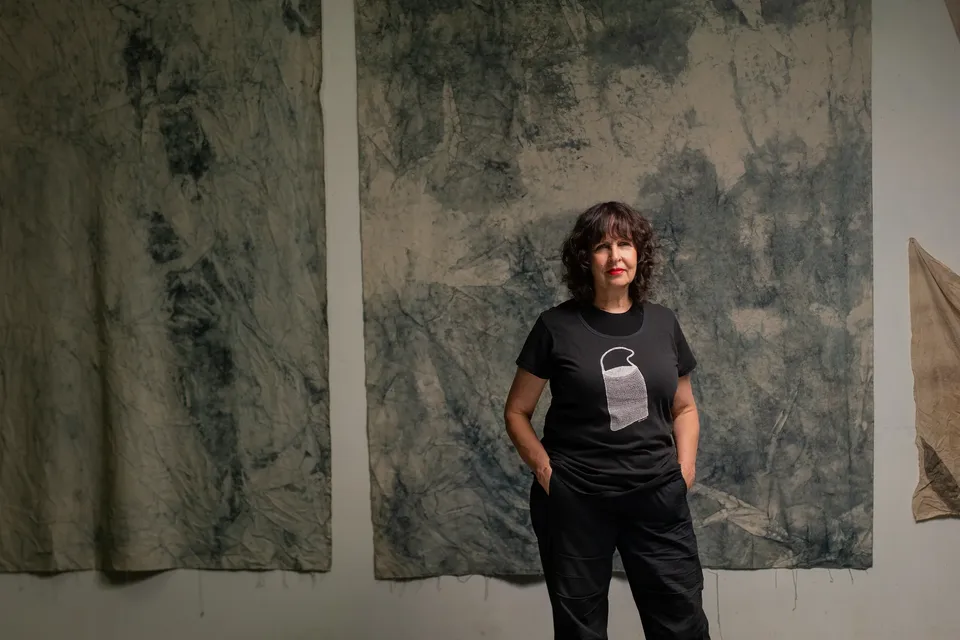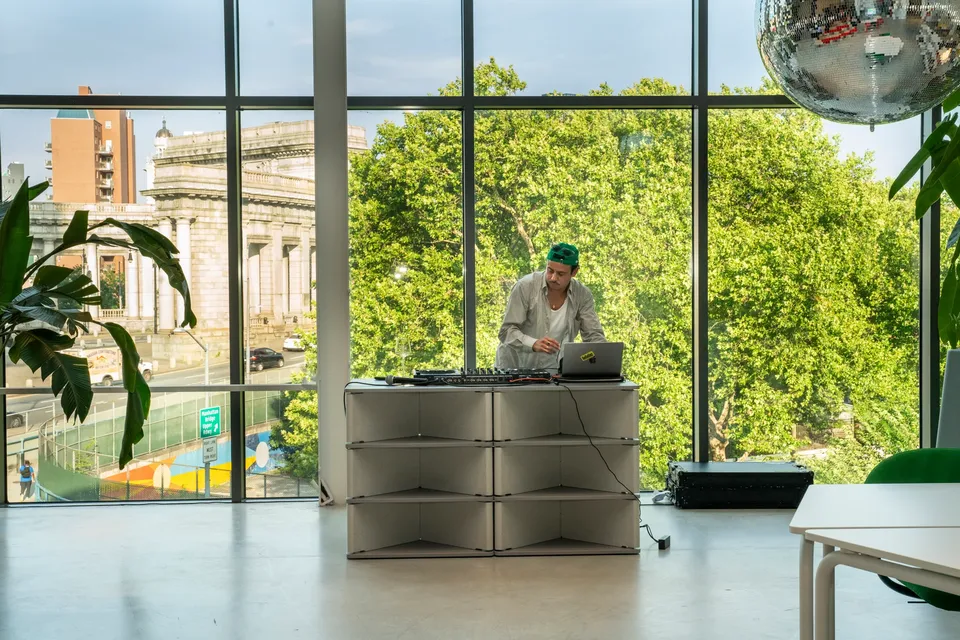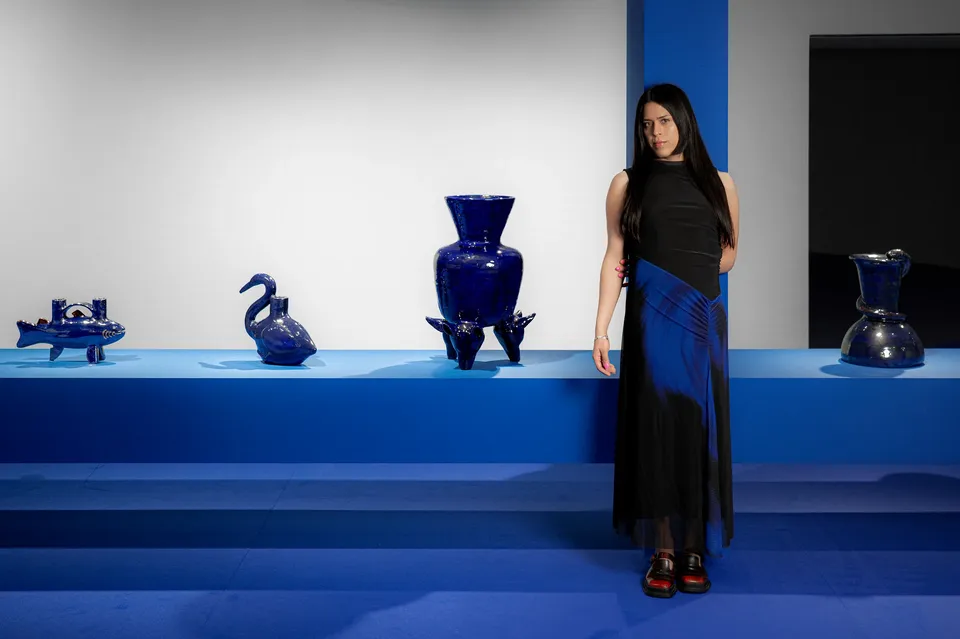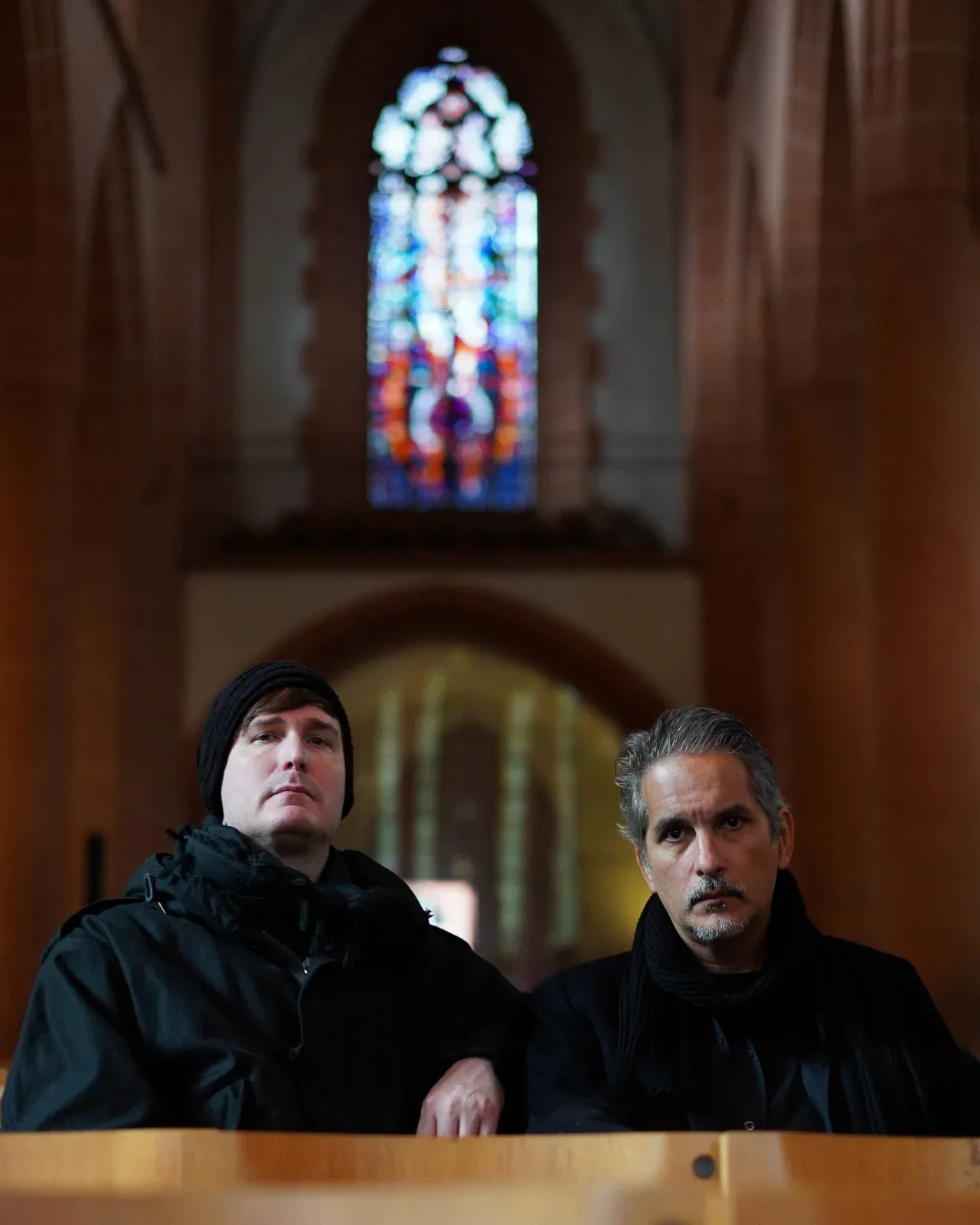
Somewhere between silence and gravity, Abul Mogard and Rafael Anton Irisarri build music that feels less composed than slowly revealed. Their work together moves through loops, distortion, space and memory, turning sound into something physical, almost architectural, but still fragile enough to breathe. With Where Light Pauses in the Silence of the Sun, their second collaborative album, out now, the two artists push that shared language further: a record born from live improvisation, shaped by distance and presence, and guided by the strange beauty of things that resist being fully explained.
To begin with the origin of the collaboration: your work together seems to have started with a performance at Condeduque in Madrid in 2023. Do you remember that first encounter as an immediate connection, or as something that gradually took shape over time?
Rafael: Somewhat, yeah. When we were setting up in Madrid, we noticed we were using the same looping software. It may sound insignificant, but aside from Brian Eno, I didn’t know anyone else using it. It’s from 2009 and pretty obscure, so it was a surprise to find someone else working with the same tools live. That kicked off a longer conversation about gear and studio workflow, and we started noticing we had a lot of similar approaches. I like to compare it to our first languages, Spanish and Italian. They’re related, mutually intelligible, but still very much their own thing. That metaphor fits what we do pretty well. The good vibes were there instantly, but our connection kept revealing itself the more we worked on music together.
Abul: Yes, we immediately felt very comfortable working together. For that particular performance at Condeduque we were asked to play an encore together to close the evening after our respective concerts. That made me think about a particular chord progression that appeared in one of Rafael’s pieces and one of mine. It felt like an interesting musical meeting point, so I used it as the basis for the encore. That recording later became one side of our first album together.
Abul: Yes, we immediately felt very comfortable working together. For that particular performance at Condeduque we were asked to play an encore together to close the evening after our respective concerts. That made me think about a particular chord progression that appeared in one of Rafael’s pieces and one of mine. It felt like an interesting musical meeting point, so I used it as the basis for the encore. That recording later became one side of our first album together.
Impossibly Distant, Impossibly Close already had a huge, almost geological sense of scale. What did you feel remained open in that first album, and what did you want to continue exploring in Where Light Pauses in the Silence of the Sun?
Rafael: The first record was almost accidental in a way. It came from a live situation, one evening, one encore, and then we extended it remotely. That process was exciting, but it also made us curious about what would happen if we were in the same room for an extended period of time. That's what the Berlin residency was about. Three days at Morphine Raum, no stage, audience right there with us, recording everything live to multitrack. And once we started playing together, we noticed the sets constantly shifted, even when we had a basic structure laid out. Because we’re always improvising, always making parts on the fly, no two performances ever felt the same. That kind of spontaneity is only really possible when you’re in the same room together. And something shifted because of that. At moments, I genuinely couldn’t tell if a sound was coming from me or from Abul. It stopped feeling like two people making decisions and started feeling like we were inside a system moving on its own. The first album opened up that territory, and the second one pushed further into it.
Abul: Knowing each other better and spending more time playing concerts together naturally made the process more spontaneous. The recordings at Morphine Raum gave us a large amount of material that allowed us to push things further and see where the music could go. I think the first album hinted at the potential of our collaboration, while this one allowed us to explore it much more deeply and without trying to define it too much.
Abul: Knowing each other better and spending more time playing concerts together naturally made the process more spontaneous. The recordings at Morphine Raum gave us a large amount of material that allowed us to push things further and see where the music could go. I think the first album hinted at the potential of our collaboration, while this one allowed us to explore it much more deeply and without trying to define it too much.
The new album grew out of a three-day residency at Morphine Raum in Berlin, a space with no stage, where musicians and listeners are on the same level. How did that physical arrangement affect the way you played and listened to one another?
Rafael: A lot of what we do live is built around the musical principle of call and response. It’s probably the oldest organising principle in music, from early humans beating drums to warn of danger to the polyrhythmic and polytonal conversations in African-American traditions like gospel, blues and jazz music. There’s a back-and-forth between the musicians. We’ve applied that to our looping systems, where one of us creates a loop, the call, and the other responds by building a new loop that complements it. And then that response becomes the new call, and so on. The whole experience ends up feeling like a dialogue between us, which I think is what makes it feel alive rather than static.
Abul: The interesting thing about those recordings, made in a live situation, is that it’s often hard to tell who is playing what, despite the fact that my musical vocabulary is mostly based on synthesisers while Rafael’s is generally centred around the guitar. There are similarities in the pace at which we play and in the way we shape sound that make the instruments almost disappear. I think that's one of the reasons why the music feels so cohesive to me.
Abul: The interesting thing about those recordings, made in a live situation, is that it’s often hard to tell who is playing what, despite the fact that my musical vocabulary is mostly based on synthesisers while Rafael’s is generally centred around the guitar. There are similarities in the pace at which we play and in the way we shape sound that make the instruments almost disappear. I think that's one of the reasons why the music feels so cohesive to me.
Rafael, you mentioned that at certain moments you could no longer tell whether a sound was coming from you or from Abul. Is that dissolution of authorship something you consciously look for, or does it appear when the system begins to move on its own?
Rafael: It’s not something I consciously look for, because the moment you start looking for it, you get in your own way. It happens when you stop thinking about what you’re doing and just trust the system. And I think that’s what Morphine Raum gave us, three nights of playing where the pressure wasn’t to deliver something fixed, but to stay open and react.
Listening back to the recordings from those sessions, I genuinely don’t remember playing most of it. Everything I do on stage is improvised, nothing’s planned. Most of the time it feels like blacking out, almost like I leave my body and just try to hold on to whatever’s coming through. In the moment, I usually assume what I’m playing is shit. But when I listen back, with some distance, I’m surprised that it feels right. Like I said something I didn't know I needed to say.
At some point, the loops start talking to each other and you're not really authoring anymore, you're just tending to something that's already moving. Playing live rarely feels like a performance to me, it feels more like a ritual. Raw. Exposed. Private, but shared. The stage disappears and it becomes a space to let go. And at the end of it, it's not so much about who created X or Y or Z, but rather how the sum of all parts sounds.
Listening back to the recordings from those sessions, I genuinely don’t remember playing most of it. Everything I do on stage is improvised, nothing’s planned. Most of the time it feels like blacking out, almost like I leave my body and just try to hold on to whatever’s coming through. In the moment, I usually assume what I’m playing is shit. But when I listen back, with some distance, I’m surprised that it feels right. Like I said something I didn't know I needed to say.
At some point, the loops start talking to each other and you're not really authoring anymore, you're just tending to something that's already moving. Playing live rarely feels like a performance to me, it feels more like a ritual. Raw. Exposed. Private, but shared. The stage disappears and it becomes a space to let go. And at the end of it, it's not so much about who created X or Y or Z, but rather how the sum of all parts sounds.
Abul, after those live recordings, the material returned to your studio in Rome, where it was stretched, fragmented and reassembled. How do you decide when to intervene in a live recording and when to preserve its original fragility?
Abul: It was a very natural process. I went through the different layers of the recordings and picked the sections that felt particularly interesting. Isolating those improvised parts made me realise there was enough material to create completely new compositions. I wanted to preserve the fragility because those performances felt very spontaneous. I started editing the recordings and adding only sounds that felt complementary, either to increase the intensity or simply to amplify the emotional quality that was already there.
There is a beautiful tension on this record between the monumental and the restrained: huge sounds, but also a great deal of patience and control. How do you prevent the music from becoming excessive when you are working with so much density?
Abul: It’s very much about listening carefully and adding density only when we genuinely feel there is a need for it. I think of it more as balancing the composition. Every new element has to justify its presence. I don’t particularly like pure embellishment in music. I only add something if it helps the composition move somewhere new or gives more meaning to what is already there.
The album deals deeply with expanded time: tempos dissolve, passages stretch, forms seem to move very slowly. Do you think of composition more as architecture, as landscape, or as memory?
Abul: For me, it’s more like a painting. Sometimes I can almost imagine the whole picture just from listening to a single sound, melody or loop. I enjoy playing with time so that the listener might gradually lose their sense of the overall duration and simply exist inside the piece rather than thinking about how long it has been playing.
On In the Eastern Wild, the Leslie speaker seems to have an almost physical role, not merely a timbral one. What interested you about that circular movement of sound, and how did it change the way the piece was built?
Rafael: Morphine Raum had a beautiful vintage Leslie speaker and I decided to run different signals through it during the sessions. At some point, I started re-amping Abul’s synths through it, and something clicked. There's already something poetic about re-amping. You're taking a signal that existed only as data and giving it a physical life again, sending it back out into the air, into a room, letting it interact with a real space. Running it through a Leslie added another layer to that.
The Leslie has a rotating horn and drum inside the cabinet that create this distinctive swirling, Doppler-like modulation, and when Abul’s synths went through it, they took on this beautiful circular rhythmic motion. Because the speaker itself was placed in a different part of the room, it also played with your perception of depth in a really intense way; the sound felt like it was coming from somewhere else, somewhere distant.
The challenge then becomes capturing that on a recording. A Leslie in a room is a three-dimensional experience and stereo can only approximate it. We placed microphones around the room to try to preserve as much of that sense of space as possible, but there's always something that lives only in the room, in that moment. I think that's okay, though. A recording doesn't have to replicate the experience exactly. If it carries enough of that spatial memory, the listener's imagination fills in the rest.
The Leslie has a rotating horn and drum inside the cabinet that create this distinctive swirling, Doppler-like modulation, and when Abul’s synths went through it, they took on this beautiful circular rhythmic motion. Because the speaker itself was placed in a different part of the room, it also played with your perception of depth in a really intense way; the sound felt like it was coming from somewhere else, somewhere distant.
The challenge then becomes capturing that on a recording. A Leslie in a room is a three-dimensional experience and stereo can only approximate it. We placed microphones around the room to try to preserve as much of that sense of space as possible, but there's always something that lives only in the room, in that moment. I think that's okay, though. A recording doesn't have to replicate the experience exactly. If it carries enough of that spatial memory, the listener's imagination fills in the rest.
In a Quiet Radiance sits at the centre of the album, bringing in Andrea Burelli’s voice and violin and Martina Bertoni’s cello. At what point did you realise that this piece needed to open itself up to other presences?
Abul: Rafael first had the intuition of adding a cello to A Blue Descent. Martina came to mind because she had been one of the guest artists during our first Morphine Raum residency, and we both really admire her sound and approach. From there, I started thinking that a voice could be exactly what In a Quiet Radiance needed to move the piece in a different emotional direction. I thought of Andrea because I really loved the music she had released under her solo project. Rafael then suggested she should also play violin, and that became an essential part of how the composition developed. I really love what they both brought to the piece.
In your work together there is a sense of beauty, but not a comfortable beauty: it’s often tied to weight, noise, distortion or melancholy. Is it important for the music to retain a certain friction?
Abul: I think so. I like the music to remain open, and distortion can introduce unexpected harmonic content which, if kept under control, creates a certain tension or friction. I like music that leaves a little uncertainty, where not everything feels completely resolved.
The title Where Light Pauses in the Silence of the Sun has a very visual, almost impossible quality. Did it come after the music, or was it an image that was already guiding the process?
Rafael: We came up with all the titles after the music was made. That's usually the hardest part of the process, at least for me it always is a struggle. The album title came from a list of ideas Abul had put together from our conversations, and it was really a combination of two different things we each suggested, so it was a balanced collaborative process. The titles drew from a pretty wide range of sources: personal anecdotes, images from our conversations, literary references. That mix felt right for an album that itself came from so many different places.
Marja de Sanctis’ cover artwork revisits the vessel from the first album, but this time it has been fired and glazed. Do you recognise yourselves in that passage from something raw and fragile towards something more permanent and defined?
Abul: I wouldn’t say it’s become permanent, but it has certainly evolved from the first album. I like the fact that Marja chose to revisit the same sculpture rather than create something completely different. It feels quite close to the way the music has evolved. Spending time together, making records and especially playing many concerts has naturally made it feel a little more focused and perhaps more restrained, while still keeping the openness that was already present in the first album.
There is already a music video from the new album. How do you translate music that is so immersive, slow and abstract into images without reducing it or over-explaining it? Were you involved in the visual direction, or did you prefer to let someone else interpret the music from the outside?
Rafael: Our photographer and filmmaker friend Alessio Pizzicannella was simply there filming us as we played and improvised live, and he captured the moment. Alessio deserves the credit for recognising that the strongest visual interpretation was just to document what was happening. What you hear and see is essentially the performance as it unfolded, with only minimal editing. All we did was to be ourselves and play the music as we naturally do in the studio, or on stage. In that sense, the video feels like the most honest representation of what we do.
With ambient or drone music, people often speak about atmosphere, but less often about concrete decisions. What are some of the small decisions that can completely transform one of your pieces?
Rafael: In ambient and drone music, the small decisions are everything. A reverb tail that’s half a second too long, the choice to let a note decay naturally versus fading it out manually, the moment you decide it’s finished and there’s nothing more to add. That last one is probably the hardest. Knowing when to stop is something most people don’t talk about, but it completely changes the character of a piece. The same applies to mastering. You’re constantly making micro-decisions that the listener will never consciously hear but will absolutely feel.
Rafael, you’ve worked in many different contexts: solo, as The Sight Below, with other artists, as a producer and as a mastering engineer. What does this dialogue with Abul give you that you do not find in your individual practice?
Rafael: Every project asks something different of you. I’ve learned immensely from every collaborator I’ve worked with. This one is no different, but working with Abul is special because he's a kindred spirit. I have the utmost respect for him, and I love how we share many ideas about music and aesthetics.
What’s surprised me the most is how effortless and seamless it feels to play together. Sometimes it feels like we've been in a band together for thirty years, when in reality we've only played fifteen or sixteen concerts together! The connection has always felt completely natural, and the response from audiences has been beautiful each time we play live together.
What’s surprised me the most is how effortless and seamless it feels to play together. Sometimes it feels like we've been in a band together for thirty years, when in reality we've only played fifteen or sixteen concerts together! The connection has always felt completely natural, and the response from audiences has been beautiful each time we play live together.
Your live performances seem to be a fundamental part of the project, rather than simply a translation of the records to the stage. You've been performing lately in places as different as Prague, Berlin, San Sebastián or Barcelona. What new layers do your live acts add to the music? And where else will we see you next?
Rafael: The live shows are a fundamental part of how I work, whether solo or with Abul. Solo, it's a very solitary and internal experience. Everything is improvised, nothing is planned, and it's just me and the system. The places you mention, Prague, Berlin, San Sebastián, Barcelona, they each bring something different out of the music. The room, the acoustics, the audience, all of it feeds into what happens on stage. With Abul, it's a different kind of energy, more of a dialogue, but the same principle applies. Nothing is fixed, everything reacts to the moment.
Abul: I think it's important to think of the live performance as a different experience from the record. Translating an album into a live concert means thinking about the overall shape and dynamics of the performance, and the higher level of intensity that a large sound system can create. What influences me most is the atmosphere of the room, which comes from both the venue and the audience. That changes the way I perform every time, even if we're playing the same pieces. I'll be playing a solo concert at Norberg Festival in Sweden this July, as well as other solo and collaborative shows with Rafael and Grand River that will be announced fairly soon.
Abul: I think it's important to think of the live performance as a different experience from the record. Translating an album into a live concert means thinking about the overall shape and dynamics of the performance, and the higher level of intensity that a large sound system can create. What influences me most is the atmosphere of the room, which comes from both the venue and the audience. That changes the way I perform every time, even if we're playing the same pieces. I'll be playing a solo concert at Norberg Festival in Sweden this July, as well as other solo and collaborative shows with Rafael and Grand River that will be announced fairly soon.